Kala Ramesh’s thousand flutes

a thousand flutes
from the bamboo forest
summer’s end

Kala Ramesh (India)
Published in Modern Haiku 48:1. Winter/spring 2017

This lovely haiku takes me back to the East where every single aspect of nature works rhythmically. I love the sound and sight of this haiku. It brought a smile on my face and pulled the strings of my heart.

A thousand flutes could mean a thousand folk stories, a thousand journeys, a thousand years, or a thousand seasons which unanimously take the writer back to those thousands of moments that she has spent throughout her life. These nostalgic feelings stir the current inertia where she is missing her past the most.

I can also feel the resonance of thoughts and feelings that are in great synchronization with nature and brings harmonious and peaceful waves of wind to sooth both the heart and mind. The flute is a great instrument for touching the core of the heart, especially when there is silence all around. So, I can feel the meditative mood of all aspects of nature, including the person that is connected through the rhythm of love and peace.

The summer’s end means, in my opinion, a transformation where one can relate to and reciprocate with the positive vibes that comes on the way. I feel as if the person has achieved the state of mind where she can listen to nature with its true colours and enjoy the songs of love and change.

Hifsa Ashraf (Pakistan)

What I noticed first in this haiku is the pivot line. “from the bamboo forest” connects with the first and second line, so that the poem can be read in two ways.

The next thing that came to mind while reading this haiku is the song of the bamboo forest as wind passes through it. It is a wonderful and fitting tribute for the end of summer. Bamboo is light and the music it occasionally makes when wind goes through is soothing, which associates well with the mood of summer. For bamboo to make that sound, it would have to have holes in it or be cut, or perhaps the poet is speaking about people who made flutes from a bamboo grove and are now performing a ceremony or concert. But, I like the idea of spontaneous music from the forest more, as it makes the song for the end of summer even more poignant.

Commonly, the kigo, or seasonal reference, will appear in the first or second line of a haiku. But in this case, having the kigo come in the third line works well, as having the poem finish with the word “end” is fitting.

In terms of sound, the most prominent letters are “o,” “s,” and “f.” Hearing the “o” sounds bring about what is akin to the song of bamboo in wind. Perhaps the “f” and “s” sounds can reflect the music of bamboo leaves flitting in the wind.

The pacing of the lines is similar to the traditional rhythm of haiku and the lack of punctuation allows the pivot line to work its magic.

Though this haiku can be seen as melancholic, the song of the bamboo flutes gives it a sense of joy. It is a fine haiku with a deep mood and strong technical elements. It teaches us that there are extraordinary moments in what seems ordinary and that we should pay attention to our surroundings carefully to witness these special moments.

Nicholas Klacsanzky (USA)

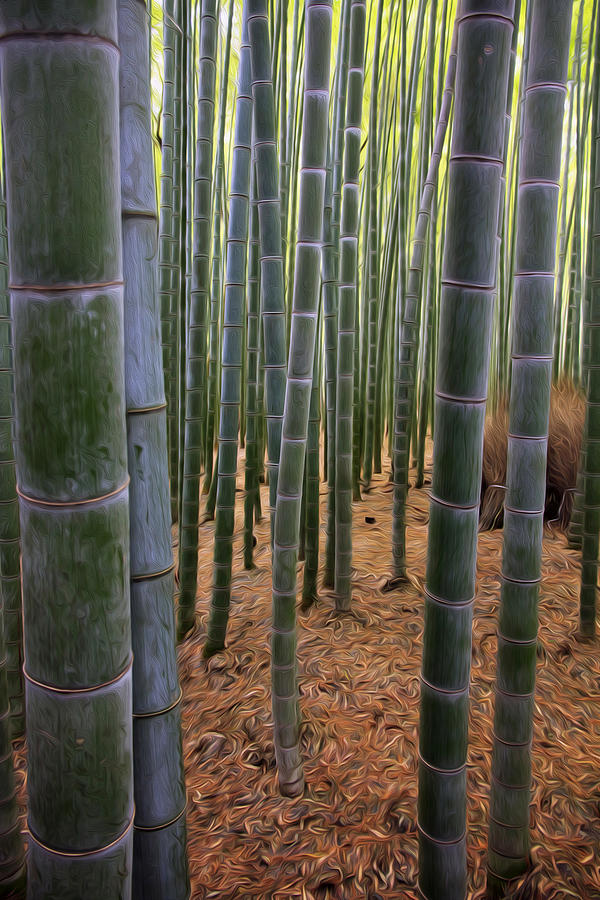
oil-painting-stylized-photo-of-bamboo-forest-greir

– Stylized photograph by G. Greir

Chen-ou Liu’s First Firefly

first firefly
among the stars …
a child’s wish

Chen-ou Liu (Canada)

When I was a child, I used to watch fireflies, considering them as a lucky charm. This haiku reminds me of my childhood memories associated with fireflies and I can relate to it.

A “first firefly” is a hope in the darkness that we want to have in our lives. The poet beautifully put two contrasting realities together.

One is stars we cannot touch and the other one is a firefly that we can touch and personally feel its existence. The firefly is more like a dream that comes true—a kind of wish that is fulfilled by feeling the existence of a firefly’s light that resembles starlight. One can also see the limitation of certain realities that are beyond our understanding and access but possible through imagination and adopting alternative approaches. A child enjoys his or her access to the stars through a firefly that takes him close to his imagination and fulfills the wish of touching stars.

Hifsa Ashraf (Pakistan)

It is an ordinary experience but extraordinary at the same time. Seeing the flash of light from a firefly against a starry night sky is enchanting and mystical to witness. It makes us appreciate nature’s majesty more.

Usually, fireflies come out strong in the summer when they are looking for mates. So, the first firefly could be an indication of summer. The child does not know about fireflies’ mating seasons and his or her wish is based on one of beauty and wonder. It makes for an interesting dichotomy, though, of innocence and experience. However, the last line could be interpreted in two ways: it is the child’s wish to see a firefly with the stars, or that a firefly among stars is like a child’s wish.

As Hifsa mentioned, this haiku merges the earthly and the cosmic, each with its own light. Though the distance is substantially different, the circumference of light might be about the same from the view of a person. In this way, a star’s twinkle might as well be a star’s brilliance, and vice versa.

At a technical glance, we have alliteration in the first line that adds a musical sense to the haiku. The structure is standard and the ellipsis as a kireji works well. It gives a chance for the reader to slow down and imagine the wonderful scene. Each line comprises four syllables, which makes it compact like most well-written haiku (though the kireji would be counted in Japanese).

A haiku powered by enchanting imagery that gives readers more than something to imagine: it prompts us to see the connection between the mundane and the cosmic, and to appreciate the wonder of a child.

Nicholas Klacsanzky (USA)

If you enjoyed this haiku and the commentary, please leave us a comment.

75385fae8b349de9c9eb13a40244afe4

Maria Chiara Miduri’s Wings

a crow feeds
tiny wings
while the bough floats

Maria Chiara Miduri (Italy)
Wales Haiku Journal, Spring Issue, 2019

Haiku about crows always brings mystery to me. I start relating them to certain deep realities of life. A crow can symbolize intelligence, flexibility, and destiny in certain cultures, whilst bad luck and death in others. For me, a crow is a symbol of wisdom and survival that keeps on knocking on the doors of our mind and heart to awaken and understand the depth of life.

The tiny wings, as I understand, is the beginning of new life that needs energy and enthusiasm to keep going and to face the harsh realities of life.

In terms of the bough that floats on the water, I think it signifies the survival of the fittest in the tidal waves of life, but it is the crow that leads us to overcome our weaknesses and to handle it with strength and wisdom.

This haiku is the combination of nature and nurture where wisdom, realities, and trials are beautifully described with the help of the elements of nature.

Hifsa Ashraf (Pakistan)

The first thing that struck me about this haiku is that it is written essentially as one part. Haiku often do not work well as one part, but there is a whole history of masterful haiku that do. In Japanese, these type of haiku are called “ichibutsu jitate” (物仕立て).

Because the imagery is so stark, the poem is carried by it and the resonance is strong. The care the mother crow is giving her chicks (“tiny wings”), while the wind or water tosses the bough that they are on, is extraordinary. It is a lesson in focus and concern. It also lends to the image of life’s precariousness and that at any moment, something can go wrong. But in the face of this, the mother crow supplies nourishment to her chicks.

Despite the haiku being one phrase, the line breaks allow readers to take in the image well. Also, the sound of the poem is rich with the letters w and o. I would say the “w” sounds supply a sense of lightness that is inherent in the imagery, whereas the “o” sounds slow down the scene for us and reflects being in awe of the moment that is captured in the haiku.

Overall, with a unique structure, stark imagery, and a fine sense of sound, this haiku conveys showing care through the obstacles of our lives.

Nicholas Klacsanzky (USA)

If you enjoyed this commentary and haiku, please leave us a message.

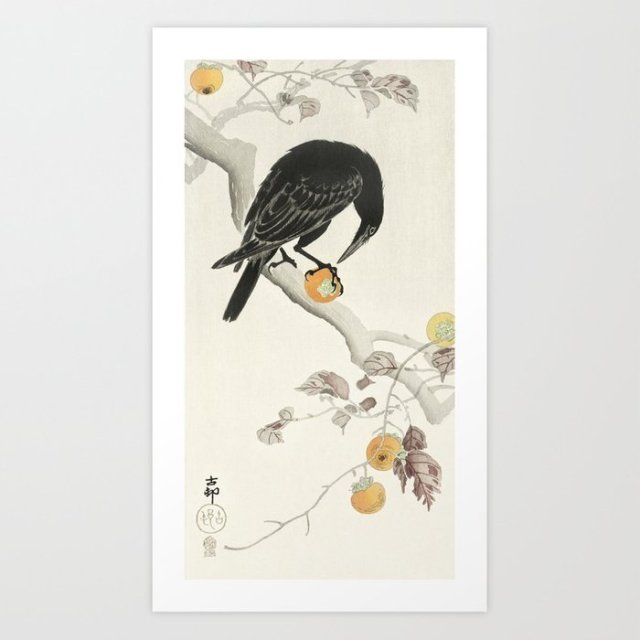
koson-ohara-crow-with-kaki-fruit-japanese-vintage-ukiyo-e-woodblock-painting-prints

– Painting by Koson Ohara