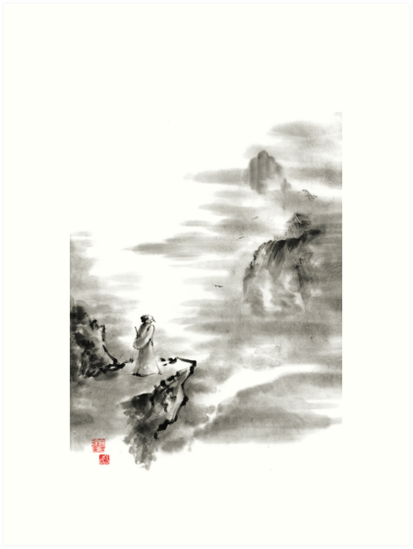
Agus Maulana Sunjaya’s Sunset

sunset
dragging my shadow
back home

© Agus Maulana Sunjaya (Indonesia)

Akitsu Quarterly, Fall issue, 2018

A very melancholic haiku that immediately suggests the image of a homecoming in which the shadow, particularly long in the sunset, seems to weigh down the steps of the poet. But the shadow, understood as the double and sometimes as the denied part of oneself, can weigh on the spirit in a more subtle and devastating way.

I don’t want to be a psychologist, but this haiku makes me think about the fact that by not facing the hidden parts of us, which we often fear strongly, we sometimes expose ourselves to inconveniences of which we do not understand the nature of and of which condition. These are not minor choices, as they affect our lives. Even in this haiku, I feel the sensation of an unfulfilled dualism that results in frustration, all expressed with elegance and with a second line that expresses also in the sounds (double “g”) a sense of oppression.

Margherita Petriccione (Italy)

This haiku reflects both the mental and physical fatigue of life where we spend most of the time facing and fighting different issues that test our cognitive and emotional abilities. It depicts the limited capacities of a person who, besides dealing with various matters of life, finally gets tired. It could be due to aging, where the sunset of life takes a person to the stage where he or she feels lonely and manages to live with great difficulty.

The shadow shows all the regrets, guilt, and bad memories that keep on following a person until the last breath of his or her life. Overall, a person who spends his or her days developing good relationships with people may end up being lonely, which also shows the insensitivity of recent human civilization.

Hifsa Ashraf (Pakistan)

I like how the first line can be interpreted as flowing into the second line or as standing alone. Also, the simplicity of the language and the surprise in the last line is pleasing. Though the third line is unexpected, it is also expected. This is a common aesthetic in haiku, where the ordinary can be extraordinary.

Like Margherita, I also enjoy the sound of the poem. With “s” in the first line and the second line, you can almost hear the shadow being dragged through the grass. With “o” in “shadow” and “home,” I feel the melancholy is illustrated. A fine haiku from a technical point of view, and also from an aesthetical perspective as well.

Nicholas Klacsanzky (Ukraine)

Did you enjoy this haiku and the commentary? Let us know in the comments.
8600431006cff1885ebbba24e764204f
© Callum Russel

Thaís Fernandes’ October

October morning—
falling one by one
my illusions

© Thaís Fernandes (Brazil)

This haiku reflects enriched experiences that are embedded in an October morning. October is a time of transition where summer almost surrenders to the colours of autumn. This is also the transitional period of our thoughts, feelings, and mood that are blended well with autumn shades. In turn, falling illusions is a process of getting into meditative thoughts that reveal the far side of realities. It also lets us jump into the autumn hush that brings forth deep, real meanings of life, and the person starts reflecting on his/her thoughts and filters them through the sieve of mindfulness. Mentioning the sound, the letter ‘o’ may allude to the recycling process of our thoughts and feelings early in the morning that redefines our current state of mind.

Hifsa Ashraf (Pakistan)

In the first line, we get grounded in the scene. In Brazil, where the poet resides, October is an interesting month. According to holiday-weather.com, “October is considered to be a month of transition—a month that is characterised by increasing temperatures and rainfall levels, as the weather moves from the mild winter season toward the hot, humid and wet summer season.” In this sense, with this inference to a transformation, the juxtaposition with the next two lines works well. As the weather heats up and the rain starts to fall, the poet perceives that her illusions are also “falling.” She perhaps saw her inner state reflected in the nature that surrounded her. This brings a sense of oneness, that perhaps humanity and the natural world are one organism.

Getting more technical, I like the use of the em dash. It presents the idea that the poet has now begun afresh, without her illusions. An ellipsis could have worked as well. In terms of the structure, the format is standard, but the syntax is reversed in lines 2 and 3. However, I think “my illusions/falling one by one” or “my illusions falling/one by one” would not have had as much impact on the reader. Though Hifsa has already mentioned the sense of sound, I would add that with the “o”s and “l”s, this haiku sings.

Nicholas Klacsanzky (Ukraine)

This haiku, although kigoless, does refer to a specific time. Even so, one might consider it a modern haiku. Then again, even if it did contain a kigo word eg. ‘autumn morning’ that does not necessarily make it a haiku either in a traditional sense (observation through nature.)

I do like this ku and its use of the em dash on line one, which gives the reader a sense of urgency or surprise, where I picture the poet finally seeing things as they truly are perhaps while meditating or under the use or entheogens, being half asleep, half awake, or what usually happens with children where one simply wakes up and see the world as it is for the first time.

There also seems to be an element of zoka in this write, which is:

‘The poet’s real enlightenment is his or her ability to open up to it, tap into it, and translate the zoka at hand into haiku. The poet recognizes what’s going on before his eyes and begins the journey of placing it into a haiku that relays what the poet has been vitalized with.’

Excerpt from Don Baird’s essay “Zoka”

https://www.underthebasho.com/essays/1714-zoka.html

Fractled (USA)

Did you enjoy this poem and commentary? Let us know in the comments.

I’ll be back soon | Volto Já - 80 x 60 cm
© Totonho

Pere Risteski’s Zenith

zenith
a cloud in a cloud
rolls around

© Pere Risteski (Republic of Macedonia)

The repetition of ‘o’ in line 2 and line 3 makes this haiku a visual delight. There is a sense of being laid-back in this which makes the reading experience very serene. Though there is no mention of the season or time of day, I am imagining a quiet, blissful summer dusk. A lovely haiku, all in all.

Pragya Vishnoi (India)

The zenith—the nadir celestial axis is the vertical axis according to which one aligns oneself in the posture of zazen. So, the immediate image that this haiku suggests to me is a moment of meditation under a clear sky in which two clouds seem to follow a circular motion. Clouds attract interest and create a point of distraction, and can be compared to thoughts that entangle and return to disturb the serenity of the moment. But I feel deeper resonance in this haiku that appears to me almost like a koan. Maybe I followed the wrong key of reading, but I find it a remarkable haiku—simple and yet well-refined in form.

Margherita Petriccione (Italy)

The word ‘zenith’ makes this haiku interesting and multidimensional as well. The person is meditating under the open sky, which makes his unique experience worth sharing, as he must have found the zenith as a part of his inner peace and he feels as if he is at his zenith for a moment.

Overall, I can see the deepest desires of the person embedded in the meditative thoughts of the day, which could be daydreaming as well. A cloud in a cloud again could reflect the deep meaning of one’s dreams or wishes that are interconnected. But in the case of meditation, a person looks through these clouds for a clear sky. Yet, in this case, the person enjoyed the experience of clouds manifesting his dreams or desires, which brings more clarity to them. He might feel as if he is out of the confusion. It may also reflect him finding the purpose of life by capturing the intuitive moments that brings a person to a state of extreme happiness, which is in a sense recognizing one’s core potential, which can seem like a miracle.

Hifsa Ashraf (Pakistan)

If you enjoyed this poem and commentary, let us know in the comments.

ap,550x550,12x16,1,transparent,t.u3

© Mariusz Szmerdt