Ken Sawitri’s Laughter

spring shower
a toddler finds the laughter button
on her doll

© Ken Sawitri  (Indonesia)

Right Hand Pointing, Low Sky, Winter Haiku 2017

Wonderful haiku in the journal, as well as above.

The magic I see here is how those fun last two lines could be so changed by various first lines. I can read it as spring representing the growth of new things. Something known about the doll that wasn’t known before…. “this doll laughs like I do.” Imagine it with a darker line one… “funeral over.” The mood changes. The child, aware at some level, that something bad has happened, finds the laugh button to be a diversion. I like the line that was chosen.

Pris Campbell (USA)

This haiku reflects the early years of a carefree life, where a child finds and celebrates different moments of life in toys and other things around her. The haiku starts with ‘spring shower’ which means a light rain—full of hope, joy, and life. Usually, a spring shower leaves a good impact on one’s mood, especially when flowers are blooming and their fragrance mixes with rain. Spring is also a time to yearn for new dreams, explore ways to gain happiness, and enjoy the bounties of life.

The toddler who is curious about her toy has the same feelings. She explores her toy, which seems like a companion to her. It is a self-exploratory process where a child finds a way to seek pleasure in  surroundings. In this case, she finds a doll as her best friend with whom she wants to share her happy moments.

The other aspect of this haiku could be the irony hidden in superficial ways of getting happiness that may not be permanent, like a spring shower. Also, the letter ‘o’ shows the continuous cycle of curiosity that ends up as happiness after achieving or receiving something surprisingly great.

Hifsa Ashraf (Pakistan)

Spring is a time of avalanches (rain is one of the triggers of an avalanche) and rain, while this poem initially reads as something to go “aww, that’s cute.” On the other hand, I see disaster because of the starting line “spring shower” as well. I’m not sure if that’s what the author intended, which is to show the pleasant side of childhood, but if the intention was to show two extremes, then I applaud the poet for achieving that.

Fractled (USA)

There is a unifying theme of youth and innocence in ‘spring’ and ‘toddler’. The alliteration in ‘spring’ and ‘shower’ and ‘toddler’, ‘button’ and ‘doll’ add to the musicality. This is a haiku that is commendable both in terms of craft and content.

Pragya Vishnoi (India)

Spring rain sometimes brings an uneasiness that results in an inexplicable melancholy, but the child finds the button for laughing on a doll. The child is by nature beyond melancholy, and captures only a joyful aspect from that spring moment. I find this haiku so comforting… among other things, although I am not a native speaker of English, I appreciate its smoothness.

Margherita Petriccione (Italy)

Did you enjoy the commentary and the poem? If so, please let us know.
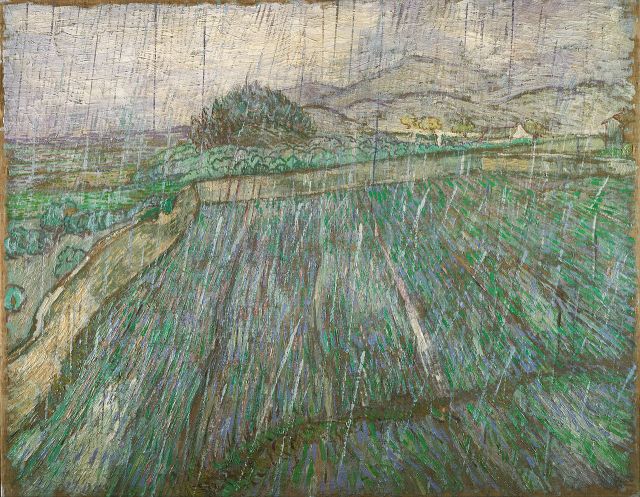
1280px-Vincent_Willem_van_Gogh,_Dutch_-_Rain_-_Google_Art_Project Enclosed Wheat Field in the Rain, by Vincent van Gogh
Brendon Kent’s Walk

mother’s walk
we wander through
each other

© Brendon Kent (UK)
Published in Moon on Water

This haiku shows deep feelings about attachment and detachment. ‘mother’s walk’ intrigues me with the purpose associated with it. Usually, a mother’s walk revolves around the daily activities of her home and children. On contrary, she may want a break from daily activities or a tough routine just to be by herself.

The second and third line suggests that she is not alone whilst walking. She may have the company of another person who has similar feelings or routines. The other person could be either a child or a spouse who is constantly trying to understand the deepest feelings of the mother. This situation also reflects the calm personality of a mother that is usually neglected due to daily activities. It seems the other person came to know about this side of hers rarely, so that’s why she/he enjoys to wander through the feelings and thoughts that are not expressed well in the daily routine.

I can also see empathic listening here, where both are sharing their estranged feelings for each other, most probably silently, as both are passing through similar experiences of life.

Hifsa Ashraf (Pakistan)

I like the many readings available for the phrase “mother’s walk.” It can mean a specific route the poet’s mother took, the way his mother walked, or a day or time the poet set aside for walking with his mother. The lack of punctuation in the first line also adds to the content of the last two lines.

The second line ends with suspense. It hangs on the edge of “through,” and we try to guess what is next. I think it is also good to have “through” at the end of the second line, as I think the poet would not like having a rhyme with “wander” and “other.”

The ending is at once simple and surprising. This poem is an example of the haiku aesthetic of brevity and common language. Haiku poets try not to be superfluous or fancy, and Mr. Kent embodies these principles in this haiku. How the act in the last line happens is a bit of a mystery but the reader can come up with several ideas: the poet is on the path where his mother used to walk and he is “wandering” though memories of her, in a way the poet’s mother left a part of herself there (metaphorically or maybe her ashes were spread there), or maybe the poet is expressing that on an atomic level, each being is connected, even after death.

In terms of sound, the first thing I noticed was the strong use of “r” in “mother,” “wander,” “through,” and “other.” It gives the haiku a serious tone. Also, there are plenty of “w” sounds, which lends a wispiness to the reading.  This gives a fine sonic balance to the haiku.

This haiku has a great mix of emotion, simplicity, and abstraction. With only seven words, it conveys the personal feelings of the poet powerfully.

Nicholas Klacsanzky (Ukraine)

Do you like this poem and commentary? Let us know in the comments.

5eef7567322767f1b4f5e4779e43a2df


Francesco Palladino’s Empty Room

empty room
a rosary and oranges
on the bedside table

© Francesco Palladino (Italy)

The mysterious starting line sketches the overall image of this haiku that leaves enough room for the reader to relate and interpret it according to their own personal experiences. In fact, this empty room could symbolize ‘loneliness’ and/or ‘melancholy’ that a person faces at least once in his or her life. I can also relate it with thoughts that trigger ’emptiness’ deep within—a sort of depression due to loneliness.

A rosary and oranges may depict healing after an illness that is both in the form of a cure and prayers. The oranges are associated with joy, good luck, and enthusiasm that goes well with the imagery of this haiku. Similarly, a rosary is considered as a hope for healing by reciting different supplications. Having both on the bedside table may indicate the hope and efforts one made to get rid of physical as well as mental issues in life.

There is a spiritual element in this haiku where ’empty room’ may indicate a peaceful mind devoid of thoughts—mindfulness. Then, rosary and oranges as components of spiritual energy enrich the aura with their presence.

As a note about the sound, the letter ‘o’ is repetitive in this haiku, which is also relates to the deep feelings of continuity and flow of divine energy within the soul.

Hifsa Ashraf (Pakistan)

What I enjoy most about this haiku is the space that it gives readers to ponder what has happened in the room and/or what continues to happen there. We can also guess as readers why the room is empty. The rosary gives a hint that it may be a monastery. However, many different types of people can carry rosaries.

The contrast between the rosary and the oranges is stark. On one hand, rosaries are about prayer and penance, while oranges are succulent, an indulgence, and bright in color. Also, the beads of the rosary are in the shape of oranges, which offers a further connection. The empty room contains so much due to this aesthetic of comparison. It has the spiritual and mundane in concord. Maybe the poem is telling us that we need both in balance.

This haiku reminds me of a poem by Shiki written late in his life:

a red apple
a green apple
on the table

(tr. by Nicholas Klacsanzky)

I think Palladino’s haiku is a fine addition to the legacy of Shiki.

Nicholas Klacsanzky (Ukraine)

If you enjoyed this poem and commentary, let us know in the comments.

van gogh

– Vincent van Gogh, “Basket with Six Oranges”