Marlene Mountain’s Pig

pig and i spring rain

(Published in Frogpond, 2:3-4, 1979)

© Marlene Mountain (1939 – 2018) (USA)

Pigs and rain both symbolize abundance, power, and strength. So, I can see a very close connection between the first word (pig) and the last word (rain). Another element that comes to my mind is the food chain. Rain helps to nourish plants and bring fertility to crops. Pig meat is used as food, so it shows the interdependence of different elements of nature that gain strength only if the cycle is not disrupted. Spring symbolizes the abundance of blessings, whether it is in the form of food or rain, that makes a person happy.

Besides that, I can see a friendly relationship between animals, nature, and human beings—key elements of nature. Spring here also indicates harmony and a balanced relationship among all nature’s agents.

Spiritually, I can see a balance between physical (pig) and spiritual (rain) needs.
In addition, I can see the dominance of ‘i’ in this haiku that indicates the individual identity of these three: pig, i, and rain.

Hifsa Ashraf (Pakistan)

“The transparent, childlike directness of this haiku and the poet’s complete immersion in sensory awareness put it in the category of “much harder to do than it looks”. I look to this poem often when I feel my own poetry is becoming too weighted down with words and thought.”

(From Favourite Haiku on the New Zealand Poetry Society‘s website)

Melissa Allen (USA)

“I think it was de Tocqueville who, after seeing how many roving bands of semi-domesticated pigs ran unattended in the city streets of America in the 18th century, remarked that they were a perfect expression of America’s come-one come-all, democratic spirit. This poem by Marlene Mountain reminded me of him because by using the non-capitalized personal pronoun “i” she puts herself on a plane with the “pig”, and is as free as a pig is to enjoy the rain which falls democratically on all alike. There is something uninhibited in the pig’s appreciation of rain that the poet may well share, even if she does not bask, Moonbeam McSwine-like, in the mud. It is the poet’s joy to participate in the fructifying seasonal rebirth brought on by the change of weather, and take pleasure in the simple companionship of this uncomplicated animal. Reading it is like breaking through barriers to a free place.”

(From re:Virals 109 on The Haiku Foundation blog)

Garry Eaton (Canada)

“American poet, Marlene Mountain, has been experimenting with single line or ‘monostich’ haiku since the late 1960s and this is one of her most anthologised.

From a formal aspect there’s a seasonal reference, what’s known as a kigo in the Japanese classical tradition, with spring rain. There’s a natural caesura, or breath pause, after pig and i: an invitation to consider its juxtaposition with spring rain. From a semantic point of view: pig and i is a more formal choice than ‘me and the pig’. And pig rather than ‘the pig’ creates a kind of archetypal pig, something more than a specific farmyard oink.

Use of the lower case personal pronoun is quite common in contemporary EL haiku: the argument for it is often the dilution of personal ego – but there’s too much of a whiff of Zen in that for me. And it’s an argument that feels contradictory too: a lower case i seems to draw even more attention to itself than the standard upper case, which we’re so familiar with we hardly notice it (as long as it’s not overused). But here I’m actually in favour of the lower case for the parallel it appears to draw between the pig and the narrator, both as equals in the spring rain, on the balanced see-saw-like single line.

pig and i – spring rain

But … is the prettiness/tentativeness of spring rain making me see the pig, probably the least pretty of animals, (and the haiku) through rose-tinted spectacles? Someone else would have to analyse and argue for that case.”

(From haiku: a poetry of absence or an absence of poetry? on the An Open Field blog)

Lynne Rees (UK)

Did you enjoy this haiku and commentary? Let us know in the comments.
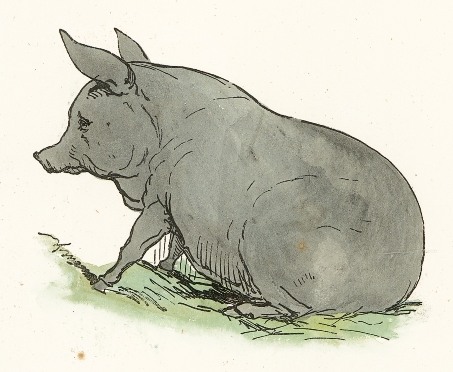
Gray_Pig_Drawing

Elliot Nicely’s Small Worries

these small worries . . .
wave upon wave,
the ocean
collapsing
beneath itself

(Presence, #58, 2017)

© Elliot Nicely (USA)

A very well-crafted tanka that shows a relationship between our feelings and ocean waves. The opening line “small worries” takes us to our daily activities, where we constantly pass through a lot, and which lets our mind and heart oscillate between logic and feelings.

The ocean here symbolizes the deep feelings and thoughts that are sometimes unfathomable, and we can’t deal with them well. Waves upon waves may be our cognitive process that keeps on filtering our thoughts to find out some solutions based on logic. I can also see an element of ego here where a person’s worries can be related to his/her egoistic approach towards life. Waves upon waves in terms of the heart could be saying that feelings are blindfolded, and we can’t see that logic and thought dominates compassion, kindness, etc. In both cases, the worries or problems are not dealt with effectively, which may lead to destructive thoughts, poor relationships, and in the long run, poor mental and physical health.

Hifsa Ashraf (Pakistan)

Yes, small worries are but waves in our lives—they come and they go. In a moment, there are worries to think about and that give color to our mundane life. And then in the next moment, these are all gone and we’re back to our own silent and secure existence.

Willie Bongcaron (Philippines)

I like that this tanka points to the fact that we often get so wrapped up in the daily grind, that we often forget that our troubles are usually pretty minor. The ocean in the poem is a kind of reminder that each moment is new, and an issue of just the moment before can be washed away.

The word “collapsing” works well not only as an image, but also in its power. We commonly see ourselves as a linear story of a person. But in fact, we are always changing, and in each moment, we can choose to be a new individual.

Let’s talk about the punctuation a bit. The ellipsis reflects the continuous motion of the waves, and the comma allows the reader to pause a bit to imagine the waves. Also, take notice of the economy of language: no line is longer than three words, but each of them is strong and creates a stark image.

Sound is also important in this tanka. In my mind, the “s” and “o” sounds create the most prominent effects. The “s” letters seem to be making the “sss” of incoming waves, and the “o” letters appear to be mimicking the “ooo” of receding waves.

This tanka is written in a convincingly straightforward manner, but the last line surprises and allows us to introspect about how daily strifes are not so essential in the larger picture.

Nicholas Klacsanzky (Ukraine)

Did you enjoy this tanka and the commentary? Leave us a comment if you did.

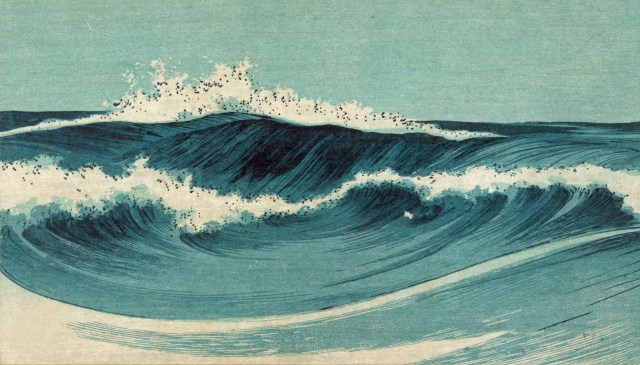
japanese-waves-painting

© Dawn Hudson

Svetlana Marisova’s Still Pond

still pond—
shadow of a mayfly
in the depths

Mainichi Daily News (April 13, 2011)

© Svetlana Marisova (1990 – 2011) (Russia/New Zealand)

Overall, I can see the serenity, calmness, and productivity in this haiku. Three words—stillness, shadows, and depths—depict that life is on the verge of either death or life. I can see the positive side of it—new life, reproduction, renewal in a season when there is no interference and disturbance.

Metaphorically, a still pond can be a meditation process where life flows in moments, and a person’s deep experiences of life reflect as shadows and show the true image of the self.

Hifsa Ashraf (Pakistan)

Reading this haiku a few times, I could not stop feeling pulled down by the deep sound of the vowels in it…. This ku seems to be a hymn to “o” and “ou,” so it deals a lot with  meditation and mantras (“om” or “aum” …).

Through its images, I’m pushed to linger in an introspective mood: it opens me to a feeling of impermanence with the ephemeral presence of a mayfly, and its shadow …

The haiku invites us also to see beyond the surface of things, bringing us into the circle of life and then death. “Death” can be easily recalled at the end of the poem thanks to the assonance with “depths” used by the poet…, as if ending a life should be something natural, but also perceived as an emotional event that cuts through our own lives—deeply helping us to grab the essence of our existence, its core, the meaning of us here and now, because life and death are always together, although we try to hide from this fact most of the time.

A haiku that can be read and read again—finally reaching a new awareness ….!

Lucia Fontana (Italy)

Not only is this haiku deep (no pun intended), but it is also meditative. The brief life of a mayfly is commonly seen as a metaphor of the extremely short span of time we get to live on this planet (according to cosmic time). Mayflies, crane flies, and cicadas usually remind us that we aren’t immortal. They give our egos a pinch. And in the context of the poet herself, she was diagnosed with terminal brain cancer. Maybe the poet saw the mayfly as a representation of herself.

The contrast with the peace of the still pond and the deep shadow of the mayfly creates poignancy. Even this little insect with such a brief life can reach down into the depths of the pond with its shadow. Also, this can be seen as expressing the idea that when all is peaceful outside and/or within, even the smallest creature can have a big influence.

This haiku is also a nod to Basho’s famous “old pond” haiku, I believe. Instead of sound, though, we have the sense of sight. But we can derive a similar conclusion: the mayfly, in a sense, has become the pond—or at least a part of it.

With plenty of “s” and “o” sounds, the haiku is musical. In my reading, the “o”s slowed me down and allowed me to take in the haiku in a bit more. There is also a judicious use of the em dash, making the reader pause to realize the stillness of the pond.

A classic haiku from a poet who was taken away from us way too early. I hope more people read her work.

Nicholas Klacsanzky (Ukraine)

Did you enjoy this haiku and commentary? Let us know in the comment section.

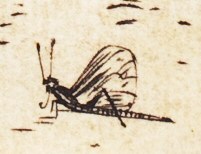
mayfly

© Albrecht Dürer (1471–1528)