Haiku by Thomas L. Vaultonburg, Tuyet Van Do, and Alexander Groth

broken bridge—
the river teaches me
its alphabet

Thomas L. Vaultonburg (USA)

Commentary from Hifsa Ashraf:

This haiku reflects wreckage, destruction, and loss—possibly due to war, natural erosion, or catastrophe. The opening line, “broken bridge,” immediately conveys a sense of disruption—be it in relationships, communication, or continuity. A bridge often symbolizes connection, transition, or passage from one state to another. Here, its brokenness suggests a severed link, a collapse in understanding or unity. The em dash after the first line pauses the reader, allowing them to fully absorb the scene and connect with it in their own personal way.

The second line shows how, in the absence of that constructed path, the observer begins to engage directly with the river. The destruction of the bridge uncovers a hidden relationship with the river—something previously ignored as people simply crossed over it, never truly noticing its flow, sound, or resilience. Now, with nothing in between, the river demands presence. It becomes a metaphor for uninterrupted thought—fluid, spontaneous, and reflective—offering insight and wisdom in the aftermath of loss.

The final line, “its alphabet,” is especially evocative. It suggests the river has its own language—one that the observer is now learning to read. This could represent poetry, expression, or a deeper understanding of the self and nature. The word “alphabet” also points to musicality, rhythm, and perhaps even healing, as if the river’s sounds become a kind of song or meditation.

Overall, it is a haiku that displays humility, and that when the human-made world breaks down, nature is there with its voice and language.

vacation at grandma’s
cicada’s symphony
singing me to sleep


Tuyet Van Do (Australia)
Haiku Girl Summer, 25 August 2025

Commentary from Nicholas Klacsanzky:

“Cicada” is a classic summer kigo (seasonal reference) in the Japanese haiku tradition, and in most countries. The poet could be implying that she was on summer vacation while visiting her grandma’s house. I got the feeling, though, that perhaps her grandma was no longer there, and the cicadas were a substitute for the lullabies that her grandma used to sing. The loudness and fullness of cicada song fill the gap left behind by a loved one to some degree.

In the second line, there is a shift to the natural world, connecting humanity with the cicadas. Oftentimes, cicadas are thought to have harsh calls, but the word “symphony” characterizes their sound as pleasant and even awe-inspiring. Perhaps at a place as so nostalgia-infused as grandma’s house, even cicadas can sound melodious and sweet.

The third line returns to the human, showing the effect of nature on the poet. It displays a clear juxtaposition of human experience and nature. Additionally, it also manifests the connection between sound and the memory of an emotion. Music, or certain sonics of nature, can often open the floodgates of memory.

Looking at the sense of sound within the words themselves, the repetition of the soft s sounds mimics the hiss and hum of the cicadas in the first line. In the last line, the s dominates again, this time softened by ng and sl, creating a lulling effect.

It is a simple haiku at first glance, but with a second look or more, one can easily see and feel layers of meaning that are poignant and resonant.

school bathroom—
the scent of fresh deodorizer
lingers in my hair

Alexander Groth (Germany)

Commentary from Jacob D. Salzer:

Many activities can happen in school bathrooms. They can be a kind of hiding place for some students, where they talk and share secrets, though more unfortunate things can happen in school bathrooms as well. The scent of the fresh deodorizer could be covering up another scent, though this is left open to the reader. In a broader sense, this haiku makes me think about the psychological, physical, and emotional effect that various scents have in our daily lives. It also makes me think about the chemicals in various deodorizers/deodorants that some people are exposed to on a daily basis. In college, I learned certain deodorants have harmful chemicals that can enter the lymph nodes and can cause various medical problems over time, including cancer. In short, this is an important haiku that sparks conversations about school safety, the sense of smell, chemicals, and the social lives of students. 
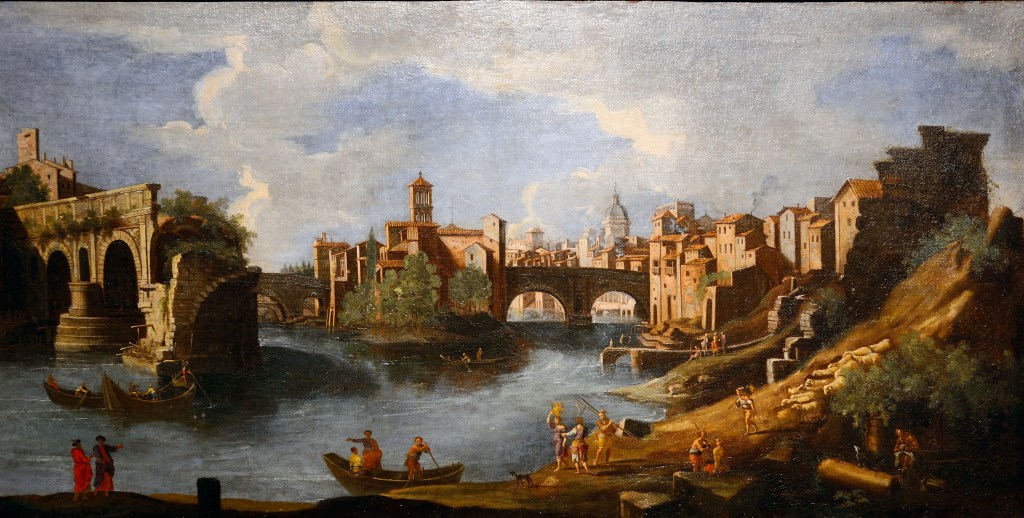
Panorama of the Tiber with a broken bridge. Caspar van Wittel (1653–1736) 
Haiku and Senryu by Gordon Brown, Kelly Sargent, and Alexander Groth

winter morning
inside the gargoyle’s mouth
a bird’s nest

Gordon Brown (USA)
tsuri-doro, issue #14, March/April 2023

Commentary from Hifsa Ashraf:

The starting line with a kigo shows the cold weather when people mostly stay inside and enjoy the coziness of rooms and memories. A winter morning may indicate fog, snowflakes, snowfall, blizzard, or simply coldness. It may be a window view, a view from the balcony, a view from a vehicle’s window, etc. In any case, the person has captured something unusual—something that people don’t focus on in their daily routine. Perhaps, the poet is trying to relate his personal life with the imagery. 

The English article ‘the’ before ‘gargoyle’ allows us to ponder statues, stubs, waterspouts, fountains, etc. But, it seems whatever form the gargoyle’s mouth takes, it needs some maintenance. In religious terms, gargoyles are meant to be both good and bad. In architecture, they are used for the disposal of water. The placement and the purpose of a gargoyle in this haiku is significant. It seems like the gargoyle is no longer in use, or simply a statue where a bird nests. This may indicate that the gargoyle is meaningful even if no one cares. It’s a sign of adjustment where insignificant things become significant—especially in hard times. In this case, a bird nests in the gargoyle’s mouth to avoid harsh weather. For that bird, this creature is a great blessing, and for the place where it is situated, it may have become a curse. We never know when and where life turns upside down. But, we need to learn from nature about how to adjust to situations that are not useful to us. 

finding my adoption papers —
polished apples 
without a stem

Kelly Sargent (USA)
Mayfly, issue #77, July 2024

Commentary from Jacob D. Salzer:

This is a powerful haiku that uses detailed images in a two-part juxtaposition to communicate emotions and meaning. There is metaphorical power in this haiku as well. The discovery of the poet’s adoption papers likely creates a myriad of emotional responses, such as shock, melancholy, and perhaps relief, simultaneously. It could be that the person or people who adopted the poet kept the adoption a secret to prevent the poet from being exposed to past psychological trauma in their biological family. The word “polished” reminds us that sometimes things are not as they appear, and much can remain hidden beneath the surface. “Without a stem” points to the disconnection between the poet and their biological family and shows how hard it is to face the mystery of their family tree. This haiku also extends what a family can mean. I appreciate the poet’s vulnerability. This is a potent haiku with psychological depth and meaning.

fishing trip 
carefully I remove the hook
from my skin

Alexander Groth (Germany)
Failed Haiku, issue #100, July 2024

Commentary from Nicholas Klacsanzky:

Not only is the last line a surprise but it also can be taken in several poetic directions. Like many great haiku and senryu, the images in this poem can be perceived as both mundane and metaphorical. Perhaps the poet “catches” himself with a hook in an ironic twist, but “hook” could also pertain to attachments or hang-ups. The poet could be saying that before engaging in fishing, he needs to let go of a few burdens—psychological or otherwise.

Since this is classed as a senryu, no punctuation, seasonal reference, or avoidance of personal pronouns is needed. Still, the poet kept to the principles of brevity, casual language, and pacing the lines in a traditional short/long/short rhythm.

Looking at the aspect of sound, the sharp “i” in all the lines of the senryu connects to the hook. In addition, the “k” sounds in “carefully,” “hook,” and “skin” contribute to the feeling of sharpness. Ultimately, this haiku appears to be effortlessly written, but on looking deeper, demonstrates the technical prowess of the poet and layered depth.

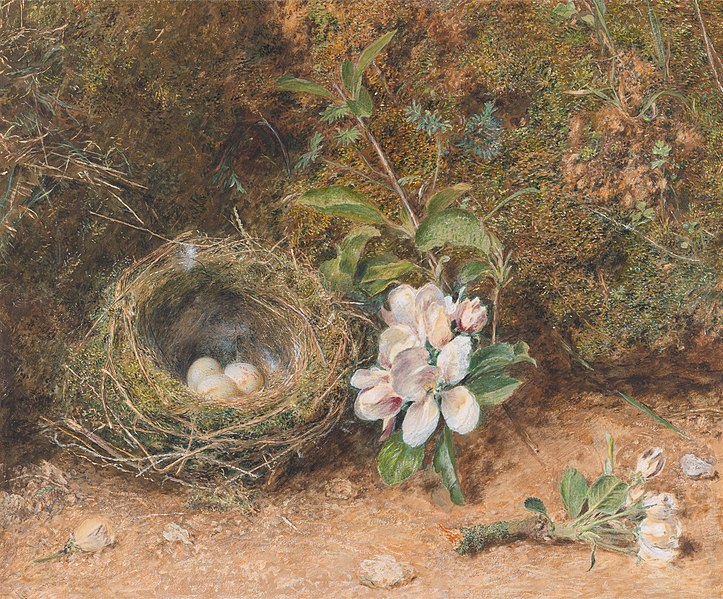
William Henry HuntBird’s Nest with Sprays of Apple Blossoms, circa 1847

Haiku by Rowan Beckett, Anne Morrigan, and Alexander Groth

stars on stars ever growing my boyhood

Rowan Beckett (USA)
Prune Juice, issue 40, 2023

Commentary from Nicholas Klacsanzky:

Having the haiku as one line adds more interpretations to it. It can be read in these ways: “stars on stars/ever growing my boyhood”; “stars on stars ever growing/my boyhood”; “stars on stars/ever growing/my boyhood.” There is no wrong or right way to read it. I enjoy this aspect.

“stars on stars” might be a seasonal reference to winter. In this season, it is easiest to see the constellations and brightness of stars. This reference contrasts poignantly with “ever growing my boyhood.” Winter is not normally associated with growth, but this haiku demonstrates that even in the coldest times, spring can happen.

Looking at the sound, the first thing I noticed was the multiple r’s. In my opinion, this sound gives the haiku more oomph and sharpness, while the o’s elongate the reading and suggest growth.

With only seven words, the poet creates many reverberations and resonances. The right balance was made: it’s hard to imagine the haiku improving from its already powerful self by adding or taking away a word.

dawn canal 
the oarsmen draw 
a new horizon

Anne Morrigan (Canada)
Poetry Pea Journal, 1:23, 2023

Commentary from Jacob D. Salzer:

I appreciate the metaphorical value of this haiku, the clear imagery, and its meaning. This haiku shows the importance of teamwork which can create more possibilities than anything one person can do alone. The new horizon formed by their oars could be seen as a hopeful future when we work together as a community or as a team. The men in this haiku are connected with the water, which also inspires community. In addition, the dawn marks a new beginning and a hopeful future. In short, this is an inspiring haiku that shows the importance of teamwork and our connections with the Earth and each other.

cherry blossoms bloom
a distant memory of
my former winter

Alexander Groth (Germany)
5-7-5 Haiku Journal, May 9, 2024

This traditional haiku on cherry blossoms made me smile because of its format. The first line emphasizes the blooming period—maybe early spring or the end of winter. The time of blooming matters as it inspired the poet to reminisce about a memory of the former winter. This haiku is one of the best examples of showing a strong bond between nature, especially two seasons (spring and winter), and personal experiences i.e. a memory. 

In this poem, the connection between the blossoms and memory is deep yet remote. The distant memory shows something fading due to forgetting or returning to the conscious mind. The second line ends at ‘of’—a cutting word that gives a double meaning to the theme if we read it like this: ‘a distant memory of(f)’. In both cases, the cherry blossoms either made the memory fade away or refreshed it.

The closing line hints about the season or period which is ‘former winter’—a season when quietness often makes people spend their time either being nostalgic.  It also depends on the kind of memory, which is not revealed in this haiku and is still a mystery. In any case, it is cherry blossoms that trigger what seems like a pleasant memory. The lack of punctuation makes this haiku more profound and open to many interpretations. 

ESA/Hubble & NASA