
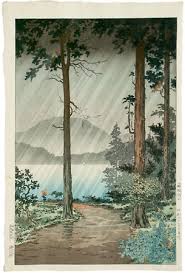
slanting rain
the shift worker whistling
slightly out of tune
— Andrea Cecon (Italy)
Modern Haiku, issue 48:2
I enjoy the layers of sound in this haiku. “slanting rain” tells me it’s raining pretty hard. On the first read, “whistling” brings to mind a construction worker, though I like how the occupation is not defined in this haiku and left open for the reader. If we imagine the work is being done outside, I have compassion for the person in the haiku, still devoted and working despite the time of day/night and the weather. Even if the work is being done inside, I have compassion for the person working late into the night and/or early morning. “whistling slightly out of tune” brings to mind how a person can be tired or somewhat fatigued working such odd hours, yet their dedication and focus carries them through. The whistling may also be slightly out of tune against the loud sound of pouring rain. I think whistling in this haiku is also helping the person finish their work-shift. Like walking through mud, it is challenging, but with strength and persistence, it can be done.
I used to work the graveyard shift at a theater. I always found it interesting to drive home at 1 am after the last movie ended. The quiet neighborhoods were palpable as I drove past silent houses. It was interesting to be awake while almost everyone else was fast asleep.
This is a powerful haiku that conveys compassion for dedicated, hard-working people who work odd hours while most people are sleeping.
— Jacob Salzer (USA)
It happens that when a person spends all day on a task that is tiresome and laborious, then they may not enjoy things in the surroundings or they may not find it soothing when there is bad weather. This haiku represents the life of a shift worker that may sound full of fatigue. ‘slanting rain’ expresses nature’s harsh mood where nothing comes straight and calm. It is a struggle when one cannot escape one’s duty during a slanting rain. But, the word ‘whistle’ gives a twist in the haiku as it shows that either the shift has ended and the person is enjoying their off-time. Maybe they are going back home or daydreaming. Or, it may give a hint of ‘whistleblowing’, calling out those who are not complying with their duties due to the slanting rain. In either situation, it seems that the person in question is enjoying their time.
Overall, slanting rain and whistling both allude to the opposite moods of a person during laborious work or a rough day. It also shows how a person after some hardship needs some relaxation, which may or may not be enough to unwind their fatigue, stress, or frustration.
Finally, the letter ‘s’ in this haiku sounds more like a complex situation where a person is not fully enjoying his life due to a laborious job that may not be paying well.
— Hifsa Ashraf (Pakistan)
Jacob and Hifsa explored a lot of what I wanted to say. But, I wanted to add that in this haiku, I see nature and humanity crossing paths. The slanted rain, with the sound of a possible storm, is akin to whistling off tune. I believe there is not quite a cause and effect relationship. It is more the shift worker feeling nature’s mood and integrating it into their being.
In this world of artificiality and superficiality, we often forget how connected we are to nature. From the food we eat, the materials we use, to our surroundings, nature and humanity is always intertwined. This haiku displays a brief moment where that relationship shows as stark as a whistle.
— Nicholas Klacsanzky (USA)
 Haiku Commentary