
crescent moon —
enough shadow
to imagine
– Elaine Wilburt (USA)
Published originally in Chrysanthemum 26, 2019
A crescent moon or a new moon is the start of a new month, which brings hope and energy with it. I take the crescent moon as a source of yearning for new dreams and plans.
“enough shadow” metaphorically has two meanings here: the dark side of the moon that goes into the light with lunar phases and becomes visible to the eyes, and the shadow of a person, which can be called a persona. In both cases, shadows reflect our desires that need time to get fulfilled. I could see a close connection to life’s stages and lunar phases, where a person grows physically, spiritually, emotionally, and mentally over a period of time. But before that, every aspect of life remains a mystery, like a shadow, and becomes visible once it gets enlightened by time and reflects our true self and/or potential.
– Hifsa Ashraf (Pakistan)
I feel this haiku represents a “glass half full” perspective. It makes me think about how something negative, depressing, or solemn can be seen in a positive light. Also, as Hifsa noted, a crescent moon represents a fresh beginning. With that, I believe the poet is expressing optimism for the path ahead on a new journey.
You can say, in addition, that when we look at a crescent moon, we sometimes to fill in the dark space with light through our imagination. We try to view the moon as full, even though it is crescent. So, the haiku could be speaking to our desire to fill in the holes in our perception.
The word “enough” is strong in this poem. It paints the scene perfectly, as it refers to dusk and the shadows that creep in at that time. It demonstrates the level of awareness the poet had when she wrote this haiku.
There is a potent sense of sound in the poem as well. With strings of “o”s, the pace slows down, reminiscent of dusk. With the ample “n”s it has, a feeling of dignity is given to its reading.
Lovely phrasing, imagery, and sound make this haiku impressive.
– Nicholas Klacsanzky (USA)
If you enjoyed this haiku and commentary, please leave us a comment.
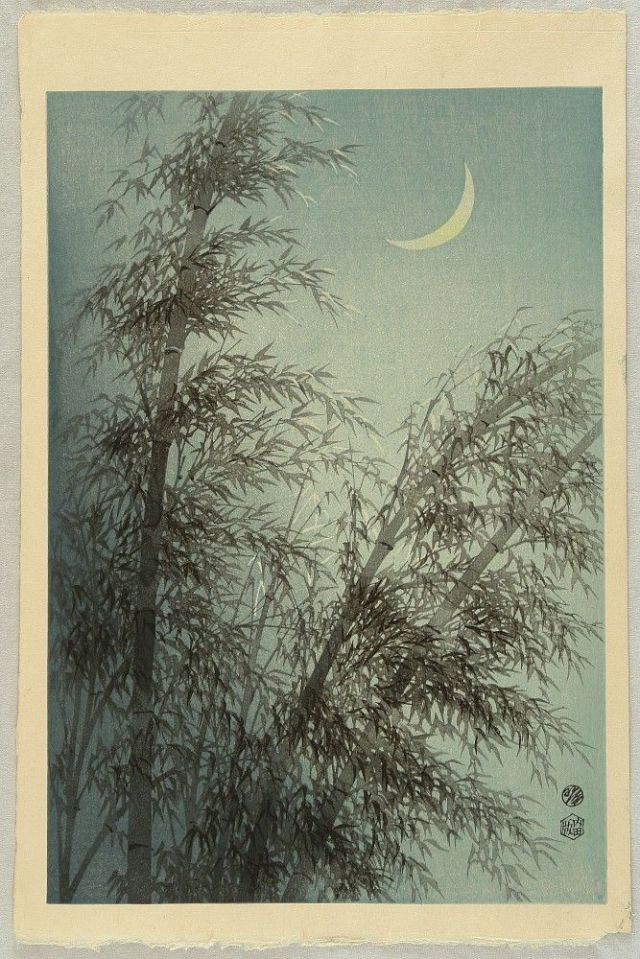
Painting by Kotozuka Eiichi(琴塚 英一 Japanese, 1906-1976)
 Haiku Commentary