Haiku by Elliot Diamond, Hifsa Ashraf, and R.C. Thomas

oil spill fish blowing bazooka bubbles

Elliot Diamond
Failed Haiku, issue 98.1, 2024

Commentary from Jacob D. Salzer:

I appreciate this one-line haiku for revealing one of the severe consequences of oil spills. In a broader sense, this haiku is also showing the inherent economical and environmental dangers of oil dependency in modern civilization.

The word “bazooka” can refer to chewing Bazooka gum. The bazooka bubbles could visually resemble the bubbles created by fish. However, a bazooka is also a military weapon. In this monoku, the bazooka seems to signify not only a war between humans, but a war between humans and the Earth. More specifically, limited human viewpoints and ideologies (that see Nature as only resources to be extracted) leads to harm and war, which also harms ourselves, in many ways. If we want to lead healthier lives, I think we need to protect the Earth and call on Indigenous wisdom.

The strong “b” sound echoes in this monoku with the sonic impact of the oil spill and the bazooka. Even so, because sound is muffled underwater, I also feel a kind of deathly quiet in this poem.

In short, this is an important monoku that shows the dangers of oil. However, it is more than a poem as it can also inspire a social call to action.

old snow
unfolding mom’s
bridal gown


Hifsa Ashraf (Pakistan)
ESUJ-H, September, 2025

Commentary from Nicholas Klacsanzky:

The contrast between “old snow” and “bridal gown” jumped out at me. Both are white, but with “old” and “mom’s,” we understand that both the bridal gown and snow are tainted in some way. From the poem, I get the feeling that either the poet’s mother has passed away, or is simply passing on her bridal gown as a form of heritage. Both images point to transience and create a sense of harmony between nature and human life (toriawase).

With the mention of “old snow,” I feel the seasonal reference, or kigo, is late winter. With the time being on the cusp of spring, it relates to a new beginning, such as a wedding—especially with the reference to being “mom’s bridal gown,” showing the passage of time leading to a new future.

The act of unfolding suggests a form of reverence. It also makes readers ponder questions about the haiku: why is the gown being unfolded now? Is this an act of remembrance or preparation? Finally, “unfolding” also mirrors the melting of now.

Though there is no punctuation in this haiku besides the possessive marker, the kireji, or cut, is felt in the line break in line one. However, with the lack of punctuation, the haiku can be read either as two parts or as one flowing part. Both readings are valid, and perhaps the poet wanted to leave more interpretations open for the reader through the lack of punctuation.

The pacing, however, is quite traditional. With a short first line, longer second line, and shorter third line, this haiku aligns with the traditional Japanese haiku rhythm of 5-7-5 sound units (not syllables). Following this rhythm usually allows the poet to make the haiku brief and colloquial in language.

Overall, this haiku embodies the qualities of seasons, subtle emotion, and the revelation that arises from an unforced contrast/comparison that lends to multi-layered reading.

hard-boiled summer
a busboy’s smile
begins to crack


R.C. Thomas (UK)
Frogpond, 46.1, Winter 2023

Commentary from Hifsa Ashraf:

The opening line, “hard-boiled summer,” presents a rich, multi-layered metaphor. At one level, it conveys the intensity of extreme heat—affecting both mind and body. On another level, it could be describing a person who is emotionally hardened or indifferent. There is also a clever allusion to hard-boiled eggs—thoroughly cooked, contained, and under pressure—suggesting both physical heat and psychological tension. The poet skillfully invites the reader to navigate these interpretations without losing the poem’s emotional depth.

The second line, “a busboy’s smile,” operates both literally and symbolically. It may express a fleeting moment of joy, perhaps the result of brisk business during the summer heat, or act as a mask worn over exhaustion. Extending the egg metaphor, the smile becomes the uncracked surface of a hard-boiled egg—calm, polished, but under pressure. One might also associate egg yolk with the golden light of summer.

The concluding line, “begins to crack,” conveys a subtle shift. It suggests the gradual collapse of composure, whether the smile breaking under heat and fatigue, or the beginning of an emotional unraveling. The metaphor completes itself with the image of an egg’s shell cracking, revealing vulnerability beneath the surface.

This haiku masterfully intertwines climate, emotion, hardship, and human resilience, using layered imagery to reflect on the strain of daily labor in harsh conditions. Finally, the repetition of the letter ‘b’ in this haiku evokes a gentle, calming rhythm, subtly reflecting the sense of ease that follows the unfolding of a mystery.

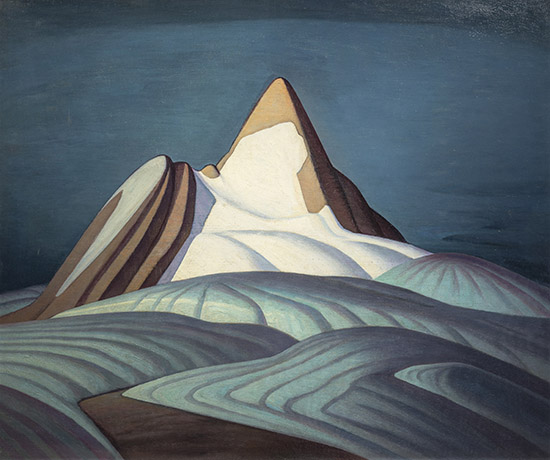
Isolation Peak, Lawren Harris (Canadian, 1885–1970), oil on canvas, © Family of Lawren S. Harris

Haiku by Elliot Diamond, Neena Singh, and Jennifer Gurney

the first hole of a shakuhachi dawn 

Elliot Diamond (USA)
Modern Haiku 55.2, 2024

Commentary from Nicholas Klacsanzky:

This haiku succeeds in seamlessly layering sound and imagery to create a spiritual atmosphere. It juxtaposes the shakuhachi—an ancient Japanese bamboo flute—with the unfolding of dawn. The “first hole” can be read both literally, as the finger-hole that allows the first note to emerge, and metaphorically, as an aperture through which the first light of day enters the world. It also could be a symbol of a threshold between silence and sound, darkness and light. The shakuhachi’s connection with Zen practice further shades the image with spiritual awakening: dawn not only as a time of day, but also as a symbol of enlightenment.

The haiku, being one line, creates a representation of the shakuhachi. It could have been written as three lines, such as “dawn/the first hole/of a shakuhachi.” However, I feel the haiku is more organic and interesting as one line.

The diction is minimal, yet the resonance is wide: the reader can hear the first note, feel the cool breeze of dawn, and perhaps see the bamboo hollowed into an instrument. In addition, the phrasing enjoyably blurs instrument and environment. What we’re left with is not just an instrument or a sunrise but a moment of initiation, where time seems to exhale through the flute.

Though there is no kigo or seasonal reference, the time is evident. There is also no kireji or marker for a break, though there can be a natural pause after “shakuhachi.”

Finally, the sound of the haiku works well with the letter “h” being the most prominent. The breathiness of the letter “h” in “hole and “shakuhachi” illustrates blowing into a flute.

Despite the minimalist aesthetic of this haiku, the poet leaves a lot for the reader to ponder and feel through inner vision.

summer solstice
the busker plays
a tune from home


Neena Singh (India)
2nd Prize, Japan Fair Haiku Contest 2025

Commentary from Hifsa Ashraf:

The haiku’s imagery, anchored by the summer solstice kigo, evokes solitude and introspection through a busker’s tune played from home. The solstice’s long daylight amplifies the sense of isolation, yet the music serves as a cathartic bridge to an unseen audience, blending self-fulfillment with a subtle yearning for connection. The summer solstice, with its prolonged daylight, casts a spotlight on the busker’s solitary performance, evoking and highlighting both isolation and self-awareness.  I see the poem as a catharsis and self-awareness where an artist thoroughly enjoys their talent without having an audience or the audience is unseen.

The haiku conveys the busker’s enjoyment of solitude, longing, or melancholy in the deepest way. The poem balances solitude and loneliness, suggesting the busker finds fulfillment in their music while possibly yearning for the connection typically found in public performance. If rooted in a Japanese context, the busker’s solitary tune might reflect a Zen-inspired embrace of the present moment, deepening the poem’s meditative quality. In any case, it is irrelevant to the person who may be in a meditative state of selflessness or enjoying being alone, only with what they enjoy the most. It also makes me wonder: does the poem suggest the busker imagines an audience, or is the music itself a bridge to an abstract sense of connection?
A “tune from home” could imply the busker is playing from within their home, possibly for an unseen audience. However, buskers traditionally perform in public spaces for passersby, so the shift to a private setting might be a deliberate contrast in the poem, symbolizing introspection or a lack of external validation.

Looking at the technical details, the lack of punctuation and the rhythmic ‘m’ sounds mirror the tune’s fluidity, creating a meditative tone that resonates with both the busker’s inner world and the listener’s sense of belonging.

the branches
of my family tree
together

Jennifer Gurney (USA)
Cold Moon Journal, 6/19/25

Commentary from Jacob D. Salzer:

I appreciate how this haiku offers at least a few different interpretations. After the first read, I saw many lives joined through her family heritage. This seems to be a relatively simple metaphor, but it can act as a portal into the details of many family members and their stories. After reading a second time, I saw the branches as fallen and now physically gathered together. This leads to an interesting metaphorical interpretation that perhaps the souls of her family ancestors could be together in a different dimension. After a third reading, I saw the poet viewing a historical family album and/or a historical document/book about her ancestors.

As a creative writing exercise, I recently wrote a letter to my first great-grandfather, who settled in the U.S. I tried my best to transport myself back in time and asked many questions about his life. In addition, my father shared historical records of our ancestors. This has deepened my understanding of our family tree and makes me realize how much has changed in a relatively short amount of time. All this being said, I appreciate how this haiku encourages us to study our genealogy and history to see what we can learn about our ancestors and ourselves.

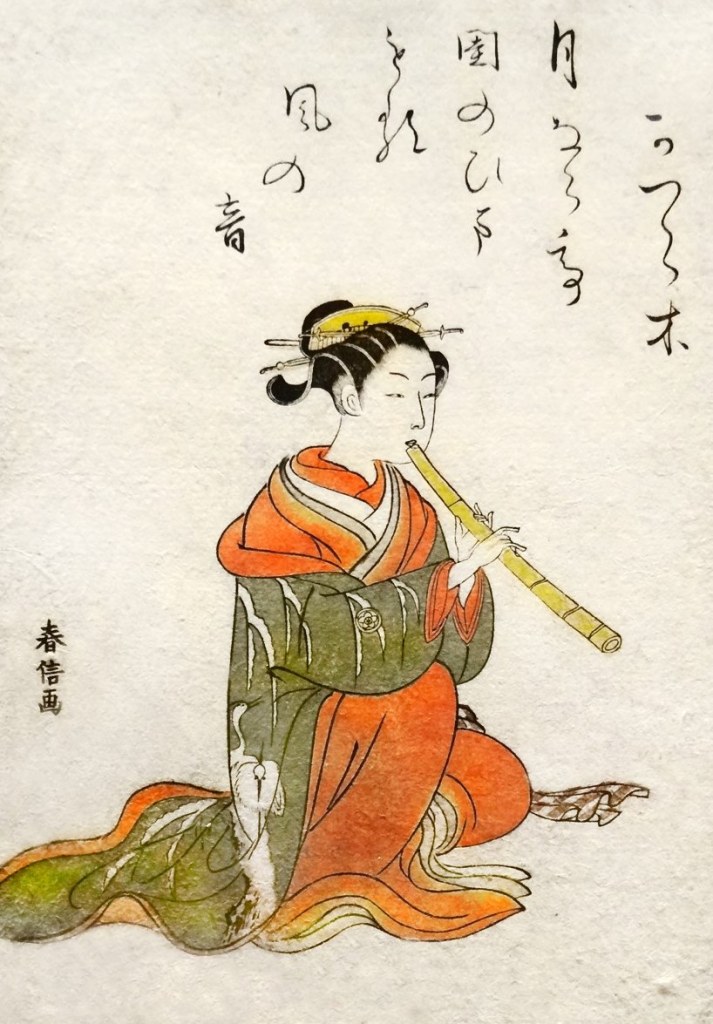
Suzuki Harunobu (circa 1725-1770). Courtesan playing Shakuhachi. Page from: Ehon Seiro Bijin Awase (Picture Book of comparative beauties of teahouses).

Haiku by Kavita Ratna, Elliot Diamond, and Jeremy Haworth

river view
a salmon floats
on a cloud of oil

Kavita Ratna (India)
Cold Moon Journal, October 2024

Commentary from Jacob D. Salzer:

An important haiku that shows not only environmental harm but also our human dependency on oil in modern culture. In turn, this haiku shows the negative consequences of modern, industrialized culture without overly explaining it, and contributes to a much larger conversation. What kind of lives do we want to lead? Are we aware that when we damage the Earth, we also damage ourselves? The depiction of death in the second line also has a haunting effect. It seems the word “floats” suspends the moment in time, showing how events like oil spills disrupt the natural cycles of the Earth and complex ecosystems. I think we should turn to Indigenous wisdom for guidance to heal the many wounds we have created on Earth and to live better lives.

This haiku also reminds me of an important poetry anthology, I Sing the Salmon Home, edited by Rena Priest.

I hope this haiku will inspire people to support the salmon population and reflect on how we can live better, and take better care of each other and the Earth.

the rush of hail                                                            
to a distant iceblink
compass to home
 

Elliot Diamond (USA)
Time, #61 2024

Commentary from Nicholas Klacsanzky:

The imagery, diction, and sense of sound drew me to this haiku. An absorbing image is described in the first two lines, which is epic to imagine as a reader. I’ve never seen the word “iceblink” before, but I had fun learning that “it is a white light seen near the horizon, especially on the underside of low clouds, resulting from [the] reflection of light off an ice field immediately beyond” (Wikipedia). The hail seems to merge with the iceblink, and this intuitively relates to having a compass to home. The integration of elements brings a sense of enlightenment, which is akin to finding one’s home. In a more practical sense, “the iceblink was used by both Inuit and explorers looking for the Northwest Passage to help them navigate safely as it indicates ice beyond the horizon” (Wikipedia).

Thinking about the kigo, or seasonal reference, it is mostly placed in winter. Hail and ice are commonly associated with winter but could appear in autumn or even spring at times. Anyway, the cold could be associated with the calculation of a compass, though it points to something as personal as a home.

The lack of punctuation or cut (kireji) makes the second line act as a pivot. So, it can be read as the rush of hail/ to a distant iceblink compass to home or the rush of hail to a distant iceblink/ compass to home. The latter is probably the most common reading of it.

Finally, looking at the sound, the letters “h” and “l” in rush, hail, iceblink, and home give me the impression of subtlety yet emotional weight. With 11 words in a short/long/short structure using common language (except the surprising “iceblink,” which is a pleasant artistic touch), this haiku follows the haiku tradition well. Beyond that, the compelling overall package of the haiku manifests a spiritual feeling that is also somehow personal.

sun haze 
what’s left of the stream 
rock shadows


Jeremy Haworth (Ireland)
Presence, issue #81, 2025

Commentary from Hifsa Ashraf:

sun haze is a kigo that refers to seeing things clearly due to environmental conditions, i.e., smoke, smog, dust particles, fog, etc. Starting with this kigo allows us to pause and imagine the condition we unfortunately often pass through. It may indicate climate change, blurred vision, oblivion, a lack of awareness or clarity, etc. In any case, the poet lets us see an image that is significant in our lives in terms of survival and quality of life. In two kigo words, there can be a lot to explain, and that’s the beauty of haiku. You can let your imagination go wild and think of all possible but relevant aspects that can link to the kigo. The poet set a ground for us through this kigo so that we can feel the severity of issues related to climate and environment. 

In the second line, the stream may be either dried or near dry due to drought, infrastructure, expansion of cities, modern life, a lack of rain, or other reasons. My impression is that the stream may never come back, which is quite alarming. The poet didn’t end the poem with the death of the stream, but he focused on what’s left behind. The word ‘of’ is used cleverly in this haiku along with ‘what’s’, which may or may not be a question one can ask themselves.

The third line, ‘rock shadows’, indicates there is still water in the stream with a low level where one can see the shadows of rocks. It seems the rock shadows are symbols of annihilation, where one can not see them clearly in water, or they are imaginary, which tells us the stories of the stream’s origin. In any case, it’s a dreadful picture of nature in danger due to our actions. The beauty of this haiku is that there is no human experience or condition mentioned in it, but it still makes us ponder environmental conditions. 

I can see an analogy between this haiku and human experience i.e. the sun haze may be the blurred vision or oblivion we are in; the stream may be a thought process that is not in a great flow; and rock shadows are speculations or doubts about critical thinking about the environment/climate that needs our attention. 

Ice blink captured by Herbert Ponting in 1913