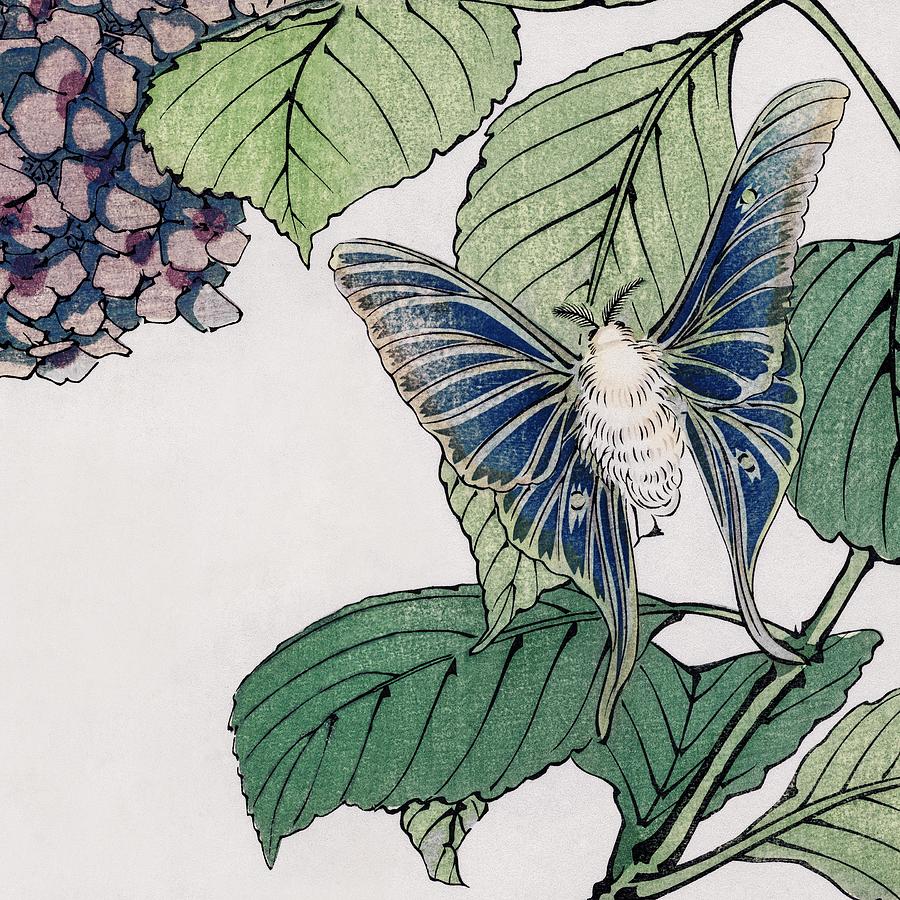
George Klacsanzky’s moth

touching
the dead moth
it flies away

George Klacsanzky (1956-2003)  
(published in Yanty’s Butterfly: Haiku Nook: An Anthology (2016))

Brevity, simplicity, and honesty always reflect in George’s haiku. Every time I write about his poems, I see a new aspect of his life that helps me know more about this great haiku poet. 


The opening line ‘touching’ pauses the moment and lets the readers feel the resonance of this sense and its subtlety. It also suggests how hard it is to focus on nuances of life but when one does, there is an element of surprise in them. In this haiku, the writer shares the concept of seeing beyond sight where even stillness looks moving. The dead moth presents the depth of life, the transformation of life, that one cannot see but feel through one’s third eye or insight and once one does, miracles happen and thoughts get transformed into wisdom and reveal the secrets of life that are long-lasting. Somehow, there are shades of mysticism that make this haiku more open to the concept of life in death.

Hifsa Ashraf (Pakistan)

I love this haiku. The first word that comes to mind is resurrection: something seemingly dead is brought back to life. The moth flying away could be a metaphor for rejuvenation within a relationship or your own self. Maybe an old hobby is given attention again. Or, maybe a neglected house is being remodeled. Something seemingly dead is given new life. George’s haiku reminds us that what appears to be motionless or dead could be only an appearance; it speaks to how subtle life can be. Maybe the moth was sleeping? Maybe it was just resting. But through his touch, by making a connection with the moth, it seems to move on to the next stage of its life.

This could apply to humans too: when someone genuinely reaches out and touches us in some way, we are often sparked with a new energy that makes us feel fresh and alive. Like making a new friend, this connection helps us grow and evolve in the next stages of our lives. The vision of the moth flying away also gives me a feeling of liberation and transcendence. Just like a butterfly, moths go through the process of metamorphosis—a process that we as humans may go through as well. A beautiful haiku. This haiku is one of my all-time favorites.

Jacob Salzer (USA)

Hifsa and Jacob have brought up great points in terms of meaning and substance. I’ll take a look at the more technical aspects of this haiku.

One can say the kigo of this haiku is summer. Traditionally in Japan, moths are a seasonal reference for summer. That may not be the case in Seattle, Washington where this poem was written though. However, as this poet’s son and growing up in Seattle, I can say that moths do come out quite a bit in the summer in the Pacific Northwest.

But the second half of the haiku seems to relate more to spring, with the theme of resurrection, as Jacob pointed out. Moths come out in sizable numbers in spring in Seattle as well. So, “moth” as a seasonal word can relate to the content directly.

I also wanted to point out the sense of sound, with the powerful music of “o” in the first two lines and the lack of “o” in the last line. This creates a stronger sense of the starkness of the moment described.

As Hifsa said, my father focused a lot on brevity. With only seven words, every word counts and shines through. It is said that only geniuses can explain complicated concepts in simple terms. I think that is the art of the haiku poet.

A haiku that is at once mundane and supernatural, and melancholic and awe-inspiring.

Nicholas Klacsanzky (USA)

By Cozy Guru

George Klacsanzky’s glasses

my glasses missing
I see impressionistic
paintings all day

George Klacsanzky (1956-2003)  (USA/Hungary)

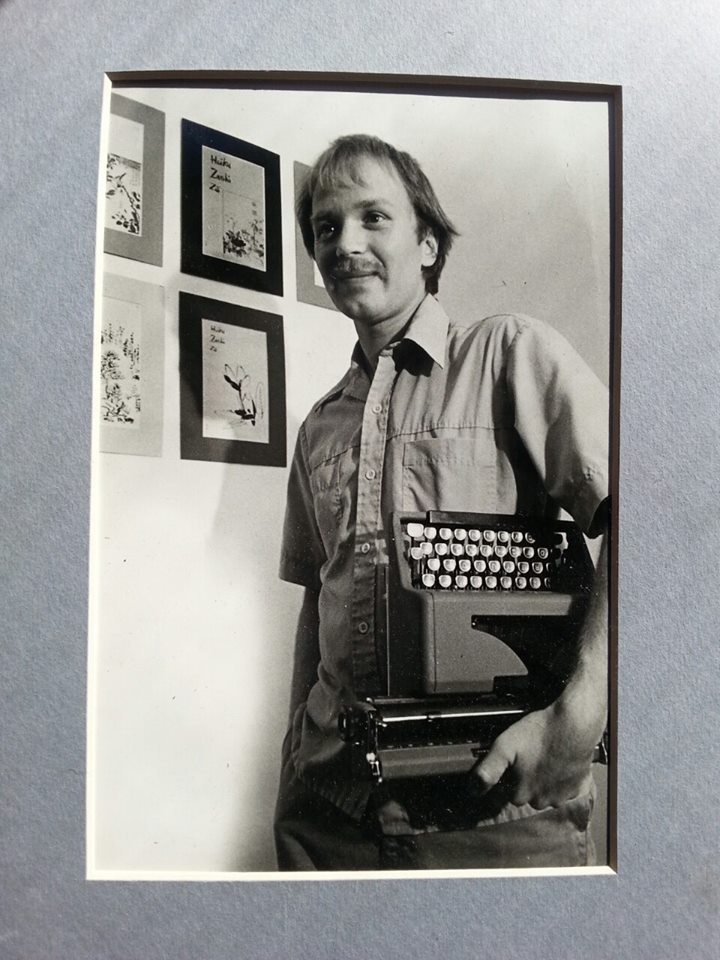
George Klacsanzky with his typewriter and issues of his journal “Haiku Zasshi Zo”

I appreciate George’s insight into sight itself. How many of us take vision for granted? The saying “Beauty is in the eye of the beholder” comes to mind when reading this haiku. I also like his sense of humor in “my glasses missing.” It seems some people have become numb to modern-day conveniences and items we use daily. But when a useful item goes missing, like glasses, then it seems we regain an appreciation for it and no longer take it for granted. In this way, George’s haiku could point to experiencing life without conveniences but also gently reminds us to not take things for granted. A beautiful haiku.

Jacob Salzer (USA)

First of all, it is a great honour for me to write commentary on this brilliant haiku of George Klacsanzky. He is truly a great and inspirational haiku poet.

The opening line gives an impression of a person’s view of the world without any artificial sight. It reflects the genuine connection of a person with nature or their surroundings where they enjoy nature or any imagery without any barrier (glasses) by using their insight or perception. I love the use of the word ‘impressionistic’ which conveys a strong image of what the person is viewing. It may also be a vivid memory that a person is cherishing or reminiscing about. There can be various interpretations of ‘paintings all day’. A person may be seeking solace in nature, their surroundings, a memory, or they are enjoying the deep elements of an image with the help of insight’s lens through daydreaming.

Hifsa Ashraf (Pakistan)

My father, George Klacsanzky, wore thick glasses. I think if he took them off or lost them, he would be seeing the world as if it was an impressionistic painting. But I think besides the humor in this haiku, I believe my father was expressing the fact that our experience as human beings is based on our subjective sensorial perception. Though our sense organs are tangible, the results they produce are variable and depend on each individual’s facilities. In a way, it seems my father was pointing to the illusion of our so-called reality.

I enjoy how the second line has enjambment. It is a witty line break that sets up a surprise in the last line. In terms of sound, it appears that the letter “s” takes the cake. From this string of “s” sounds, I can hear a paintbrush against a canvas. The letter “l” is also employed well, which gives the reading a more weighted feeling, in my opinion.

Another haiku by my father that on the face seems to be only comical but has deep philosophical undertones.

Nicholas Klacsanzky (USA)

George Klacsanzky’s Seagull

dead seagull
on the beach—eyes still
looking for fish

Haiku Zasshi Zo (winter/spring, 1988)

© George Klacsanzky (USA)  (1956-2003)
George Klacsanzky has captured a moment that is hard to forget. When applied to our human lives, this haiku conjures up subtle feelings of devotion. Even after the passing of the seagull, the continuous desire for fish lives on.

There is also a double meaning in “eyes still”: the eyes are actually not moving, yet it also implies the continuation of looking. In that light, through the eyes of a neuroscientist, even at the time of human death, there is still 6 to 12 minutes of brain activity. Additionally, a dream second is infinitely longer than a waking second. This allows the reader to contemplate the sheer possibility that a seagull can still have brain activity and look for fish in a dream, even though (through our human eyes), it is clearly dead on the beach.

The pause in the second line achieved through the dash allows the reader to effectively contemplate the 2 parts of the haiku, without creating too much distance between them.

This haiku ultimately sparks conversation about life, death, and dreams. At the time of death, what will we see? What desires will remain in the mind? Will we simply enter a dream world fabricated by thoughts? Will the seagull enter a dream where he/she continues to look for fish? George Klacsanzky’s haiku urges us to ask ourselves what is most important to us in this lifetime, and what will remain within us when we take our last breath.

– Jacob Salzer (USA)