Haiku by Goran Gatalica, Manoj Sharma, and Jennifer Gurney

between the hills
blown away like the seeds
a shepherd’s song


Goran Gatalica (Croatia)
Basho-an Award, The 6th Basho-an International English Haiku Competition, 2023

Commentary from Jacob D. Salzer:

A powerful haiku that includes multiple senses. There are four images in this haiku (the hills, the seeds, the shepherd, and the sheep). There are two sounds (the wind and the shepherd’s song), and there is a silence in the seeds, hills, and sheep, and in the shepherd, especially after the song is over.

In the first line, cemeteries are sometimes found on hills. This potential reference to death contrasts with the seeds symbolizing birth, although I actually see cycles of life and death vs. a stark contrast. 

In terms of sound, it’s interesting to note how the shepherd’s song travels farther between the hills. I can hear the song in the wind, which adds sonic depth. The sonic quality of “b” and “ee” seems to create an eerie feeling, while “away” and “song” seem to support a feeling of longing. I also usually see wind as a reference to a passing soul or souls. When we pass away, what seeds do we want to leave behind? The seeds could even be seen as seeds of karma, which implies the cycles of life and death and reincarnation.

The common definition of a shepherd is: (1) One who herds, guards, and tends sheep. However, a second definition is: (2) One who cares for and guides a group of people, as a minister or teacher. This second definition adds another layer to this haiku. Is the shepherd teaching a group of people through a song? What does the shepherd’s song sound like? Is it a spiritual song or a religious hymn? There is an inclination that this is an old song passed down through several generations. However, it could also be a new song. What are the lyrics? Where did this song come from? And what does it mean? The shepherd’s song could be one of hope, as seeds can be symbols of hope. However, the seeds may have been carried too far by the wind and perhaps didn’t land in healthy soil. In that case, perhaps this is a song of both hope and sorrow. Indeed, the words “blown away” seem to contain a clear sense of melancholy. There is also a sense of deep time in this haiku, as the hills are ancient.

In short, this is an interesting haiku that can be read from different perspectives. It is a deep and thoughtful haiku that asks us to consider our place on Earth, our ancestors, and Divinity. This haiku also asks us to contemplate our souls, our brief lives on Earth, and the afterlife.

looking back
at my younger self. . .
sun-kissed mangoes


Manoj Sharma (Nepal)
Modern Haiku 55.2 : Summer 2024

Commentary from Hifsa Ashraf:

We cherish and miss our youth the most because it is full of adventures. I can feel this kind of youth in this haiku. The person is reminiscing about being young—the phase of life where one usually has the energy and freedom to do the things one wants. The narrator seems to be old enough that he finds it difficult to move on and reminisce about a time in his life that was opposite to his current self. So, in line one, looking back is not simply the remembrance of youth but also wishing to have the same energies or seeking solace in youth.

The second line ‘at my younger self’ with ellipses makes us pause for a while by asking some questions i.e. is this a photo or portrait, is he looking at a reflection in a mirror or in the water? A vivid memory? It seems the person is going through a transformation i.e. from middle adulthood to late adulthood. It is the most difficult time especially when one feels it mentally, physically, emotionally, and psychologically. It seems as if one self is departing and replacing another one, which is probably feeble. 

The last line in this haiku is really interesting and makes it more dynamic. Sun-kissed mangoes are definitely a beautiful analogy to the time of youth when mangoes not only ripen in the sun but also have their best taste. It shows how a youthful life flows like pulpy and juicy mangoes, which are sweet and provide energy. Sun-kissed mangoes as a kigo also show the beauty, care, and connection of nature with different phases of our lives. On the other hand, I see it as a very romantic and loving expression where a person fully enjoys one’s youth being surrounded by loved ones and expresses their feelings fully. 

your ratty sneakers
hanging out in the garage
as if you’re still here


Jennifer Gurney (USA)
Five Fleas, March 17, 2025

Commentary from Nicholas Klacsanzky:

Having had several close members of my family pass away, this haiku resonates with me. It can connect with many readers, as the circumstance described is commonplace yet emotionally potent. The “ratty sneakers” become alive, serving in stead of the deceased (or possibly distant) important person. They transform into a representation of the mystery individual or even an independent entity that takes on a life of its own. There is also an irony in ratty sneakers becoming so poignant. It demonstrates that with emotional weight, any object can be of significance. This relates to the Japanese aesthetic concept of aware, which denotes how a physical object can trigger a personal or spiritual response.

The writing style of the haiku is extremely relaxed and natural. I believe this is what the great master Basho advocated for with his concept karumi. There is no particular kigo or seasonal reference. However, the poet may have been aiming more for a senryu or simply did not see the importance of adding a kigo. Either way, the poem does well with the subject matter and descriptions, giving us just enough for us to imagine and feel deeply.

The pace of the poem approximates the traditional Japanese haiku rhythm, which comes out to a short first line, a longer second line, and a short third line in English. The effectiveness of the haiku/senryu also is seen in its conciseness, with no word out of place. Finally, the sound of the poem propels its atmosphere further. I especially enjoy the “r” sounds, which provide weight, and the letter “s” which appears to slow down the reading so we can take in the poem better.

This is a poem that looks like it was written with the utmost ease yet it has several layers of meaning and feeling. Most importantly, it can easily connect to readers and move them to memories of loved ones and the power of objects that surround us.

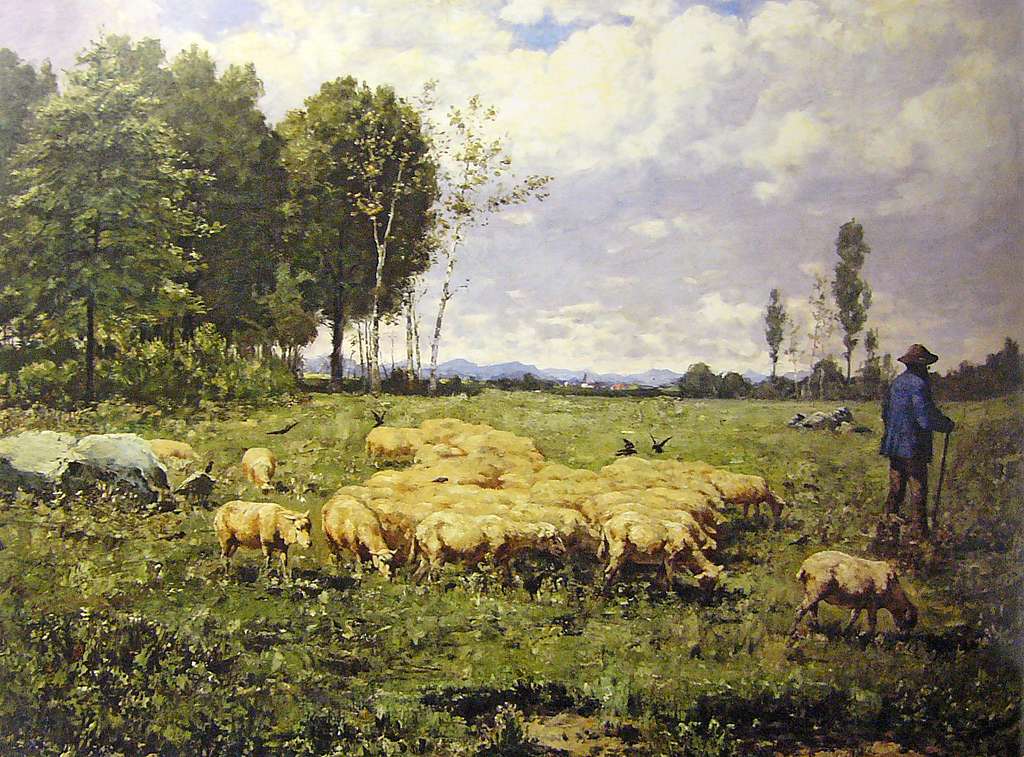
“The Shepard,” a painting by Alexander Roche (1861-1921)

Goran Gatalica’s glint

daughter’s wedding —
glinting in moonlight
the first snowflakes

Goran Gatalica (Croatia)
(published in The Mainichi, 1/13/2021)

The haiku starts with one of the most precious and emotional days of a person’s life. The festivity, reunion, laughter, and collectivity at a daughter’s wedding may not surpass the deep feelings that are contrary to the celebrations, as it’s a day of departure as well. The subtlety of a parent’s feelings is well interwoven with the weather outside. The first snowflakes are light in weight but still leave behind heavy hearts due to old or new memories—particularly the memories of loved ones that glint or get highlighted in the moonlight where a person, especially parents, reminisce about those memories near the window or fireplace. The winter hush usually brings to the surface feelings of special days and it seems time slows down like a flurry of snowflakes that takes its time before finally touching the ground.

The em dash in the first line pauses one’s thoughts and feelings to imagine the whole scene of the wedding day. I loved the way the writer linked this special event with the subtlety of moonlight and the silence of snowflakes.

Hifsa Ashraf (Pakistan)

Written from the perspective of a mother or father, I immediately feel the special connection between the parent and daughter in this haiku. This allows me to step into the parent’s shoes and reflect on the long journey it took to arrive at this moment. 

I think the juxtaposition between the daughter’s presumably white wedding dress and moonlit snowflakes is a stark comparison, showing the fragile, delicate nature of a marriage, yet also its beauty. I see her wedding dress made of delicate patterns that are interwoven, just as so many lives have been interwoven in the daughter’s life that has led her to this significant event.

The connection between women and the moon is well-known with a long history, stretching back to ancient indigenous cultures on this Earth. In that light, it seems the moon in this haiku connects the daughter with past generations of women and her family lineage. I like how the moon in this haiku links to the mysteries of women and the cycles of life. In a more spiritual sense, during a reverential moment, I can see the daughter’s mind becoming quiet and reflecting a kind of hidden inner light, just as the moon reflects sunlight in silence. It’s interesting to note the daughter’s wedding has continued into the evening hours. I normally associate weddings as a daytime event, but I like how it seems the celebration started in the day and has continued into the evening. I feel this depicts a more romantic and mystical atmosphere. 

In the last line, I like how the first snowflakes mark new beginnings, as the newlywed couple starts their journey together. At the same time, I like how snowflakes mark the eventual depth of snow over time, and the depth of the relationship, that ultimately, will seemingly melt and evaporate, “’till death do us part” or perhaps the couple will eventually be reincarnated and meet in another life or in another dimension. Either way, juxtaposing snowflakes with marriage allows me to reflect on the nature of marriage, our human impermanence, and the importance of a spiritual dimension in a partner relationship.  

Finally, I like the implied contrast of warmth and coldness in this haiku, and the contrast of darkness and light. I can feel the warmth of people, the glow of lights, and a hopeful, uplifting atmosphere at this wedding, despite the cold, dark night. A beautiful, touching haiku. 

Jacob Salzer (USA)

Hifsa and Jacob went into great detail about the subject of this haiku and its symbolism. I want to provide a bit more technical insight.

I enjoy and respect that the poet used an em dash in the first dash to make the two parts of the haiku distinct. Without it, the second line would act as a pivot, which might not have made sense in this instance.

The length of the lines is in the common range for English-language haiku. Brevity was employed well. The pace and flow of the haiku are smooth, and mirror the original pace of Japanese haiku appropriately.

We have a definite kigo with “first snowflakes,” placing the haiku in early winter. The comparison between such a jovial time as a daughter’s wedding and the enchantment of seeing the first snowflakes is poignant.

The haiku is quite vivid, with the imagery of moonlight on snowflakes, and them glinting during a wedding. There is a lot to imagine for the reader, and that is always a plus. Moods of mirth, eeriness (moonlight), wonder, and more are here.

In terms of sound, I can say that the letter “t” holds sway. With five appearances, and perhaps a semi-appearance of it in “wedding,” I can feel the classiness and tenderness of the event.

It is a fine haiku that illustrates the power of humanity’s connection with nature and vice versa.

Nicholas Klacsanzky (USA)

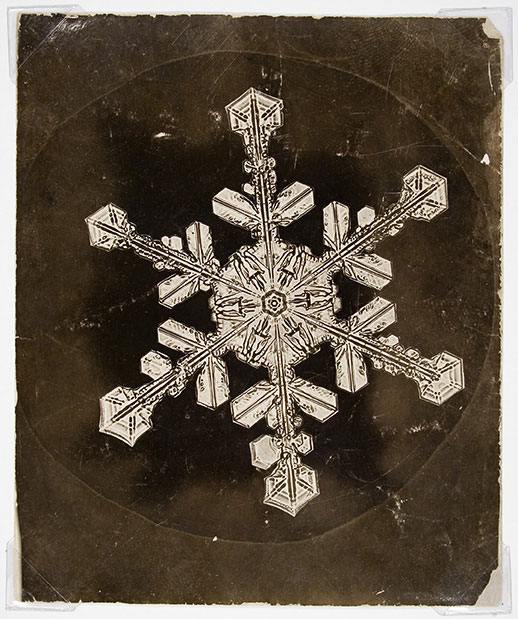
Photograph by Wilson Bentley

Goran Gatalica’s Tadpoles

starlight —
the tadpoles vanish
in a blurry pond

Goran Gatalica (Croatia)

Under the Basho, (modern haiku), March 2019

This haiku resonates with the things that don’t get a lot of importance in our lives. The opening line ‘starlight’ symbolizes two aspects in the context of this poem.

– It glows but remains unnoticed, especially when the stars are far away from the earth.

– A light dot that is mysterious in many ways.

The tadpoles depict the initial stages of life when things remain insignificant and mysterious, like the tiny stars that are in fact huge.

The blurry pond may symbolize our limited vision and perception of not seeing things beyond their looks. We don’t go into the depth of things that look small in shape and size.

The starlight and tadpoles in a blurry pond lose their impact and significance once they lose their reflection.

Hifsa Ashraf (Pakistan)

This is one of those haiku that takes us by surprise with its juxtaposition. At first, we might be puzzled by the comparison or contrast being made.

Starlight can take many light years to travel into our view. Also, if we look directly at a distant star, due to it being so far and surrounded by darkness, it can escape our vision after a while.

This all might relate to tadpoles vanishing in a blurry pond. Tadpoles are very small and are hard to spot in a body of water, like stars in the sky. We can easily lose track of them. Plus, the next time we see the tadpoles that we saw before, they might have grown up as a frog or toad. This length of time connects to the duration it takes starlight to travel into our perception.

In another way, the haiku could be presenting a contrast. Tadpoles are larvae and new to life, whereas starlight may be luminescence from a star that has already died. Yet, the shape of a tadpole and starlight are very similar. So, the aesthetic of “as above, so below” in Japanese poetry is demonstrated.

There is a lot of sound in this poem to notice, though it is small. Check out how each line has “l” sounds. There is also a prevalence of “r”s and “p”s. Not only does this make the haiku more musical and a joy to read, but these consonants give the reading more weight.

The format works well, which has the standard pacing of English-language haiku. The dash in the first line gives a clear cut between the two parts of the poem, allowing the reader to easily see a juxtaposition is being made.

Overall, this is a subtle haiku that can swing from being a comparison to contrast in imagery, which can bring about the feeling of connection between mundane life and the cosmos.

Nicholas Klacsanzky (USA)

If you enjoyed this haiku and commentary, let us know in the comments.

gieorgia-night-sky

– “Starlight Night” by Georgia O’Keeffe