Sydell Rosenberg’s Feather

in a toyless cage
the parakeet discovers
a feather to twirl
02

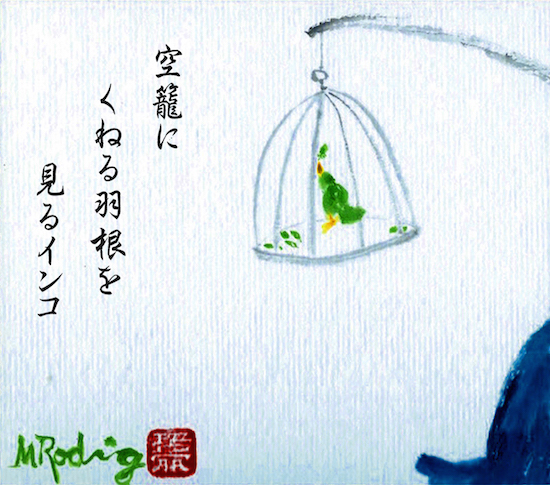
Haiku by Sydell Rosenberg (USA) (1929-1996), art by Mary E. Rodning (USA), and translation into Japanese and calligraphy by Hiromi Inoue (Japan).

A nice collaboration (I do not know or read Japanese, so I don’t know about it, other than the looks of the writing is aesthetically pleasing). The crueltyI suppose it is unintentionalof a captive spirit is stated matter of factly. It is a powerful piece. The three elements work well together, but the haiku easily stands alone.

– Dana Grover (USA)

This is powerfully sad and shows how pathetic it is to capture a free spirit (wild bird) and keep it prisoner in a cage. I find that objectionable. The feather seems to symbolise the loneliness of the bird.

– Martha Magenta (UK)

To me, it shows desperation with ingenuity and intelligence of a captured being, but do animals have emotions such as being bored? This is a debate that’s been going on for a long time. I noticed that this was written in the 5-7-5 format and I can imagine the difficulty of writing the first line without telling too much, which to me it does.

Since the image already shows a cage why not emphasize it and not repeat what’s already shown?

Ex:

toyless prisoner
the parakeet discovers
a feather to twirl

Just thinking of the possibilities, where I could be wrong as well. My 2 cents disclaimer.

– Fractled (USA)

Wow. I think it’s very potent. To me, it speaks clear of how horribly sad and senseless it is to confine another being created to be wild and free. I can only hope it conveys the message to others on how very wrong and inhumane imprisoning a fellow earthling is, along with the selfishness and cruelty of it.

– Michelle Hyatt (Canada)

L1 might work better without “in a” since “parakeet” and
“cage” suggest being within.

– Edwin Lomere (USA)

I think the poem is quite strong. It oscillates nicely between a theme of making the most of what you’ve got (“a feather to twirl”), and one of being trapped with little available to you (“a toyless cage”).

– Dave Read (Canada)

Wow… I have mixed feelings regarding this particular haiku, but the intention to convey loneliness is stark and well-taken. First, it saddens me that the little fellow doesn’t have any material/objects to keep itself occupied and happy while being confined.

You see, I have an African Grey that never knew of being in the wild, (I spoon-fed her during infancy) but she escaped twiceonce in Maryland and another time in Georgia. One of her phrases is, ‘Help me.” In her last escape, she stayed away for about a week (I forgot the exact time frame).

She ( Lilo) ended up flying onto a gentleman’s lap as he and his brother were chatting in an open garage. Because of posting Lilo’s description/markings and behaviour patterns in a nearby pet store, I was blessed to have her returned to me. She has a 6-foot cage, several toys, eats fresh fruit and seeds daily (she growls at vegetables) and is rarely confined. At this time in my life, I can’t imagine not having her as my companion (she can live up to 60 years+).

I have spoken with many people, including friends, who believe birds should be free. Well, I must say horses should be free too. :)

Many animals can be domesticated. More importantly, to me, they should be treated with as much kindness as the next person. I have to admit most of my friends have 4-legged pets. It just so happened a little bird who truly talks to me became my best friend. That is not to say I’m not fond of felines & canines as well.

– Lovette Carter (traveler)

Since the haiku portion of the haiga has been commented on at length, I will do my best to discuss the art.

The white between the words and the cage, to me, portrays the loneliness the parakeet is feeling.

Most of the color is used on the bird itself, while the cage and the cage’s stand is painted lightly. This allows the viewer to focus on the bird as the main subject and see that with the play with the feather, the bird is perhaps drawn away from its loneliness. Even the poet’s name is written in green, which could point to the parakeet being a metaphor for the poet’s life.

At the bottom right, there is what appears to be a dark blue chair, which is an appropriate color for sadness.

Though simple, the emotions of the haiku runs through the art, and perhaps gives a glimpse into the true feelings of the poet.

– Nicholas Klacsanzky (Ukraine)

What do you think or feel about this haiga? Let us know in the comments.
Kaji Aso’s Dancing Crabs

crabs

dance crabs
under the full moon
until you become a skeleton

© Kaji Aso (1936-2006) (Japan)

Before discussing this haiga (art plus poetry), I will supply some biographical information about the artist and poet.

Kaji Aso was born in Tokyo, Japan in 1936. He received an BFA in Painting and MFA in Printmaking at the Tokyo University of Art. But he was not only an artist; he was also a teacher, singer, adventurer, poet, and philosopher. All those who speak of Kaji Aso use the words “renaissance man” to capture his many accomplishments and his boundless spirit.

In 1972, he founded the Kaji Aso Studio Institute for the Arts in Boston, MA. Here he brought together Japanese and western culture: visual art, music, poetry, philosophy, theater, and good food. He also designed and built the first Japanese teahouse in Boston, where he presided as tea master. For thirty-three years, Kaji Aso was also a professor at the School of the Museum of Fine Arts, Boston. His art is part of the permanent collections of many museums around the world, including the Museum of Fine Arts, Boston; the National Museum of Modern Art, Tokyo;  the Museum of Modern Art, NY; National Museum of Czechoslovakia;  the State Pushkin Museum, Moscow and Padua Museum of Fine Arts, Italy. Thirteen of his works are registered as Japanese National Properties.

As a talented tenor, Kaji Aso performed opera and Italian and Japanese songs. He ran in thirty-six Boston Marathons and led kayak expeditions down some of the longest rivers in the world including the Mississippi, the Nile, and the Volga.

Although haiku was just one of his many special gifts, Kaji Aso very often expressed the wisdom of his beliefs in haiku and did a lot of haiku illustrations. He organized and took an active part in many seminars and lectures about Japanese art, haiku, sumi painting and calligraphy. With countless awards and publications attributed to him, he can be rightly called a legend. [Adapted from The Living Haiku Anthology]

Commentary

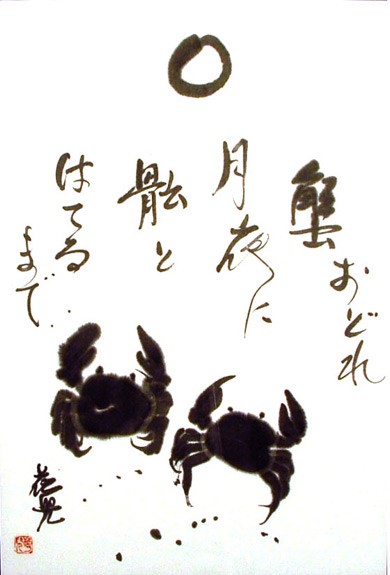
In the art, we can notice the moon at the top, with the haiku written in an accented way to take in the haiku slowly. The crabs below the haiku are shown dancing by the dots below them. This type of painting is not exacting, but rather an approach is taken to capture the spirit of what is seen. This relates to wabi-sabi, allowing imperfections to be and seeing the beauty in them. Sumi art is more of a sketch of life, rather than an exact showcasing of it.

Though the art seems simple, we can get a poignant feeling from it. I perceive joy and austerity in the blots and lines of the ink. It gives off vibrations of spirituality, but also a pure simplicity that makes one joyful when viewing it.

The feeling the art exudes compliments the mood of the haiku. Though the art does not show the crabs as skeletons, it shows their dancing and allows us to feel the mysticism of the haiku more.

In terms of the haiku, each line is striking and wakes one up to the moment. Though the haiku can be taken literally, I believe it has a spiritual mood.

Crabs are a reference to different seasons, but most commonly, they reference summer. It would make sense that they would be dancing if it is summer.

The full moon has so much symbolism in Japan that it is hard to define it in a few short lines. But the full moon can mean complete enlightenment, the absolute truth, and even specific mystical beings. In the context of this haiku, I feel the full moon is in a sense luring the crabs into a mystical experience, and that the poet suggests the crabs to give up the attachment of their bodies. The poet recognizes the crabs as seekers of truth when they dance under the full moon, and is instructing the crabs as he would students of Zen or other forms of spiritual practices. There is no sense of division of the human and natural world in the mind of the poet.

We get a contrast of the full moon and the skeleton. This juxtaposition, though it seems obvious after a few readings, does not seem apparent quickly. This is because the starkness of the moment described is so strong, that the reader does not consider the aesthetic of it at first.

A masterful haiga by an enormously talented artist and poet.

– Nicholas Klacsanzky (Ukraine)


Momolu Freeman’s Guitar

summer breeze painting my old guitar

16-1

Words and art © Momolu Freeman (USA)

I believe Freeman made the right decision to make this a one liner. When you have too few words, it is often better to make a haiku one line instead of two or three.

For example:

painting
my old guitar
summer breeze

or:

summer breeze
painting
my old guitar

or:

summer breeze
painting my old guitar

… seems to have less impact on the reader and does not look as appealing on the page.

The one line version also encourages readers to see the double meaning easier. It can be read as “summer breeze/painting my old guitar” or without a stop as “summer evening painting my old guitar.” The first one is a contrast/comparison, and the second one is implying the summer breeze is painting the old guitar, either by splashing paint unto the guitar with its force, or by staining the guitar with whatever is in the surroundings. It could also be metaphorical, as the wind could be painting the guitar in an unseen way, painting it with its currents and unseen shapes.

“Summer,” the seasonal reference or kigo, is that of romance, relaxation, joy, but also the burning sun which crumbles crops. This being paired with painting an old guitar is poignant. Indeed, in a summer breeze, we can feel something of memories and the renewal of those memories. Like painting an old guitar, a summer breeze brings many memories back of joy, but also maybe of sadness or reminiscence.

No season is black and white, especially in haiku. Though seasons have themes, each season has counterpoints we can be aware of.

The “r” sound in the haiku gives the effect of wind rustling through trees and maybe the guitar itself. The “i” sound in “painting” and “guitar” seems to give greater emphasis and maybe a sense of the toil in the process of painting a guitar.

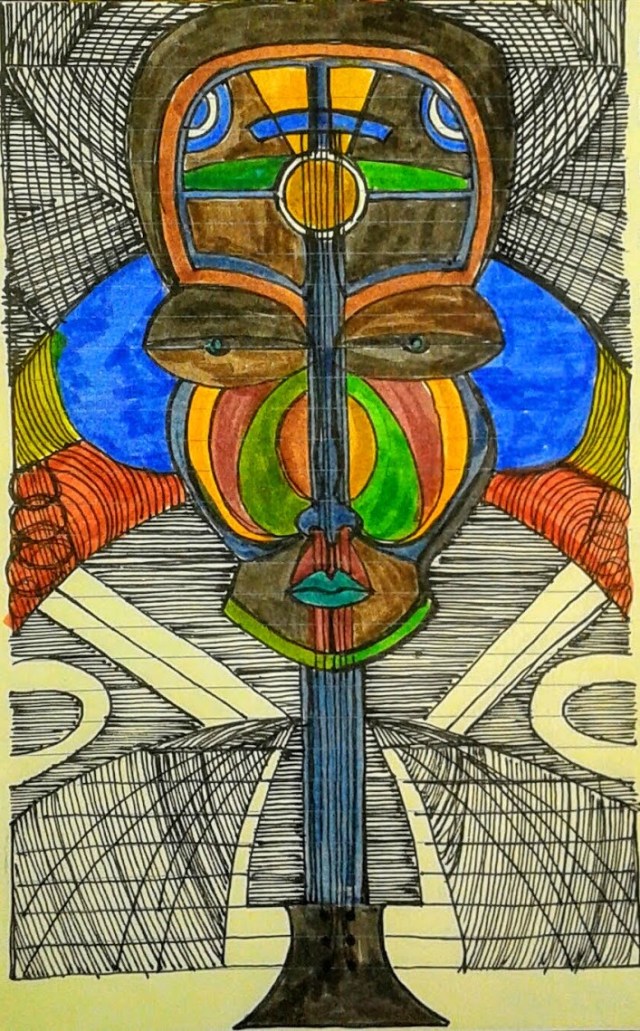
The art gives an indication of the seriousness of the topic as well. The guitar appears to have been given African attributes, and points to African-American tradition in the blues and other music based on the guitar. Though America is a young country in relative terms, the ancient African heritage brought to America by way of slavery has had a profound impact on music, from blues, jazz, rock, funk, soul, disco, house, and much more.

This haiku might be less of pointing towards a personal experience, and more of a collective experience, how Africans are reclaiming their heritage and finding it through the strains and strands of history.

– Nicholas Klacsanzky (Ukraine)