Heike Gewi’s Children

04.08.16 - 1

Words and art © Heike Gewi

With four words, one can find at least four interpretations within the poem. That is one of the magical things about poetry: the line acts as a device for delivering additional meaning.

Interpretation 1: The author is missing her children 24/7.

Interpretation 2: The author’s kids have been missing 24/7.

Interpretation 3: 24/7, the kids are missing something.

Interpretation 4: Time (24/7) is absent, and that is juxtaposed with the kids.

Which interpretation should we take? What is the tone of the haiku with so many interpretations? Those are questions that can’t be answered, but shine a light on how haiku operates.

Through simplicity and implication, authors make readers dive into their own imagination to make up a third part out of the two parts of the haiku that juxtapose each other.

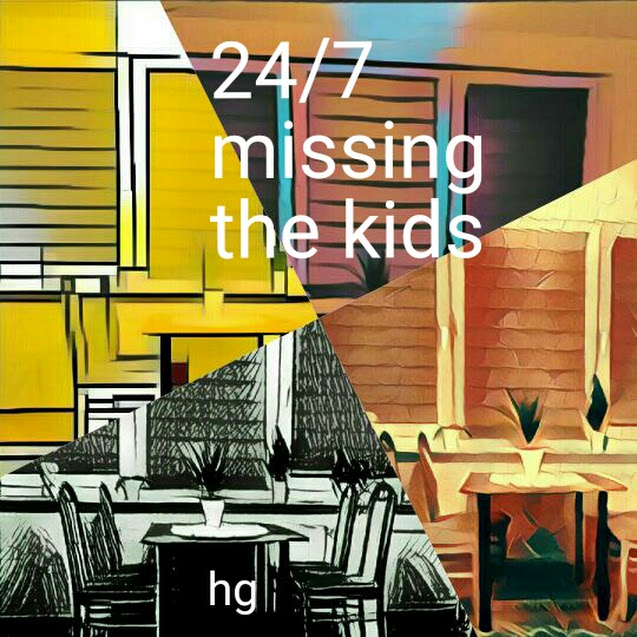
The art accompanying the words show the times of the day in two different locations. The emptiness in each section and the somber lines suggest melancholy.

The “i” sound in “missing” and “kids” gives a sharpness to the reading of it, which makes the apparent emergency more alarming.

The last two lines are of equal length and appear to be stacked on top of each other, which gives the impression to the reader that the poem has more fullness to it than stated in terms of length and exudes a sense of power when you see it.

Though there is no season specifically referenced, autumn comes to mind with “missing” and the mood of the art. But haiku do not need to have seasonal references to be haiku. As long as haiku aesthetics are on display, haiku are haiku. This haiku showcases an aesthetic of loneliness, but maybe not the element of sabi, which is a Japanese aesthetic of loneliness that gives solace to a sorrowful life. However, the potency of the inherent aesthetic is felt poignantly, no matter what interpretation you take.

– Nicholas Klacsanzky (Ukraine)


Rika Inami’s End

when the end
comes upon me ―
sirens blowing
through the darkness
rushes to the fire
© Rika Inami (Japan)
IMG_7618

This self-eulogy is evocative in its simplicity and pacing. There is nothing difficult to understand in this tanka, but the subtle meaning behind it might be.

The end of the tanka is not about her, but about fire, an all-consuming element. I think Rika is expressing that in the end, she will become one with her surroundings, or maybe  she or her life was an illusion all along.

It also seems the author is saying that when her end comes, there will be no use in trying to pity her or get involved in feelings. But rather, the author could be pointing to the problem that made her die in the first place. “Fire” has a lot of symbolism attached to it, such as passion, anger, inspiration, and so on.

With the em dash in the second line, we feel more of her end, as she gives us time to take it in. The em dash might seem unnatural, but for poetry, it totally makes sense to have there. In tanka, we sometimes use punctuation to show two parts more clearly. So, Rika is also demarcating the parts in the tanka.

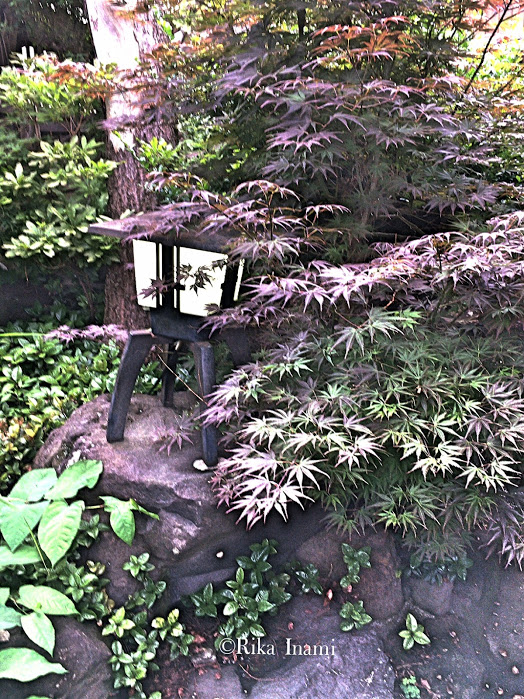
The photo connects indirectly to the tanka wonderfully. The red of the maple leaves shows the fire and the latern is similar to a siren light.

The most prominent sound to me in this tanka is the “o” sound in “comes,” “upon,” “blowing,” “through” and “to.” It gives an effect of a suspension of time and makes us read the poem slower.

A humble poem about one’s death, written in a simple style. But that is just the surface. I think this tanka brings up a lot of symbolism and thoughts about the reality/illusion of life, where we go when we die, and what we are meant for in the end.

– Nicholas Klacsanzky (Ukraine)

Yumino Aoiro’s Cicada

05 - 1

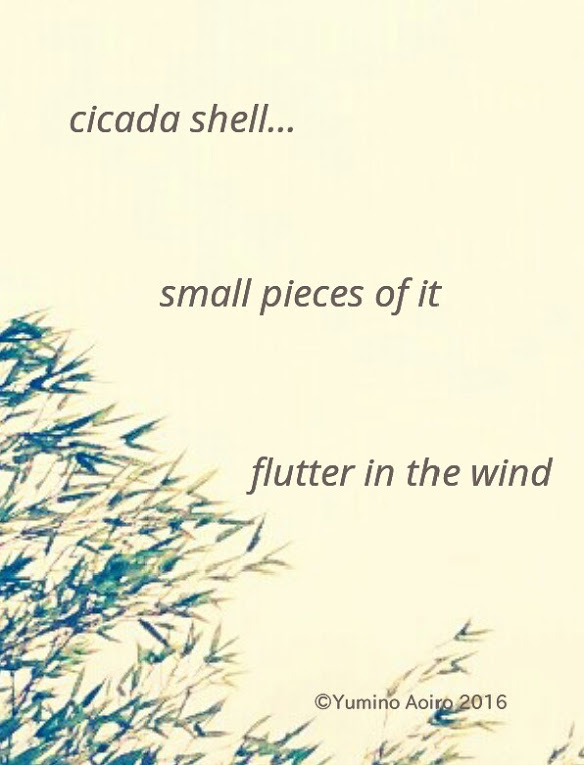
In this haiku, we have a classic aesthetic showcased: continuance. With the first line, we understand that the cicada has moved out of its larva shell, but what happens after…

Its shell flutters in the wind, almost like its real self, now flying through the air–only for a short time though. The short-lived nature of both the fluttering shell and the cicada itself is poignantly shown in one’s imagination. Though the shell is living a new, “full” life of a cicada by flying in the air (even fluttering like wings), that life will end too soon.

The ellipses is used well to show the continuation of the shell and to make the two parts in the haiku clear. The lines are short and the words are not complicated, which is important in haiku. Also, both parts are easy to understand.

This haiku is a sketch from life, of which master haiku poet Shiki championed. Something simple, objective, and in the moment is celebrated and focused on with a sense of awe.

The alliteration of “shell” and “small” emphasize the importance of these words, and the “i” sound carried through the poem in “cicada” “pieces” “it” “in” and “wind” gives this haiku a sense of sharpness.

The art, what I presume to be bamboo leaves, resemble the shape of the fluttering wings of a cicada well and create a definite mood. How the lines are laid out on the page show a continuation as well.

Yumino seemed to put a lot of thought behind the words and image of this haiku. A great haiku with much to think about and to feel.

– Nicholas Klacsanzky (Ukraine)