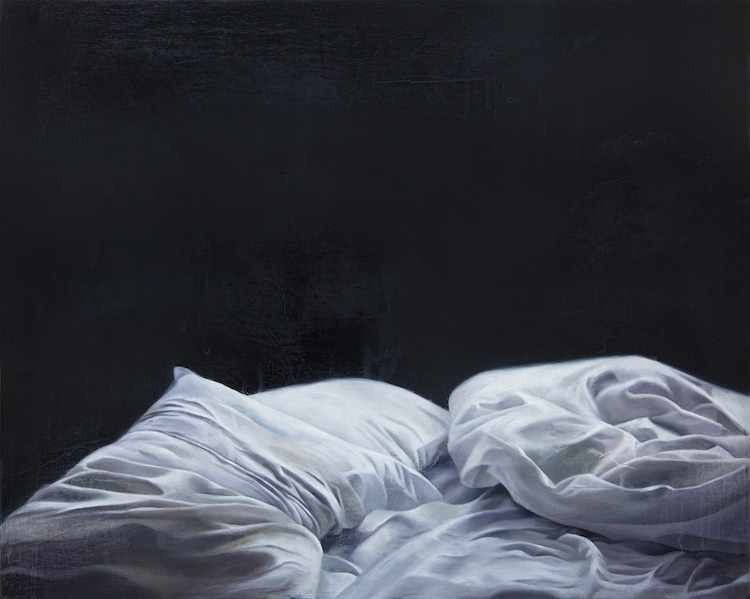
Jay Friedenberg’s fading dream

fading dream
the shape of her curve
in empty sheets

Jay Friedenberg (USA)

Melancholy is the first impression (pun intended) I get from this poem. The impression of this woman’s body on the bedsheets seems to point to a relationship that has ended or is ending. I get the feeling this woman got up early in the morning before the poet did and left without a sound. There is some mystery as to why she left. There is also a mystery as to what the dream entailed. Did the author have a dream of raising a family with this woman? Did the poet have a dream that the woman had no interest in? Or did she leave for other reasons and the poet’s dream is left unsaid? The poet did a good job leaving room for the reader to enter the poem. 

Specifically, the words “fading” and “empty” carry a heavy emotional weight in this poem.

Sometimes it seems someone’s silence (or absence) can speak louder than words. This poem sparks a conversation about what dreams we can have with a partner and perhaps what dreams are best to be avoided. I also think this poem could imply the dream(s) we have can adversely affect our relationships and blur our vision without even knowing it. In other words, it seems if someone is preoccupied with (or attached to) his or her own dream (or a vision of what they want a relationship to be), it could narrow their mind and result in negative outcomes. This dream could also be subconsciously influenced by society and mental programming of what is believed to be “normal” in a relationship. For instance, I think of “the American Dream” and honestly wonder what those words mean from person to person. Regardless of our answer, it seems by being attached to a specific dream, we can close the doors to other possibilities with a partner and it seems this can sometimes lead to the end of a relationship.

In short, this is an emotional poem that sparks an important conversation about our values, and encourages us to explore the complex psychology of our relationships and dreams. 

Jacob Salzer (USA)

The mystery in this haiku makes it a manifold poem that is a bit challenging to interpret. This haiku starts with hopelessness where something is slipping out of a person’s hand—a ‘fading dream’. It seems the person yearned for this dream for a long time, held it dearly, strove for it, and longed for it. To see your dream fading in front of you is more like missing a train that goes away in front of your eyes and you can’t stop it or catch it. ‘Fading’ indicates that the dream is still there but not strong enough to be fulfilled, or the person gave up on it which leads to restlessness, anxiety, and frustration, as it can be observed through ‘the shape of her curve’ where she is sleepless and passing through some deep pain left by the dream. ‘Curve’ shows how complicated the situation is where there is nothing straight or clear, making the situation more ambiguous.

‘Empty sheets’ depict loneliness, detachment, and emptiness that a dreamer faces when they can’t fulfill their dreams. This also indicates that the person is fearful and not ready to sleep again to yearn for another dream. The possible white sheets may also allude to a ‘shroud’ where the person metaphorically is thinking to shroud the dream in white sheets before burying it.

Overall, the depth of this haiku makes the reader pause, and explore various dimensions before reaching a conclusion.

Hifsa Ashraf (Pakistan)

Jacob and Hifsa went over the substance and word usage well. I want to cover a bit more of the technical areas of the haiku.

There is not a direct kigo expressed but the word “fading” might refer to autumn. The word “empty,” however, might refer to winter.

In terms of kireji, there is no punctuation marking the separation between the two parts of the haiku. But as with many English-language haiku, a line break is commonly sufficient to show this distinction.

For the format, the length of the lines is standard for English-language haiku, with a short first line, a longer second line, and a short third line.

When looking at the haiku sonically, the “i”, “y”, “ea”, and “ee” sounds in the first and last line adds to the melancholy of the scene.

No word used is excessive and overall this haiku is concise. It is written in a simple, natural style that is a hallmark of fine haiku.

Nicholas Klacsanzky (USA)

Painting by Stephanie Serpick

Jay Friedenberg’s soap bubble

children’s laughter
the iridescent sheen
of a soap bubble

Jay Friedenberg (USA)

There is a mixture of emotions that can be found in this haiku. You have children’s laughter and brightness, which are associated with happiness and positivity. However, the mention of a soap bubble supplies an added perspective. The ethereal nature of a soap bubble lends to thoughts of sadness and the limits innocence’s longevity.

This relates to the Japanese aesthetic of “fūryū” which can be described as transitory beauty. Bath time for children is usually playful and memorable. But as an adult, when we see our children enjoying this moment, we may view it with a more introspective eye. We might take note of the transitory nature of childhood innocence and become nostalgic for simpler times.

The word “iridescent” is also important in this haiku. It refers to degrees of luminescence from different angles, and this might point to the fact that the poet is seeing this particular moment from a new view.

There is no kigo, or seasonal reference, mentioned in this haiku, but I would place it in spring. The laughter and joy mixed with melancholic introspection seem appropriate with this season.

Getting more into the technical aspects of this haiku, I think the poet did right by not adding punctuation as a “cutting word” or kireji in the first line. It would have made the first line too long, in my opinion. The length of the lines is standard for English-language haiku, which does its best to follow the go-shichi-go rhythm of Japanese haiku. Also, there is a plenitude of “l”s, “i”s, and “s”s in this poem. Not only does it make it musical, but it adds to the happy but stark nature of this haiku.

Friedenberg, through this poem, has given readers a chance to reflect on their childhood years and to cherish the joy they might have lost. Possibly, this haiku might prompt readers to integrate some of their innocent nature back into their lives. Sometimes we need reminders that life doesn’t always have to be serious. It can be fun and silly, and we can derive happiness from the smallest of things.

Nicholas Klacsanzky (USA)

This beautiful and colorful haiku took me back to my childhood. I started reminiscing about this time of joy and happiness. I can relate to the deep and subtle feelings embedded in the imagery of this haiku that echo back, which creates a soothing impact on the reader’s memory.

In terms of the senses, I can divide this haiku into three parts:

– Line 1 is about hearing children’s laughter

– Line 2 is about seeing the iridescent sheen

– Line 3 could be about touching the soap bubble

Children’s laughter—the sound of a carefree life that starts from our childhood when there is little-to-no sense of responsibility or worldly possessions. The sound of children’s laughter is quite soothing as it has a great impact on the psyche of not only children but also the people who surround them. I take it as laughter therapy that we rarely experience these days but still want to be a part of. Our inner child misses these moments and sometimes, we seek solace in reminiscing about those happy moments that still strike our eardrums softly and make us smile.

The iridescent sheen depicts rainbow colors, the colors of life, and happiness, which connects to laughter. This shows the ‘wholeness’ of life where various colors impact our ‘aura’ and make it beautiful and positive. The sheen is the glow that subtly and miraculously brings light to life, especially in the form of elation and utmost joy. The iridescent sheen also presents hope and positivity in life which helps us to focus on small moments of happiness and the blessings we miss or ignore.

A soap bubble here shows how short our childhood bliss lasts. It also indicates the delicacy and subtlety of moments that we enjoy with our loved ones that unfortunately has a short duration.

Looking at the haiku at a more granular level, as Nicholas said, there are no ellipses in the first line. This makes this poem more open for interpretation and more flexible for enjoying the positive energy that the poet beautifully weaved into it.

To me, this haiku is about gathering our childhood memories related to hearing, seeing, and touching. I loved the way the poet magnified the micro-elements of innocence and positivity, which turned it into a life lesson.

Hifsa Ashraf (Pakistan)

soap bubble painting

— Painting by Vandy Massey