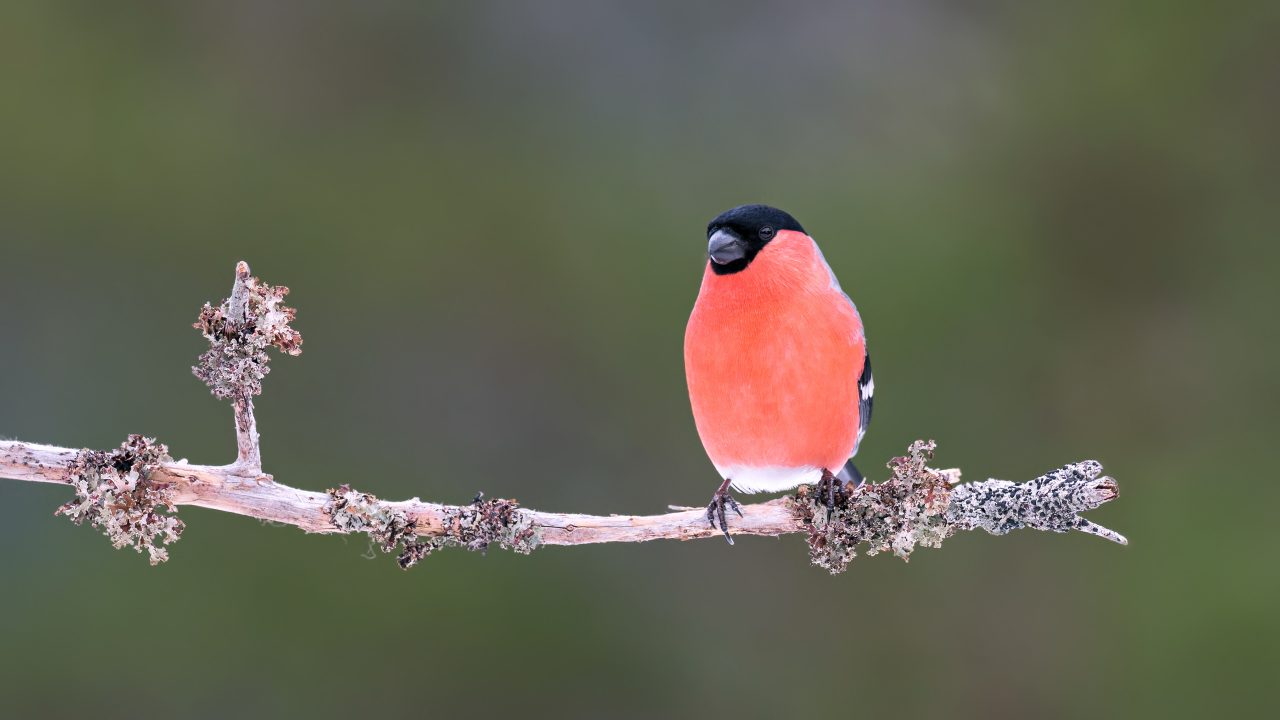
Haiku by Elliot Diamond, Neena Singh, and Jennifer Gurney

the first hole of a shakuhachi dawn 

Elliot Diamond (USA)
Modern Haiku 55.2, 2024

Commentary from Nicholas Klacsanzky:

This haiku succeeds in seamlessly layering sound and imagery to create a spiritual atmosphere. It juxtaposes the shakuhachi—an ancient Japanese bamboo flute—with the unfolding of dawn. The “first hole” can be read both literally, as the finger-hole that allows the first note to emerge, and metaphorically, as an aperture through which the first light of day enters the world. It also could be a symbol of a threshold between silence and sound, darkness and light. The shakuhachi’s connection with Zen practice further shades the image with spiritual awakening: dawn not only as a time of day, but also as a symbol of enlightenment.

The haiku, being one line, creates a representation of the shakuhachi. It could have been written as three lines, such as “dawn/the first hole/of a shakuhachi.” However, I feel the haiku is more organic and interesting as one line.

The diction is minimal, yet the resonance is wide: the reader can hear the first note, feel the cool breeze of dawn, and perhaps see the bamboo hollowed into an instrument. In addition, the phrasing enjoyably blurs instrument and environment. What we’re left with is not just an instrument or a sunrise but a moment of initiation, where time seems to exhale through the flute.

Though there is no kigo or seasonal reference, the time is evident. There is also no kireji or marker for a break, though there can be a natural pause after “shakuhachi.”

Finally, the sound of the haiku works well with the letter “h” being the most prominent. The breathiness of the letter “h” in “hole and “shakuhachi” illustrates blowing into a flute.

Despite the minimalist aesthetic of this haiku, the poet leaves a lot for the reader to ponder and feel through inner vision.

summer solstice
the busker plays
a tune from home


Neena Singh (India)
2nd Prize, Japan Fair Haiku Contest 2025

Commentary from Hifsa Ashraf:

The haiku’s imagery, anchored by the summer solstice kigo, evokes solitude and introspection through a busker’s tune played from home. The solstice’s long daylight amplifies the sense of isolation, yet the music serves as a cathartic bridge to an unseen audience, blending self-fulfillment with a subtle yearning for connection. The summer solstice, with its prolonged daylight, casts a spotlight on the busker’s solitary performance, evoking and highlighting both isolation and self-awareness.  I see the poem as a catharsis and self-awareness where an artist thoroughly enjoys their talent without having an audience or the audience is unseen.

The haiku conveys the busker’s enjoyment of solitude, longing, or melancholy in the deepest way. The poem balances solitude and loneliness, suggesting the busker finds fulfillment in their music while possibly yearning for the connection typically found in public performance. If rooted in a Japanese context, the busker’s solitary tune might reflect a Zen-inspired embrace of the present moment, deepening the poem’s meditative quality. In any case, it is irrelevant to the person who may be in a meditative state of selflessness or enjoying being alone, only with what they enjoy the most. It also makes me wonder: does the poem suggest the busker imagines an audience, or is the music itself a bridge to an abstract sense of connection?
A “tune from home” could imply the busker is playing from within their home, possibly for an unseen audience. However, buskers traditionally perform in public spaces for passersby, so the shift to a private setting might be a deliberate contrast in the poem, symbolizing introspection or a lack of external validation.

Looking at the technical details, the lack of punctuation and the rhythmic ‘m’ sounds mirror the tune’s fluidity, creating a meditative tone that resonates with both the busker’s inner world and the listener’s sense of belonging.

the branches
of my family tree
together

Jennifer Gurney (USA)
Cold Moon Journal, 6/19/25

Commentary from Jacob D. Salzer:

I appreciate how this haiku offers at least a few different interpretations. After the first read, I saw many lives joined through her family heritage. This seems to be a relatively simple metaphor, but it can act as a portal into the details of many family members and their stories. After reading a second time, I saw the branches as fallen and now physically gathered together. This leads to an interesting metaphorical interpretation that perhaps the souls of her family ancestors could be together in a different dimension. After a third reading, I saw the poet viewing a historical family album and/or a historical document/book about her ancestors.

As a creative writing exercise, I recently wrote a letter to my first great-grandfather, who settled in the U.S. I tried my best to transport myself back in time and asked many questions about his life. In addition, my father shared historical records of our ancestors. This has deepened my understanding of our family tree and makes me realize how much has changed in a relatively short amount of time. All this being said, I appreciate how this haiku encourages us to study our genealogy and history to see what we can learn about our ancestors and ourselves.
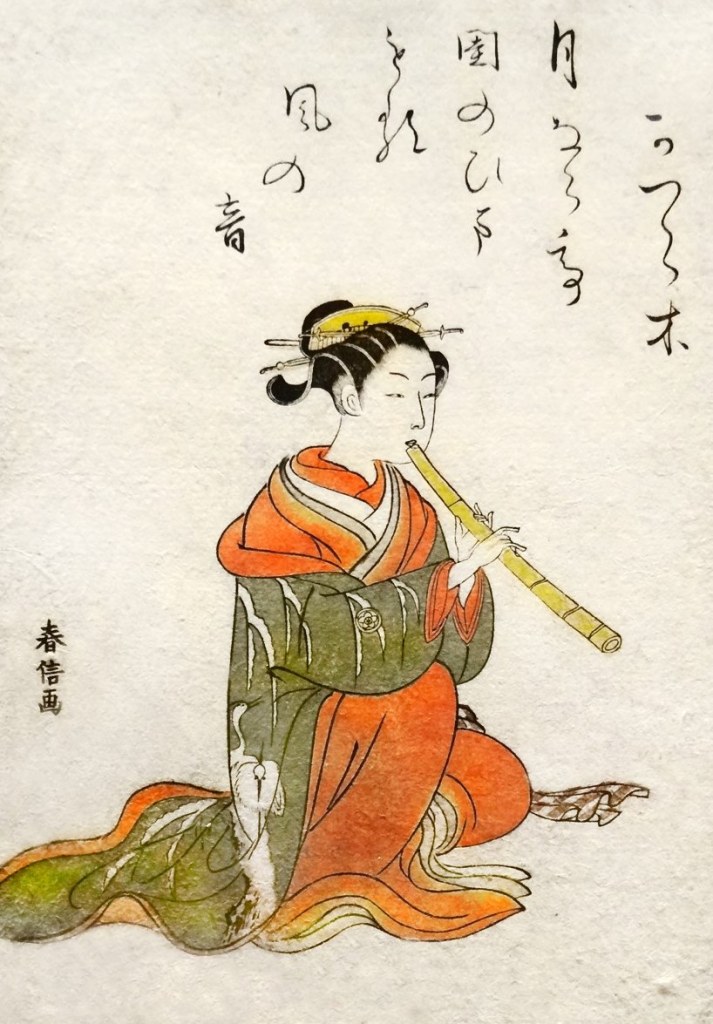
Suzuki Harunobu (circa 1725-1770). Courtesan playing Shakuhachi. Page from: Ehon Seiro Bijin Awase (Picture Book of comparative beauties of teahouses).
Haiku by Goran Gatalica, Manoj Sharma, and Jennifer Gurney

between the hills
blown away like the seeds
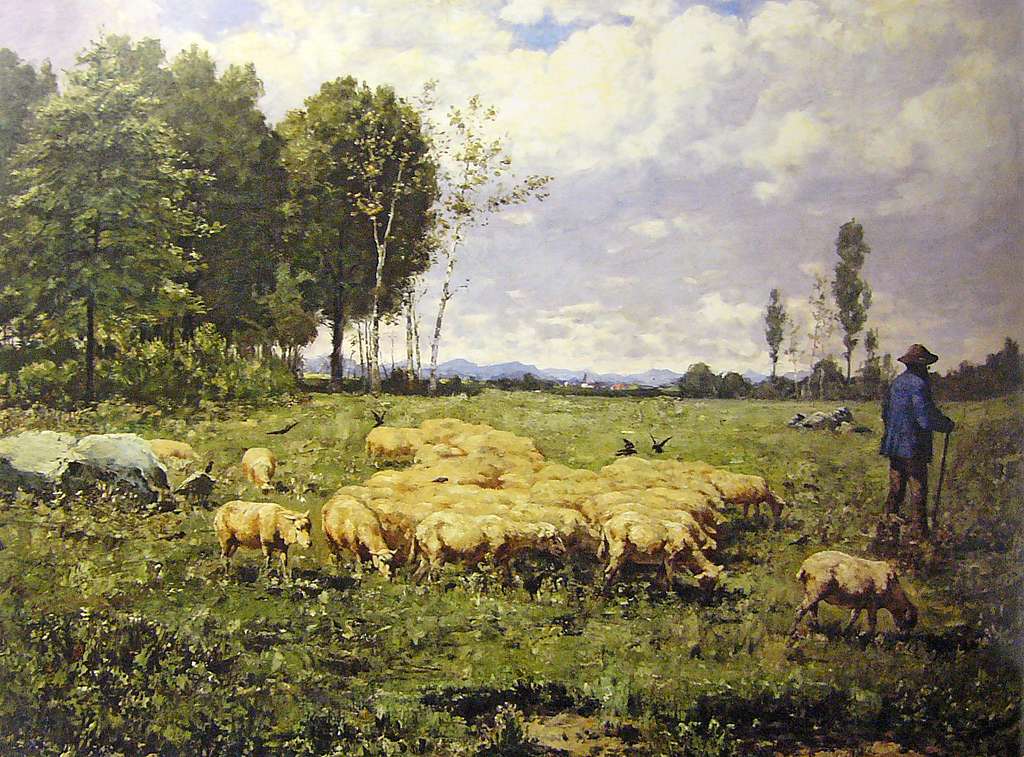
a shepherd’s song


Goran Gatalica (Croatia)
Basho-an Award, The 6th Basho-an International English Haiku Competition, 2023

Commentary from Jacob D. Salzer:

A powerful haiku that includes multiple senses. There are four images in this haiku (the hills, the seeds, the shepherd, and the sheep). There are two sounds (the wind and the shepherd’s song), and there is a silence in the seeds, hills, and sheep, and in the shepherd, especially after the song is over.

In the first line, cemeteries are sometimes found on hills. This potential reference to death contrasts with the seeds symbolizing birth, although I actually see cycles of life and death vs. a stark contrast. 

In terms of sound, it’s interesting to note how the shepherd’s song travels farther between the hills. I can hear the song in the wind, which adds sonic depth. The sonic quality of “b” and “ee” seems to create an eerie feeling, while “away” and “song” seem to support a feeling of longing. I also usually see wind as a reference to a passing soul or souls. When we pass away, what seeds do we want to leave behind? The seeds could even be seen as seeds of karma, which implies the cycles of life and death and reincarnation.

The common definition of a shepherd is: (1) One who herds, guards, and tends sheep. However, a second definition is: (2) One who cares for and guides a group of people, as a minister or teacher. This second definition adds another layer to this haiku. Is the shepherd teaching a group of people through a song? What does the shepherd’s song sound like? Is it a spiritual song or a religious hymn? There is an inclination that this is an old song passed down through several generations. However, it could also be a new song. What are the lyrics? Where did this song come from? And what does it mean? The shepherd’s song could be one of hope, as seeds can be symbols of hope. However, the seeds may have been carried too far by the wind and perhaps didn’t land in healthy soil. In that case, perhaps this is a song of both hope and sorrow. Indeed, the words “blown away” seem to contain a clear sense of melancholy. There is also a sense of deep time in this haiku, as the hills are ancient.

In short, this is an interesting haiku that can be read from different perspectives. It is a deep and thoughtful haiku that asks us to consider our place on Earth, our ancestors, and Divinity. This haiku also asks us to contemplate our souls, our brief lives on Earth, and the afterlife.

looking back
at my younger self. . .
sun-kissed mangoes


Manoj Sharma (Nepal)
Modern Haiku 55.2 : Summer 2024

Commentary from Hifsa Ashraf:

We cherish and miss our youth the most because it is full of adventures. I can feel this kind of youth in this haiku. The person is reminiscing about being young—the phase of life where one usually has the energy and freedom to do the things one wants. The narrator seems to be old enough that he finds it difficult to move on and reminisce about a time in his life that was opposite to his current self. So, in line one, looking back is not simply the remembrance of youth but also wishing to have the same energies or seeking solace in youth.

The second line ‘at my younger self’ with ellipses makes us pause for a while by asking some questions i.e. is this a photo or portrait, is he looking at a reflection in a mirror or in the water? A vivid memory? It seems the person is going through a transformation i.e. from middle adulthood to late adulthood. It is the most difficult time especially when one feels it mentally, physically, emotionally, and psychologically. It seems as if one self is departing and replacing another one, which is probably feeble. 

The last line in this haiku is really interesting and makes it more dynamic. Sun-kissed mangoes are definitely a beautiful analogy to the time of youth when mangoes not only ripen in the sun but also have their best taste. It shows how a youthful life flows like pulpy and juicy mangoes, which are sweet and provide energy. Sun-kissed mangoes as a kigo also show the beauty, care, and connection of nature with different phases of our lives. On the other hand, I see it as a very romantic and loving expression where a person fully enjoys one’s youth being surrounded by loved ones and expresses their feelings fully. 

your ratty sneakers
hanging out in the garage
as if you’re still here


Jennifer Gurney (USA)
Five Fleas, March 17, 2025

Commentary from Nicholas Klacsanzky:

Having had several close members of my family pass away, this haiku resonates with me. It can connect with many readers, as the circumstance described is commonplace yet emotionally potent. The “ratty sneakers” become alive, serving in stead of the deceased (or possibly distant) important person. They transform into a representation of the mystery individual or even an independent entity that takes on a life of its own. There is also an irony in ratty sneakers becoming so poignant. It demonstrates that with emotional weight, any object can be of significance. This relates to the Japanese aesthetic concept of aware, which denotes how a physical object can trigger a personal or spiritual response.

The writing style of the haiku is extremely relaxed and natural. I believe this is what the great master Basho advocated for with his concept karumi. There is no particular kigo or seasonal reference. However, the poet may have been aiming more for a senryu or simply did not see the importance of adding a kigo. Either way, the poem does well with the subject matter and descriptions, giving us just enough for us to imagine and feel deeply.

The pace of the poem approximates the traditional Japanese haiku rhythm, which comes out to a short first line, a longer second line, and a short third line in English. The effectiveness of the haiku/senryu also is seen in its conciseness, with no word out of place. Finally, the sound of the poem propels its atmosphere further. I especially enjoy the “r” sounds, which provide weight, and the letter “s” which appears to slow down the reading so we can take in the poem better.

This is a poem that looks like it was written with the utmost ease yet it has several layers of meaning and feeling. Most importantly, it can easily connect to readers and move them to memories of loved ones and the power of objects that surround us.

“The Shepard,” a painting by Alexander Roche (1861-1921)