
river view
a salmon floats
on a cloud of oil
— Kavita Ratna (India)
Cold Moon Journal, October 2024
Commentary from Jacob D. Salzer:
An important haiku that shows not only environmental harm but also our human dependency on oil in modern culture. In turn, this haiku shows the negative consequences of modern, industrialized culture without overly explaining it, and contributes to a much larger conversation. What kind of lives do we want to lead? Are we aware that when we damage the Earth, we also damage ourselves? The depiction of death in the second line also has a haunting effect. It seems the word “floats” suspends the moment in time, showing how events like oil spills disrupt the natural cycles of the Earth and complex ecosystems. I think we should turn to Indigenous wisdom for guidance to heal the many wounds we have created on Earth and to live better lives.
This haiku also reminds me of an important poetry anthology, I Sing the Salmon Home, edited by Rena Priest.
I hope this haiku will inspire people to support the salmon population and reflect on how we can live better, and take better care of each other and the Earth.
the rush of hail
to a distant iceblink
compass to home
— Elliot Diamond (USA)
Time, #61 2024
Commentary from Nicholas Klacsanzky:
The imagery, diction, and sense of sound drew me to this haiku. An absorbing image is described in the first two lines, which is epic to imagine as a reader. I’ve never seen the word “iceblink” before, but I had fun learning that “it is a white light seen near the horizon, especially on the underside of low clouds, resulting from [the] reflection of light off an ice field immediately beyond” (Wikipedia). The hail seems to merge with the iceblink, and this intuitively relates to having a compass to home. The integration of elements brings a sense of enlightenment, which is akin to finding one’s home. In a more practical sense, “the iceblink was used by both Inuit and explorers looking for the Northwest Passage to help them navigate safely as it indicates ice beyond the horizon” (Wikipedia).
Thinking about the kigo, or seasonal reference, it is mostly placed in winter. Hail and ice are commonly associated with winter but could appear in autumn or even spring at times. Anyway, the cold could be associated with the calculation of a compass, though it points to something as personal as a home.
The lack of punctuation or cut (kireji) makes the second line act as a pivot. So, it can be read as the rush of hail/ to a distant iceblink compass to home or the rush of hail to a distant iceblink/ compass to home. The latter is probably the most common reading of it.
Finally, looking at the sound, the letters “h” and “l” in rush, hail, iceblink, and home give me the impression of subtlety yet emotional weight. With 11 words in a short/long/short structure using common language (except the surprising “iceblink,” which is a pleasant artistic touch), this haiku follows the haiku tradition well. Beyond that, the compelling overall package of the haiku manifests a spiritual feeling that is also somehow personal.
sun haze
what’s left of the stream
rock shadows
— Jeremy Haworth (Ireland)
Presence, issue #81, 2025
Commentary from Hifsa Ashraf:
sun haze is a kigo that refers to seeing things clearly due to environmental conditions, i.e., smoke, smog, dust particles, fog, etc. Starting with this kigo allows us to pause and imagine the condition we unfortunately often pass through. It may indicate climate change, blurred vision, oblivion, a lack of awareness or clarity, etc. In any case, the poet lets us see an image that is significant in our lives in terms of survival and quality of life. In two kigo words, there can be a lot to explain, and that’s the beauty of haiku. You can let your imagination go wild and think of all possible but relevant aspects that can link to the kigo. The poet set a ground for us through this kigo so that we can feel the severity of issues related to climate and environment.
In the second line, the stream may be either dried or near dry due to drought, infrastructure, expansion of cities, modern life, a lack of rain, or other reasons. My impression is that the stream may never come back, which is quite alarming. The poet didn’t end the poem with the death of the stream, but he focused on what’s left behind. The word ‘of’ is used cleverly in this haiku along with ‘what’s’, which may or may not be a question one can ask themselves.
The third line, ‘rock shadows’, indicates there is still water in the stream with a low level where one can see the shadows of rocks. It seems the rock shadows are symbols of annihilation, where one can not see them clearly in water, or they are imaginary, which tells us the stories of the stream’s origin. In any case, it’s a dreadful picture of nature in danger due to our actions. The beauty of this haiku is that there is no human experience or condition mentioned in it, but it still makes us ponder environmental conditions.
I can see an analogy between this haiku and human experience i.e. the sun haze may be the blurred vision or oblivion we are in; the stream may be a thought process that is not in a great flow; and rock shadows are speculations or doubts about critical thinking about the environment/climate that needs our attention.
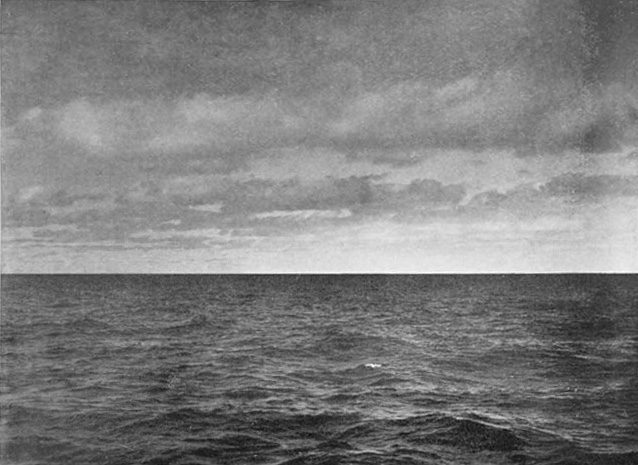
Ice blink captured by Herbert Ponting in 1913
 Haiku Commentary