
small green leaves —
the ticket machine
is acting up
— Maurizio Brancaleoni (Italy)
Trash Panda, Vol. 7, Summer Issue 2024
Commentary from Jacob D. Salzer:
I appreciate the message and humor in this haiku. On first read, I saw the small green leaves being stuck in the ticket machine, preventing it from working. Alternatively, the machine could be malfunctioning for other reasons. In terms of a visual comparison, this haiku reminds me that ticket machines have semiconductor chips that are very small. What happens when a ticket machine (that has become a normal part of life) stops working? That moment of humor and frustration comes through this haiku. We also don’t know what kind of ticket machine is being referred to in this haiku. I like that it’s left open for the reader.
Sometimes, I think certain technological interruptions in daily life can reap many benefits and different points of view. It can break habitual thought patterns and offer fresh perspectives on life. As Gururaj Ananda Yogi has said, “Life is not meant to be lived like a machine. Life is an art.” This haiku also brings to mind haiku about power outages and how a power outage can open up new perspectives and ways of living and being in the world. Parallel to this observation, I think that because the machine is not working in this haiku, the poet is able to notice Nature. I find there is beauty in that. In general, perhaps if more people spent less time with technology and less time on their phones, they could notice more beauty around them.
In my city, there are various machines along streets and bus stops, including parking ticket machines, that help generate revenue for the city budget. How much money do cities make per year in parking tickets alone? According to qz.com, “San Jose made $11.4 million through parking tickets in 2019, an amount that doesn’t include the fees that weren’t collected.”
In short, this is an interesting haiku that explores the various intersections between Nature, psychology, money, and technology in modern life.
cycling the moon and i in sync
— Kala Ramesh (India)
Wales Haiku Journal: Summer 2025 edition
Commentary from Hifsa Ashraf:
This haiku elegantly captures the interplay between nature and personal experience, linking the lunar cycle to the menstrual cycle. Even without an accompanying description, the connection between the average 29-day menstrual cycle and the lunar cycle remains clear. The term “cycling” conveys more than temporal alignment; it signals synchronized phases—waxing and waning, thickening and thinning—of both the moon’s surface and the womb’s lining. This suggests profound harmony between human biology and cosmic rhythms. “Cycling” carries layered meanings: endurance, patience, and transformation, whether physical or subtle, in both body and moon. Its repetitive nature reflects the universe’s order—growth and decline, life and death, beginnings and endings. These parallel the shared journeys of nature and humanity. Finally, the moon emerges as a symbol of life, fertility, love, rebirth, and transformation. It shares an intimate, almost invisible connection with the womb.
The monoku’s use of “i” in lowercase conveys humility and grace. It embraces the cyclical nature of both body and moon. The poet forges a unique bond, aligning the feminine essence of the moon and the self in harmony.
The word “sync” acts as a clever pivot. It implies both alignment and an inevitable pause—perhaps signaling transformation, rebirth, or menopause, where cycles break before renewing. This pause invites meditation, renewal, or a shift in life’s course. It offers a moment of rejuvenation after exhaustion.
The monoku’s spacing encourages reflection on each word, slowing the reader’s rush to judgment. This structure, combined with the lowercase “i,” underscores humility and invites the contemplation of the interconnected cycles of nature and self, unified in their feminine essence.
dusk —
riding tandem
with his shadow
— Sarah Mirabile-Blacker (Switzerland)
Commentary from Nicholas Klacsanzky:
This haiku captures a fleeting yet intimate moment between self and shadow, set against the liminal time of dusk. “dusk” isn’t a conventional kigo (seasonal reference), but it functions evocatively. Dusk carries universal associations with transition and ending—themes rich with emotional and symbolic resonance. Although not tied directly to a season, it offers a subtle kigo-like atmosphere, hinting at cyclical closure or introspection.
The dash after “dusk” pauses the reader, allowing the scene to transition—between day and night, visibility and obscurity. The dash puts “dusk” into “solitude” before introducing the duo of the rider and his shadow. That separation allows the two elements—time and action—to resonate individually, then recombine through the act of juxtaposition. The dash is an approximation of kireji, the Japanese cut marker in a haiku.
“Riding tandem” suggests companionship and rhythm. To “ride tandem with his shadow” conveys both literal imagery—a cyclist lengthened by his dark double—and metaphorical resonance. The shadow is no longer a passive outline; it becomes an equal partner, keeping pace, inseparable yet independent. “his shadow” could also refer to the narrator riding alongside the shadow of a friend, husband, or family member.
Looking at the sound of the haiku, dusk closes with the hushed consonant cluster -sk, trailing off like something that is dimming. shadow ends in the long, fading vowel -ow, evoking dissolving, like a sound disappearing into the air. So, the word choices themselves suggest a diminishing, mirroring the passage into night. Also, the sharp sounds (bolded) in “riding,” “tandem,” “with,” “his,” and “shadow” provide a stark atmosphere to the poem.
This haiku displays a precise perception that opens into wider emotional and philosophical terrain. Through the use of kireji, the mood-infused “dusk,” and the economical but striking juxtaposition of rider and shadow, the poem evokes transience, identity, and companionship in a moment suspended between day and night.
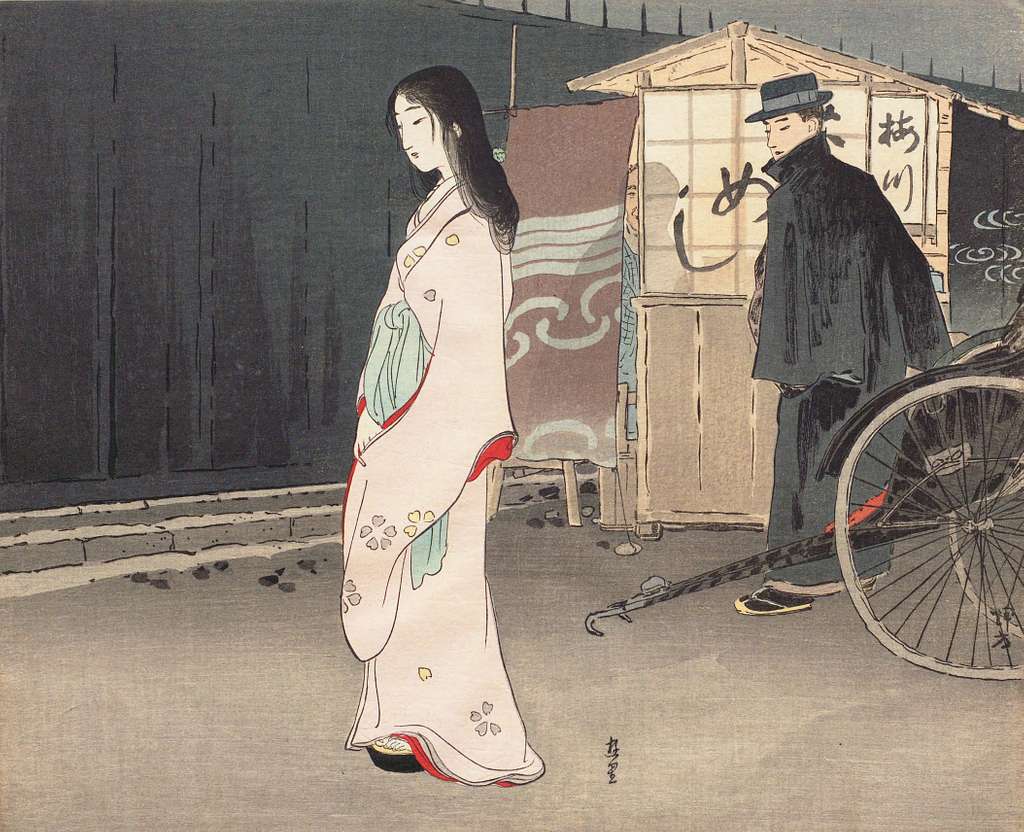
Frontispiece to “Sharing an umbrella (Ai ai gasa)” by Izumi Kyōka, frontispiece illustration, woodblock print.
 Haiku Commentary