Kat Lehmann’s forest stream

an answer without end quotes the forest stream

Kat Lehmann (USA)
Published in Frogpond 46:2, 2023

Commentary

I greatly appreciate how the answer in this monoku is open-ended and ongoing vs. definitive. I think sometimes the best answer is not-knowing and living in the mystery. 

Another interpretation is that even if there is an answer, there is space to be more flexible and open-minded (i.e. the answer itself is changing or capable of changing). This also shows that, despite our knowledge, there is a lot we don’t know.

I also appreciate how we don’t know the question in this monoku. This makes the poem very versatile and applies to many different questions and situations. It seems asking questions in general is often a sign of humility. Byron Katie once said: “I don’t know is my favorite position.”

The vitality of a forest stream could be a metaphor for the flow of consciousness when we are not stuck or attached to rigid thoughts, living in the constant flow of “now.” In addition, biologically, we are mostly water. It seems if more people lived like a forest stream, we would live in a much more beautiful world. “Without end quotes” also seems to speak to the continuity of life and could speak of reincarnation or a spiritual river that flows on into the afterlife. A beautiful haiku.

Jacob D. Salzer

Thinking about the kigo or seasonal reference, it is not exactly clear, as forest streams could be present during many times of the year. However, spring and fall are common times for flowing forest streams in the poet’s part of the world. The poem flows homogeneously like a stream represented as one line. I would vie for spring, as “an answer without end” illustrates the abundance of that season.

There is no punctuation in the haiku, but there are definite ways to section the parts:
1. an answer/without end quotes, the forest stream
2. an answer without end quotes/the forest stream
3. an answer without end/quotes the forest stream

…and possibly more.

This makes it a task to choose just one interpretation, but it also gives it more breadth. The association between the words creates interesting readings, such as between “without end” and “stream”; “quotes” and “steam” (both small but integral), etc. A reader can easily sit and investigate this haiku for a good while without feeling the need to move on.

An important part of this haiku is its sound. The standout letters are “o” and “t.” The flowing “o” matches well with the subject of a stream, and “t” provides a sense of the stream’s power, in my opinion.

I like that the poet did not shy away from the possibility of surrealism. Often, westerners have the false idea that haiku needs to be written with objective realism or as an objective sketch. Subjectivity has been a cornerstone of Japanese poetics, and haiku, since its inception. Sometimes, westerners confuse the “sketch from life” approach that Shiki proposed with strict objectivity when he rather focused on writing from one’s life experiences and occurrences (including individual feelings).

This is a haiku to make you ponder and perhaps create your own meaning with. Original, imaginative, and verging on the surreal, this poem has a lot to offer.
Nicholas Klacsanzky

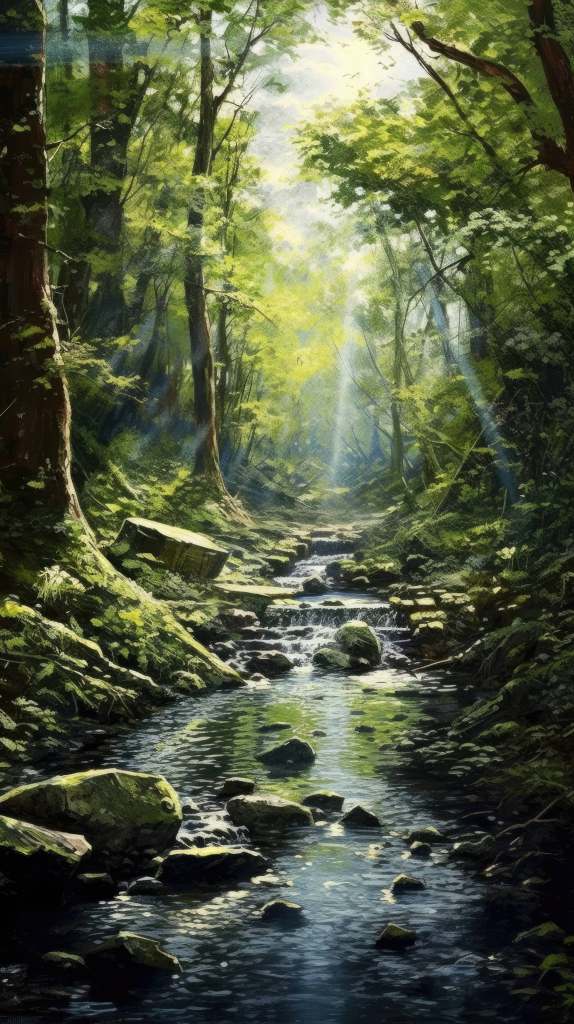
Painting done by AI.

Kat Lehmann’s news


evening news
junipers consume
the moon

Haiku Society of America Harold G. Henderson Haiku Award, Second Place (2020)
— Kat Lehmann (USA)

This haiku has a very effective juxtaposition. It shows us through imagery how consuming the news can be. The word “consume” has a negative connotation that implies an extreme. The juniper’s invasiveness is an apt image to describe this. It seems the news tends to be very unbalanced and focused on negative events that cloud our perception, while many positive events go unnoticed and are often not covered. While most news seems to be dark and narrow-minded, by stark contrast, the moon inspires open-mindedness, mystery, and wonder. 

My father had junipers in his yard many years ago. They were very large and obstructed the view to his yard and the neighborhood. Now that they’re removed, he can see his yard and neighborhood in full view.  

This is a powerful haiku that reminds us to not be consumed by news stations, which seems to be a form of mental programming, and to notice the beauty of the moon and what is beyond us.

—  Jacob Salzer (USA)

It starts with the news that may or may not be reliable, ‘evening news’ which means one has to read it carefully before relating it to any news and its relationship with the rest of the haiku. Evening news can be thrilling, mysterious, and evokes our deepest feelings.

A juniper tree is a sign of strength, divinity, power, and safety. If we see it from that context, then it means something is being covered or not openly revealed. The word ‘consume’, like the evening news, shows exaggeration here but it is cleverly used to make this haiku more powerful and with broader perspectives. I see ‘the moon’ as a metaphor which may show signs of visibility as someone/something in the limelight but not now because of the junipers’ shadows and the same are not catching much attention in the evening news.

I love the rhythmic sounds of ‘news, consume, and moon’ as these provide an interesting and lighter side of this haiku. Overall, I think this haiku represents someone who needs attention but is getting it neither in nature nor in the evening news. 

Hifsa Ashraf (Pakistan)

The juniper, with its prickly branches and stout shape, covering the moon, is a great comparison with the evening news. I think this comparison can be seen both in a positive and negative light, which has been expounded on by Jacob and Hifsa above. I think this gives this haiku more nuance and layers, which is a common quality of strong haiku.

I also think the usage of the word “consume” is an interesting choice. It relates to us as people in modern society, who consume information and materials at an alarming rate. The poet could have used “cover” but I think the poet chose a word that is more pertinent and imaginative, which works well in this particular haiku.

As Hifsa mentioned, the sound of the haiku is rhythmic. The “e” and “o” vowel sounds bring about a soothing tone despite the subject. This contrast creates a more nuanced power behind the haiku.

Nicholas Klacsanzky (USA)

By Paivi Ojala


Kat Lehmann’s River

what remains
after the river is gone
this empty bed

Kat Lehmann (USA)
Published in Mayfly 68, 2020

I always wonder how to express my deepest feelings about certain themes of life that are well connected with the most essential element of nature: ‘water’. I love it when someone challenges me to write about topics that really cover annihilation.

In this haiku, Kat beautifully expressed her feelings in a simple but most elegant way without letting go of the flavours of the right metaphor that is the beauty of a well-crafted haiku.

What remains is a question mark that we all need to address at the end of this temporary life for which we spend a lifetime to solve the mystery of what we get in the end. The ‘river’ is well placed in this haiku that reflects our thoughts, feelings, and constant learning and building up of a momentum in our lives. I think the flow of the river may be interpreted in two ways: 1) physical life 2) mental or spiritual life. Both goes on until we stop breathing and/or stop thinking about what is necessary for survival.

The empty bed both of the river and our life indicates nothingness and or annihilation where only a deep silence prevails. This haiku also depicts the process of evolution and revolution that both start and end in nothing. This is the ultimate meaning of life.

Hifsa Ashraf (Pakistan)

At first glance, this poem might seem like a matter-of-fact statement, which a lot of fine haiku do. But then, we get an “aha” moment. The empty bed is both positive and negative. The empty bed could be a representation of the emptiness and harshness of the dry season, but it could also mean a place where new life can flourish without hindrance. Plus, the author could be referring not to a riverbed but to the bed in her house—thus making it a double entendre.

The empty bed is also a sight to behold. The way the river carved into the earth is now fully visible and we can witness what the river did to the soil and rock. It may be empty, but it’s full of memories etched into the earth.

I think the poet did right by not including punctuation, as it would have made the second line too long, in my opinion. The poet retains the traditional Japanese rhythm of haiku.

In terms of sound, the most striking letter is “r,” which gives the haiku added power and weight. The sound of “e” in the last line with “empty bed” has long syllables, which creates a sense of melancholy and starkness.

A fine haiku that gives many introspective associations to readers.

Nicholas Klacsanzky (USA)

blue-mountains-at-corbett-national-park-landscape-painting-mandar-marathe

– Painting by Mandar Marathe