Haiku and Senryu by Gordon Brown, Kelly Sargent, and Alexander Groth

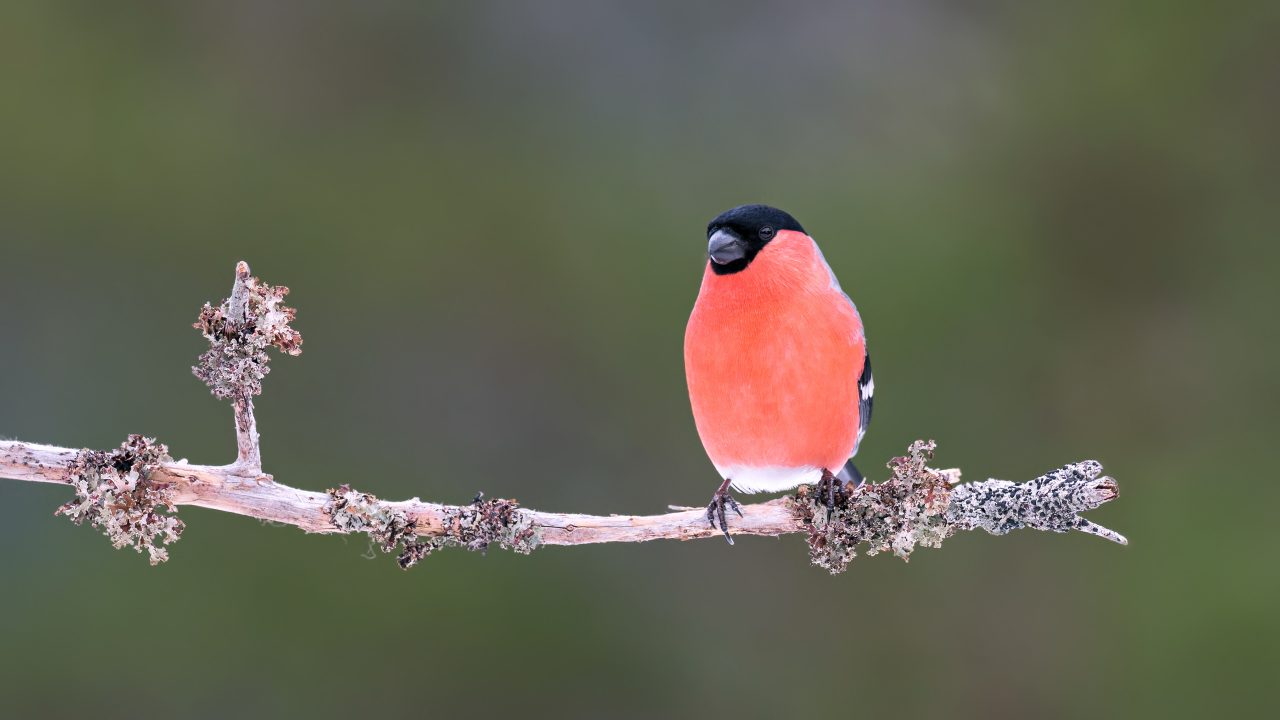
winter morning
inside the gargoyle’s mouth
a bird’s nest

Gordon Brown (USA)
tsuri-doro, issue #14, March/April 2023

Commentary from Hifsa Ashraf:

The starting line with a kigo shows the cold weather when people mostly stay inside and enjoy the coziness of rooms and memories. A winter morning may indicate fog, snowflakes, snowfall, blizzard, or simply coldness. It may be a window view, a view from the balcony, a view from a vehicle’s window, etc. In any case, the person has captured something unusual—something that people don’t focus on in their daily routine. Perhaps, the poet is trying to relate his personal life with the imagery. 

The English article ‘the’ before ‘gargoyle’ allows us to ponder statues, stubs, waterspouts, fountains, etc. But, it seems whatever form the gargoyle’s mouth takes, it needs some maintenance. In religious terms, gargoyles are meant to be both good and bad. In architecture, they are used for the disposal of water. The placement and the purpose of a gargoyle in this haiku is significant. It seems like the gargoyle is no longer in use, or simply a statue where a bird nests. This may indicate that the gargoyle is meaningful even if no one cares. It’s a sign of adjustment where insignificant things become significant—especially in hard times. In this case, a bird nests in the gargoyle’s mouth to avoid harsh weather. For that bird, this creature is a great blessing, and for the place where it is situated, it may have become a curse. We never know when and where life turns upside down. But, we need to learn from nature about how to adjust to situations that are not useful to us. 

finding my adoption papers —
polished apples 
without a stem

Kelly Sargent (USA)
Mayfly, issue #77, July 2024

Commentary from Jacob D. Salzer:

This is a powerful haiku that uses detailed images in a two-part juxtaposition to communicate emotions and meaning. There is metaphorical power in this haiku as well. The discovery of the poet’s adoption papers likely creates a myriad of emotional responses, such as shock, melancholy, and perhaps relief, simultaneously. It could be that the person or people who adopted the poet kept the adoption a secret to prevent the poet from being exposed to past psychological trauma in their biological family. The word “polished” reminds us that sometimes things are not as they appear, and much can remain hidden beneath the surface. “Without a stem” points to the disconnection between the poet and their biological family and shows how hard it is to face the mystery of their family tree. This haiku also extends what a family can mean. I appreciate the poet’s vulnerability. This is a potent haiku with psychological depth and meaning.

fishing trip 
carefully I remove the hook
from my skin

Alexander Groth (Germany)
Failed Haiku, issue #100, July 2024

Commentary from Nicholas Klacsanzky:

Not only is the last line a surprise but it also can be taken in several poetic directions. Like many great haiku and senryu, the images in this poem can be perceived as both mundane and metaphorical. Perhaps the poet “catches” himself with a hook in an ironic twist, but “hook” could also pertain to attachments or hang-ups. The poet could be saying that before engaging in fishing, he needs to let go of a few burdens—psychological or otherwise.

Since this is classed as a senryu, no punctuation, seasonal reference, or avoidance of personal pronouns is needed. Still, the poet kept to the principles of brevity, casual language, and pacing the lines in a traditional short/long/short rhythm.

Looking at the aspect of sound, the sharp “i” in all the lines of the senryu connects to the hook. In addition, the “k” sounds in “carefully,” “hook,” and “skin” contribute to the feeling of sharpness. Ultimately, this haiku appears to be effortlessly written, but on looking deeper, demonstrates the technical prowess of the poet and layered depth.
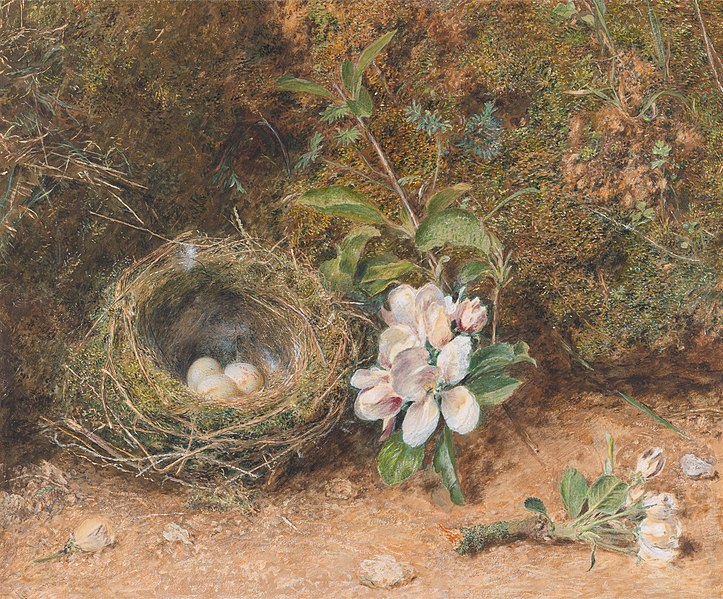
William Henry HuntBird’s Nest with Sprays of Apple Blossoms, circa 1847
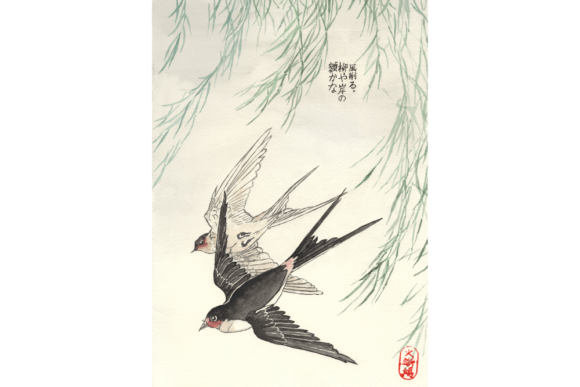
Haiku from Kelly Sargent, W. Barrett Munn, and Fatma Zohra Habis

winter sky swallows the words I can’t take back

Kelly Sargent (USA)
Cold Moon Journal, March 2024

Commentary from Hifsa Ashraf:

A winter sky stays dull and dim but remains open to wild imagination. This monoku reflects various shades of a winter sky when we read it in one go. I focused on the first three words for a while, which can be read in three ways: winter/sky swallows, winter sky/swallows, and winter sky swallows.

The repetition of ‘s’ and ‘w’ sounds makes it more interesting to read and interpret. Sky swallows usually reflect loyalty, a new beginning, hope, transformation, and more. It seems it alludes to a murmuration that is getting the poet’s attention due to its shapeshifting, shades, shadows, and sound. The use of ‘swallows’ makes this monoku more profound and dynamic. The swallows in the sky could indicate the end of the winter as well which commonly is related to positive outcomes.

The second part of this monoku takes this monoku to another aspect that is more personal and profound. It looks like a mirror reflection of the first part of the monoku. When I read it as a whole, ‘the words I can’t take back’, it gives me a feeling that the person wants to express all that follows the murmuration in the winter sky. ‘the words’ is a catch here as they may reflect personal experiences that are either positive or negative.

If I read the second part of this monoku with the central word ‘swallows’ that juxtaposed this poem, it looks like the person is still in conflict.

“winter sky” is a ground where the poet masterfully displayed profound feelings and thoughts, while allowing readers to find as many interpretations as possible. It is a good exercise for the brain and heart to solve the mystery of this haiku.

no headstones;                         
buried all across the south
remains of slave ships

W. Barrett Munn (USA)
Haikuniverse, January 9, 2024

Commentary from Jacob D. Salzer

An important haiku that shows part of the darker history of the U.S. This haiku transports us back in time, yet we can still feel the consequences of slavery today. I can feel the unbearable weight of colonialism and capitalism when I read this haiku. It is unfathomable in my eyes to imagine being a slave or a slave owner. Some people who are buried are not always remembered with a designated tomb or headstone. This haiku conjures up several questions that we can ask ourselves: What else dwells beneath the ground that we walk on every day? How much of history is skewed, buried, or not documented? How can we preserve history to the best of our abilities, so that we, collectively, can (hopefully) learn and grow and not make the same mistakes? What are examples of modern-day slavery and what are the consequences? How many consumers are conscious of where their products come from? How many people know the origins of the things they buy? How many are aware of the working conditions in various factories? How many of us are open-minded to life after death? Where does karma originate? What is the nature of the soul? Despite the horrifying history, I appreciate how this haiku shines a light into the dark and lets us attempt to see those who are not seen. 

this morning
in the shell hole
lone bud

Fatma Zohra Habis (Algeria) 

Commentary from Nicholas Klacsanzky:

I enjoy how the second line interacts with the first and third lines. It can be read as “this morning in the shell hole/lone bud” or “this morning/in the shell hole lone bud.” The phrase “shell hole” makes me imagine both an ammunition shell and a shell from the sea. Both interpretations are valid and intriguing. Perhaps, though, morning and a bud connecting with ammunition is more poetic.

“lone bud” could refer to early spring or late winter, when buds are either just coming up or leaving for the time being. With “morning,” I get the feeling it could be the start of spring. This provides the haiku with a tone of hope. Ultimately, I believe it expresses that like the morning, new beginnings arise even in the most difficult of times and that life goes on even through the passed.

Another striking element of this haiku is its sound. The strongest sound comes from the letter “o,” which could represent a hole in its own right and demonstrate a soothing atmosphere to the poem. Also, with only eight words and the traditional rhythm of a short line/longer line/short line, the poem is economical and effective. The poet, I believe, rightly did not add punctuation, as it could have detracted from the flow of the pivot line and would have stood out too much. The haiku presents a simple image but has poignant overtones that can take the reader to different symbolistic places.

Painting by Daria Melantova

Poems by Kelly Sargent, Marc Brimble, and Anthony Lusardi

fallen acorn renewing our vows

Kelly Sargent (USA) 
Frogpond, issue 47:1, winter 2024

Commentary from Nicholas Klacsanzky:

The way the word “renewing” works as a pivot to create different readings is spectacular. I think the monoku could be read in at least three ways: “fallen/acorn renewing our vows”; “fallen acorn/renewing our vows”; “fallen acorn renewing/our vows.”

The contrast between “fallen” and “renewing” creates a powerful link. Acorns are also often used as symbols of rebirth, and the monoku could be personifying it. In addition, I enjoy how the kind of vows that are being expressed is left up to the reader.

Finally, the train of “n,” “o,” and “w” sounds makes this haiku sonically pleasant. The poem begins with harder sounds and ends with softer tones. With only five words, the poem has much euphony and meaning.

waiting for confession
I notice
The Virgin’s thigh

Marc Brimble (Spain)

Commentary from Hifsa Ashraf:

The opening line of this haiku is personal and well thought out. It seems the person is going through the process of reflecting on what went wrong in their life. The mistakes bother the person but at the same time, there is no sort of hesitation, conflict, or confusion in obtaining a confession. The question is: “Is it a big confession?” “Is it someone’s first confession?” “Is it a self-motivated confession?” “Is it a forced confession?” In any case, the one who will confess is taking time to think about it.

In the second part of the poem, there is a surprising element of moving from spiritual to worldly desires. It may imply that the person will confess something about yearnings or an intimate relationship. Nonetheless, their thought process is oscillating between what is seen and what is not, what is more significant and what is less, what is right and what is wrong. It seems the person is being distracted from a symbolic meaning of life by worldly desires and is not yet ready for a deeply felt confession. 

within its web
within a hollow stump
a grass spider                      
feels the earth
and all its vibrations

Anthony Lusardi (USA)
Ribbons, Spring/Summer issue, 2022

Commentary from Jacob D. Salzer

The clear imagery and the perspective from the spider’s point of view make this a strong tanka. The web could be seen as a symbol for the web of life. I appreciate how this tanka reminds us of the interconnectedness of life and the impact we have on Earth and her creatures. The last line also opens up many possibilities as we imagine the different vibrations. When I read this tanka, I feel compassion for the spider. There could also be metaphorical interpretations in the first two lines. Ultimately, I think this tanka reminds us to be more mindful of our actions. I believe this is an important, ecologically-based tanka that inspires compassion.

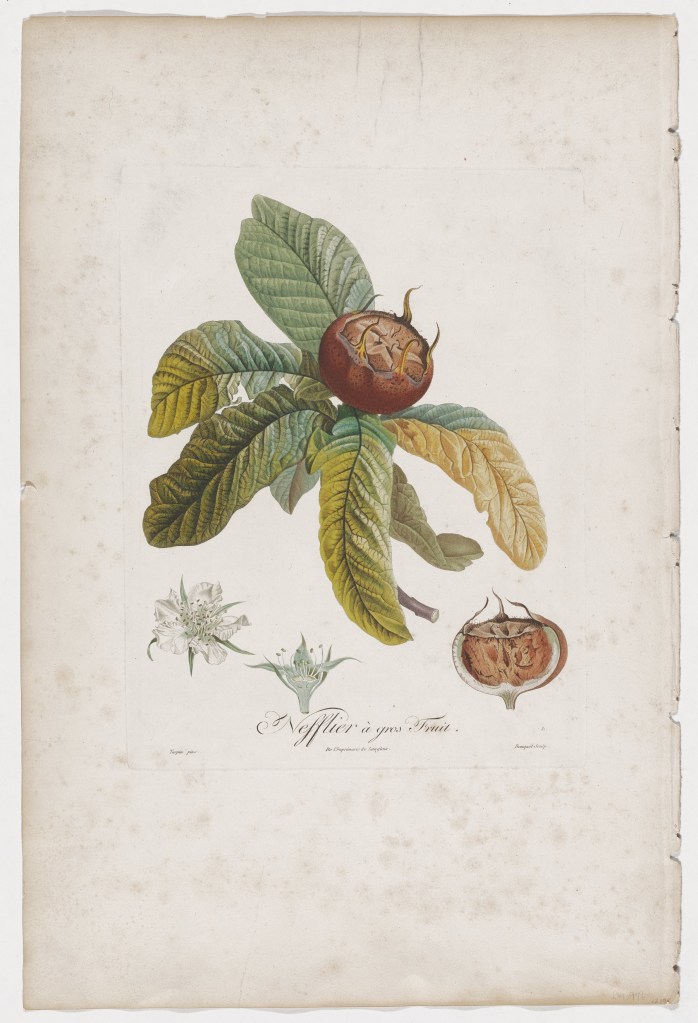
Nefflier a gros Fruit. Original from the Minneapolis Institute of Art. Dated: 19th century ; Artist: Michel Bouquet ; Nationality: French ; Artist Life: 1807-1890.

Haiku by Joshua St. Claire, Kelly Sargent, and Daniela Rodi

hot sand
my son asks me
about sin

Joshua St. Claire (USA)
The Heron’s Nest, Volume XXV, Number 3: September 2023

Commentary from Nicholas Klacsanzky:

Living by beaches most of my life, I instantly resonated with the first line. I’ve even seen shoes being melted by hot sand. Anyway, the concept of “sin” is extremely complex and nuanced. I suppose the son is a young boy who has recently taken an interest in either church studies or philosophy. Many times, parents don’t have succinct or clear answers to children’s questions, as they are still trying to work out the answers themselves.

I can feel the humor in this haiku as well, as perhaps the father has been dealing with some “sin” and doesn’t want to teach something he doesn’t subscribe to himself. In some faiths, it is taught that everyone is a sinner, and the hot sand is a fine representation of that.

Looking at the technicalities, I enjoy the “o” sounds that mark exasperation and the “s” sounds that mimic the hiss of hot sand. I also admire the pace of the poem and the twist in the third line. Finally, it has a clear kigo or seasonal reference for summer, which contrasts poetically and humorously with the topic.

mud season again —
the crow’s feet
a little deeper 

Kelly Sargent (USA)
Modern Haiku, Issue 54.2, Summer 2023

Commentary from Jacob D. Salzer:

Slight differences in the season and climate have a significant impact on the health of plants, birds, insects, and animals. Mud season is the period between winter and spring, and is marked by melting snow, rain, and mud. In this haiku, the mud is even deeper than the year before, which could be due to climate change. This haiku conjures up compassion for the crow who is or was stuck in the mud. This haiku could be in the setting of someone’s yard in a suburban environment or somewhere in Nature. While the haiku focuses on the crow’s feet or footprints, I simultaneously envisioned the crow’s strength as he or she flies away. In this haiku, I also think of Indigenous legends that involve a crow. In short, this haiku has vivid imagery and makes us think about our impact on the Earth and many other species. May we choose to live more mindfully with more awareness and compassion.

the longest journey…
a falling leaf
returns to dust

Daniela Rodi (Finland)
Selected, 10 winning works, The 5th Basho — an International English Haiku Competition 2023

Commentary from Hifsa Ashraf:

It’s a concise poem with a clear meaning of death, annihilation, or transformation. “The longest journey” may be specific to death or a spiritual/inner journey. In both cases, the person reaches an eternal or purposeful destination. The falling leaf in the second line tells us about the annihilation, end of life, or transformation. A leaf can reflect life stages where one passes through rigorous experiences and eventually reaches the end where existence has become nothing or loses its superficial meaning.

A falling leaf depicts transformation, as according to nature’s rules, one stage of life transforms into another in a set period. ‘Returns to dust’ is about our origin which means no matter what, all of us have to meet our genesis one day in the form of death or the true recognition of who we are. The latter can translate to understanding the ultimate purpose of our lives.
 
This poem shows how selflessly a person continues their life after fading away, or after having deep experiences, where a materialistic life or possessions mean nothing and humility become one’s true virtue. 

Painting by Sean McGrath

Kelly Sargent’s campfire sparks

campfire sparks 
teenagers
slip away

Kelly Sargent (USA)

(published previously in Frogpond, 45:1, 2022; Touchstone Award for Individual Poems nominee 2022)

Commentary

“Campfire sparks” is a vivid image. It lets us pause and imagine the scene, which is realistic yet imaginative and subtle in several ways. One can wonder about the setting, which can be either a recreational camp or a refugee camp. It connects us with both sides of the story (visible/tangible and invisible/intangible) where one can see not only the mundane but also the spiritual side.

In addition, campfire sparks show transience but it also reflects how beautifully they are transformed from the ashes of wood into something that carves the darkness with their unique structure. However, they also demonstrate how our existence can become fragile over time, especially when it passes through hardship like the wood in a fire.

Teenage is a period where an individual’s personality is developing and reshaping. This is a stage of life when the focus can be more on heroism and risks that may end up in thrills and joy. Teenagers may concentrate less on lessons that nature displays than adults. Teenagers usually can’t see the subtlety or delicacy of life and its realities that spark off and on. This is shown in the closing line where the poet takes us from a vivid image to something that disappears either as part of the subconscious or as a memory.

With no punctuation and soft sounds in this haiku, the poem is more open for interpretation. I liked the way sparks are highlighted and well connected with perhaps the most significant part of life.

Hifsa Ashraf

Campfire sparks are a powerful visual to start with. The sparks can speak to our primeval life and spirituality. The word “campfire” could be referring to a student camp or a fire made while camping—both are relatable for readers.

The focus on teenagers is interesting. It is a peculiar age to be, as one is in the middle of being a child and an adult. It is easy to be unsure of oneself at that age. With “slip away,” I feel there are several dimensions to it in the context of teenagers. The teens could simply be bored and want to go away to do other things instead of being around a campfire. Or, “slip away” could be more metaphoric in that teens often seem distant from parents and loved ones. It could also have a more somber meaning in that many teenagers commit suicide or follow a path that leads to an early death.

This kind of haiku is difficult to write in terms of the subject matter, but I believe the poet did well in keeping it simple and concise.

Nicholas Klacsanzky

As a spark proceeds from the fire, it has been said jivas (individual souls) with their respective karma emanate from Shiva (universal Divinity). 

I feel the campfire could be a summer kigo, though I like that this haiku could apply to any season or time of year.

I feel the campfire resembles the emotions of teenagers (which are often difficult to self-manage) and passion. The teenagers slipping away could imply impatience and wanting to express love, away from society and its conditioning. I also see the fire as a symbol of the transience of a human lifetime, though I do believe in life after death. 

There is a balance of concrete imagery and mystery in this haiku, allowing us as readers to enter the experience in our own way. Teenage years are a challenging time. A powerful haiku.

Jacob D. Salzer

Photo Credit: Public Domain