
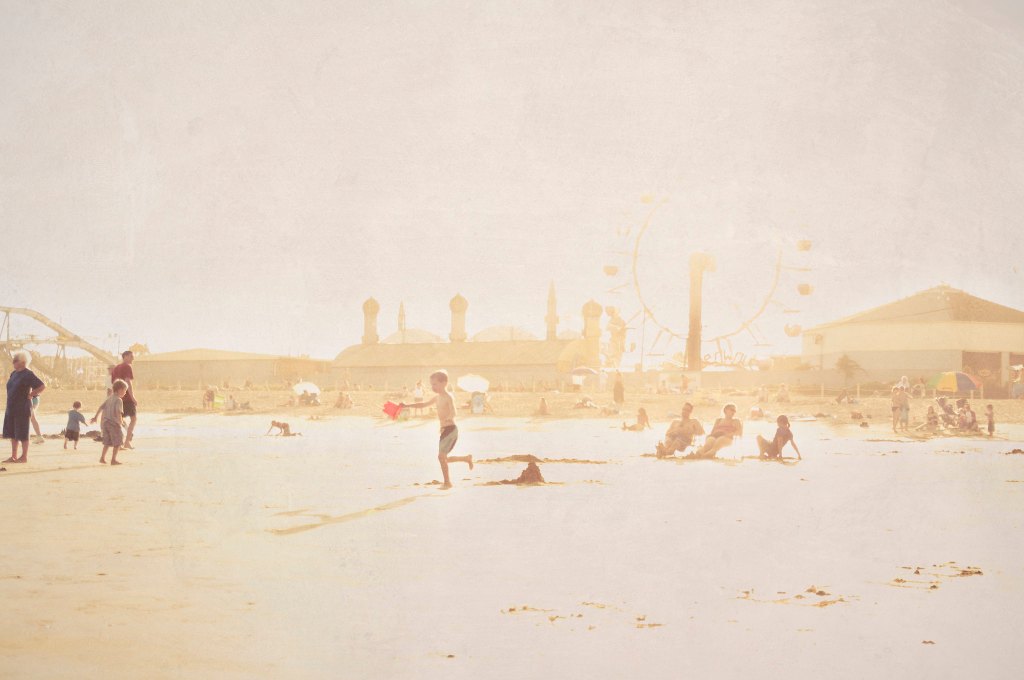
hot sand
my son asks me
about sin
— Joshua St. Claire (USA)
The Heron’s Nest, Volume XXV, Number 3: September 2023
Commentary from Nicholas Klacsanzky:
Living by beaches most of my life, I instantly resonated with the first line. I’ve even seen shoes being melted by hot sand. Anyway, the concept of “sin” is extremely complex and nuanced. I suppose the son is a young boy who has recently taken an interest in either church studies or philosophy. Many times, parents don’t have succinct or clear answers to children’s questions, as they are still trying to work out the answers themselves.
I can feel the humor in this haiku as well, as perhaps the father has been dealing with some “sin” and doesn’t want to teach something he doesn’t subscribe to himself. In some faiths, it is taught that everyone is a sinner, and the hot sand is a fine representation of that.
Looking at the technicalities, I enjoy the “o” sounds that mark exasperation and the “s” sounds that mimic the hiss of hot sand. I also admire the pace of the poem and the twist in the third line. Finally, it has a clear kigo or seasonal reference for summer, which contrasts poetically and humorously with the topic.
mud season again —
the crow’s feet
a little deeper
— Kelly Sargent (USA)
Modern Haiku, Issue 54.2, Summer 2023
Commentary from Jacob D. Salzer:
Slight differences in the season and climate have a significant impact on the health of plants, birds, insects, and animals. Mud season is the period between winter and spring, and is marked by melting snow, rain, and mud. In this haiku, the mud is even deeper than the year before, which could be due to climate change. This haiku conjures up compassion for the crow who is or was stuck in the mud. This haiku could be in the setting of someone’s yard in a suburban environment or somewhere in Nature. While the haiku focuses on the crow’s feet or footprints, I simultaneously envisioned the crow’s strength as he or she flies away. In this haiku, I also think of Indigenous legends that involve a crow. In short, this haiku has vivid imagery and makes us think about our impact on the Earth and many other species. May we choose to live more mindfully with more awareness and compassion.
the longest journey…
a falling leaf
returns to dust
— Daniela Rodi (Finland)
Selected, 10 winning works, The 5th Basho — an International English Haiku Competition 2023
Commentary from Hifsa Ashraf:
It’s a concise poem with a clear meaning of death, annihilation, or transformation. “The longest journey” may be specific to death or a spiritual/inner journey. In both cases, the person reaches an eternal or purposeful destination. The falling leaf in the second line tells us about the annihilation, end of life, or transformation. A leaf can reflect life stages where one passes through rigorous experiences and eventually reaches the end where existence has become nothing or loses its superficial meaning.
A falling leaf depicts transformation, as according to nature’s rules, one stage of life transforms into another in a set period. ‘Returns to dust’ is about our origin which means no matter what, all of us have to meet our genesis one day in the form of death or the true recognition of who we are. The latter can translate to understanding the ultimate purpose of our lives.
This poem shows how selflessly a person continues their life after fading away, or after having deep experiences, where a materialistic life or possessions mean nothing and humility become one’s true virtue.
Painting by Sean McGrath

 Haiku Commentary