
lockdown raised
at sunrise he releases
his prized canary
— Michael Dudley (Canada)
(27th Kusamakura International Haiku Contest, Second Prize)
Commentary
I appreciate the notion of freedom and non-attachment in this haiku. I also appreciate the shift in perspective from a confined space to the limitless sky. What was once highly valued and clung to is now released. It seems giving space is a gift in itself, and I admire how our attention shifts from what is seen to what is unseen in this poem. In turn, maybe the very notion of “mine” is released with the canary, as this beautiful bird returns to their true home outside of human civilization. Perhaps by releasing the sense of “me” and “mine,” we can rediscover our spiritual home as well. A beautiful haiku.
This haiku in a cascading style makes me think about its formation before I interpret it. It seems the person wants to convey a specific message through this style that can be read both horizontally and somehow vertically. The cascading style stops us so that we read the poem step by step before reaching a conclusion. I see it as if something is going down or ending nowhere.
Lockdown raised but what? It could be anxiety, uncertainty, frustration, or something that has a great impact on the person’s life that is being referenced. The past tense at the end of line one stresses the grave effects of the tense situation due to the lockdown. The sudden shift to the present in line two shows how smoothly the person has gotten over what he has been going through (maybe for a long time).
The sunrise brings hope and warmth to one’s thoughts and feelings. We can feel the way the sunrise provides a sense of relief or healing. I see it as if the person is liberated after having a change in thoughts or has detached himself from what he may hold dear. This line stands alone, where one can try to guess what the whole story is.
The prized canary may have an association with the person’s life in terms of honour, achievement, memorable event, etc. But, it also symbolizes a hope for the future where the person in question has stepped over the barrier of attachment and possession. If it is a pet bird, then releasing it at the time of a lockdown is the realization of freedom, which often comes through rigorous life experiences.
— Hifsa Ashraf
If we try to figure out the season this haiku is placed in, it is not so easy. However, if I had to pick one, it would be spring. Not only is it a season with less disease (“lockdown raised”), but it is also the time when canaries are more active. Spring, in addition, symbolizes a new life—corresponding well with “sunrise” and “releases.”
The two parts of the haiku can be delineated from the grammatical pause after the first line, or even after “at sunrise.” So, punctuation is not quite needed.
The association between the words “raised” and “releases” is quite deliberate, I feel. Furthermore, the color of the sunrise and the canary are most likely similar, if not yellow. Both the canary and the sunrise are not only colorful but also bring hope and pack a punch though one lasts a short time (sunrise) and one is small (the canary).
The spacing of the lines brings about a sense of release and perhaps steps to that letting go. However, the lines still approximate the traditional rhythm of haiku in Japanese in terms of syllables with a short first line, a longer second line, and a shorter last line.
In terms of sound, the haiku prominently features the letter “i” in “raised,” “sunrise,” and “prized.” Through this sound, it creates a starker mood for the haiku and points to the importance of the canary.
With a unique format, the implication of color, a keen sense of sound, and relatable kindness, this haiku deserves study and ponderance.
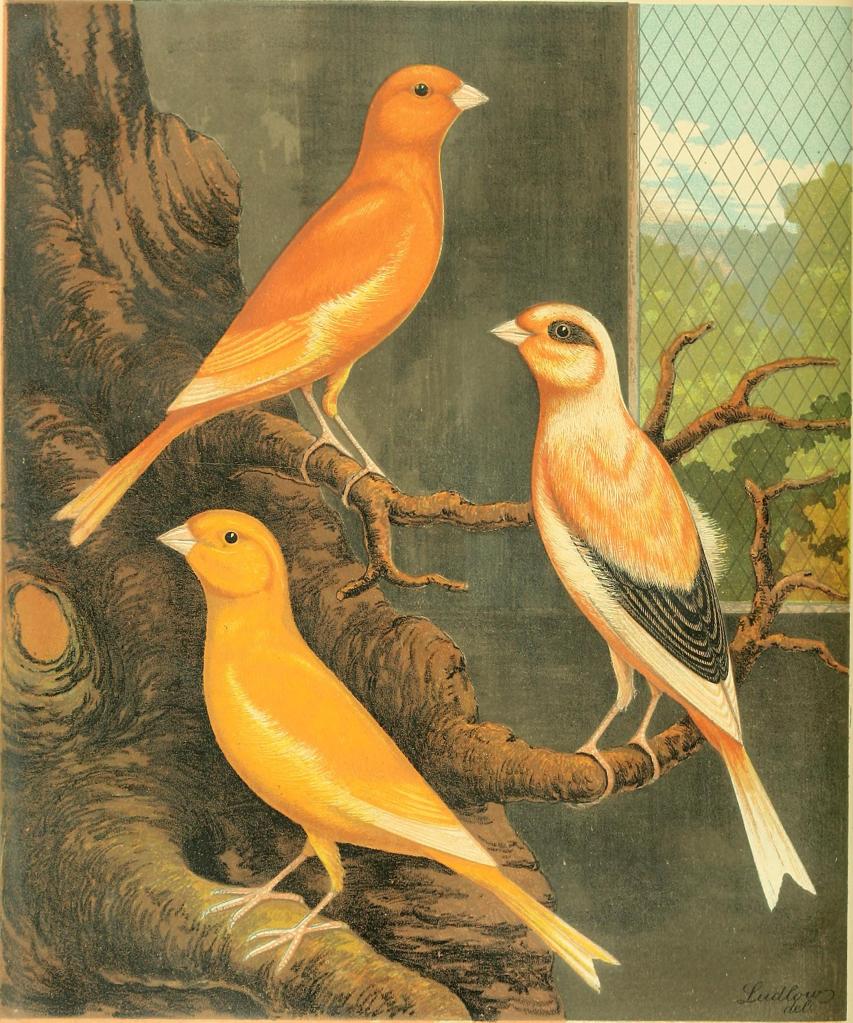
“The illustrated book of canaries and cage-birds, British and foreign” (1878) Public Domain
 Haiku Commentary