Poems by Kelly Sargent, Marc Brimble, and Anthony Lusardi

fallen acorn renewing our vows

Kelly Sargent (USA) 
Frogpond, issue 47:1, winter 2024

Commentary from Nicholas Klacsanzky:

The way the word “renewing” works as a pivot to create different readings is spectacular. I think the monoku could be read in at least three ways: “fallen/acorn renewing our vows”; “fallen acorn/renewing our vows”; “fallen acorn renewing/our vows.”

The contrast between “fallen” and “renewing” creates a powerful link. Acorns are also often used as symbols of rebirth, and the monoku could be personifying it. In addition, I enjoy how the kind of vows that are being expressed is left up to the reader.

Finally, the train of “n,” “o,” and “w” sounds makes this haiku sonically pleasant. The poem begins with harder sounds and ends with softer tones. With only five words, the poem has much euphony and meaning.

waiting for confession
I notice
The Virgin’s thigh

Marc Brimble (Spain)

Commentary from Hifsa Ashraf:

The opening line of this haiku is personal and well thought out. It seems the person is going through the process of reflecting on what went wrong in their life. The mistakes bother the person but at the same time, there is no sort of hesitation, conflict, or confusion in obtaining a confession. The question is: “Is it a big confession?” “Is it someone’s first confession?” “Is it a self-motivated confession?” “Is it a forced confession?” In any case, the one who will confess is taking time to think about it.

In the second part of the poem, there is a surprising element of moving from spiritual to worldly desires. It may imply that the person will confess something about yearnings or an intimate relationship. Nonetheless, their thought process is oscillating between what is seen and what is not, what is more significant and what is less, what is right and what is wrong. It seems the person is being distracted from a symbolic meaning of life by worldly desires and is not yet ready for a deeply felt confession. 

within its web
within a hollow stump
a grass spider                      
feels the earth
and all its vibrations

Anthony Lusardi (USA)
Ribbons, Spring/Summer issue, 2022

Commentary from Jacob D. Salzer

The clear imagery and the perspective from the spider’s point of view make this a strong tanka. The web could be seen as a symbol for the web of life. I appreciate how this tanka reminds us of the interconnectedness of life and the impact we have on Earth and her creatures. The last line also opens up many possibilities as we imagine the different vibrations. When I read this tanka, I feel compassion for the spider. There could also be metaphorical interpretations in the first two lines. Ultimately, I think this tanka reminds us to be more mindful of our actions. I believe this is an important, ecologically-based tanka that inspires compassion.
Nefflier a gros Fruit. Original from the Minneapolis Institute of Art. Dated: 19th century ; Artist: Michel Bouquet ; Nationality: French ; Artist Life: 1807-1890.

Haiku from Antoine Cassar, Tuyet Van Do, and Srini

Negotiations —
owner, bank, architect, notary,
and now this mosquito…

Antoine Cassar (Malta)

Commentary from Jacob D. Salzer:

As humans, we are frequently faced with negotiations, but this haiku also has a humorous twist in the last line, which I appreciate. It seems the poet’s sense of humor in this haiku may be a kind of coping mechanism among frustrating and/or challenging situations in life.

Another unique feature of this haiku is the poet’s use of punctuation. We have an em dash, four commas, and an ellipsis, which is rarely seen in a single haiku. I think the many forms of punctuation amplify a drawn-out, elongated effect, which seems to give the impression that the poet may be tired of negotiations and wants more peace and silence. Indeed, some negotiations also go on for quite some time. For example, competing for the ownership of a house can involve several negotiations regarding the mortgage payments and the down payment. 

In short, this is an interesting haiku that blends humor with the heavy financial decisions, negotiations, and struggles that many of us face in modern life.

musical notes
across the power lines
spotted doves

Tuyet Van Do (Australia)
haikuNetra, issue 1.2, 2023

Commentary from Nicholas Klacsanzky:

I prefer haiku that employ pivot lines, and this one delivers. “Musical notes across power lines” is a neat phenomenon to imagine. However, it can turn morbid if we imagine the doves are getting electrocuted and there is sound coming from that occurrence. “Across the power lines, spotted doves” is much more tame, in my opinion, as it sees the doves adding their songs to the hum of electrical lines. This interpretation makes a connection between nature and the human world.

This haiku is also pleasant to the ear, with the strong presence of “o” and “s.” It is paced well, too, with the traditional short/long/long rhythm. Also, with only eight words, the poet focused on brevity and the economy of language. In addition, the poet made sure the poem didn’t lean into verbosity. Overall, this haiku combines a variety of poignant interpretations with technical accuracy in its craft.

where school ends wildflowers

Srini (India)
haikuNetra, issue 1.4, 2023

Commentary from Hifsa Ashraf:

This simple monoku says a lot in four words. I see it in terms of time and space. It starts with a question that lets us pause and think about the space or place. The school may be in a remote area, a war-affected domain, a refugee camp, or a city/town. The location is significant in this case. I see it as a war-affected area or a refugee camp where it’s unpredictable what will happen after school or where learning and knowledge will take a student. ‘School ends’ doesn’t mean anything certain in the future or ‘school ends wildflowers’ may lead to something specific. Another aspect could be a school where a person rejoices in a carefree life, and when it comes to an end, the worries or anxieties about the future start coming.

I like the way the poet ends it with ‘wildflowers’—something I often use in my poems, and it’s the title of my micropoetry book on refugees. ‘Wildflowers’ show both abundance and abandonment here depending on how we read it i.e. ‘school ends wildflowers’= abundance or ‘school ending at wildflowers’= abandonment. So, it can be an opportunity for a new life or a new beginning. It could also display a hope for abundance. On the flipside, it could demonstrate abandonment in a real sense where someone may get stuck with a career or responsibility, or remain directionless like wildflowers. Ultimately, I take it as something positive irrespective of the location or situation of the school or personal experiences associated with it. 


Michael Dudley’s prized canary

lockdown raised
  at sunrise he releases
       his prized canary

Michael Dudley (Canada)
(27th Kusamakura International Haiku Contest, Second Prize)

Commentary

I appreciate the notion of freedom and non-attachment in this haiku. I also appreciate the shift in perspective from a confined space to the limitless sky. What was once highly valued and clung to is now released. It seems giving space is a gift in itself, and I admire how our attention shifts from what is seen to what is unseen in this poem. In turn, maybe the very notion of “mine” is released with the canary, as this beautiful bird returns to their true home outside of human civilization. Perhaps by releasing the sense of “me” and “mine,” we can rediscover our spiritual home as well. A beautiful haiku.

Jacob D. Salzer

This haiku in a cascading style makes me think about its formation before I interpret it. It seems the person wants to convey a specific message through this style that can be read both horizontally and somehow vertically. The cascading style stops us so that we read the poem step by step before reaching a conclusion. I see it as if something is going down or ending nowhere.

Lockdown raised but what? It could be anxiety, uncertainty, frustration, or something that has a great impact on the person’s life that is being referenced. The past tense at the end of line one stresses the grave effects of the tense situation due to the lockdown. The sudden shift to the present in line two shows how smoothly the person has gotten over what he has been going through (maybe for a long time). 

The sunrise brings hope and warmth to one’s thoughts and feelings. We can feel the way the sunrise provides a sense of relief or healing. I see it as if the person is liberated after having a change in thoughts or has detached himself from what he may hold dear. This line stands alone, where one can try to guess what the whole story is.

The prized canary may have an association with the person’s life in terms of honour, achievement, memorable event, etc. But, it also symbolizes a hope for the future where the person in question has stepped over the barrier of attachment and possession. If it is a pet bird, then releasing it at the time of a lockdown is the realization of freedom, which often comes through rigorous life experiences. 

Hifsa Ashraf

If we try to figure out the season this haiku is placed in, it is not so easy. However, if I had to pick one, it would be spring. Not only is it a season with less disease (“lockdown raised”), but it is also the time when canaries are more active. Spring, in addition, symbolizes a new life—corresponding well with “sunrise” and “releases.”

The two parts of the haiku can be delineated from the grammatical pause after the first line, or even after “at sunrise.” So, punctuation is not quite needed.

The association between the words “raised” and “releases” is quite deliberate, I feel. Furthermore, the color of the sunrise and the canary are most likely similar, if not yellow. Both the canary and the sunrise are not only colorful but also bring hope and pack a punch though one lasts a short time (sunrise) and one is small (the canary).

The spacing of the lines brings about a sense of release and perhaps steps to that letting go. However, the lines still approximate the traditional rhythm of haiku in Japanese in terms of syllables with a short first line, a longer second line, and a shorter last line.

In terms of sound, the haiku prominently features the letter “i” in “raised,” “sunrise,” and “prized.” Through this sound, it creates a starker mood for the haiku and points to the importance of the canary.

With a unique format, the implication of color, a keen sense of sound, and relatable kindness, this haiku deserves study and ponderance.

Nicholas Klacsanzky

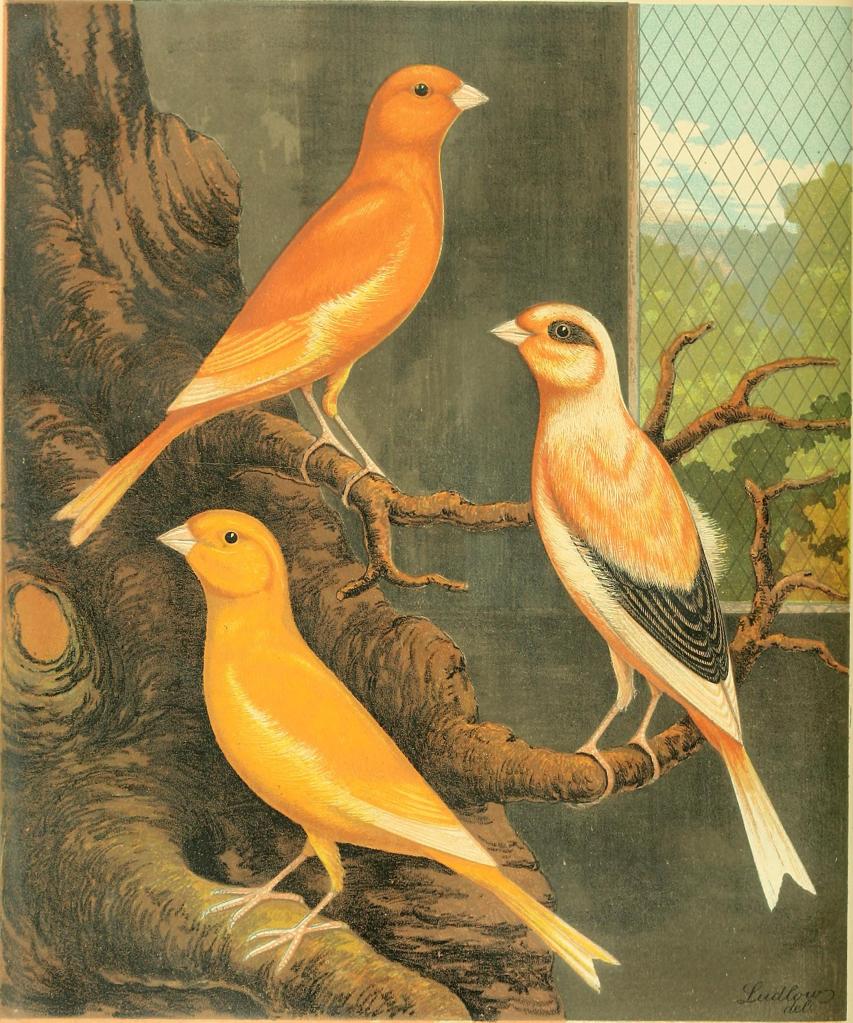
“The illustrated book of canaries and cage-birds, British and foreign” (1878) Public Domain