Haiku by Maurizio Brancaleoni, Kala Ramesh, and Sarah Mirabile-Blacker

small green leaves —
the ticket machine
is acting up


Maurizio Brancaleoni (Italy)
Trash Panda, Vol. 7, Summer Issue 2024

Commentary from Jacob D. Salzer

I appreciate the message and humor in this haiku. On first read, I saw the small green leaves being stuck in the ticket machine, preventing it from working. Alternatively, the machine could be malfunctioning for other reasons. In terms of a visual comparison, this haiku reminds me that ticket machines have semiconductor chips that are very small. What happens when a ticket machine (that has become a normal part of life) stops working? That moment of humor and frustration comes through this haiku. We also don’t know what kind of ticket machine is being referred to in this haiku. I like that it’s left open for the reader.

Sometimes, I think certain technological interruptions in daily life can reap many benefits and different points of view. It can break habitual thought patterns and offer fresh perspectives on life. As Gururaj Ananda Yogi has said, “Life is not meant to be lived like a machine. Life is an art.” This haiku also brings to mind haiku about power outages and how a power outage can open up new perspectives and ways of living and being in the world. Parallel to this observation, I think that because the machine is not working in this haiku, the poet is able to notice Nature. I find there is beauty in that. In general, perhaps if more people spent less time with technology and less time on their phones, they could notice more beauty around them.

In my city, there are various machines along streets and bus stops, including parking ticket machines, that help generate revenue for the city budget. How much money do cities make per year in parking tickets alone? According to qz.com, “San Jose made $11.4 million through parking tickets in 2019, an amount that doesn’t include the fees that weren’t collected.”

In short, this is an interesting haiku that explores the various intersections between Nature, psychology, money, and technology in modern life.

cycling   the moon and i    in sync

Kala Ramesh (India)
Wales Haiku Journal: Summer 2025 edition

Commentary from Hifsa Ashraf:

This haiku elegantly captures the interplay between nature and personal experience, linking the lunar cycle to the menstrual cycle. Even without an accompanying description, the connection between the average 29-day menstrual cycle and the lunar cycle remains clear. The term “cycling” conveys more than temporal alignment; it signals synchronized phases—waxing and waning, thickening and thinning—of both the moon’s surface and the womb’s lining. This suggests profound harmony between human biology and cosmic rhythms. “Cycling” carries layered meanings: endurance, patience, and transformation, whether physical or subtle, in both body and moon. Its repetitive nature reflects the universe’s order—growth and decline, life and death, beginnings and endings. These parallel the shared journeys of nature and humanity. Finally, the moon emerges as a symbol of life, fertility, love, rebirth, and transformation. It shares an intimate, almost invisible connection with the womb.

The monoku’s use of “i” in lowercase conveys humility and grace. It embraces the cyclical nature of both body and moon. The poet forges a unique bond, aligning the feminine essence of the moon and the self in harmony.

The word “sync” acts as a clever pivot. It implies both alignment and an inevitable pause—perhaps signaling transformation, rebirth, or menopause, where cycles break before renewing. This pause invites meditation, renewal, or a shift in life’s course. It offers a moment of rejuvenation after exhaustion.

The monoku’s spacing encourages reflection on each word, slowing the reader’s rush to judgment. This structure, combined with the lowercase “i,” underscores humility and invites the contemplation of the interconnected cycles of nature and self, unified in their feminine essence.

dusk —
riding tandem
with his shadow


Sarah Mirabile-Blacker (Switzerland)

Commentary from Nicholas Klacsanzky:

This haiku captures a fleeting yet intimate moment between self and shadow, set against the liminal time of dusk. “dusk” isn’t a conventional kigo (seasonal reference), but it functions evocatively. Dusk carries universal associations with transition and ending—themes rich with emotional and symbolic resonance. Although not tied directly to a season, it offers a subtle kigo-like atmosphere, hinting at cyclical closure or introspection.

The dash after “dusk” pauses the reader, allowing the scene to transition—between day and night, visibility and obscurity. The dash puts “dusk” into “solitude” before introducing the duo of the rider and his shadow. That separation allows the two elements—time and action—to resonate individually, then recombine through the act of juxtaposition. The dash is an approximation of kireji, the Japanese cut marker in a haiku.

“Riding tandem” suggests companionship and rhythm. To “ride tandem with his shadow” conveys both literal imagery—a cyclist lengthened by his dark double—and metaphorical resonance. The shadow is no longer a passive outline; it becomes an equal partner, keeping pace, inseparable yet independent. “his shadow” could also refer to the narrator riding alongside the shadow of a friend, husband, or family member.

Looking at the sound of the haiku, dusk closes with the hushed consonant cluster -sk, trailing off like something that is dimming. shadow ends in the long, fading vowel -ow, evoking dissolving, like a sound disappearing into the air. So, the word choices themselves suggest a diminishing, mirroring the passage into night. Also, the sharp sounds (bolded) in “riding,” “tandem,” “with,” “his,” and “shadow” provide a stark atmosphere to the poem.

This haiku displays a precise perception that opens into wider emotional and philosophical terrain. Through the use of kireji, the mood-infused “dusk,” and the economical but striking juxtaposition of rider and shadow, the poem evokes transience, identity, and companionship in a moment suspended between day and night.

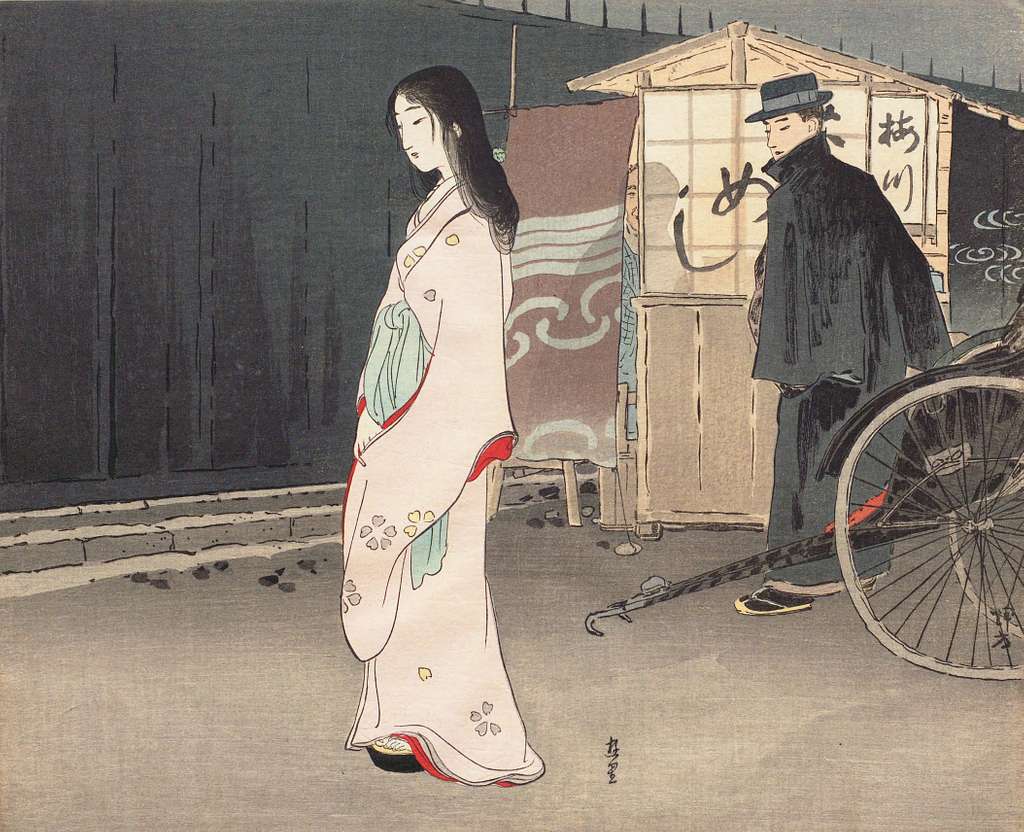
Frontispiece to “Sharing an umbrella (Ai ai gasa)” by Izumi Kyōka, frontispiece illustration, woodblock print.

Haiku by Elliot Diamond, Neena Singh, and Jennifer Gurney

the first hole of a shakuhachi dawn 

Elliot Diamond (USA)
Modern Haiku 55.2, 2024

Commentary from Nicholas Klacsanzky:

This haiku succeeds in seamlessly layering sound and imagery to create a spiritual atmosphere. It juxtaposes the shakuhachi—an ancient Japanese bamboo flute—with the unfolding of dawn. The “first hole” can be read both literally, as the finger-hole that allows the first note to emerge, and metaphorically, as an aperture through which the first light of day enters the world. It also could be a symbol of a threshold between silence and sound, darkness and light. The shakuhachi’s connection with Zen practice further shades the image with spiritual awakening: dawn not only as a time of day, but also as a symbol of enlightenment.

The haiku, being one line, creates a representation of the shakuhachi. It could have been written as three lines, such as “dawn/the first hole/of a shakuhachi.” However, I feel the haiku is more organic and interesting as one line.

The diction is minimal, yet the resonance is wide: the reader can hear the first note, feel the cool breeze of dawn, and perhaps see the bamboo hollowed into an instrument. In addition, the phrasing enjoyably blurs instrument and environment. What we’re left with is not just an instrument or a sunrise but a moment of initiation, where time seems to exhale through the flute.

Though there is no kigo or seasonal reference, the time is evident. There is also no kireji or marker for a break, though there can be a natural pause after “shakuhachi.”

Finally, the sound of the haiku works well with the letter “h” being the most prominent. The breathiness of the letter “h” in “hole and “shakuhachi” illustrates blowing into a flute.

Despite the minimalist aesthetic of this haiku, the poet leaves a lot for the reader to ponder and feel through inner vision.

summer solstice
the busker plays
a tune from home


Neena Singh (India)
2nd Prize, Japan Fair Haiku Contest 2025

Commentary from Hifsa Ashraf:

The haiku’s imagery, anchored by the summer solstice kigo, evokes solitude and introspection through a busker’s tune played from home. The solstice’s long daylight amplifies the sense of isolation, yet the music serves as a cathartic bridge to an unseen audience, blending self-fulfillment with a subtle yearning for connection. The summer solstice, with its prolonged daylight, casts a spotlight on the busker’s solitary performance, evoking and highlighting both isolation and self-awareness.  I see the poem as a catharsis and self-awareness where an artist thoroughly enjoys their talent without having an audience or the audience is unseen.

The haiku conveys the busker’s enjoyment of solitude, longing, or melancholy in the deepest way. The poem balances solitude and loneliness, suggesting the busker finds fulfillment in their music while possibly yearning for the connection typically found in public performance. If rooted in a Japanese context, the busker’s solitary tune might reflect a Zen-inspired embrace of the present moment, deepening the poem’s meditative quality. In any case, it is irrelevant to the person who may be in a meditative state of selflessness or enjoying being alone, only with what they enjoy the most. It also makes me wonder: does the poem suggest the busker imagines an audience, or is the music itself a bridge to an abstract sense of connection?
A “tune from home” could imply the busker is playing from within their home, possibly for an unseen audience. However, buskers traditionally perform in public spaces for passersby, so the shift to a private setting might be a deliberate contrast in the poem, symbolizing introspection or a lack of external validation.

Looking at the technical details, the lack of punctuation and the rhythmic ‘m’ sounds mirror the tune’s fluidity, creating a meditative tone that resonates with both the busker’s inner world and the listener’s sense of belonging.

the branches
of my family tree
together

Jennifer Gurney (USA)
Cold Moon Journal, 6/19/25

Commentary from Jacob D. Salzer:

I appreciate how this haiku offers at least a few different interpretations. After the first read, I saw many lives joined through her family heritage. This seems to be a relatively simple metaphor, but it can act as a portal into the details of many family members and their stories. After reading a second time, I saw the branches as fallen and now physically gathered together. This leads to an interesting metaphorical interpretation that perhaps the souls of her family ancestors could be together in a different dimension. After a third reading, I saw the poet viewing a historical family album and/or a historical document/book about her ancestors.

As a creative writing exercise, I recently wrote a letter to my first great-grandfather, who settled in the U.S. I tried my best to transport myself back in time and asked many questions about his life. In addition, my father shared historical records of our ancestors. This has deepened my understanding of our family tree and makes me realize how much has changed in a relatively short amount of time. All this being said, I appreciate how this haiku encourages us to study our genealogy and history to see what we can learn about our ancestors and ourselves.

Suzuki Harunobu (circa 1725-1770). Courtesan playing Shakuhachi. Page from: Ehon Seiro Bijin Awase (Picture Book of comparative beauties of teahouses).

Haiku by Kavita Ratna, Tuyet Van Do, and Katherine E Winnick

in the margins
of a funeral
a message pings


Kavita Ratna (India)
LEAF, June 2023

Commentary from Jacob D. Salzer:

An important haiku that sparks a conversation about our views of death, funerals, and technology in modernity. The first line is unique because it has literal and potentially metaphorical interpretations. Was the person with the cellphone living at the psychological margins of the deceased person’s life when they were alive? Was the person with the cellphone a friend or acquaintance who didn’t know most of the people at the funeral? This can create an awkward social situation. At the same time, it can be humbling to see how one person touched so many people’s lives. The word “margins” seems to imply there are a lot of people attending the funeral. Perhaps this person doesn’t truly feel they can celebrate the deceased person’s life among the crowd of people. Does the modern-day ritual of funerals truly celebrate the deceased person in a unique way that they would actually want? 

According to Elizabeth Fournier in her book, “The Green Burial Guide: Everything You Need to Plan an Affordable, Environmentally Friendly Burial”: “Funeral expenses in the United States average more than $10,000. And every year conventional funerals bury millions of tons of wood, concrete, and metals, as well as millions of gallons of carcinogenic embalming fluid. There is a better way.”

Here is The Green Burial Guide on Bookshop.org, which I recommend:
https://bookshop.org/p/books/the-green-burial-guidebook-everything-you-need-to-plan-an-affordable-environmentally-friendly-burial-elizabeth-fournier/10952712?ean=9781608685233&next=t

Even though the person in this haiku is not noticeable at the funeral, their cellphone ping briefly interrupts the service and has a ripple effect. This makes me wonder about the ways we communicate in our culture and the quality of our communication methods. Text messages can be useful, but they can also be overly used. Since the English Language and technology are both tools, I think they need to be used carefully and wisely. Silencing our cellphones is also a clear gesture of respect, which this person in the haiku clearly forgot to do. The ping notification could mean an important message came through, or it could be something more superficial. It reminds me that we are constantly communicating with each other, both verbally and non-verbally, all the time. But do we use cellphones too much? What are the consequences of spending too much time on our cellphones and other devices?

I think the social norms of funerals in the U.S. need to be psychologically interrupted in light of how costly they are, both environmentally and financially. I sincerely hope that more people could plan ahead for how they want to be remembered and celebrated in modest ways through a living will. I also sincerely hope more people would choose an eco-friendly burial option. This truly benefits everyone and saves a significant amount of money, too.

In short, this is an important haiku that starts a larger conversation about funerals, how we remember and celebrate someone, and the role of technology in our lives. It could also spark conversations about the afterlife and reincarnation. How do we want to be remembered? What are we leaving behind? How can death remind us of how we truly want to live within this limited lifetime, moment by moment? As a community, I hope that compassion and wisdom can be our guiding light.

spoon by spoon 
feeding my patient …
a setting sun


Tuyet Van Do (Australia)
Poetry Pea Journal 2:25, 2025

Commentary from Hifsa Ashraf:

I can sense pain, endurance, caring, and departure in this subtle poem where the patient is either dying or getting relief from suffering. I see both hope and despair. The patient being taken care of by a nurse or paramedic staff is all alone and helpless. ‘Spoon by spoon’ is a deep expression, showing bits and pieces of healing by nourishing the patient. It could be food, medicine, or something more energetic, but it also depicts old age, where a person depends on others for their well-being.  

The use of ellipses in the second line after ‘feeding my patient’ stresses the depth of feelings of the person who is nursing the patient. Do they have any association with the patient? Do they empathise with the patient? Do they feel bad about the patient? Who is the patient? What’s the age of the patient? Is the patient alone or have a family? All these details remain open for interpretation. 

The last part of this haiku reveals something unfortunate and helpless. The dying sun symbolizes the end of life, when day transforms into night. In other words, the transformation of life into death or from an uncomfortable condition to a comfortable condition, where the patient sleeps well after getting some care. I see another aspect here: ‘sun’ may also be symbolic of the gender of the patient by creating an analogy of the sun with ‘son’. The beauty of this poem is that you can interpret it in as many ways as you can, and each aspect may lead to the harsh reality of life, which is death. 

Sakura Jishidi 
shadows of sparrows 
amongst the pink 


Katherine E Winnick (UK) 
Presence #79, 2024 

Commentary from Nicholas Klacsanzky:

“Sakura Jishidi” is the name of the Japanese tree peony. They commonly bloom in spring, and are used in haiku to signify this season. Employing the Japanese word for the flower instead of the English version is an intriguing choice. I believe it increases the sound quality of the haiku, as “Japanese tree peony” doesn’t mesh with the “s” and “i” sounds in the rest of the poem as much.

The keyword in this haiku, in my opinion, is “shadows.” I feel it has two meanings: the physical presence of shadows and the memory of sparrows. It could also be a reference to something fleeting, ominous, or gloomy. The mood of this haiku centers around this word, as even though the sakura blossoms display their pink, the memory, absence, or distance of sparrows decorates the flowers. Ultimately, this brings about a melancholy mood amidst spring. I resonate with these types of moods in haiku, as they mirror our nuanced lives. Within joy, there is oftentimes a touch of sadness or loss. This does not diminish joy, in my opinion, but allows us to be more grateful when it occurs and to experience it with a mature lens.

Copyright 2022, Tsun Ming Chmielinski