Haiku by Kala Ramesh, Valentina Meloni, and M. R. Defibaugh

beachcombing
countless empty homes
washed ashore

Kala Ramesh (India)
haikuKATHA: #35, September 2024

Commentary from Nicholas Klacsanzky:

What most connects me to this haiku is the multifaceted second line. I can see at least two ways to interpret “countless empty homes.” The more poetic way to see it is the homes of creatures like mollusks, and the like, washing ashore. The other interpretation is that people’s homes are coming ashore after a natural disaster like a powerful storm. Both versions bring a sense of dread and melancholy, especially in light of the contrasting leisurely activity of beachcombing. Another interpretation that may dawn on the reader is the imagery’s association with war. Our modern world is engulfed in several wars at the moment, and this haiku might be reflecting this. This way of perceiving the poem especially highlights a connection between humanity and the natural world.

Looking at the more technical aspects of this haiku, we can look at the punctuation, sound, and phrasing. There is a lack of punctuation, yet it is not quite needed. The second line acts more as a pivot without punctuation. As a reader, I intuitively paused after the first line, as if a comma or dash were there.

Kala Ramesh is a classically trained musician in Indian classical music, and it shows in her haiku. The “k” sound in “beachcombing” and “countless” brings about starkness in my mind. Conversely, the “o” sound in each line reinforces the melancholic mood of this poem.

Lastly, this haiku is paced in a way that approximates the original Japanese rhythm of haiku, which is a short first line, a longer second line, and a short third line as an English-language standard. Even though haiku is originally written in one line, it is delineated in two parts through kireji, and three lines in English represent those two parts. It is also noticeable that the poet practiced brevity and conciseness, with each word in this haiku being important and efficient.

The sum of this haiku is greater than its parts, though. The feeling one gets from the imagery, sound, and pacing is best simply felt rather than explained. A sense of compassion washes over the reader, which is sorely needed these days.

music plays—
sweet air holds a longing
for what might be

Valentina Meloni (Italy)

Commentary from Jacob D. Salzer

As a musician, I appreciate the dynamic atmosphere in this haiku. I admire how this haiku includes sound, scent, and perhaps a sixth sense, or the sense of longing. I like how the music is not defined, which allows us as the readers to hear different kinds of music. “music plays” gives me a feeling that the music is unfamiliar, and perhaps heard at some distance. I feel this adds spatial and psychological depth to this haiku. When I read the second line, I imagine breathing in the scent of a flower (or perhaps several different kinds of flowers) that has a sweet scent, though I like how the poet left the sweet scent open for the reader. I also like how the sweet air implies wind or a soft breeze that combines with the music. Through music and scent, the poet succeeds in leaving room for mystery. Perhaps most importantly, this haiku shows the power of music and its ability to inspire and bring us hope in a way that transcends words and thoughts. For me, among all art forms, music continues to be the most powerful creative expression of the human spirit. This haiku effectively expresses this sentiment, with grace, beauty, and mystery. A beautiful haiku.

prayer balloon—
our scribbled wishes
just out of reach


M. R. Defibaugh (USA)
English-Speaking Union of Japan-Haiku, March 2025

Commentary from Hifsa Ashraf:

This is a haiku that is purely based on the belief in prayers. I am a great believer in prayers. A prayer balloon is a symbolic way of writing and sending prayers, which is quite subtle. I find it a beautiful way to show one’s deep connection with prayers, wishes, and desires, and demonstrate it tangibly. It also helps the person psychologically to let go of worries with the flying balloon. 

The em dash after the prayer balloon shows its significance for the poet. The second line is about one’s wishes that are scribbled and highlighted on the balloon. It is a way to share one’s desires in the most obvious manner, where one is not only wishing them in their hearts but also aware of those wishes by scribbling them.

I find it therapeutic when one writes down their prayers or wishes on a delicate balloon that can carry the weight of those prayers and wishes easily, and acts as a bridge between the person and God. When a prayer is being scribbled on a balloon, it involves all senses, which means the person is mindful and fully aware of what’s in their heart and what should be written. This is the act of knowing. 

The third line is a sort of comparison and contrast with the second one—the act of unknowing. The person’s conviction and beliefs are intact whilst scribbling the wishes, but there is a sense of helplessness or no anticipation of those wishes; there are some sort of expectations and thoughts that gather in the mind after releasing the balloon in the air. This is a sort of realization that certain things are not in our control; we can make efforts only. ‘Just’ in the third line means the person has precise thoughts on it that once the wishes are done, they are not in our hands anymore—especially in this case, where the balloon disappears after some time. So, it’s a journey from seeing to beyond seeing, where one’s thoughts and feelings oscillate from known to unknown or vice versa. 
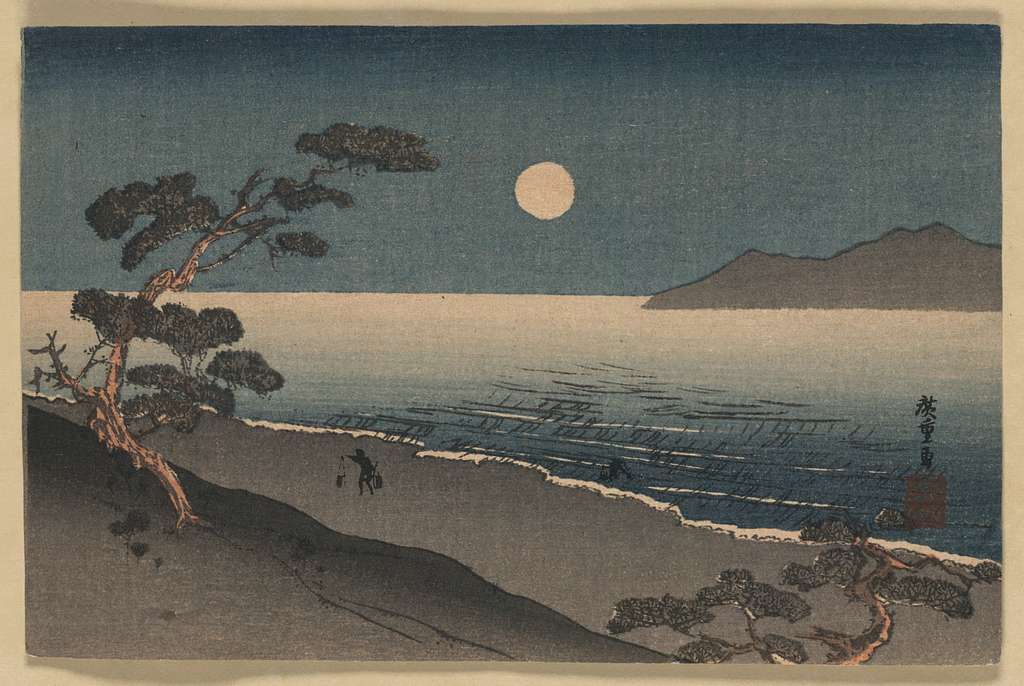
Matsumoto print, no. 39. The Matsumoto Do, Ltd. Tokyo, Japan.
Haiku by Michael Shoemaker, Anthony Lusardi, and Richard L. Matta

morning campfire smoke
curls and rises above pines
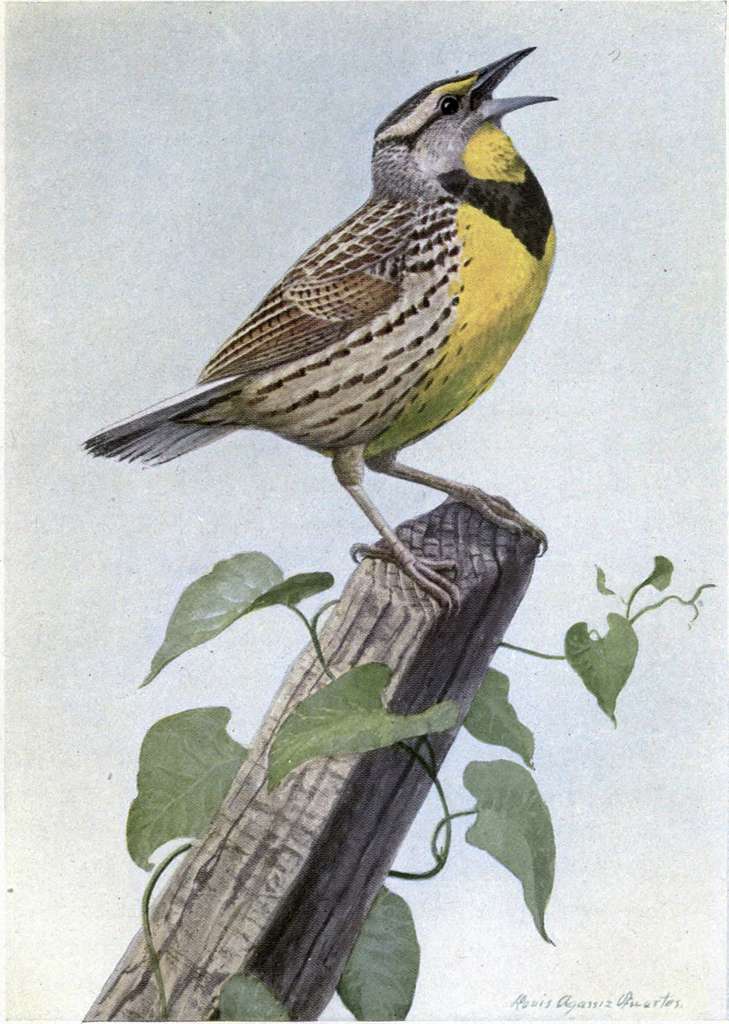
meadowlark’s sing-song

Michael Shoemaker (USA)
Under the Bashō, June 24, 2024

Commentary from Hifsa Ashraf:

The first line of this 5/7/5 haiku tells us the time and space where one can directly imagine the whole scene before going into the details. A morning campfire can be used for warming the ambience, a get-together, cooking, etc. In any case, a campfire usually is a sign of lively activities. Adding smoke makes this haiku a bit more profound and mystical. Is it just smoke and no fire? Does it happen before or after the fire? 

The second line is more focused on the details of the smoke, curling and rising above the pines. This leaves our imagination to run wild and to think of the shape, structure, intensity, and smell of smoke. The second line could be about how smoke overshadows nature. It may be a sign of air pollution adding toxicity to the pines, which is a symbol of purity.

The meadowlark’s sing-song could be a sign of alertness depending on the pitch. For me, it may be more like a complaint or a reaction to smoke/pollution—probably in the form of a sad melody we commonly ignore. The other aspect to consider is how nature responds to our acts of toxicity with sweet melodies. The meadowlark’s song demonstrates resistance and determination in the form of music and voice.

This haiku, in its simplicity, describes a story of our actions to spread pollution and toxicants and nature’s response to it.

gloaming . . .
a spider clings to                
her egg sac

Anthony Lusardi (USA)
tsuri-doro, issue #19, Jan/Feb 2024

Commentary from Jacob D. Salzer

“Gloaming” means twilight or dusk, but it can also mean sullenness and melancholy. I appreciate how this haiku shows a mother’s love and protection with the verb “clings” and the egg sac. The mother spider is protecting her eggs from something or perhaps many things. We don’t know what dangers might be present for the spider and her eggs, which opens the door to our imagination. Dusk or twilight effectively sets the mood and atmosphere of the poem, as light fades into darkness. With that in mind, this haiku might have a somewhat haunting atmosphere as what is visible becomes invisible, yet there is still enough light for the poet to capture this moment. As the night deepens, we enter the Great Mystery. In short, this is an effective haiku that gives us a glimpse of a mother’s love for her soon-to-be children, which can apply to other creatures, insects, and mammals as well.

pinewood derby
still missing the weight 
of dad’s touch

Richard L. Matta (USA)
1st Place Senryu, Kaji Aso Studio, 35th International Haiku Contest 2024

Commentary from Nicholas Klacsanzky:

This senryu tapped into my memories, as I participated in pinewood derbies when I was a young lad with my father. More than that, this senryu uses the word “weight” effectively to have a double meaning of the physical weight of the cars and the emotional/spiritual weight of a father’s presence. “Missing” could imply that the poet’s father has either passed away or is out of contact—leaving that justly up to the reader to interpret.

I also enjoyed the sound in this senryu, with the letters “o” and “w” prominently featured. The instances of “o” contribute to the senryu being slowed down and savored, whereas “w” manifests an airy feeling to the poem. In my opinion, both of these attributes complement the context in which the senryu is written. Lastly, the senryu is efficiently written with only nine words, simple language, and excellent pacing in the line breaks. It is clear why this senryu won an award: it not only resonates with readers effortlessly but also demonstrates a keen understanding of the technical aspects of senryu.

Illustration by Louis Agassiz Fuertes of an Eastern Meadowlark (Sturnella magna), from The Burgess Bird Book for Children (1919)

Haiku from Kelly Sargent, W. Barrett Munn, and Fatma Zohra Habis

winter sky swallows the words I can’t take back

Kelly Sargent (USA)
Cold Moon Journal, March 2024

Commentary from Hifsa Ashraf:

A winter sky stays dull and dim but remains open to wild imagination. This monoku reflects various shades of a winter sky when we read it in one go. I focused on the first three words for a while, which can be read in three ways: winter/sky swallows, winter sky/swallows, and winter sky swallows.

The repetition of ‘s’ and ‘w’ sounds makes it more interesting to read and interpret. Sky swallows usually reflect loyalty, a new beginning, hope, transformation, and more. It seems it alludes to a murmuration that is getting the poet’s attention due to its shapeshifting, shades, shadows, and sound. The use of ‘swallows’ makes this monoku more profound and dynamic. The swallows in the sky could indicate the end of the winter as well which commonly is related to positive outcomes.

The second part of this monoku takes this monoku to another aspect that is more personal and profound. It looks like a mirror reflection of the first part of the monoku. When I read it as a whole, ‘the words I can’t take back’, it gives me a feeling that the person wants to express all that follows the murmuration in the winter sky. ‘the words’ is a catch here as they may reflect personal experiences that are either positive or negative.

If I read the second part of this monoku with the central word ‘swallows’ that juxtaposed this poem, it looks like the person is still in conflict.

“winter sky” is a ground where the poet masterfully displayed profound feelings and thoughts, while allowing readers to find as many interpretations as possible. It is a good exercise for the brain and heart to solve the mystery of this haiku.

no headstones;                         
buried all across the south
remains of slave ships

W. Barrett Munn (USA)
Haikuniverse, January 9, 2024

Commentary from Jacob D. Salzer

An important haiku that shows part of the darker history of the U.S. This haiku transports us back in time, yet we can still feel the consequences of slavery today. I can feel the unbearable weight of colonialism and capitalism when I read this haiku. It is unfathomable in my eyes to imagine being a slave or a slave owner. Some people who are buried are not always remembered with a designated tomb or headstone. This haiku conjures up several questions that we can ask ourselves: What else dwells beneath the ground that we walk on every day? How much of history is skewed, buried, or not documented? How can we preserve history to the best of our abilities, so that we, collectively, can (hopefully) learn and grow and not make the same mistakes? What are examples of modern-day slavery and what are the consequences? How many consumers are conscious of where their products come from? How many people know the origins of the things they buy? How many are aware of the working conditions in various factories? How many of us are open-minded to life after death? Where does karma originate? What is the nature of the soul? Despite the horrifying history, I appreciate how this haiku shines a light into the dark and lets us attempt to see those who are not seen. 

this morning
in the shell hole
lone bud

Fatma Zohra Habis (Algeria) 

Commentary from Nicholas Klacsanzky:

I enjoy how the second line interacts with the first and third lines. It can be read as “this morning in the shell hole/lone bud” or “this morning/in the shell hole lone bud.” The phrase “shell hole” makes me imagine both an ammunition shell and a shell from the sea. Both interpretations are valid and intriguing. Perhaps, though, morning and a bud connecting with ammunition is more poetic.

“lone bud” could refer to early spring or late winter, when buds are either just coming up or leaving for the time being. With “morning,” I get the feeling it could be the start of spring. This provides the haiku with a tone of hope. Ultimately, I believe it expresses that like the morning, new beginnings arise even in the most difficult of times and that life goes on even through the passed.

Another striking element of this haiku is its sound. The strongest sound comes from the letter “o,” which could represent a hole in its own right and demonstrate a soothing atmosphere to the poem. Also, with only eight words and the traditional rhythm of a short line/longer line/short line, the poem is economical and effective. The poet, I believe, rightly did not add punctuation, as it could have detracted from the flow of the pivot line and would have stood out too much. The haiku presents a simple image but has poignant overtones that can take the reader to different symbolistic places.

Painting by Daria Melantova

Haiku from Antoine Cassar, Tuyet Van Do, and Srini

Negotiations —
owner, bank, architect, notary,
and now this mosquito…

Antoine Cassar (Malta)

Commentary from Jacob D. Salzer:

As humans, we are frequently faced with negotiations, but this haiku also has a humorous twist in the last line, which I appreciate. It seems the poet’s sense of humor in this haiku may be a kind of coping mechanism among frustrating and/or challenging situations in life.

Another unique feature of this haiku is the poet’s use of punctuation. We have an em dash, four commas, and an ellipsis, which is rarely seen in a single haiku. I think the many forms of punctuation amplify a drawn-out, elongated effect, which seems to give the impression that the poet may be tired of negotiations and wants more peace and silence. Indeed, some negotiations also go on for quite some time. For example, competing for the ownership of a house can involve several negotiations regarding the mortgage payments and the down payment. 

In short, this is an interesting haiku that blends humor with the heavy financial decisions, negotiations, and struggles that many of us face in modern life.

musical notes
across the power lines
spotted doves

Tuyet Van Do (Australia)
haikuNetra, issue 1.2, 2023

Commentary from Nicholas Klacsanzky:

I prefer haiku that employ pivot lines, and this one delivers. “Musical notes across power lines” is a neat phenomenon to imagine. However, it can turn morbid if we imagine the doves are getting electrocuted and there is sound coming from that occurrence. “Across the power lines, spotted doves” is much more tame, in my opinion, as it sees the doves adding their songs to the hum of electrical lines. This interpretation makes a connection between nature and the human world.

This haiku is also pleasant to the ear, with the strong presence of “o” and “s.” It is paced well, too, with the traditional short/long/long rhythm. Also, with only eight words, the poet focused on brevity and the economy of language. In addition, the poet made sure the poem didn’t lean into verbosity. Overall, this haiku combines a variety of poignant interpretations with technical accuracy in its craft.

where school ends wildflowers

Srini (India)
haikuNetra, issue 1.4, 2023

Commentary from Hifsa Ashraf:

This simple monoku says a lot in four words. I see it in terms of time and space. It starts with a question that lets us pause and think about the space or place. The school may be in a remote area, a war-affected domain, a refugee camp, or a city/town. The location is significant in this case. I see it as a war-affected area or a refugee camp where it’s unpredictable what will happen after school or where learning and knowledge will take a student. ‘School ends’ doesn’t mean anything certain in the future or ‘school ends wildflowers’ may lead to something specific. Another aspect could be a school where a person rejoices in a carefree life, and when it comes to an end, the worries or anxieties about the future start coming.

I like the way the poet ends it with ‘wildflowers’—something I often use in my poems, and it’s the title of my micropoetry book on refugees. ‘Wildflowers’ show both abundance and abandonment here depending on how we read it i.e. ‘school ends wildflowers’= abundance or ‘school ending at wildflowers’= abandonment. So, it can be an opportunity for a new life or a new beginning. It could also display a hope for abundance. On the flipside, it could demonstrate abandonment in a real sense where someone may get stuck with a career or responsibility, or remain directionless like wildflowers. Ultimately, I take it as something positive irrespective of the location or situation of the school or personal experiences associated with it. 


Haiku by Ivy Raff, Sushma A. Singh, and Daniela Misso

Mist runs fingers through
green tendrils of mountain hair
One soulmate? A myth

Ivy Raff (USA)

Commentary from Jacob D. Salzer:

I think the first two lines are original and interesting. They show what the third line tells. I appreciate the notion regarding the dangers of relying on one person to meet so many needs in life. Ultimately, I am averse to the idea of a soulmate, which seems to have become a cultural norm in the West. 

This is a 5-7-5 haiku. While there is nothing wrong with 5-7-5 haiku, I would encourage the poet not to be solely restricted to this format when writing haiku in English.

It’s also interesting to include questions in haiku. Most times, I feel leaving the question open to the reader is most effective. In this haiku, the question is answered, which may be too telling for some readers. Still, I feel the juxtaposition is strong. I think this haiku is an excellent start to a conversation about relationships, marriage, and divorce. An interesting haiku.

Here is a statistical article on divorce in the U.S.: https://www.forbes.com/advisor/legal/divorce/divorce-statistics/

summer visit
mother fits into
a smaller hug

Sushma A. Singh (India)
The Heron’s Nest, Issue 4, December 2018
Shortlisted for The Touchstone Awards 2018
Red Moon Anthology 2018

Commentary from Hifsa Ashraf:

Sometimes, we don’t need a lot of words to tell our loved ones how we are feeling about them. A heartfelt moment is enough to say it all.

‘Summer visit’ indicates vacation time or long days. Either way, the person wants to have spare time to spend with their mother after a long time. Summer days, especially in Eastern countries, are really hot and humid. People usually feel uncomfortable physically and mentally. They need someone around them who can soothe their feelings. Visiting one’s mother is mostly a profound experience where there is deep communication on both sides.

In this poem, we can see the power of non-verbal communication where simply a small hug can make a lot of difference and tell the whole story of her poor health. I also see other hidden aspects here i.e. departure, lonliness, grief, etc. that has a great impact on health. One can feel it if they visit that person after a while.

Lastly, the letter ‘m’ dominates in this haiku with some underlying feelings that are left unexpressed. 

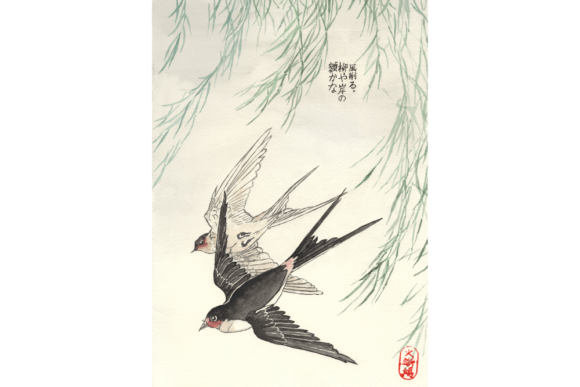
a goodbye
lost in the wind
morning swallows

Daniela Misso (Italy)
Frogpond 46:3, Autumn 2023

Commentary from Nicholas Klacsanzky:

The first aspect of this haiku that I noticed was the pivot line. It can work for both the first and third lines. The two ways the pivot line can be read reveal potent meanings. The second thing that struck me was the sense of sound. The elongated “o”s in the haiku slows the pace and allows the reader to soak in the poem. The string of “o”s also brings about emotions, such as melancholy and sympathy.

With only eight words, the poet doesn’t waste anything. The words “lost” and “morning” are the most impactful, in my opinion. Both may be hints to the kigo or seasonal reference. This haiku could be about the migration of swallows and that being compared to a goodbye being said. In addition, it could be a contrast between the harshness of a goodbye and the joy of morning sparrows. Either way, this haiku strikes several emotional chords and is also technically efficient on top of that.

Kiyomizu Temple in Autumn by Yamamoto Shunkyo, 1891