Jane Williams’ low tide

low tide
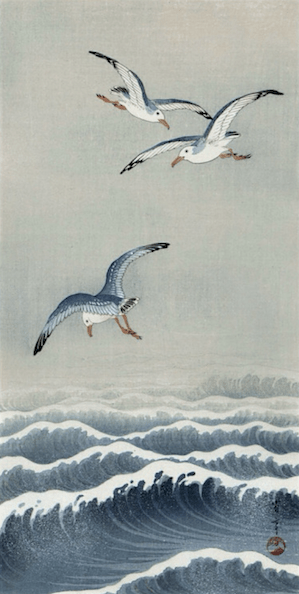
in the gull’s footprints
echoes of flight

Jane Williams (Australia)

First of all, I would like to discuss my immediate thought about this haiku that struck my senses and that’s the letter ‘o’ which dominates this haiku. This indicates the life cycle where we strive to fulfill our needs or dreams and to move to the next level or phase to do the same.

When there’s low tide, the waves are not as charged as they are during high tide, which means there is a calm situation on the seashore. So, low tide is equivalent to our positive or constructive thinking that helps us to make our life more meaningful by planning and managing our goals.

The gull’s footprints are a subtle expression of things that may not be very strong but can create a huge impact on our lives. The webbed feet of a gull is commonly prominent on seashores and are a sign of life, freedom, free will, mindfulness, and positivity.

To me, “echoes of flight” is about the destiny that is calling someone to take a flight, to strive and achieve the purpose of life. Echoes are the personal experiences that resonate in one’s mind about one’s forthcoming life. In other words, it’s the clarity of purpose that comes with maturity and a peaceful mind.

Hifsa Ashraf (Pakistan)

The thing that intrigued me initially about this haiku is the pivot line: “in the gull’s footprints.” This allows the poem to be read in at least two ways: “low tide in the gull’s footprints/echoes of flight” or “low tide/in the gull’s footprints echoes of flight.”

In the first reading, you can see water fill the footprint, and this act being said to be echoes of flight. In contrast, in the second reading, we get a juxtaposition of low tide with the echoes of flight in the gull’s footprints.

“echoes of flight” can be seen as metaphorical or physical. It could be about memories of flight, or it could be about the sound of wings reverberating (or even the shadow of wings). This phrase gives this haiku a special touch of originality.

Personally, the way I read it is that within our beginnings, we can see what we can achieve. Though this haiku is mostly objective, it’s probably a metaphor for how our trajectory as a person can be perceived from the very outset.

Hifsa rightly admired the usage of the letter “o” in this poem. I want to point out the letter “l” in this haiku as well. With its prevalence, it gives the reading of the poem a lilting feeling, like the flight of a gull.

The structure of the poem is the standard for English-language haiku that mirrors the traditional Japanese rhythm of haiku. The lack of punctuation is a benefit as it allows the pivot line to work its wonders. In terms of the kigo, or seasonal reference, gulls can be either a kigo for spring or autumn, traditionally. I think in this haiku, it most likely is a seasonal reference to spring.

With its substance, pivot line, musicality, and imagery, this is a must-read haiku.

Nicholas Klacsanzky (USA)

450e90c4d19d0c40c944c316d69ef3b0

Painting by Seitei (Shotei) Watanabe
Muskaan Ahuja’s Robin

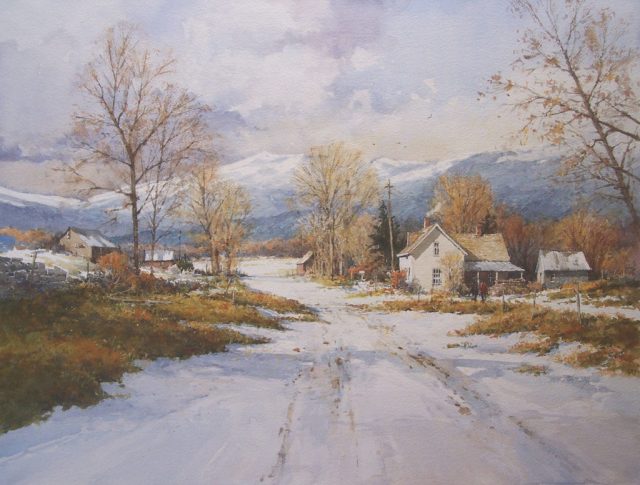
winter dusk
the robin’s last chirp
before hiding into a tree

Muskaan Ahuja (India)

Winter dusk is a time of converging all the thoughts of the day where one focuses on the inner state of mind—in other words, the locus of control is one’s own self. The mysterious magic of the forces at dusk creates a great impact on the psyche of a person where they are attracted by the invisible pull of the inner self.

The last chirp of a robin may indicate the departure or annihilation of life that comes before one has possibly enjoyed life fully and then ends up in deep silence.

The hiding into a tree is more like an occultation where there is no more left to say or do. A life full of mysteries and chaos let us go through experiences where we enjoy positivity, happiness, and blessings but when all is over, we have nothing except silence and loneliness.

Another aspect of this haiku can be a deep understanding of life after passing through various experiences that enrich our intellect and bring maturity. This is the stage where people enjoy their solitude and silence more than words.

It’s the focus of life from outside where worldly life builds up a dwelling for our end, which is annihilation and mortality.

From chirp to deep silence, from dawn to dusk, from interaction to solitude, all these stages of life show a momentum towards our ultimate destiny, which is nothingness.

Hifsa Ashraf (Pakistan)

We have the kigo, or the seasonal reference, right in the first line. As you probably know, haiku are traditionally seasonal poems, and starting a haiku with a kigo is a safe bet and a fine idea.

With “winter dusk,” we can get the picture of cold solitude and maybe melancholy. This tinge of the solitary is continued on the second line with a robin’s last chirp of the day (or perhaps of its life, for any number of circumstances).

Haiku often focus on one thing at a time to allow readers to dive into that moment more readily and to gain a sense of mindfulness. You can say it’s a tradition to focus on one thing at a time in the spirit of Zen, which is popular in Japan (ichigyo-zammai). Haiku is not a Zen art, but its history is intertwined with it. So, having this philosophy on display in the craft of this haiku is well-founded.

In the last line, we see the robin taking refuge within a tree cavity or deep within the labyrinth of its branches. The robin is essentially going through the process of its own dusk. Its chirp is colorful like the sunset and then recedes like the dying colors of the sky. In this way, you can say dusk and the robin are both manifestations of each other.

Looking at the haiku in a technical sense, we might first notice the unusually long last line. It’s common practice to have a shorter last line than the middle line. However, it’s not only difficult to format the lines differently without creating an issue but also it’s not long enough to be of concern. Like most great arts, haiku writing doesn’t have strict rules and allows for plenty of exceptions.

I think the first line could have benefited from a dash to add to the serious mood of the haiku. But, the poem is fine without it and no problem is created with the absence of punctuation in this haiku. For the sound, I felt the letter “r” was particularly important. It gave the haiku more weight.

This haiku captured the mood of winter dusk through a strong visual and sensory sense and brings readers to stillness and introspection.

Nicholas Klacsanzky (USA)

winter dusk

– “Winter Road” by Ian Ramsey

Kat Lehmann’s River

what remains
after the river is gone
this empty bed

Kat Lehmann (USA)
Published in Mayfly 68, 2020

I always wonder how to express my deepest feelings about certain themes of life that are well connected with the most essential element of nature: ‘water’. I love it when someone challenges me to write about topics that really cover annihilation.

In this haiku, Kat beautifully expressed her feelings in a simple but most elegant way without letting go of the flavours of the right metaphor that is the beauty of a well-crafted haiku.

What remains is a question mark that we all need to address at the end of this temporary life for which we spend a lifetime to solve the mystery of what we get in the end. The ‘river’ is well placed in this haiku that reflects our thoughts, feelings, and constant learning and building up of a momentum in our lives. I think the flow of the river may be interpreted in two ways: 1) physical life 2) mental or spiritual life. Both goes on until we stop breathing and/or stop thinking about what is necessary for survival.

The empty bed both of the river and our life indicates nothingness and or annihilation where only a deep silence prevails. This haiku also depicts the process of evolution and revolution that both start and end in nothing. This is the ultimate meaning of life.

Hifsa Ashraf (Pakistan)

At first glance, this poem might seem like a matter-of-fact statement, which a lot of fine haiku do. But then, we get an “aha” moment. The empty bed is both positive and negative. The empty bed could be a representation of the emptiness and harshness of the dry season, but it could also mean a place where new life can flourish without hindrance. Plus, the author could be referring not to a riverbed but to the bed in her house—thus making it a double entendre.

The empty bed is also a sight to behold. The way the river carved into the earth is now fully visible and we can witness what the river did to the soil and rock. It may be empty, but it’s full of memories etched into the earth.

I think the poet did right by not including punctuation, as it would have made the second line too long, in my opinion. The poet retains the traditional Japanese rhythm of haiku.

In terms of sound, the most striking letter is “r,” which gives the haiku added power and weight. The sound of “e” in the last line with “empty bed” has long syllables, which creates a sense of melancholy and starkness.

A fine haiku that gives many introspective associations to readers.

Nicholas Klacsanzky (USA)

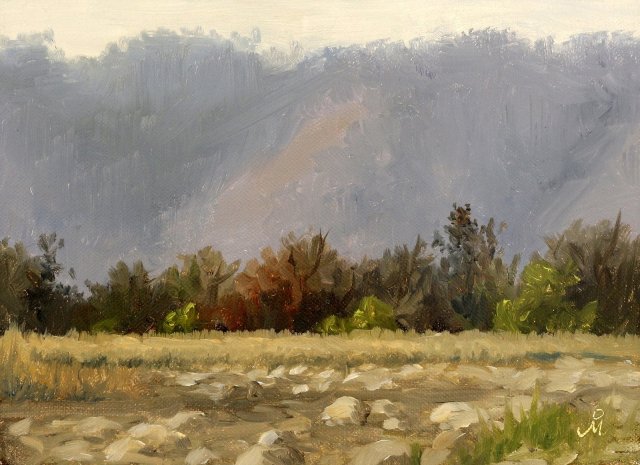
blue-mountains-at-corbett-national-park-landscape-painting-mandar-marathe

– Painting by Mandar Marathe

Robin Anna Smith’s Alchemy

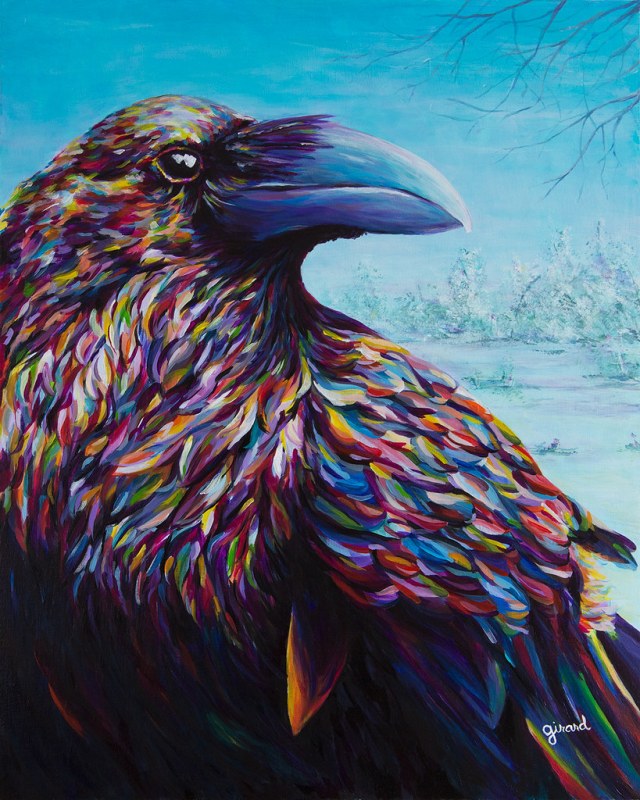
dusk gathers
with the alchemy
of ravens . . .
alone, in a clearing
my heart picked clean

Robin Anna Smith (USA)
UHTS Fleeting Words Tanka Contest 2019, First Place

There are a few short poems that inspire me deeply due to their brevity and brilliance. The beauty and the dimensions of our imagination are endless as one can grasp the attention of anyone through its majestic power and subtlety. This poem is one of them.

I loved the opening line of this wonderful tanka that pauses my thoughts and lets me feel the colours and the hues of dusk that tickle my slumberous senses to fully grasp the overall picture of that dusk.

The second and third lines, ‘with the alchemy/of ravens . . .’, is beautifully embedded in this dynamic poem and this may be the crux of the whole theme of this tanka. The word ‘alchemy’ depicts the magical power of the dark that purifies our thoughts and heart through contemplation and maybe through meditation. Ravens here depict the sign of intellect that pass through the trials of time before getting into proper shape. This is the experience of wholeness where a person walks alone in this journey as it varies from individual to individual. This highest level of personal experience also touches the spiritual boundaries where a person wants peace at heart, which is the ultimate goal of life. This only comes through the self-awareness that is reflecting very clearly in this tanka and brings one’s thoughts and feelings together to enjoy the subtle experience of wholeness.

Looking at the technicalities, the ellipsis placed after the word ‘ravens’ makes it significant to ponder in our day-to-day experiences before we finally get to the path of our ultimate destiny. By uniting the first and the last lines, one can understand the ultimate purpose of life.

Hifsa Ashraf (Pakistan)

The power behind this tanka lies in its imagery and the connection between its two parts. Also, the poem packs in a lot of substance within five lines, while allowing the reader to imagine and fill in blanks.

I like that Robin embraces the more metaphorical and free approach to tanka that many western poets don’t delve into. Some western adherents of tanka practice it as a longer haiku and don’t utilize its more abstract and imaginative side.

Let’s break this tanka down line by line. “dusk gathers” sets the time and scene. We can feel that this poem will contemplative.

“with the alchemy” is a surprising line and makes the reader excited to see what will happen next in the tanka.

“of ravens . . .” is highly symbolic. In Native American culture, the raven is sacred and in some tribes, was the creator of the world. This could be the connection to alchemy. Also, in many cultures, ravens are seen as mystical creatures that are either seers, magical beings, or harbingers of something to come. The ellipsis makes the clear sign of this part of the tanka ending and shows that this process of alchemy and dusk gathering is gradual.

“alone, in a clearing” is concise but delivers substantial symbolism with the clearing being like the poet’s sense of being alone. The comma puts more emphasis on the word “alone” and allows the reader to feel it more.

With “my heart picked clean”, Robin does not say, but as a reader, I can imagine the ravens picking the poet’s heart clean. Maybe this could be part of the alchemy mentioned earlier. Alchemy is about transformation, and the process of cleaning one’s heart can be said to be a type of metamorphosis.

In terms of the format, this tanka follows the traditional Japanese rhythm faithfully. Looking at its sound, the letter “c” is most prominent. It reminds me of the clicking of beaks. In this case, ravens’ beaks.

A tanka packed with imagery, symbolism, and feeling, it’s clear why this poem won first place in the UHTS Fleeting Words Tanka Contest.

Nicholas Klacsanzky (USA)

Raven painting– Painting by Claudelle Girard

Elancharan Gunasekaran’s Raft

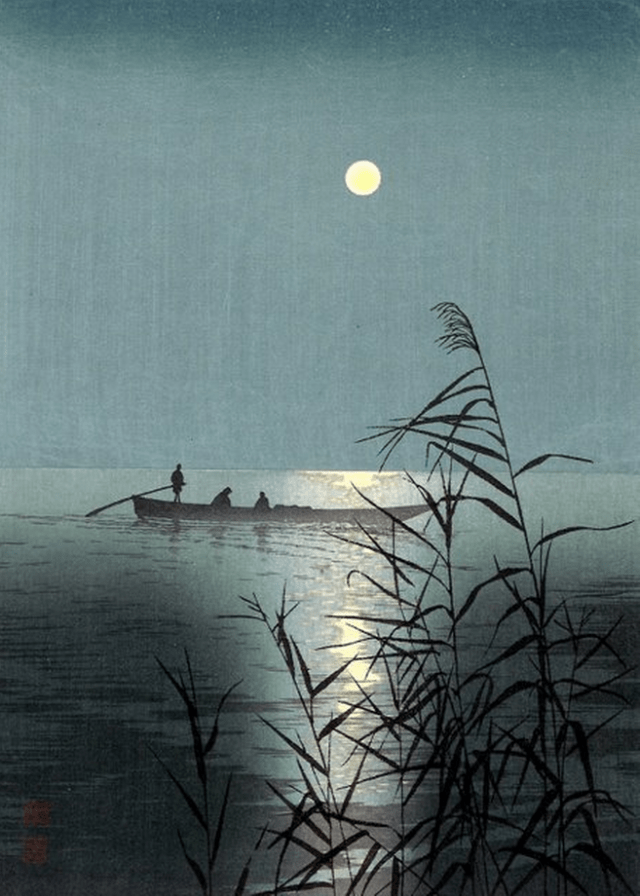
raft anchored
to the full moon…
shadows dive in

Elancharan Gunasekaran (Singapore)
Published in Wales Haiku Journal, summer, 2019

Not only is the imagery striking but the way the poet plays with the senses is highly creative. The full moon, reflected on the water, appears to be anchoring the raft either by a string or a chain. This, of course, isn’t factual, but it looks this is actually taking place. This type of imagery is prevalent in haiku and was used often by the old masters, such as Basho.

In the second part, we have another play on our perception. The shadows diving into the full moon could be from anything around: plants, trees, people, animals, etc. But not everything has to be spelled out in haiku. It’s often key to allow space for the reader to imagine a scene from their own experience and ideas so that they can participate in the poem.

With these two fantastical images, the poet merges the cosmos and the earthly. They interact with each other and the distance between them is bridged. I think this connects well with the Zen concept of non-dualism.

Looking at the technical aspects of this haiku, the ellipsis slows down the pace of the scene and hints at its peacefulness. The length of the lines is in standard fashion, connecting to the rhythm of traditional Japanese haiku. In terms of sound, the most interesting part is the two “f”s in the poem. It’s a heavy letter that seems to correlate well with the weight of an anchor, as noted in the haiku.

Full of intriguing imagery and plays of perception, this haiku makes for an enjoyable and mysterious read.

Nicholas Klacsanzky (USA)

I liked the opening line of this, where there is a sense of proximity and closeness. It puts my ongoing thoughts on a halt and I start exploring my deep connection with the deep water and its mysterious shades. I feel as if my thoughts are anchored for a short while and the sea becomes a subtle ground for anchoring myself to the moon.

It sounds meditative. The full moon is another reason for this mesmerism as the moonlight takes me deep into my profound inner self and I run my imagination wild where strings of the moonlight anchor my thoughts and feelings.

The ellipsis pauses our thoughts to fully absorb the feelings and to enjoy the imagery. The last part of this haiku is a shift from light to dark which seems more like yin-yang where there are comparisons and contrasts in feelings where one can see the moonlight clearly on water due to the shadows that define its boundaries.

The overall imagery of this haiku is subtle and surreal but it’s very well crafted with a fact that there’s a very deep connection between Earth, water, and celestial bodies and one can feel this deep connection with a peaceful mind. It’s definitely beyond seeing.

In terms of sound, the letter “o” creates an uninterrupted rhythm of mystic feelings where there’s no concept of time and space but a continuous cycle of an extraordinary experience.

Hifsa Ashraf (Pakistan)

b7e7e2e5f57fc33cdaaaeb2018a78b55

– Painting by Shoda Koho, “Moonlit Sea,” c. 1920

Goran Gatalica’s Night Loneliness

night loneliness —
a line of hoofprints
in the snow

Goran Gatalica (Croatia)
The Mainichi, 3/9/2020

In loneliness, sometimes we feel empty yet alive at the same time. I think the poet wanted to express this by showing the image of a line of hoofprints in snow. As a reader, I’m imagining fairly fresh deer prints in snow. They are impressive in their emptiness, similar to how grand a lonely night can feel. Since the haiku mentions snow, it’s safe to assume this poem refers to winter. In this season, loneliness is even more acute. Winter loneliness can feel like a stamp on the mind like a hoofprint in snow.

In terms of the structure of the haiku, it has a standard rhythm of a short first line, a longer second line, and a short third line. The dash allows readers to have more time to let the feeling of loneliness soak in, plus it associated well with the word “line.”

For sound, the most prominent letter is “i” with “night,” “loneliness,” “line,” “hoofprints,” and “in.” Tn my eyes, this succession of sounds brings about a sense of starkness that is akin to winter loneliness.

All these elements point to a haiku rooted in feeling, season, and a connection between human nature and mother nature.

Nicholas Klacsanzky (USA)

This haiku contains all the mysteries of a night that we usually imagine when sitting near a fireplace. If we dig deeper into this haiku, I find a melancholic self who is desperately looking for some dawn light.

Night loneliness depicts the winter night when nothing prevails but deep silence. I feel the loneliness symbolizes both inner and outer conditions. So, we can interrelate our loneliness with the outer world where our thoughts and feelings are in sync with the environment.

A line of hoofprints may indicate the long but slow journey of a person’s life that is more static at the moment. These hoofprints are in the snow which indicates the intangible struggle of life where we have to use extra energies to wade through tough periods of life.

In terms of sound, the letter “o” here shows the endless cycle of struggle that a person goes through to survive.

Hifsa Ashraf (Pakistan)

Hoof prints

Srinivas S. Chennai’s Evening Rain

silently
the gossip spreads
evening rain

Srinivas S. Chennai (India)

(Haiku Presence, Issue 64)

We daily come across a lot of information that’s based on the individual perceptions and understandings of various realities and experiences spread all around us. This is the era of information and news where a small expression or thought may take less than a minute to spread like a fire.

In this haiku, the gossip silently spreads all over because of the sensitivity of its nature. I may take the gossip as part of certain taboos that need to be broken. This gossip might not be accepted by the masses but still finds its place among people. This gossip may be less important before it’s being spread but becomes significant once it gets highlighted.

Evening rain is barely noticed by many as everyone is quite busy or tired due to their daily life routines. But, evening rain can subtly bother our mind or feelings. So, there is a deep connection between the sound of evening rain that is almost invisible due to the darkness and gossip that still finds it worth among people before they go to sleep.

Hifsa Ashraf (Pakistan)

I like that this haiku can be read in two ways:

“silently the gossip spreads/evening rain”

or:

“silently the gossip spreads evening rain”

In the first way, the evening rain is being juxtaposed with gossip spreading silently. In the second version, the gossip is spreading evening rain. This is one of the joys of haiku, that a reader can pass through a haiku in various ways and arrive at myriad interpretations.

“evening rain” is not quite a kigo (seasonal reference) because every season can have evening rain in many areas of the world. However, with the poet residing in India, it might reflect the monsoon season. That’s why it’s important to know the context in which the poem is written to understand kigo.

Evening rain can be sometimes silent or loud to us. With all the events that have gone on during the day, our minds might be cluttered. With this buzzing mind, we might not be able to appreciate this sound of evening rain. However, there are times in the evening when we’re lonely and introspective when rain is a welcome sound to soothe our spirit. In this sense, “evening rain” might be either a comparison or contrast with the first part of the poem. It might also be associating each droplet as a piece of gossip.

The most prominent letter used in this haiku is “s,” and I believe there’s a reason for this. The poet might have wanted the “sss” clamor of rain reflected in the haiku. In the last line, the strong presence of “n” brings a serious tone and a sense of finality.

The structure of the haiku is standard with the rhythm of traditional Japanese haiku. The lack of punctuation gives rise to varied readings of this poem, which adds to its strength. A fine haiku written with an introspective mind.

Nicholas Klacsanzky (USA)

If you enjoyed this haiku and commentary, please leave us a comment.

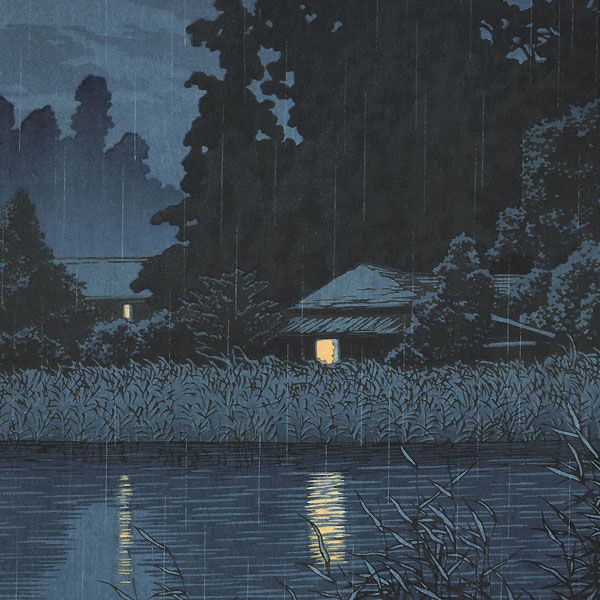
Evening rain

– Night Rain at Omiya, 1930 by Kawase Hasui (1883 – 1957)

Kala Ramesh’s thousand flutes

a thousand flutes
from the bamboo forest
summer’s end

Kala Ramesh (India)
Published in Modern Haiku 48:1. Winter/spring 2017

This lovely haiku takes me back to the East where every single aspect of nature works rhythmically. I love the sound and sight of this haiku. It brought a smile on my face and pulled the strings of my heart.

A thousand flutes could mean a thousand folk stories, a thousand journeys, a thousand years, or a thousand seasons which unanimously take the writer back to those thousands of moments that she has spent throughout her life. These nostalgic feelings stir the current inertia where she is missing her past the most.

I can also feel the resonance of thoughts and feelings that are in great synchronization with nature and brings harmonious and peaceful waves of wind to sooth both the heart and mind. The flute is a great instrument for touching the core of the heart, especially when there is silence all around. So, I can feel the meditative mood of all aspects of nature, including the person that is connected through the rhythm of love and peace.

The summer’s end means, in my opinion, a transformation where one can relate to and reciprocate with the positive vibes that comes on the way. I feel as if the person has achieved the state of mind where she can listen to nature with its true colours and enjoy the songs of love and change.

Hifsa Ashraf (Pakistan)

What I noticed first in this haiku is the pivot line. “from the bamboo forest” connects with the first and second line, so that the poem can be read in two ways.

The next thing that came to mind while reading this haiku is the song of the bamboo forest as wind passes through it. It is a wonderful and fitting tribute for the end of summer. Bamboo is light and the music it occasionally makes when wind goes through is soothing, which associates well with the mood of summer. For bamboo to make that sound, it would have to have holes in it or be cut, or perhaps the poet is speaking about people who made flutes from a bamboo grove and are now performing a ceremony or concert. But, I like the idea of spontaneous music from the forest more, as it makes the song for the end of summer even more poignant.

Commonly, the kigo, or seasonal reference, will appear in the first or second line of a haiku. But in this case, having the kigo come in the third line works well, as having the poem finish with the word “end” is fitting.

In terms of sound, the most prominent letters are “o,” “s,” and “f.” Hearing the “o” sounds bring about what is akin to the song of bamboo in wind. Perhaps the “f” and “s” sounds can reflect the music of bamboo leaves flitting in the wind.

The pacing of the lines is similar to the traditional rhythm of haiku and the lack of punctuation allows the pivot line to work its magic.

Though this haiku can be seen as melancholic, the song of the bamboo flutes gives it a sense of joy. It is a fine haiku with a deep mood and strong technical elements. It teaches us that there are extraordinary moments in what seems ordinary and that we should pay attention to our surroundings carefully to witness these special moments.

Nicholas Klacsanzky (USA)

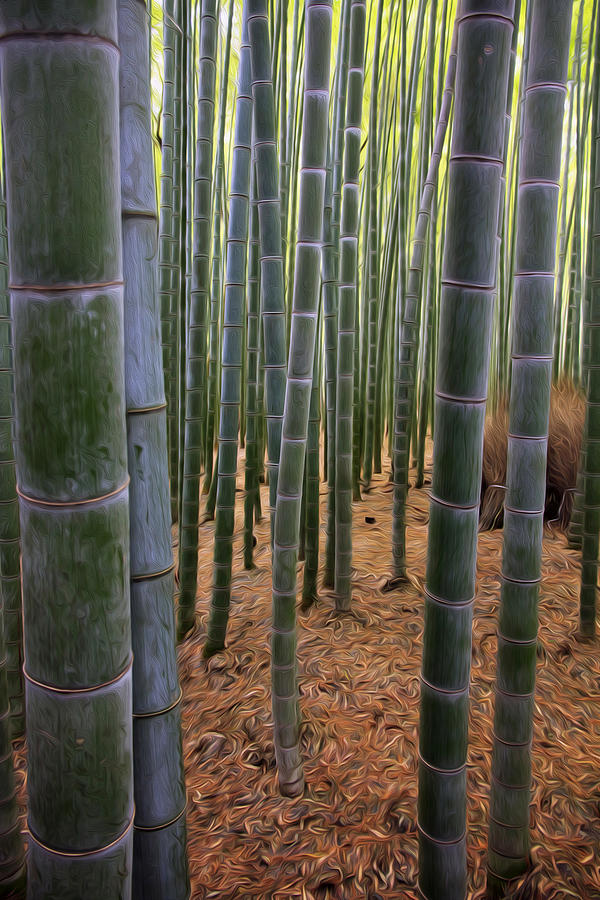
oil-painting-stylized-photo-of-bamboo-forest-greir

– Stylized photograph by G. Greir

Chen-ou Liu’s First Firefly

first firefly
among the stars …
a child’s wish

Chen-ou Liu (Canada)

When I was a child, I used to watch fireflies, considering them as a lucky charm. This haiku reminds me of my childhood memories associated with fireflies and I can relate to it.

A “first firefly” is a hope in the darkness that we want to have in our lives. The poet beautifully put two contrasting realities together.

One is stars we cannot touch and the other one is a firefly that we can touch and personally feel its existence. The firefly is more like a dream that comes true—a kind of wish that is fulfilled by feeling the existence of a firefly’s light that resembles starlight. One can also see the limitation of certain realities that are beyond our understanding and access but possible through imagination and adopting alternative approaches. A child enjoys his or her access to the stars through a firefly that takes him close to his imagination and fulfills the wish of touching stars.

Hifsa Ashraf (Pakistan)

It is an ordinary experience but extraordinary at the same time. Seeing the flash of light from a firefly against a starry night sky is enchanting and mystical to witness. It makes us appreciate nature’s majesty more.

Usually, fireflies come out strong in the summer when they are looking for mates. So, the first firefly could be an indication of summer. The child does not know about fireflies’ mating seasons and his or her wish is based on one of beauty and wonder. It makes for an interesting dichotomy, though, of innocence and experience. However, the last line could be interpreted in two ways: it is the child’s wish to see a firefly with the stars, or that a firefly among stars is like a child’s wish.

As Hifsa mentioned, this haiku merges the earthly and the cosmic, each with its own light. Though the distance is substantially different, the circumference of light might be about the same from the view of a person. In this way, a star’s twinkle might as well be a star’s brilliance, and vice versa.

At a technical glance, we have alliteration in the first line that adds a musical sense to the haiku. The structure is standard and the ellipsis as a kireji works well. It gives a chance for the reader to slow down and imagine the wonderful scene. Each line comprises four syllables, which makes it compact like most well-written haiku (though the kireji would be counted in Japanese).

A haiku powered by enchanting imagery that gives readers more than something to imagine: it prompts us to see the connection between the mundane and the cosmic, and to appreciate the wonder of a child.

Nicholas Klacsanzky (USA)

If you enjoyed this haiku and the commentary, please leave us a comment.

75385fae8b349de9c9eb13a40244afe4

Maria Chiara Miduri’s Wings

a crow feeds
tiny wings
while the bough floats

Maria Chiara Miduri (Italy)
Wales Haiku Journal, Spring Issue, 2019

Haiku about crows always brings mystery to me. I start relating them to certain deep realities of life. A crow can symbolize intelligence, flexibility, and destiny in certain cultures, whilst bad luck and death in others. For me, a crow is a symbol of wisdom and survival that keeps on knocking on the doors of our mind and heart to awaken and understand the depth of life.

The tiny wings, as I understand, is the beginning of new life that needs energy and enthusiasm to keep going and to face the harsh realities of life.

In terms of the bough that floats on the water, I think it signifies the survival of the fittest in the tidal waves of life, but it is the crow that leads us to overcome our weaknesses and to handle it with strength and wisdom.

This haiku is the combination of nature and nurture where wisdom, realities, and trials are beautifully described with the help of the elements of nature.

Hifsa Ashraf (Pakistan)

The first thing that struck me about this haiku is that it is written essentially as one part. Haiku often do not work well as one part, but there is a whole history of masterful haiku that do. In Japanese, these type of haiku are called “ichibutsu jitate” (物仕立て).

Because the imagery is so stark, the poem is carried by it and the resonance is strong. The care the mother crow is giving her chicks (“tiny wings”), while the wind or water tosses the bough that they are on, is extraordinary. It is a lesson in focus and concern. It also lends to the image of life’s precariousness and that at any moment, something can go wrong. But in the face of this, the mother crow supplies nourishment to her chicks.

Despite the haiku being one phrase, the line breaks allow readers to take in the image well. Also, the sound of the poem is rich with the letters w and o. I would say the “w” sounds supply a sense of lightness that is inherent in the imagery, whereas the “o” sounds slow down the scene for us and reflects being in awe of the moment that is captured in the haiku.

Overall, with a unique structure, stark imagery, and a fine sense of sound, this haiku conveys showing care through the obstacles of our lives.

Nicholas Klacsanzky (USA)

If you enjoyed this commentary and haiku, please leave us a message.

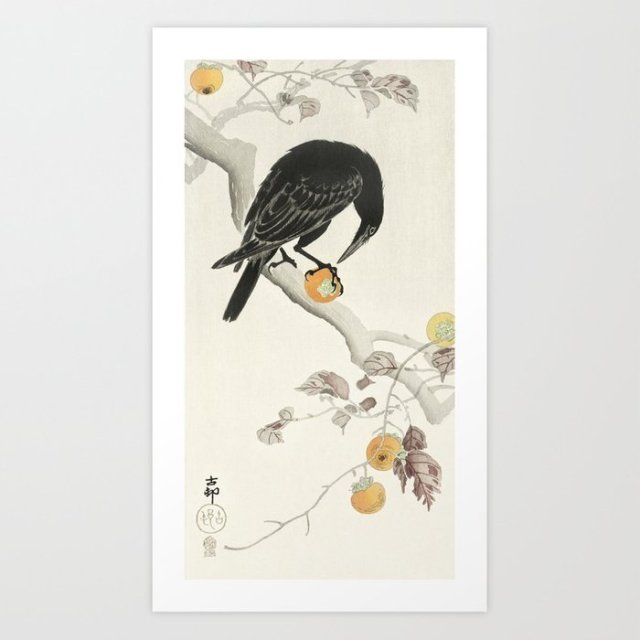
koson-ohara-crow-with-kaki-fruit-japanese-vintage-ukiyo-e-woodblock-painting-prints

– Painting by Koson Ohara