Elliot Nicely’s New Love

new love . . .
offering the firefly
cupped in my hands

(first appeared in the 2018 Holden Arboretum Haiku Path)

© Elliot Nicely (USA)

We start off with a romantic theme. The use of the ellipsis gives way to thinking about feeling the joy of being in love and bathing in it. It also allows the reader to remember his or her first love and what that felt like.

Then we get into contact with nature. I like the use of “offering” as it is poetic and fits the mood of the first line. I also enjoy the “f” and “i” sounds in this line.

But let’s get into the subject of the firefly. New love is transient, much like the lifespan of a firefly and the light it emits. Offering it to his new lover is poignant. It can symbolize the beauty of something so fleeting yet so enrapturing.

The third line adds to the reverence with which the firefly is offered. “cupped” shows care and also could be a comparison with the “bulb” of the firefly. In addition, the solid “d” sounds in this line add more weight to the last line.

It’s a haiku with a distinct mood and atmosphere. I think Nicely captured the feeling of a new love well with his choice of words, sounds, and imagery.

Nicholas Klacsanzky (Ukraine)

“new love” could be the first, could be the last, it could be a fragile bud after a disappointment, delicate and perhaps ephemeral, like a firefly.

The hieratic gesture of offering the firefly in cupped hands seems to be a part of a pagan ritual. The heart burns to be consumed on the altar of feeling, just as the light of the firefly is consumed in the ritual of mating.

A very simple haiku without sentimentality and, within the limits of the subject treated, with the right amount of detachment.

Margherita Petriccione (Italy)

This haiku to me can be seen in two ways. Without the ellipsis, it reads like a run-on sentence and where there are possibly two people enjoying the presence of a (ホタル) firefly, which is a kigo word for mid-summer to early autumn in Japan. It’s a lovely image if read as an ichibutsujitate haiku (single image with a run-on sentence).

What intrigues me about this haiku is that the ellipses somewhat forces me to pause where I see another interpretation that perhaps the person is alone and finds compassion for the firefly cupped in their hands. The juxtaposition in this haiku is in the phrase, which contrasts and then harmonizes with the first line because the word “firefly” in Japan is also a metaphor for passionate love which contradicts my thoughts of this person being alone. Since there’s a juxtaposition, it now reads as an ichimonojitate haiku, which is still a single-image run-on sentence poem if the ellipses are ignored (there is an ichibutsujitate and an ichimonojitate, which sounds the same, but the latter has a juxtaposition).

Lastly, I like the sound of the haiku between the vowel “o” and “i,” and between that, the words “firefly” and “my.”

Fractled (USA)

If we consider Japanese culture, there are two symbolisms of fireflies. First is love and the second is the souls of dead soldiers who died in the war (“war” here indicates World War II).

If we stick to the first meaning, the fragment evokes an image of first love. The innocence and freshness of first love, along with fireflies, works very well as a spring kigo. The writer knows that adolescent innocence is transient and so is the magic of first love—still she surrenders to the beauty of love by offering fireflies to her beloved. The act of offering fireflies is a poignant metaphor of the fragile courage in giving your heart to someone for the first time.

But if we keep the second interpretation of fireflies in Japan in mind, the meaning of the haiku changes entirely. Now, we know that “new love” is not first love. It is most probable that someone dear has died in the war and the act of offering fireflies to the “new love” is a metaphor for offering memories of ceased love to move forward. The haiku thus becomes a bittersweet expression of human resilience.

Pragya Vishnoi (India)

The feelings of being associated with a new person, along with expectations and hopes, are obvious in this haiku. The word ‘new’ reflects the beginning of a new life that may or may not be associated with the past. Love is an endless journey where a person passes through an evolution process of knowing what is best and that makes him or her move from one relationship to another.

The firefly symbolizes moving through darkness with the light of hope and the rejuvenating emotions that silently seep into one’s heart during the night. It may also reflect the dreams of love that a person yearns for throughout his or her life. Cupped hands, in this case, may reflect capturing a moment of love—holding fast to beliefs and prayers for the fulfillment of desires and longings.

Hifsa Ashraf (Pakistan)

If you enjoyed this poem and commentary, leave us a comment.
2593

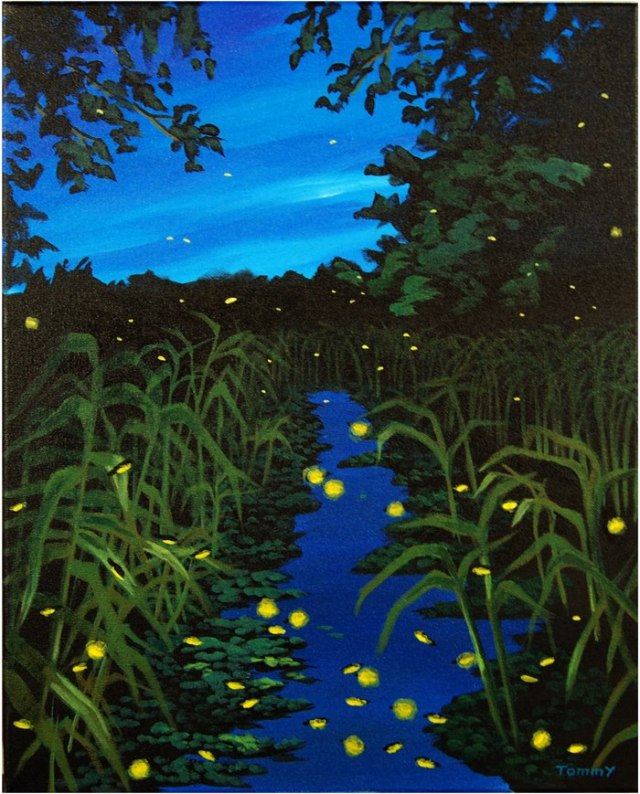
“Lightning Bugs” by Tomas Philips
 

Michael Dylan Welch’s Frisbee

a floating Frisbee—
the river widens
as it nears the sea

© Michael Dylan Welch (USA)

(Published in “Nesting Dolls,” the 2018 Yuki Teikei Haiku Society annual members’ anthology)

A floating Frisbee… in water or in the air? The image of this Frisbee remains mysteriously suspended, as the power of the river appears suspended when reaching the limit of its course, it spreads beyond the banks dividing into a thousand rivulets, almost reluctantly…. The river and the sea are made of the same substance at the bottom, even though each has its own identity—yet in the culminating moment of total unification, it seems the river draws back.

I can’t penetrate the emotion that pushed the haijin to write this verse, but I have had the same feeling when, during a form of meditation, I feel that something is blocking the overcoming of my mental conditioning and hindering my awareness. The poem engaged me with its melodious rhythm and aroused feelings from heart to heart as with the best haiku.

Margherita Petriccione (Italy)

While some may scoff at the double article word “the,” how this rhymes, the use of two verbs, and what reads as “matter of fact” in the phrase of this ku, one must combine the three lines and loosen their grip on the rules to see that content matters more, which this haiku has plenty of.

Starting with the first line, note that the word “Frisbee” is capitalized, which to me instantly conjures an image of a concave disk that’s used as a pastime or for sport (ultimate) with an emphasis especially with the em dash after the word.

In combination with the phrase where the magic begins, I wonder if the frisbee as defined exists at all in the haiku. The frisbee could also be a whirlpool, hurricane, or a tornado where all have concave disk shapes that spin as a frisbee does, widening the river as it floats to the sea. Perhaps the frisbee does exist but I asked myself, “can it widen a river or is it the writer’s intention to juxtapose an object with the unsaid images not written in the haiku for the reader to fill in?” If so, it’s a masterful technique the author used very well.

Lastly, I believe the technique of “narrowing focus” was used in this haiku but in reverse. Rather viewing it from the top down, in this case, the sea is the wide lens, the river is the normal one, and the frisbee’s focal point is the narrow one, which makes this write all the more interesting.

Fractled (USA)

It takes a lot of time to understand the depth of a haiku that is written by a haiku master.

This well-constructed haiku reflects the depth of creativity and imagination.
One aspect of it gives me the image of a gliding frisbee that floats freely like our happy feelings and cheers us up both by our recreational and aesthetic senses. When someone is carefree, calm, and relaxed, he or she loves to enjoy the bounties of life and imagine life as free as a flying frisbee.

The other two lines of this haiku show the depth of our feelings that may initiate with a small action but it has a ripple effect. The river may look like a wide smiling face with profound effects that can bring great inner satisfaction.
The other side of this haiku could be a kind of cyclone that may look like a frisbee and bring turbulence in the river’s waters before it ends up in the sea.

Also, the capital letter ‘F’ in frisbee is intriguing, which may reflect the association of the writer with a particular type of frisbee.

Overall, this haiku is a combination of our cheerful feelings or childhood memories that bring its deep effects on our mind and heart.

Hifsa Ashraf (Pakistan)

Although I am an editor, I did not know before reading this haiku that “Frisbee” is sometimes capitalized. Since it is a registered trademark of the Wham-O company, it is indeed capitalized. Knowing that Welch is an editor, I admire him for sticking to the original.

Anyway, the first line is meditative. The reader takes in the movement and floating of the Frisbee more with the em dash, acting as a pause marker. The musicality of two “f”s in succession makes me think about the sound of the Frisbee tearing through the air.

The second line opens up with the juxtaposition. We come from a Frisbee perhaps in a park to a river. The river could be next to the park, but it could also be miles away. Regardless, I like the image. The intuitive feeling between a Frisbee floating and a river widening is definite. The shape and spin of the Frisbee give rise to the connection. Note also the musicality of the “i” sounds which bring a sense of sharpness.

The third line changes the scene and resolves the second line. When a Frisbee reaches the catcher, it starts to slow down and drag more. This is akin to the widening of the river before it reaches the sea. However, there is more to this image than the facts. I think this is a metaphor about how we act and feel when meeting our death or a goal. We open our hearts and minds more. Luckily, when coming to our end or when obtaining a goal, we approach it with open arms. On a side note, I enjoy the “ea” sounds in “nears” and “sea,” which to my mind brings a calming effect.

This haiku looks simple at first glance, but with its underlying metaphors, meditativeness, and musicality, it is an excellently crafted poem.

Nicholas Klacsanzky (Ukraine)

Did you enjoy this poem and the commentary? If so, please let us know in the comments.

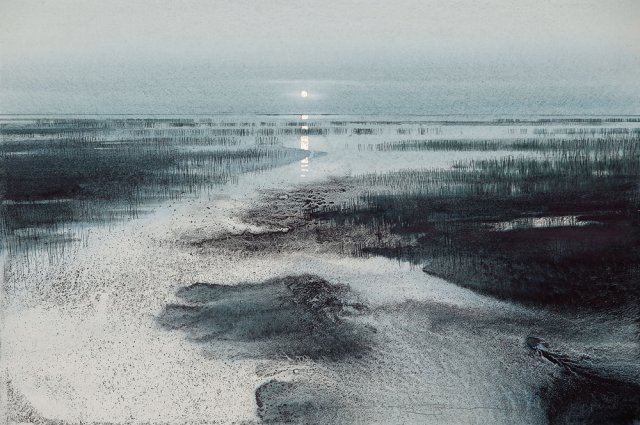
tumblr_oliw1gOUMy1qbidlso1_1280

Art by © Naomi Tydeman

Srinivasa Rao Sambangi’s Thread

chrysanthemums
the thread slips from
granny’s needle

© Srinivasa Rao Sambangi (India)
Modern Haiku, Issue 49:3, 2018

This haiku is very intelligently crafted. “Chrysanthemum” is a late autumn kigo, hence the fragment itself sets a mood of decay and destruction. The slipping of the thread is poignant in the sensitive portrayal of the loss of abilities which we take for granted in our youth.

The fragment and phrase nicely use the technique of association. There is a struggle against the natural course of things, and in between the lines, we find a glimpse of grace.

One of the deepest haiku I’ve read.

Pragya Vishnoi (India)

I have an old sewing machine from my mother in my possession, and every time I use the needle for sewing work, I can think of her presbyopic goggles and that thread that avoided the eye of the needle as if it were equipped with its own life…

In this way, this haiku of Srinivasa Rao becomes something that belongs to me, generating correspondence and the widening of perception—the qualities of a good haiku.

Melancholy, impermanence, and the sense of loss are linked to chrysanthemums. Fleeting humor is a classic element that enriches this very touching text. The rhythm of the verses leads from the slow murmur of line 1 to the fluidity of line 2, then almost pausing to savor a memory on line 3.

Margherita Petriccione (Italy)

The overall theme of this haiku is based on ageing with loneliness and melancholic feelings. I can see a very deep connection between the chrysanthemums and the sewing. The chrysanthemums symbolises grief, sadness, or pain in some parts of the world, but it is also considered as a symbol of joy and optimism. That is why in certain countries, women used to embroider chrysanthemums on skirts, shirts, and tablecloths.

In this case, maybe the granny needs to embroider a chrysanthemum not just to kill time but also to bring back memories of her past. The thread slipping may show the ‘cultural annihilation’ or ‘change of time’ where no one follows old traditions. Being nostalgic, she wants to revive that tradition to overcome her loneliness and melancholy but ageing drains her energy to do so.

It also shows the transformation of time, culture, and traditions where different phases of life are replaced with something new with a little or more acceptance. In granny’s case, she still misses her past life that was full of festivity and traditional activities that are now fading away with time.

Hifsa Ashraf (Pakistan)

In this haiku, I wondered if it could be a one-liner. But to me, line 1 has a stronger break in three lines even without the use of kireji, which is important because as a reader, it makes me contemplate the kigo word (how it is a fragment in this particular haiku and how it ties to the phrase in the two last lines), which is an all autumn/winter seasonal word in Japan and also its imperial seal.

Chrysanthemums are used as a health benefit for various ailments in its tea form, especially in Asia. To me, the juxtaposition between the words harmonizes rather than contrasts between the words “chrysanthemums” and “granny” because in China the plant represents longevity. What’s interesting to me is that the phrase “the thread slips from granny’s needle” to me can be interpreted in two ways, which can be tragic but if combined with the fragment and the history of the word “chrysanthemum,” there’s also the possibility that there’s nothing wrong with granny and the thread slipped from the needle from daily distractions of life.

In conclusion, this haiku is highly dependent on readers to create context from their own personal experiences, which I believe the author does a great job expressing by telling little.

Fractled (USA)

The poets above have done a great job discussing the content and technical aspects of this haiku. However, I want to point out how the shape of chrysanthemum petals are akin to a sewing thread. In a way, the chrysanthemums take over the scene as the thread slips from the needle. This creates a continual sense of completeness.

In terms of sound, the “th” sounds in the first and second line make a sound similar to manual sewing. Also, I appreciate the musicality of “slips” and “needle.”

A strong image and powerful juxtaposition that takes a keen look to fully appreciate its beauty.

– Nicholas Klacsanzky (Ukraine)

Did you enjoy the poem and commentary? Let us know in the comments.

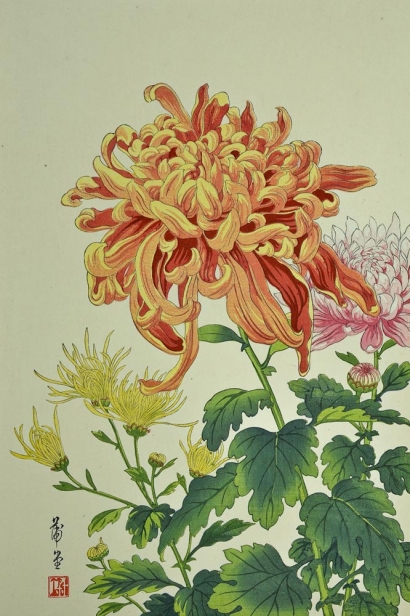
Chrysanthemum.haiku.autumn

– Art by Nishimura Hodo

Agus Maulana Sunjaya’s Sunset

sunset
dragging my shadow
back home

© Agus Maulana Sunjaya (Indonesia)

Akitsu Quarterly, Fall issue, 2018

A very melancholic haiku that immediately suggests the image of a homecoming in which the shadow, particularly long in the sunset, seems to weigh down the steps of the poet. But the shadow, understood as the double and sometimes as the denied part of oneself, can weigh on the spirit in a more subtle and devastating way.

I don’t want to be a psychologist, but this haiku makes me think about the fact that by not facing the hidden parts of us, which we often fear strongly, we sometimes expose ourselves to inconveniences of which we do not understand the nature of and of which condition. These are not minor choices, as they affect our lives. Even in this haiku, I feel the sensation of an unfulfilled dualism that results in frustration, all expressed with elegance and with a second line that expresses also in the sounds (double “g”) a sense of oppression.

Margherita Petriccione (Italy)

This haiku reflects both the mental and physical fatigue of life where we spend most of the time facing and fighting different issues that test our cognitive and emotional abilities. It depicts the limited capacities of a person who, besides dealing with various matters of life, finally gets tired. It could be due to aging, where the sunset of life takes a person to the stage where he or she feels lonely and manages to live with great difficulty.

The shadow shows all the regrets, guilt, and bad memories that keep on following a person until the last breath of his or her life. Overall, a person who spends his or her days developing good relationships with people may end up being lonely, which also shows the insensitivity of recent human civilization.

Hifsa Ashraf (Pakistan)

I like how the first line can be interpreted as flowing into the second line or as standing alone. Also, the simplicity of the language and the surprise in the last line is pleasing. Though the third line is unexpected, it is also expected. This is a common aesthetic in haiku, where the ordinary can be extraordinary.

Like Margherita, I also enjoy the sound of the poem. With “s” in the first line and the second line, you can almost hear the shadow being dragged through the grass. With “o” in “shadow” and “home,” I feel the melancholy is illustrated. A fine haiku from a technical point of view, and also from an aesthetical perspective as well.

Nicholas Klacsanzky (Ukraine)

Did you enjoy this haiku and the commentary? Let us know in the comments.

8600431006cff1885ebbba24e764204f
© Callum Russel

Thaís Fernandes’ October

October morning—
falling one by one
my illusions

© Thaís Fernandes (Brazil)

This haiku reflects enriched experiences that are embedded in an October morning. October is a time of transition where summer almost surrenders to the colours of autumn. This is also the transitional period of our thoughts, feelings, and mood that are blended well with autumn shades. In turn, falling illusions is a process of getting into meditative thoughts that reveal the far side of realities. It also lets us jump into the autumn hush that brings forth deep, real meanings of life, and the person starts reflecting on his/her thoughts and filters them through the sieve of mindfulness. Mentioning the sound, the letter ‘o’ may allude to the recycling process of our thoughts and feelings early in the morning that redefines our current state of mind.

Hifsa Ashraf (Pakistan)

In the first line, we get grounded in the scene. In Brazil, where the poet resides, October is an interesting month. According to holiday-weather.com, “October is considered to be a month of transition—a month that is characterised by increasing temperatures and rainfall levels, as the weather moves from the mild winter season toward the hot, humid and wet summer season.” In this sense, with this inference to a transformation, the juxtaposition with the next two lines works well. As the weather heats up and the rain starts to fall, the poet perceives that her illusions are also “falling.” She perhaps saw her inner state reflected in the nature that surrounded her. This brings a sense of oneness, that perhaps humanity and the natural world are one organism.

Getting more technical, I like the use of the em dash. It presents the idea that the poet has now begun afresh, without her illusions. An ellipsis could have worked as well. In terms of the structure, the format is standard, but the syntax is reversed in lines 2 and 3. However, I think “my illusions/falling one by one” or “my illusions falling/one by one” would not have had as much impact on the reader. Though Hifsa has already mentioned the sense of sound, I would add that with the “o”s and “l”s, this haiku sings.

Nicholas Klacsanzky (Ukraine)

This haiku, although kigoless, does refer to a specific time. Even so, one might consider it a modern haiku. Then again, even if it did contain a kigo word eg. ‘autumn morning’ that does not necessarily make it a haiku either in a traditional sense (observation through nature.)

I do like this ku and its use of the em dash on line one, which gives the reader a sense of urgency or surprise, where I picture the poet finally seeing things as they truly are perhaps while meditating or under the use or entheogens, being half asleep, half awake, or what usually happens with children where one simply wakes up and see the world as it is for the first time.

There also seems to be an element of zoka in this write, which is:

‘The poet’s real enlightenment is his or her ability to open up to it, tap into it, and translate the zoka at hand into haiku. The poet recognizes what’s going on before his eyes and begins the journey of placing it into a haiku that relays what the poet has been vitalized with.’

Excerpt from Don Baird’s essay “Zoka”

https://www.underthebasho.com/essays/1714-zoka.html

Fractled (USA)

Did you enjoy this poem and commentary? Let us know in the comments.

I’ll be back soon | Volto Já - 80 x 60 cm
© Totonho

Pere Risteski’s Zenith

zenith
a cloud in a cloud
rolls around

© Pere Risteski (Republic of Macedonia)

The repetition of ‘o’ in line 2 and line 3 makes this haiku a visual delight. There is a sense of being laid-back in this which makes the reading experience very serene. Though there is no mention of the season or time of day, I am imagining a quiet, blissful summer dusk. A lovely haiku, all in all.

Pragya Vishnoi (India)

The zenith—the nadir celestial axis is the vertical axis according to which one aligns oneself in the posture of zazen. So, the immediate image that this haiku suggests to me is a moment of meditation under a clear sky in which two clouds seem to follow a circular motion. Clouds attract interest and create a point of distraction, and can be compared to thoughts that entangle and return to disturb the serenity of the moment. But I feel deeper resonance in this haiku that appears to me almost like a koan. Maybe I followed the wrong key of reading, but I find it a remarkable haiku—simple and yet well-refined in form.

Margherita Petriccione (Italy)

The word ‘zenith’ makes this haiku interesting and multidimensional as well. The person is meditating under the open sky, which makes his unique experience worth sharing, as he must have found the zenith as a part of his inner peace and he feels as if he is at his zenith for a moment.

Overall, I can see the deepest desires of the person embedded in the meditative thoughts of the day, which could be daydreaming as well. A cloud in a cloud again could reflect the deep meaning of one’s dreams or wishes that are interconnected. But in the case of meditation, a person looks through these clouds for a clear sky. Yet, in this case, the person enjoyed the experience of clouds manifesting his dreams or desires, which brings more clarity to them. He might feel as if he is out of the confusion. It may also reflect him finding the purpose of life by capturing the intuitive moments that brings a person to a state of extreme happiness, which is in a sense recognizing one’s core potential, which can seem like a miracle.

Hifsa Ashraf (Pakistan)

If you enjoyed this poem and commentary, let us know in the comments.

ap,550x550,12x16,1,transparent,t.u3

© Mariusz Szmerdt

Antonietta Losito’s Childhood Home

childhood home
from a crack crawls
an icy wind

© Antonietta Losito (Italy)

So many horrendous events have taken place as of late, and this poem reflects such a blow to the heart. We are all used to seeing nurseries as a nest, a place of kindness and joy, of serene guidance towards balanced growth. Unfortunately, this is not the case and often a cold wind blows over them.

A haiku expressed with admirable simplicity and detachment, yet strong as an icy gust of wind in the face accentuated by the harsh repetition of the “cra” sound in line two that strikes sensitively after the fluidity of line one.

Margherita Petriccione (Italy)

It’s a strong haiku. Although there’s a subtle break on line 1 while reading it out loud because of the conjunction “from” followed after it on line 2, I also see this as a great one-liner due to the sound of the vowels “o” and “a” that’s more apparent in that form.

As for the content of the haiku, I picture poverty in very cold weather and a child possibly in a foster home, or even homeless, seeking shelter. It’s a poignant haiku that’s direct, which is not only a sketch of a particular scene as a sensory image, but one that can be felt physically and emotionally as well.

Fractled (USA)

There is a time in life when we look back into our past and reflect on deep experiences. These experiences leave a great impression on our lives, guide us in the later part of life, and help us to learn from them. Our childhood home is a very special place, where one collects a lot of memories that become a part of the subconscious. Irrespective of the type, childhood memories always remain close to one’s heart.

The author reflects very deeply on her childhood experiences that may sound traumatic but still fresh in her mind. The cracks are maybe those flaws of the past that influenced the life of the person profoundly and triggers unpleasant memories when she visits that place. Icy wind could be showing the sensitivity of childhood experiences that still haunt her mind. Metaphorically, perhaps a childhood home are memories, the crack is guilt conscious, and the icy wind represents broken thoughts.

Overall, I can see the conscious effort of the person to recall and understand the flaws that always take her back to the time when she faced a lot of pain. In terms of sound, the letter ‘c’ in this haiku shows the disturbance and interruption in one’s normal life cycle.

Hifsa Ashraf (Pakistan)

Did you enjoy this poem and commentary? Let us know in the comments section below.

wind

© Skip Allen

Indra Neil Mekala’s Pill

old age home —
a pill for everything
but loneliness

© Indra Neil Mekala (India)

Under the Basho, 2018

This is really a heartfelt haiku that shows the dilemma of our society. This is still a question mark for many of those who take relationships for granted.

The opening line looks very simple, indicating an ‘old age home’, but metaphorically it is not simply a place where old citizens take shelter and spend the rest of their lives. It is a place where one can find every comfort but still not feel like one is at home, still have something missing in their lives, still deprived of the connection with their loved ones.

In the second line, ‘pill’ symbolizes not only a medicine that is used for relief of any kind of pain but also indicates the intrinsic connection that one needs through a touch of genuine feelings that itself is healing. In old age, a person always needs a loved one to stay with them and listen to their stories of life or share great memories and spend some quality time with them so that he or she can mentally and psychologically feel healthy and satisfied.

The dilemma of old age and old age houses was cleverly described in the third line, where the poet depicted that there is a cure and medication for every type of pain but loneliness. Nothing can overcome loneliness except love and genuine feelings of close ones including children, siblings, friends, family members, etc. There is no substitute of a true relationship in one’s life, which a person needs the most in old age, but ironically senior citizens often don’t get them. It reminds me of a quote by the Dalai Lama that helps me to conclude my views. It says:
“The planet doesn’t need more successful people. The planet desperately needs more peacemakers, healers, restorers, storytellers, and lovers of all kinds.”

Hifsa Ashraf (Pakistan)

This haiku tackles one of the most dreadful things and that is loneliness. In line one, where I’m from, it’s called a “nursing home.” And I used to work in one, so I can definitely relate to what the poet wrote from the words of the patients themselves.

Although there’s no kigo, I can only assume that this is a gendai/modern haiku. With a sabi tone (loneliness or miserable) the haiku does a great job with a powerful third line, though it may be read as “matter of fact.” I see no other way to write about the subject matter ex. “a pill for every thing except old age/death/“ etc.

This haiku to me is also a stark reminder of the company people take for granted and other important meaningful things in life while in their youth. It’s a fine haiku as I see it. Congratulations Indra!

Fractled (USA)

This is a fine example of restraint in haiku. Without any wordplay, the writer effectively expresses the stark scene. When we see it from an Indian perspective, where the haijin resides, an old age home is a place for old people whom their children are unable to provide care for. This leads to feelings of abandonment which is a major contributing factor for depression among the old age home residents. Normally the children pay money to these homes but even though the money can buy medicines, it cannot guarantee the cure for loneliness. A powerful social comment which achieves what it intended.

Pragya Vishnoi (India)

A modern haiku, very strong in the sentiment that it emanates, yet very simple in its presentation like any work that respects the original spirit of this poetic genre. It does not leave much to the imagination but is vibrant and, according to the experience of those who read it, it can arouse reflections of personal, social, and cultural value.

I also find the shape impeccable; not being a native speaker, I cannot dwell on the choice of words, etc., but I find it fluid and harmonious.

Margherita Petriccione (Italy)

Indra’s poem speaks to me far beyond a nursing home when I think of all the medications people must take for various physical and/or mental illnesses and the simple act of getting old, all of which can result in isolation or invisibility. The couplet is a truism that can’t be denied. While the poem isn’t placed in a season, and isn’t isolated to a moment, or even a person, I found it works for me despite the generalization of the first line, and assumptions of the phrase because my own experiences with such homes involved seasons and senses, smells, taste, touch… and in a broad sense, this one speaks to me metaphorically as the ‘winter’ of our lives, or simply getting old.

Carole MacRury (USA)

Did you enjoy this haiku and the commentary? Let us know in the comments section below.

pechane-10

– By Pechane Sumie

Minh-Triêt Pham’s Shooting Stars

shooting stars —
in the canal’s waters
fish jumps

© Minh-Triêt Pham (France)

The Mainichi, Aug. 18, 2018

If the em dash at the end of the first line is deleted, the haiku would clearly benefit from the pivot and revolving interpretations: shooting stars reflected in the canal’s waters and the fish jumping in the canal’s waters. There is also the theme of two worlds separated and connected by water. The movement in line 1 and line 2 against the second line makes the haiku a visual delight. Though there is no explicit mention of kigo, the haiku evokes a summer-time feeling. The merging of two worlds is completely in line with the Zen aesthetic of onism, which has been alluded by many great Japanese writers, artists, and filmmakers. All in all, a memorable haiku.

Pragya Vishnoi (India)

As to the phrasal structure of the poem, I would consider the article “a” in front of “fish” for better flow—no pun intended.

Dennis Gobou (USA)

A great sense of serene unity emanates from this haiku (which I would see much better as a monoku) where for a moment the earth seems to blend into the sky. The fact that a kigo is not present, in my opinion, enhances the sense of universality that permeates it, making it a timeless moment. Once the boundaries of space and time are overcome, this haiku would be a small masterpiece if rightly there was an article in front of “fish.”

Margherita Petriccione (Italy)

This particular haiku to me has a few flaws but it’s interesting as well. About the errors, the first thing I asked myself was why is there an em dash on line 1 when it reads as a phrase with line 2. Because of the conjunction word “in,” the em dash should have been on line 2 after the word “waters.” Then, I wondered why the author repeated what is already said, which is between the words “canal’s” and “waters.” The author could have dropped the word “waters” or drop “canal’s for even more space, but there’s another problem, which is the plural on water which indicates to me that the author had superpowers to be at multiple places at once to see this particular moment. Also, I believe the word “waters” was added so that the author could keep the short/long/short form of a haiku, therefore forcing something that isn’t necessary in the poem.

Maybe the author should have written:

fish jumps
in the canal—
shooting stars

Or better yet to use the “technique of narrowing focus”:

shooting stars
lights the canal—
jumping fish

While I’m cringing with the use of two “ing” words, for now it’s the only way I could keep technique intact with a wide lens “shooting stars” to the medium “the canal” and finally a small lens focusing on the jumping fish.

That’s just my opinion on a published haiku that needs some surgery.

Fractled (USA)

I too would omit the em dash to achieve a pivot. “waters” I feel is redundant. Line 3 is not grammatically correct: “a fish jumps” or “fish jump”. Thus, I would suggest: shooting stars / in the canal / fish jump – with matching plurals. A pleasing poem with striking imagery but it has a “dodgy” final line.

Susan King (UK)

This presents an interesting juxtaposition: the movement of objects across the sky above and across the water below. From that one similarity, the images open up and veer off from one another. A shooting star is a dying object of dust and rock falling into the earth’s atmosphere that burns up. Fish jump out of the water for various reasons, including perceiving a threat from a predator, or acting as prey. This haiku makes me wonder if, like the shooting star that’s dying, the fish is on a hook and is about to be caught? Or is the fish’s jump temporary—a momentary arc where, unlike the star, it will go back to its habitat and continue its life in the water. Either way, I feel that the poem speaks to the impermanence of nature, or the nature of impermanence.

Michael Morell  (USA)

I like the ‘startle’ effect against the sky and the canal… the movement of a shooting star, the movement of a fish. It brings together, for this moment, the heavens and the earth.

Carole MacRury (USA)

There is an element of amusement in this haiku that makes it interesting in many ways. Shooting stars may indicate a sign of luck, happiness, and celebrations (fireworks) as well. One wishes upon shooting stars to get desired things in life. I see a shooting star as a kind of celebration where someone is enjoying the vastness of the universe, and taking it as the fulfillment of all wishes.

Canal water is usually used for irrigation, so there may be celebrations for having a good crop.

The third part of this haiku is the most interesting one, as fish jumps may again indicate prosperity, happiness, and the abundance of resources. Overall, the haiku shows the blessings and bounties of life, where a person is experiencing different elements as a whole and which are interrelated. In short, stars show luck, water shows a flow of life (prosperity), and fish jumps show happiness/celebrations. So, who would not want to have all this in life?

In addition, the letter ‘s’ at the end of each line may symbolize the twist and turns in life that bring great surprises for us.

Hifsa Ashraf (Pakistan)

If you enjoyed the poem and commentary, please let us know in the comments section.

night-sky

Ken Sawitri’s Laughter

spring shower
a toddler finds the laughter button
on her doll

© Ken Sawitri  (Indonesia)

Right Hand Pointing, Low Sky, Winter Haiku 2017

Wonderful haiku in the journal, as well as above.

The magic I see here is how those fun last two lines could be so changed by various first lines. I can read it as spring representing the growth of new things. Something known about the doll that wasn’t known before…. “this doll laughs like I do.” Imagine it with a darker line one… “funeral over.” The mood changes. The child, aware at some level, that something bad has happened, finds the laugh button to be a diversion. I like the line that was chosen.

Pris Campbell (USA)

This haiku reflects the early years of a carefree life, where a child finds and celebrates different moments of life in toys and other things around her. The haiku starts with ‘spring shower’ which means a light rain—full of hope, joy, and life. Usually, a spring shower leaves a good impact on one’s mood, especially when flowers are blooming and their fragrance mixes with rain. Spring is also a time to yearn for new dreams, explore ways to gain happiness, and enjoy the bounties of life.

The toddler who is curious about her toy has the same feelings. She explores her toy, which seems like a companion to her. It is a self-exploratory process where a child finds a way to seek pleasure in  surroundings. In this case, she finds a doll as her best friend with whom she wants to share her happy moments.

The other aspect of this haiku could be the irony hidden in superficial ways of getting happiness that may not be permanent, like a spring shower. Also, the letter ‘o’ shows the continuous cycle of curiosity that ends up as happiness after achieving or receiving something surprisingly great.

Hifsa Ashraf (Pakistan)

Spring is a time of avalanches (rain is one of the triggers of an avalanche) and rain, while this poem initially reads as something to go “aww, that’s cute.” On the other hand, I see disaster because of the starting line “spring shower” as well. I’m not sure if that’s what the author intended, which is to show the pleasant side of childhood, but if the intention was to show two extremes, then I applaud the poet for achieving that.

Fractled (USA)

There is a unifying theme of youth and innocence in ‘spring’ and ‘toddler’. The alliteration in ‘spring’ and ‘shower’ and ‘toddler’, ‘button’ and ‘doll’ add to the musicality. This is a haiku that is commendable both in terms of craft and content.

Pragya Vishnoi (India)

Spring rain sometimes brings an uneasiness that results in an inexplicable melancholy, but the child finds the button for laughing on a doll. The child is by nature beyond melancholy, and captures only a joyful aspect from that spring moment. I find this haiku so comforting… among other things, although I am not a native speaker of English, I appreciate its smoothness.

Margherita Petriccione (Italy)

Did you enjoy the commentary and the poem? If so, please let us know.

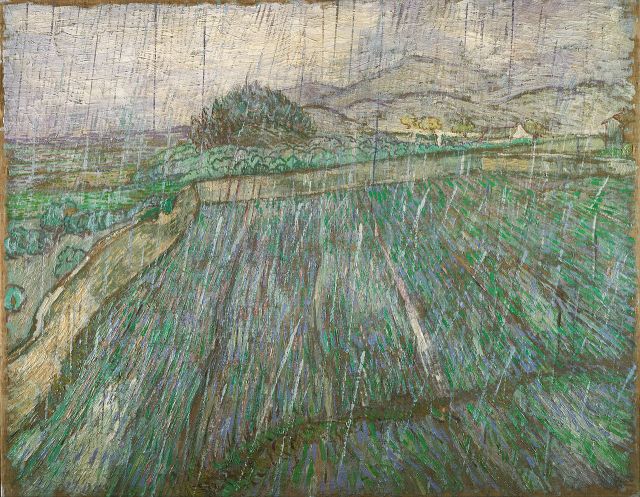
1280px-Vincent_Willem_van_Gogh,_Dutch_-_Rain_-_Google_Art_Project Enclosed Wheat Field in the Rain, by Vincent van Gogh