
my first hijab . . .
a shadow
on the flower
– Praniti Gulyani (India)
(Previously published in Old Song: Red Moon Anthology, 2017)
The opening line of this haiku indicates the first experience of a person wearing a hijab (veil) which is significant in terms of its religious, cultural, and social value. A first hijab also means that a girl has entered into puberty where she has to cover herself up as a means of her protection when she is interacting with a world full of strangers and experiencing a different perspective of life that is more mature.
A shadow, in my opinion, means the self-reflection of one’s thoughts about drawing a line to protect herself from the outer world. A new self-image that is more careful and thoughtful. This shadow can also be the fears that a woman holds in her youth regarding her body, beauty, and self. Through a hijab, she is trying to keep herself away from the darkness of the outer world.
It is like a flower that unfurls and reaches the stage of blossom where many insects and seasons ruin its beauty and loses the charm of life.
The use of an ellipsis after ‘hijab’ indicates the deepest feelings of a person, which is more than merely a piece of cloth.
– Hifsa Ashraf (Pakistan)
What drew me to this haiku was the topic of “hijab” which is not a common theme in this art form, and that the second part of the poem is open to many powerful associations.
As Hifsa mentioned, donning a hijab is part of the process of coming of age for a Muslim girl. Going through puberty as a girl is not something I’m familiar with as a man, but I can see the possible mixed emotions that it would bring. You are at once excited and scared for what becoming a young woman can entail. Perhaps the second part of the haiku is speaking about a more universal experience of one’s innocence being tainted. The poet, it seems, is expressing this through the lens of her religious and cultural experience.
I feel each word and line break in this haiku is deliberate and potent. It has a serious tone and is not celebratory. In my opinion, the pacing of the poem is telling the reader “take this seriously” as the weight of the words can be felt palpably.
In haiku, we speak of kigo, or seasonal references. “First hijab” can be said to be a kigo as it refers to a certain period of time. We can also say that wearing one’s first hijab could signify the spring of one’s life.
What is also interesting to note is the relation between the shadow and a hijab’s color, which is traditionally black. The correlation between the two parts of the haiku becomes even more apparent when considering this.
I like that Gulyani did not explain what kind of flower she was referring to. That would detract from the power of mentioning her first hijab. It would also make the haiku too heavy with three distinct subjects to consider. “Flower” has many references, spiritually, physically, and metaphorically. I will leave it to the reader to puzzle over them in the context of this haiku.
Finally, I want to take note of its technicalities. Though the first line is the longest, which is traditionally short, I believe having “my” in the poem is important. Without it, the haiku would not be perceived as so personal. The brevity of the poem is commendable and no word is wasted. The poem seems to have been written effortlessly, but I doubt it. The best poems seem natural on the page, but behind them, there are sometimes hours and days of work. In terms of the sound, the “i”s in the first line make it stark and the “o” sounds in the last two lines slow down the pace, which is effective with such a short poem.
Gulyani has written a unique and personal haiku that needs to be heard. It has resonance, brevity, and flow. Not only that, but she has also written about a substantial subject with the weight it deserves.
– Nicholas Klacsanzky (USA)
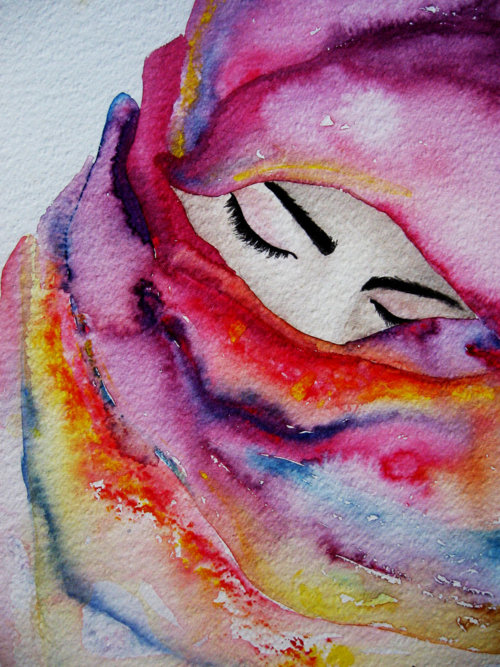
– Painting by nysahanny
 Haiku Commentary