
Haiku by Sandip Chauhan, Lisa Reynolds, and Neena Singh

grandpa’s coat
a loose button dangling
from a thread

Sandip Chauhan (USA)
Published in haikuKATHA, issue 36, October 2024

Commentary from Hifsa Ashraf:

This haiku reflects miseries, the carefree life in old age, or memories of a deceased person. Grandpa’s coat symbolizes the protection of the body but it’s not clear that the coat is hanging somewhere, in the closet, or the person is wearing it. In any case, it looks like a close association with the person and the coat. 

The loose button dangling from a thread describes the vulnerability in old age, where a person gets weak and powerless in many ways. Life becomes more predictable as the person is close to annihilation. There may be two aspects: one is a carefree life as a person doesn’t bother to take care of himself or be attentive to self-grooming and another is loneliness where no one is around to take care of the person or his belongings. In any case, the poet beautifully depicted old age which may be the same for many around us. 

separating strands
from gum —
first grade crush

Lisa Reynolds (Canada)
First Frost, issue #7, 2024

Commentary from Jacob D. Salzer:

This poem is relatable to many people who had a crush at such an early age. For this poet, it may even be her first crush. The first two lines depict the emotional and psychological tension the poet is wrestling with, especially in the words “separating strands.” The sticky qualities of gum could also lead readers to think about emotional and psychological attachments in general. What exactly is a crush? Who do we attach to, and why? What are the consequences of our emotional and/or romantic attachments? This haiku is a portal into these questions and into the mind of a first-grade child who is innocent and vulnerable. It’s also interesting to observe how a single object (in this case, gum) can conjure up memories from long ago and transport readers back in time. An interesting haiku that focuses on child psychology and emotions.

cherry blossoms…
a war refugee
empties his pockets


Neena Singh (India)
Sakura Award, Vancouver Cherry Blossom Contest 2024

Commentary from Nicholas Klacsanzky:

Cherry blossoms are a traditional Japanese kigo or seasonal reference to spring. They are often seen as a symbol of the elegance, splendor, and fleetingness of things. Because of the commonplace usage of this kigo, it isn’t easy to write an original haiku when mentioning cherry blossoms. However, I think the poet here rendered a new image, and one with energy and feeling.

The imagery could be interpreted in multiple ways. The blossoms could be falling from the refugee’s pockets, or the refugee emptied his pockets so that the blossoms could fit into pockets either by falling into them or by picking them up and putting them there. Either way, the imagery is poignant and points to the beauty of transience. Furthermore, the haiku beautifully contrasts the season of spring with being a war refugee.

I enjoy the ellipsis as it not only slows down the reader to take in the scene of cherry blossoms but also directs us to imagine the cherry blossoms floating in the wind. In addition, it delineates the haiku into a two-part structure so there is no confusion and the association between the parts of the haiku is clearer.

Though the haiku does not follow the English-language standard of a short line/longer line/short line rhythm (optional anyway), it does focus on the principle of brevity with only eight words. Also, the poet employed clear and simple language, which aligns with haiku tradition. There is also euphony with the weight of the “r” sounds and the lightness of the “o” sounds. This brings a contrast and balance to the reading of the haiku.

All the above-mentioned attributes of this haiku demonstrate why it won a Sakura Award at the Vancouver Cherry Blossom Contest. More than that, war refugees have been prevalent throughout history—especially now. This haiku can speak to readers through the ages up to the present time.

Japanese woodblock print (nishiki-e); ink and color on paper. Public Domain. Unknown artist.
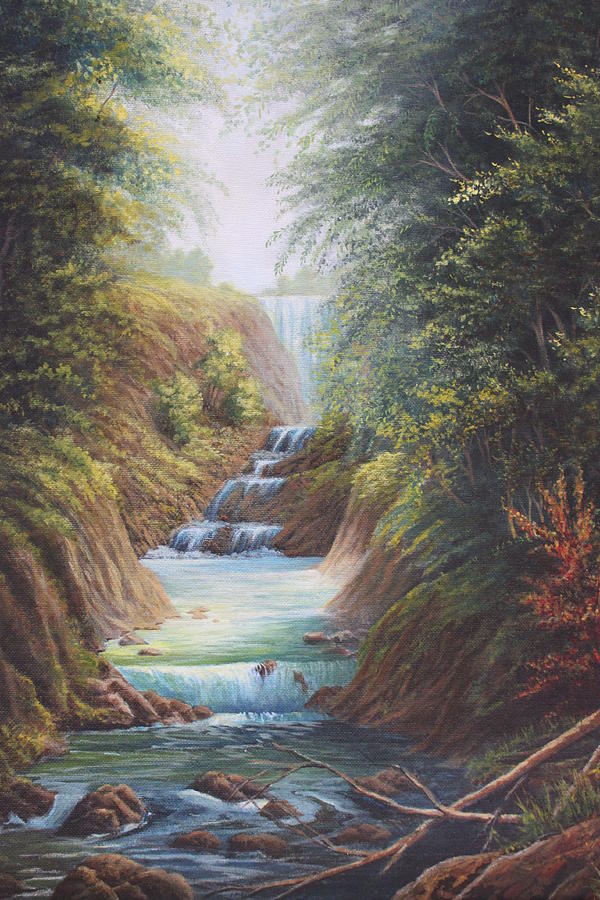
Sandip Chauhan’s flowing river

flowing river . . .
the spot where I poured
his ashes

Sandip Chauhan (USA)
(IAFOR Vladimir Devidé Haiku Award 2016 – Runners Up)

Commentary

This is a powerful haiku that sparks a conversation about life, death, cycles, time, and the afterlife. Does a river know of past or future, or any sense of time? Because of its continuity, the ever-present flow of now is the only time we are ever truly alive, while past and future seem to be abstractions. In the river’s flow, the person’s ashes seem to simultaneously conjure up the past and the future of the person’s soul. The interesting part about this haiku is “the spot” because it implies a specific place, but that spot in the river is always flowing. In fact, it seems the spot in this haiku can only be recognized because of a nearby landmark, such as a boulder.

This haiku contains yugen (mystery), leaving room for us as readers. Who is the male persona in this haiku who has passed away? How did he pass away? Because we don’t know the answer to these questions, this haiku can conjure up mixed emotions that relate to our own experience. In addition to grief, this haiku could conjure up gratitude for both the person who passed away and the river itself. To the poet, the male persona in this haiku could be his father, brother, son, another family member, or a friend. Regardless of who he is, it’s clear this is a moment many people can relate to. 

In this haiku, the person’s ashes become one with the river. Perhaps this haiku can inspire us to feel connected with Mother Earth and treat water with more respect before physical death as well. 

In terms of spirituality, it seems the individual soul (jiva) is like a river that eventually becomes one with the universal spirit (Shiva) likened to the sea. According to the spiritual teachings of Sri Ramana Maharshi, if there are karmic mental impressions (samskaras) left at the time of physical death, this necessitates rebirth at the right time, and this is how individual souls are reborn. 

Regardless of our views on death and the afterlife, this haiku brings mixed emotions and ultimately seems to bring a sense of ease that even at the time of physical death, life goes on. A powerful haiku. 

Jacob D. Salzer (USA)

It’s about life and death where ‘pausing and flowing’ comes together. It’s time that heals grief and lets us move on like a flowing river. The ellipsis in the first line shows how meaningful and significant it is to keep going on no matter how difficult life is. ‘The spot’ is the place where life and death depart from each other in terms of letting go and catching on.

I see it as a person, despite grieving over the death of a loved one, trying to console themselves by accepting the bitter reality, which is the ‘departure or death’—ready to accept what comes next. 

Hifsa Ashraf (Pakistan)

I’ll explore the seasonal reference, pacing, language, sound, and meaning.

There is no clear kigo (seasonal reference), but a flowing river probably cancels out it being winter (lack of frozen water). Because of the tone, I imagine this haiku to be autumnal.

The pacing of the lines is a prime example of the English-language attempt at replicating the traditional Japanese rhythm of “go-shichi-go.” The standard is a short first line, a longer second line, and a short third line. As many know, syllable counting does not match the 5-7-5 Japanese sound units on well, and we use the aforementioned rhythm primarily.

In terms of the language, the poet rightly uses simple vocabulary so as to not be formal or verbose. Like the haiku written by the masters, the poet employs language that cuts straight to the reader. The last thing you want to do in a haiku is bog down the expression of the moment in verbosity and formality. From Matsuo Basho onwards, the haiku (then hokku) became a vehicle of vernacular speech and casual expression.

The first thing I noticed about the sound of this haiku was the repetition of “o” sounds. These elongated sounds carry the leisurely but melancholic movement of the river. “S” also features strongly, providing the music of the river in the reader’s mind.

Jacob and Hifsa have discussed the meaning of this haiku already, but I’ll add that this poem gives me feelings of both the importance and triviality of the body—and perhaps identity. The poet knows the exact spot where he offered the ashes of a loved one in the river, but the river is not stagnant or static. The river is ever-changing, which mirrors Heraclitus who said, “The only constant in life is change.” We can try to claim an identity, but even that is constantly fluid and flowing.

Nicholas Klacsanzky (USA)

“Flowing River” by Diana Miller