
Haiku and senryu by Srini, Danny Blackwell, and Tuyet Van Do

starlit pond…
a paper boat floats
for light years


Srini (India)
Tinywords, 25:2, October 3, 2025

Commentary from Hifsa Ashraf:

This haiku transports us into a quiet, enclosed space—perhaps a park, a backyard, or a secluded garden. The opening image is enchanting and dreamy: a starlit pond blurs the line between sky and earth, mirroring the cosmos in its still waters. The ellipsis at the end of the first line invites a pause, allowing the reader to absorb the magic of the moment. I can almost see a tapestry of stars delicately reflected on the pond’s surface.

The second line introduces a subtle shift: a paper boat floats on the water. It acts as both an interruption and an anchor—drawing us back from reverie into something tangible and innocent. The boat may symbolize a small dream, a fleeting hope, or a playful childhood memory. Its fragility contrasts with the vastness of the sky, evoking a sense of childlike wonder and gentle yearning.

The closing line, “for light years,” broadens the scale dramatically, allowing us to feel the vastness of our universe. This simple phrase goes beyond time and space, suggesting a desire for an unending journey or an unreachable dream, sort of imaginative, but still holds some meaning. It transforms the scene into something meditative—where a single paper boat becomes a bridge between the earth and the cosmos, a bridge that also connects a dream with reality. It seems one is thoroughly enjoying the surreal environment that inspires them to see beyond limited vision and express one’s longing in the most beautiful and innocent way.

the mosquito mesh
pixelating
the night


Danny Blackwell (Spain)
NHK TV program Haiku Masters, July 31, 2017. Reprinted in tiny words 17:2

Commentary from Nicholas Klacsanzky:

With the mention of “mosquito,” we could be receiving a kigo (seasonal reference), as they are most active during the warmer months—especially in June and July. Summer, as it relates to pixelation, can be likened to something overwhelming.

There is no explicit kireji (marker for the cut between parts in a haiku), but the line breaks act as a quasi one. The flow of the haiku can be read as one part, yet it is broken down as a pixelated mesh would be. This brings the reader more into the “space” of the poem.

The mosquito mesh is dual-acting: keeping out mosquitoes but also a catalyst for altered perception. As a person who used to work in information technology, I have often thought about the poetic implications of mesh and it being like pixelation. It is a visual metaphor drawn from the digital realm that plays with mundane texture. The mesh breaks the darkness of night into fragments, perhaps making it more manageable and less oppressive. This toriawase (combination of elements to create harmony) of the analog and digital invites multiple readings, with the word “night” having physical and metaphysical implications. “Night” could be indicative of a sadness, a horror, or a malaise.

The mesh could also be illustrative of the distance between intimacy and separation. The poet is close enough to notice the effect of the mesh, yet the mesh itself signifies a boundary between inside and outside, human and nature, the safe and the wild. It is a contemplative image that captures the modern condition: the world increasingly filtered, fragmented, and mediated through invisible grids.

With the repetition of t and i sounds, I can almost hear the tick of mosquitoes against the net and their whining. Overall, it is a haiku that expresses succinctly and poignantly a bridge between technology and the natural world, and the false divide we put up between nature and humanity.

emergency room
an elderly patient
rocking back and forth


Tuyet Van Do (Australia) 
Pulse, 19th September 2025

Commentary from Jacob D. Salzer

The emergency room (ER) is a tough place to be, for a variety of reasons. While there is a triage process that’s designed for providers to first see patients with the most severe injuries and diseases, a lot of people end up in the waiting room for anywhere between 2 to 3 hours (or sometimes more) before being seen by a provider. The ER can be a crowded place. I’m personally a strong advocate for preventing diseases and injuries, though some things are hard or impossible to avoid. In this senryu, I first saw the ER waiting room full of people, and then noticed the elderly patient rocking back and forth. This movement could help create a soothing rhythm in the midst of what is often chaos and uncertainty. The elderly person could be rocking back and forth as they wait for the doctor or test results. While the ER can be a very difficult place to be, it’s also often a place of healing, recovery, and discovering what’s gone wrong.

We don’t know what the patient is going through in this senryu, but when I read this poem, I immediately feel compassion and empathy for the elderly person and for the human condition. It’s never easy being human, and it gets increasingly more common for things to go wrong in the body and mind as we age.

While this poem may seem simple on the surface, there are layers of psychological and medical complexity that I appreciate. A well-written senryu that offers a portal into another world.

Painting by Hisae Shouse
Haiku by Ingrid Jendrzejewski, Joseph Howse, and Srini

rush hour
the paper bag
crossing the street

Ingrid Jendrzejewski (UK)
April 2024 at Cafe Haiku (Cityscape series)

Commentary from Hifsa Ashraf:

The opening line makes this haiku quite interesting. ‘Rush hour’ is now a new normal, where everyone is trying to meet the requirements of a fast-paced life. No ellipses after it may mean it’s open to interpretation. Everyone can fit in the scene according to their daily routine. It can be jobs, errands, studies, meet-ups, business, events, etc. In any case, the time is crucial and significant. The ‘sh’ sound in ‘rush’ highlights the urgency of work, while the silent ‘h’ in ‘hour’ shows how quickly it passes without letting us be aware of it. 

The second line shows us those priorities that are usually not significant enough but keep poking us throughout the day. These priorities or tasks may distract us or deviate us from our main focus. ‘The’ before ‘paper bag’ refers to a specific bag or an analogy to our materialistic life that may be hollow and empty yet chaotic as well. This also indicates the mess around us that makes our life more complicated as mentioned in the third line of this haiku.

Crossing the street, or crossing our path, prompts us stop or slow down the ‘rush hour’. This could also relate to ceasing our thoughts or feelings. It also means that sometimes certain irrelevant things become relevant even if we are not paying much attention. This is how delicate our lives are. This is how emptiness or loneliness behind a fast-paced life keeps following us or crosses our paths. We realize that our relevance is defined by our attitude towards life.

raspberry fenceline
a neighbour asks
how many kids in the plan


Joseph Howse (Canada)
Kokako 42, April 2025

Commentary from Jacob D. Salzer:

An effective haiku that speaks of boundaries, social dynamics, and responsibilities. The first line is unique in that the fence itself could be the raspberry vines. Alternatively, the raspberry vines could be growing against an actual fence, and perhaps over the fence. The imagery and scent in the first line include both the sweetness of raspberries and the thorns of their vines that are likely entangled. This creates a powerful juxtaposition because we can imagine the tangled raspberry vines as being a metaphor for the complexity of relationships. In addition, there is a correlation between the plants growing (and the raspberries ripening) and the children growing and maturing over time. Will the children eventually climb over the neighbor’s fence? There is some potential humor in this haiku as well. Indeed, the neighbor’s question in the third line seems to signify a mental preparation for more babies and children in the neighborhood. I imagine a young couple buying their first house and talking about having children, which is a deep conversation that requires a lot of careful thought and planning. The last two lines could also imply that the neighbor may offer to help raise their children and support the family over the years. In summary, this is an interesting and effective haiku that speaks of boundaries, planning, responsibility, and the complex dynamics of social life in neighborhoods. A well-written haiku.

a sentence without punctuation desert silence

Srini (India)
Kingfisher Journal, issue 10, 2025

Commentary from Nicholas Klacsanzky:

The concept of this haiku is clever. It discusses a sentence without punctuation and also presents itself as such. The word “sentence” can have dual meanings: a syntactical construction and what a criminal receives (or an innocent person sent to trial) as a punishment. Having “a sentence without punctuation” could refer to a person sentenced to life in prison.

Being a one-line haiku, it can be read in multiple ways: “a sentence without punctuation/desert silence”; “a sentence/without punctuation desert silence”; “a sentence without punctuation desert/silence”; and read as one flowing thought. The most natural, in my view, would be to read it as “a sentence without punctuation/desert silence.” However, each reader may approach it intuitively in different ways. Either way, this haiku shows a strong bond between human linguistics and nature. Another perspective is that this haiku is a contrast between something fabricated (language) and something standing alone in itself (the desert).

There is no kigo or seasonal reference per se, but “desert silence” does point to a certain time. It is most probably at twilight or early morning in the desert. This has an interesting potential for resonance with the idea of a sentence. A sentence is something formed and could relate to these times when life is waking up or is unclear.

Looking at the sound, I enjoy the letters “s” and “c” being reflections possibly of the hiss of sand. The letter “t” also has a finality to it that could connect to the context of a sentence or desert silence.

This haiku follows the principle of brevity with only six words present. Basho spoke of the necessity of haiku having no hindrance for the reader, yet there is deep meaning. I believe this haiku strikes this chord. It is one of the few haiku I have seen use the word “silence” successfully without me flinching, as often the word is employed in a cliche or lazy fashion. Srini has written a haiku that is at once natural and linguistic, which comes full circle in the context of the poem.

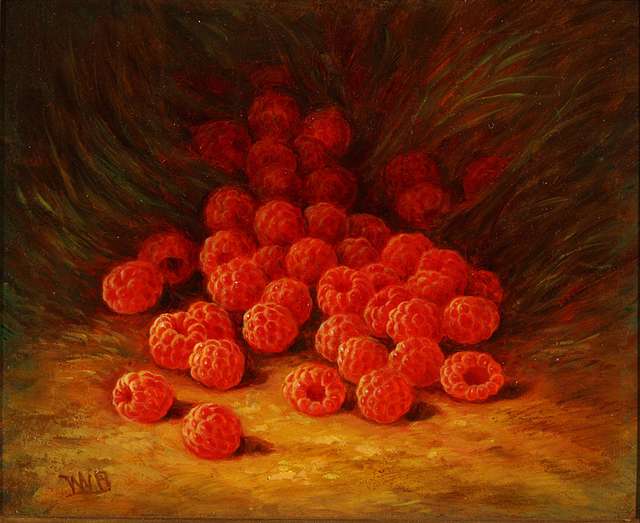
Red Raspberries on a Forest Floor by William Mason Brown, c. 1866, High Museum of Art

Haiku from Antoine Cassar, Tuyet Van Do, and Srini

Negotiations —
owner, bank, architect, notary,
and now this mosquito…

Antoine Cassar (Malta)

Commentary from Jacob D. Salzer:

As humans, we are frequently faced with negotiations, but this haiku also has a humorous twist in the last line, which I appreciate. It seems the poet’s sense of humor in this haiku may be a kind of coping mechanism among frustrating and/or challenging situations in life.

Another unique feature of this haiku is the poet’s use of punctuation. We have an em dash, four commas, and an ellipsis, which is rarely seen in a single haiku. I think the many forms of punctuation amplify a drawn-out, elongated effect, which seems to give the impression that the poet may be tired of negotiations and wants more peace and silence. Indeed, some negotiations also go on for quite some time. For example, competing for the ownership of a house can involve several negotiations regarding the mortgage payments and the down payment. 

In short, this is an interesting haiku that blends humor with the heavy financial decisions, negotiations, and struggles that many of us face in modern life.

musical notes
across the power lines
spotted doves

Tuyet Van Do (Australia)
haikuNetra, issue 1.2, 2023

Commentary from Nicholas Klacsanzky:

I prefer haiku that employ pivot lines, and this one delivers. “Musical notes across power lines” is a neat phenomenon to imagine. However, it can turn morbid if we imagine the doves are getting electrocuted and there is sound coming from that occurrence. “Across the power lines, spotted doves” is much more tame, in my opinion, as it sees the doves adding their songs to the hum of electrical lines. This interpretation makes a connection between nature and the human world.

This haiku is also pleasant to the ear, with the strong presence of “o” and “s.” It is paced well, too, with the traditional short/long/long rhythm. Also, with only eight words, the poet focused on brevity and the economy of language. In addition, the poet made sure the poem didn’t lean into verbosity. Overall, this haiku combines a variety of poignant interpretations with technical accuracy in its craft.

where school ends wildflowers

Srini (India)
haikuNetra, issue 1.4, 2023

Commentary from Hifsa Ashraf:

This simple monoku says a lot in four words. I see it in terms of time and space. It starts with a question that lets us pause and think about the space or place. The school may be in a remote area, a war-affected domain, a refugee camp, or a city/town. The location is significant in this case. I see it as a war-affected area or a refugee camp where it’s unpredictable what will happen after school or where learning and knowledge will take a student. ‘School ends’ doesn’t mean anything certain in the future or ‘school ends wildflowers’ may lead to something specific. Another aspect could be a school where a person rejoices in a carefree life, and when it comes to an end, the worries or anxieties about the future start coming.

I like the way the poet ends it with ‘wildflowers’—something I often use in my poems, and it’s the title of my micropoetry book on refugees. ‘Wildflowers’ show both abundance and abandonment here depending on how we read it i.e. ‘school ends wildflowers’= abundance or ‘school ending at wildflowers’= abandonment. So, it can be an opportunity for a new life or a new beginning. It could also display a hope for abundance. On the flipside, it could demonstrate abandonment in a real sense where someone may get stuck with a career or responsibility, or remain directionless like wildflowers. Ultimately, I take it as something positive irrespective of the location or situation of the school or personal experiences associated with it.