Haiku and senryu by Srini, Danny Blackwell, and Tuyet Van Do

starlit pond…
a paper boat floats
for light years


Srini (India)
Tinywords, 25:2, October 3, 2025

Commentary from Hifsa Ashraf:

This haiku transports us into a quiet, enclosed space—perhaps a park, a backyard, or a secluded garden. The opening image is enchanting and dreamy: a starlit pond blurs the line between sky and earth, mirroring the cosmos in its still waters. The ellipsis at the end of the first line invites a pause, allowing the reader to absorb the magic of the moment. I can almost see a tapestry of stars delicately reflected on the pond’s surface.

The second line introduces a subtle shift: a paper boat floats on the water. It acts as both an interruption and an anchor—drawing us back from reverie into something tangible and innocent. The boat may symbolize a small dream, a fleeting hope, or a playful childhood memory. Its fragility contrasts with the vastness of the sky, evoking a sense of childlike wonder and gentle yearning.

The closing line, “for light years,” broadens the scale dramatically, allowing us to feel the vastness of our universe. This simple phrase goes beyond time and space, suggesting a desire for an unending journey or an unreachable dream, sort of imaginative, but still holds some meaning. It transforms the scene into something meditative—where a single paper boat becomes a bridge between the earth and the cosmos, a bridge that also connects a dream with reality. It seems one is thoroughly enjoying the surreal environment that inspires them to see beyond limited vision and express one’s longing in the most beautiful and innocent way.

the mosquito mesh
pixelating
the night


Danny Blackwell (Spain)
NHK TV program Haiku Masters, July 31, 2017. Reprinted in tiny words 17:2

Commentary from Nicholas Klacsanzky:

With the mention of “mosquito,” we could be receiving a kigo (seasonal reference), as they are most active during the warmer months—especially in June and July. Summer, as it relates to pixelation, can be likened to something overwhelming.

There is no explicit kireji (marker for the cut between parts in a haiku), but the line breaks act as a quasi one. The flow of the haiku can be read as one part, yet it is broken down as a pixelated mesh would be. This brings the reader more into the “space” of the poem.

The mosquito mesh is dual-acting: keeping out mosquitoes but also a catalyst for altered perception. As a person who used to work in information technology, I have often thought about the poetic implications of mesh and it being like pixelation. It is a visual metaphor drawn from the digital realm that plays with mundane texture. The mesh breaks the darkness of night into fragments, perhaps making it more manageable and less oppressive. This toriawase (combination of elements to create harmony) of the analog and digital invites multiple readings, with the word “night” having physical and metaphysical implications. “Night” could be indicative of a sadness, a horror, or a malaise.

The mesh could also be illustrative of the distance between intimacy and separation. The poet is close enough to notice the effect of the mesh, yet the mesh itself signifies a boundary between inside and outside, human and nature, the safe and the wild. It is a contemplative image that captures the modern condition: the world increasingly filtered, fragmented, and mediated through invisible grids.

With the repetition of t and i sounds, I can almost hear the tick of mosquitoes against the net and their whining. Overall, it is a haiku that expresses succinctly and poignantly a bridge between technology and the natural world, and the false divide we put up between nature and humanity.

emergency room
an elderly patient
rocking back and forth


Tuyet Van Do (Australia) 
Pulse, 19th September 2025

Commentary from Jacob D. Salzer

The emergency room (ER) is a tough place to be, for a variety of reasons. While there is a triage process that’s designed for providers to first see patients with the most severe injuries and diseases, a lot of people end up in the waiting room for anywhere between 2 to 3 hours (or sometimes more) before being seen by a provider. The ER can be a crowded place. I’m personally a strong advocate for preventing diseases and injuries, though some things are hard or impossible to avoid. In this senryu, I first saw the ER waiting room full of people, and then noticed the elderly patient rocking back and forth. This movement could help create a soothing rhythm in the midst of what is often chaos and uncertainty. The elderly person could be rocking back and forth as they wait for the doctor or test results. While the ER can be a very difficult place to be, it’s also often a place of healing, recovery, and discovering what’s gone wrong.

We don’t know what the patient is going through in this senryu, but when I read this poem, I immediately feel compassion and empathy for the elderly person and for the human condition. It’s never easy being human, and it gets increasingly more common for things to go wrong in the body and mind as we age.

While this poem may seem simple on the surface, there are layers of psychological and medical complexity that I appreciate. A well-written senryu that offers a portal into another world.

Painting by Hisae Shouse

Haiku by Thomas L. Vaultonburg, Tuyet Van Do, and Alexander Groth

broken bridge—
the river teaches me
its alphabet

Thomas L. Vaultonburg (USA)

Commentary from Hifsa Ashraf:

This haiku reflects wreckage, destruction, and loss—possibly due to war, natural erosion, or catastrophe. The opening line, “broken bridge,” immediately conveys a sense of disruption—be it in relationships, communication, or continuity. A bridge often symbolizes connection, transition, or passage from one state to another. Here, its brokenness suggests a severed link, a collapse in understanding or unity. The em dash after the first line pauses the reader, allowing them to fully absorb the scene and connect with it in their own personal way.

The second line shows how, in the absence of that constructed path, the observer begins to engage directly with the river. The destruction of the bridge uncovers a hidden relationship with the river—something previously ignored as people simply crossed over it, never truly noticing its flow, sound, or resilience. Now, with nothing in between, the river demands presence. It becomes a metaphor for uninterrupted thought—fluid, spontaneous, and reflective—offering insight and wisdom in the aftermath of loss.

The final line, “its alphabet,” is especially evocative. It suggests the river has its own language—one that the observer is now learning to read. This could represent poetry, expression, or a deeper understanding of the self and nature. The word “alphabet” also points to musicality, rhythm, and perhaps even healing, as if the river’s sounds become a kind of song or meditation.

Overall, it is a haiku that displays humility, and that when the human-made world breaks down, nature is there with its voice and language.

vacation at grandma’s
cicada’s symphony
singing me to sleep


Tuyet Van Do (Australia)
Haiku Girl Summer, 25 August 2025

Commentary from Nicholas Klacsanzky:

“Cicada” is a classic summer kigo (seasonal reference) in the Japanese haiku tradition, and in most countries. The poet could be implying that she was on summer vacation while visiting her grandma’s house. I got the feeling, though, that perhaps her grandma was no longer there, and the cicadas were a substitute for the lullabies that her grandma used to sing. The loudness and fullness of cicada song fill the gap left behind by a loved one to some degree.

In the second line, there is a shift to the natural world, connecting humanity with the cicadas. Oftentimes, cicadas are thought to have harsh calls, but the word “symphony” characterizes their sound as pleasant and even awe-inspiring. Perhaps at a place as so nostalgia-infused as grandma’s house, even cicadas can sound melodious and sweet.

The third line returns to the human, showing the effect of nature on the poet. It displays a clear juxtaposition of human experience and nature. Additionally, it also manifests the connection between sound and the memory of an emotion. Music, or certain sonics of nature, can often open the floodgates of memory.

Looking at the sense of sound within the words themselves, the repetition of the soft s sounds mimics the hiss and hum of the cicadas in the first line. In the last line, the s dominates again, this time softened by ng and sl, creating a lulling effect.

It is a simple haiku at first glance, but with a second look or more, one can easily see and feel layers of meaning that are poignant and resonant.

school bathroom—
the scent of fresh deodorizer
lingers in my hair

Alexander Groth (Germany)

Commentary from Jacob D. Salzer:

Many activities can happen in school bathrooms. They can be a kind of hiding place for some students, where they talk and share secrets, though more unfortunate things can happen in school bathrooms as well. The scent of the fresh deodorizer could be covering up another scent, though this is left open to the reader. In a broader sense, this haiku makes me think about the psychological, physical, and emotional effect that various scents have in our daily lives. It also makes me think about the chemicals in various deodorizers/deodorants that some people are exposed to on a daily basis. In college, I learned certain deodorants have harmful chemicals that can enter the lymph nodes and can cause various medical problems over time, including cancer. In short, this is an important haiku that sparks conversations about school safety, the sense of smell, chemicals, and the social lives of students. 

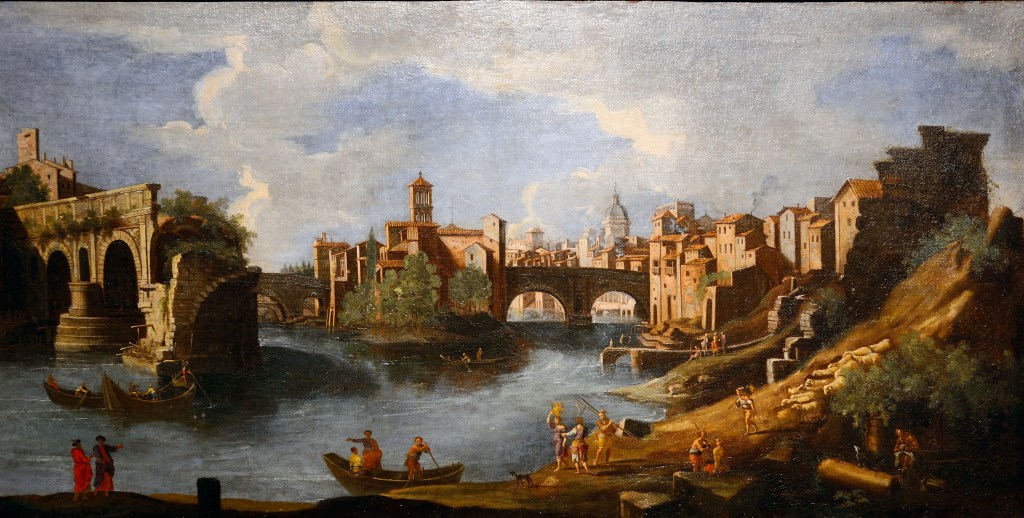
Panorama of the Tiber with a broken bridge. Caspar van Wittel (1653–1736) 

Haiku by Kavita Ratna, Tuyet Van Do, and Katherine E Winnick

in the margins
of a funeral
a message pings


Kavita Ratna (India)
LEAF, June 2023

Commentary from Jacob D. Salzer:

An important haiku that sparks a conversation about our views of death, funerals, and technology in modernity. The first line is unique because it has literal and potentially metaphorical interpretations. Was the person with the cellphone living at the psychological margins of the deceased person’s life when they were alive? Was the person with the cellphone a friend or acquaintance who didn’t know most of the people at the funeral? This can create an awkward social situation. At the same time, it can be humbling to see how one person touched so many people’s lives. The word “margins” seems to imply there are a lot of people attending the funeral. Perhaps this person doesn’t truly feel they can celebrate the deceased person’s life among the crowd of people. Does the modern-day ritual of funerals truly celebrate the deceased person in a unique way that they would actually want? 

According to Elizabeth Fournier in her book, “The Green Burial Guide: Everything You Need to Plan an Affordable, Environmentally Friendly Burial”: “Funeral expenses in the United States average more than $10,000. And every year conventional funerals bury millions of tons of wood, concrete, and metals, as well as millions of gallons of carcinogenic embalming fluid. There is a better way.”

Here is The Green Burial Guide on Bookshop.org, which I recommend:
https://bookshop.org/p/books/the-green-burial-guidebook-everything-you-need-to-plan-an-affordable-environmentally-friendly-burial-elizabeth-fournier/10952712?ean=9781608685233&next=t

Even though the person in this haiku is not noticeable at the funeral, their cellphone ping briefly interrupts the service and has a ripple effect. This makes me wonder about the ways we communicate in our culture and the quality of our communication methods. Text messages can be useful, but they can also be overly used. Since the English Language and technology are both tools, I think they need to be used carefully and wisely. Silencing our cellphones is also a clear gesture of respect, which this person in the haiku clearly forgot to do. The ping notification could mean an important message came through, or it could be something more superficial. It reminds me that we are constantly communicating with each other, both verbally and non-verbally, all the time. But do we use cellphones too much? What are the consequences of spending too much time on our cellphones and other devices?

I think the social norms of funerals in the U.S. need to be psychologically interrupted in light of how costly they are, both environmentally and financially. I sincerely hope that more people could plan ahead for how they want to be remembered and celebrated in modest ways through a living will. I also sincerely hope more people would choose an eco-friendly burial option. This truly benefits everyone and saves a significant amount of money, too.

In short, this is an important haiku that starts a larger conversation about funerals, how we remember and celebrate someone, and the role of technology in our lives. It could also spark conversations about the afterlife and reincarnation. How do we want to be remembered? What are we leaving behind? How can death remind us of how we truly want to live within this limited lifetime, moment by moment? As a community, I hope that compassion and wisdom can be our guiding light.

spoon by spoon 
feeding my patient …
a setting sun


Tuyet Van Do (Australia)
Poetry Pea Journal 2:25, 2025

Commentary from Hifsa Ashraf:

I can sense pain, endurance, caring, and departure in this subtle poem where the patient is either dying or getting relief from suffering. I see both hope and despair. The patient being taken care of by a nurse or paramedic staff is all alone and helpless. ‘Spoon by spoon’ is a deep expression, showing bits and pieces of healing by nourishing the patient. It could be food, medicine, or something more energetic, but it also depicts old age, where a person depends on others for their well-being.  

The use of ellipses in the second line after ‘feeding my patient’ stresses the depth of feelings of the person who is nursing the patient. Do they have any association with the patient? Do they empathise with the patient? Do they feel bad about the patient? Who is the patient? What’s the age of the patient? Is the patient alone or have a family? All these details remain open for interpretation. 

The last part of this haiku reveals something unfortunate and helpless. The dying sun symbolizes the end of life, when day transforms into night. In other words, the transformation of life into death or from an uncomfortable condition to a comfortable condition, where the patient sleeps well after getting some care. I see another aspect here: ‘sun’ may also be symbolic of the gender of the patient by creating an analogy of the sun with ‘son’. The beauty of this poem is that you can interpret it in as many ways as you can, and each aspect may lead to the harsh reality of life, which is death. 

Sakura Jishidi 
shadows of sparrows 
amongst the pink 


Katherine E Winnick (UK) 
Presence #79, 2024 

Commentary from Nicholas Klacsanzky:

“Sakura Jishidi” is the name of the Japanese tree peony. They commonly bloom in spring, and are used in haiku to signify this season. Employing the Japanese word for the flower instead of the English version is an intriguing choice. I believe it increases the sound quality of the haiku, as “Japanese tree peony” doesn’t mesh with the “s” and “i” sounds in the rest of the poem as much.

The keyword in this haiku, in my opinion, is “shadows.” I feel it has two meanings: the physical presence of shadows and the memory of sparrows. It could also be a reference to something fleeting, ominous, or gloomy. The mood of this haiku centers around this word, as even though the sakura blossoms display their pink, the memory, absence, or distance of sparrows decorates the flowers. Ultimately, this brings about a melancholy mood amidst spring. I resonate with these types of moods in haiku, as they mirror our nuanced lives. Within joy, there is oftentimes a touch of sadness or loss. This does not diminish joy, in my opinion, but allows us to be more grateful when it occurs and to experience it with a mature lens.

Copyright 2022, Tsun Ming Chmielinski

Haiku from Antoine Cassar, Tuyet Van Do, and Srini

Negotiations —
owner, bank, architect, notary,
and now this mosquito…

Antoine Cassar (Malta)

Commentary from Jacob D. Salzer:

As humans, we are frequently faced with negotiations, but this haiku also has a humorous twist in the last line, which I appreciate. It seems the poet’s sense of humor in this haiku may be a kind of coping mechanism among frustrating and/or challenging situations in life.

Another unique feature of this haiku is the poet’s use of punctuation. We have an em dash, four commas, and an ellipsis, which is rarely seen in a single haiku. I think the many forms of punctuation amplify a drawn-out, elongated effect, which seems to give the impression that the poet may be tired of negotiations and wants more peace and silence. Indeed, some negotiations also go on for quite some time. For example, competing for the ownership of a house can involve several negotiations regarding the mortgage payments and the down payment. 

In short, this is an interesting haiku that blends humor with the heavy financial decisions, negotiations, and struggles that many of us face in modern life.

musical notes
across the power lines
spotted doves

Tuyet Van Do (Australia)
haikuNetra, issue 1.2, 2023

Commentary from Nicholas Klacsanzky:

I prefer haiku that employ pivot lines, and this one delivers. “Musical notes across power lines” is a neat phenomenon to imagine. However, it can turn morbid if we imagine the doves are getting electrocuted and there is sound coming from that occurrence. “Across the power lines, spotted doves” is much more tame, in my opinion, as it sees the doves adding their songs to the hum of electrical lines. This interpretation makes a connection between nature and the human world.

This haiku is also pleasant to the ear, with the strong presence of “o” and “s.” It is paced well, too, with the traditional short/long/long rhythm. Also, with only eight words, the poet focused on brevity and the economy of language. In addition, the poet made sure the poem didn’t lean into verbosity. Overall, this haiku combines a variety of poignant interpretations with technical accuracy in its craft.

where school ends wildflowers

Srini (India)
haikuNetra, issue 1.4, 2023

Commentary from Hifsa Ashraf:

This simple monoku says a lot in four words. I see it in terms of time and space. It starts with a question that lets us pause and think about the space or place. The school may be in a remote area, a war-affected domain, a refugee camp, or a city/town. The location is significant in this case. I see it as a war-affected area or a refugee camp where it’s unpredictable what will happen after school or where learning and knowledge will take a student. ‘School ends’ doesn’t mean anything certain in the future or ‘school ends wildflowers’ may lead to something specific. Another aspect could be a school where a person rejoices in a carefree life, and when it comes to an end, the worries or anxieties about the future start coming.

I like the way the poet ends it with ‘wildflowers’—something I often use in my poems, and it’s the title of my micropoetry book on refugees. ‘Wildflowers’ show both abundance and abandonment here depending on how we read it i.e. ‘school ends wildflowers’= abundance or ‘school ending at wildflowers’= abandonment. So, it can be an opportunity for a new life or a new beginning. It could also display a hope for abundance. On the flipside, it could demonstrate abandonment in a real sense where someone may get stuck with a career or responsibility, or remain directionless like wildflowers. Ultimately, I take it as something positive irrespective of the location or situation of the school or personal experiences associated with it.