
beachcombing
countless empty homes
washed ashore
— Kala Ramesh (India)
haikuKATHA: #35, September 2024
Commentary from Nicholas Klacsanzky:
What most connects me to this haiku is the multifaceted second line. I can see at least two ways to interpret “countless empty homes.” The more poetic way to see it is the homes of creatures like mollusks, and the like, washing ashore. The other interpretation is that people’s homes are coming ashore after a natural disaster like a powerful storm. Both versions bring a sense of dread and melancholy, especially in light of the contrasting leisurely activity of beachcombing. Another interpretation that may dawn on the reader is the imagery’s association with war. Our modern world is engulfed in several wars at the moment, and this haiku might be reflecting this. This way of perceiving the poem especially highlights a connection between humanity and the natural world.
Looking at the more technical aspects of this haiku, we can look at the punctuation, sound, and phrasing. There is a lack of punctuation, yet it is not quite needed. The second line acts more as a pivot without punctuation. As a reader, I intuitively paused after the first line, as if a comma or dash were there.
Kala Ramesh is a classically trained musician in Indian classical music, and it shows in her haiku. The “k” sound in “beachcombing” and “countless” brings about starkness in my mind. Conversely, the “o” sound in each line reinforces the melancholic mood of this poem.
Lastly, this haiku is paced in a way that approximates the original Japanese rhythm of haiku, which is a short first line, a longer second line, and a short third line as an English-language standard. Even though haiku is originally written in one line, it is delineated in two parts through kireji, and three lines in English represent those two parts. It is also noticeable that the poet practiced brevity and conciseness, with each word in this haiku being important and efficient.
The sum of this haiku is greater than its parts, though. The feeling one gets from the imagery, sound, and pacing is best simply felt rather than explained. A sense of compassion washes over the reader, which is sorely needed these days.
music plays—
sweet air holds a longing
for what might be
— Valentina Meloni (Italy)
Commentary from Jacob D. Salzer:
As a musician, I appreciate the dynamic atmosphere in this haiku. I admire how this haiku includes sound, scent, and perhaps a sixth sense, or the sense of longing. I like how the music is not defined, which allows us as the readers to hear different kinds of music. “music plays” gives me a feeling that the music is unfamiliar, and perhaps heard at some distance. I feel this adds spatial and psychological depth to this haiku. When I read the second line, I imagine breathing in the scent of a flower (or perhaps several different kinds of flowers) that has a sweet scent, though I like how the poet left the sweet scent open for the reader. I also like how the sweet air implies wind or a soft breeze that combines with the music. Through music and scent, the poet succeeds in leaving room for mystery. Perhaps most importantly, this haiku shows the power of music and its ability to inspire and bring us hope in a way that transcends words and thoughts. For me, among all art forms, music continues to be the most powerful creative expression of the human spirit. This haiku effectively expresses this sentiment, with grace, beauty, and mystery. A beautiful haiku.
prayer balloon—
our scribbled wishes
just out of reach
— M. R. Defibaugh (USA)
English-Speaking Union of Japan-Haiku, March 2025
Commentary from Hifsa Ashraf:
This is a haiku that is purely based on the belief in prayers. I am a great believer in prayers. A prayer balloon is a symbolic way of writing and sending prayers, which is quite subtle. I find it a beautiful way to show one’s deep connection with prayers, wishes, and desires, and demonstrate it tangibly. It also helps the person psychologically to let go of worries with the flying balloon.
The em dash after the prayer balloon shows its significance for the poet. The second line is about one’s wishes that are scribbled and highlighted on the balloon. It is a way to share one’s desires in the most obvious manner, where one is not only wishing them in their hearts but also aware of those wishes by scribbling them.
I find it therapeutic when one writes down their prayers or wishes on a delicate balloon that can carry the weight of those prayers and wishes easily, and acts as a bridge between the person and God. When a prayer is being scribbled on a balloon, it involves all senses, which means the person is mindful and fully aware of what’s in their heart and what should be written. This is the act of knowing.
The third line is a sort of comparison and contrast with the second one—the act of unknowing. The person’s conviction and beliefs are intact whilst scribbling the wishes, but there is a sense of helplessness or no anticipation of those wishes; there are some sort of expectations and thoughts that gather in the mind after releasing the balloon in the air. This is a sort of realization that certain things are not in our control; we can make efforts only. ‘Just’ in the third line means the person has precise thoughts on it that once the wishes are done, they are not in our hands anymore—especially in this case, where the balloon disappears after some time. So, it’s a journey from seeing to beyond seeing, where one’s thoughts and feelings oscillate from known to unknown or vice versa.
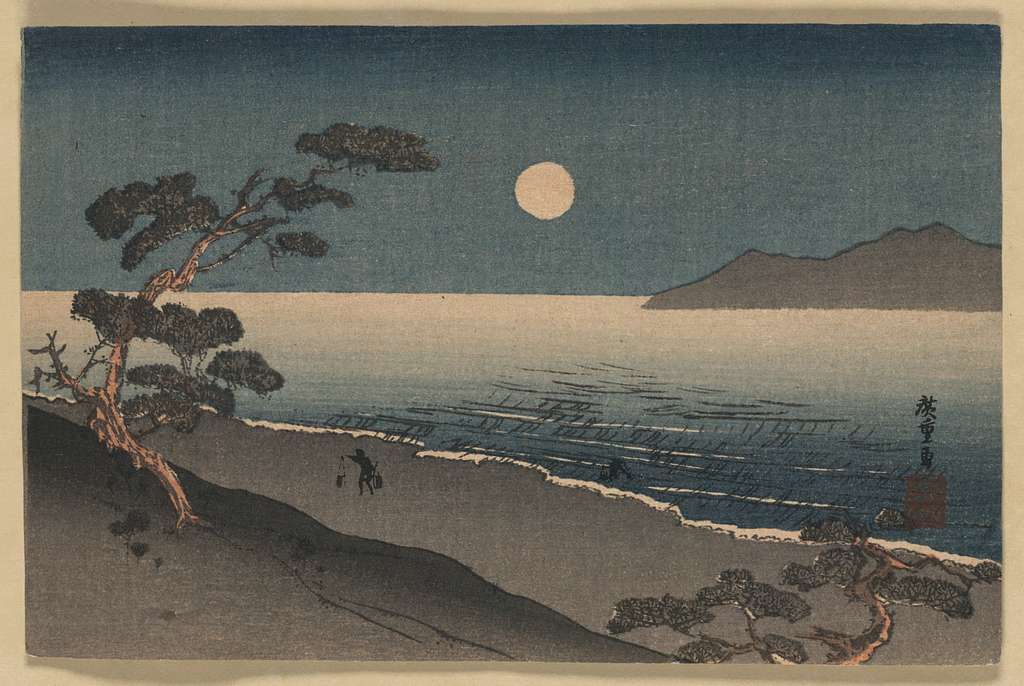
Matsumoto print, no. 39. The Matsumoto Do, Ltd. Tokyo, Japan.
 Haiku Commentary