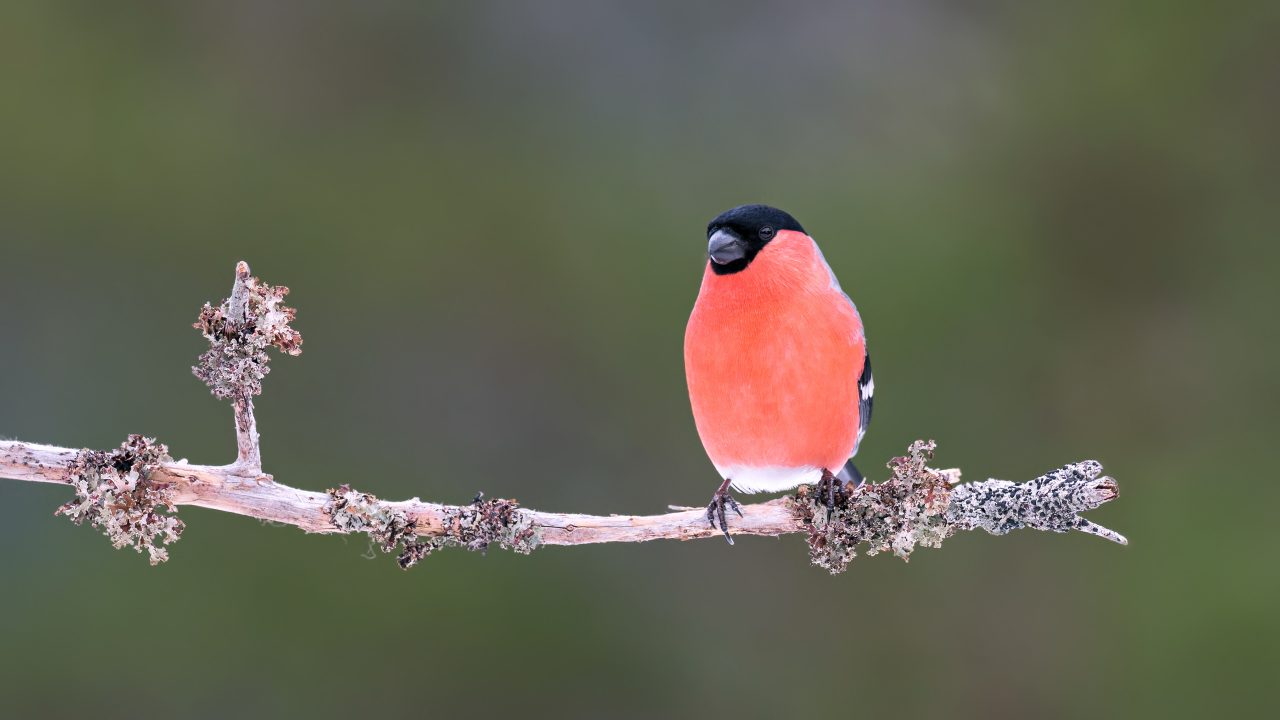
Haiku by Goran Gatalica, Manoj Sharma, and Jennifer Gurney

between the hills
blown away like the seeds
a shepherd’s song


Goran Gatalica (Croatia)
Basho-an Award, The 6th Basho-an International English Haiku Competition, 2023

Commentary from Jacob D. Salzer:

A powerful haiku that includes multiple senses. There are four images in this haiku (the hills, the seeds, the shepherd, and the sheep). There are two sounds (the wind and the shepherd’s song), and there is a silence in the seeds, hills, and sheep, and in the shepherd, especially after the song is over.

In the first line, cemeteries are sometimes found on hills. This potential reference to death contrasts with the seeds symbolizing birth, although I actually see cycles of life and death vs. a stark contrast. 

In terms of sound, it’s interesting to note how the shepherd’s song travels farther between the hills. I can hear the song in the wind, which adds sonic depth. The sonic quality of “b” and “ee” seems to create an eerie feeling, while “away” and “song” seem to support a feeling of longing. I also usually see wind as a reference to a passing soul or souls. When we pass away, what seeds do we want to leave behind? The seeds could even be seen as seeds of karma, which implies the cycles of life and death and reincarnation.

The common definition of a shepherd is: (1) One who herds, guards, and tends sheep. However, a second definition is: (2) One who cares for and guides a group of people, as a minister or teacher. This second definition adds another layer to this haiku. Is the shepherd teaching a group of people through a song? What does the shepherd’s song sound like? Is it a spiritual song or a religious hymn? There is an inclination that this is an old song passed down through several generations. However, it could also be a new song. What are the lyrics? Where did this song come from? And what does it mean? The shepherd’s song could be one of hope, as seeds can be symbols of hope. However, the seeds may have been carried too far by the wind and perhaps didn’t land in healthy soil. In that case, perhaps this is a song of both hope and sorrow. Indeed, the words “blown away” seem to contain a clear sense of melancholy. There is also a sense of deep time in this haiku, as the hills are ancient.

In short, this is an interesting haiku that can be read from different perspectives. It is a deep and thoughtful haiku that asks us to consider our place on Earth, our ancestors, and Divinity. This haiku also asks us to contemplate our souls, our brief lives on Earth, and the afterlife.

looking back
at my younger self. . .
sun-kissed mangoes


Manoj Sharma (Nepal)
Modern Haiku 55.2 : Summer 2024

Commentary from Hifsa Ashraf:

We cherish and miss our youth the most because it is full of adventures. I can feel this kind of youth in this haiku. The person is reminiscing about being young—the phase of life where one usually has the energy and freedom to do the things one wants. The narrator seems to be old enough that he finds it difficult to move on and reminisce about a time in his life that was opposite to his current self. So, in line one, looking back is not simply the remembrance of youth but also wishing to have the same energies or seeking solace in youth.

The second line ‘at my younger self’ with ellipses makes us pause for a while by asking some questions i.e. is this a photo or portrait, is he looking at a reflection in a mirror or in the water? A vivid memory? It seems the person is going through a transformation i.e. from middle adulthood to late adulthood. It is the most difficult time especially when one feels it mentally, physically, emotionally, and psychologically. It seems as if one self is departing and replacing another one, which is probably feeble. 

The last line in this haiku is really interesting and makes it more dynamic. Sun-kissed mangoes are definitely a beautiful analogy to the time of youth when mangoes not only ripen in the sun but also have their best taste. It shows how a youthful life flows like pulpy and juicy mangoes, which are sweet and provide energy. Sun-kissed mangoes as a kigo also show the beauty, care, and connection of nature with different phases of our lives. On the other hand, I see it as a very romantic and loving expression where a person fully enjoys one’s youth being surrounded by loved ones and expresses their feelings fully. 

your ratty sneakers
hanging out in the garage
as if you’re still here


Jennifer Gurney (USA)
Five Fleas, March 17, 2025

Commentary from Nicholas Klacsanzky:

Having had several close members of my family pass away, this haiku resonates with me. It can connect with many readers, as the circumstance described is commonplace yet emotionally potent. The “ratty sneakers” become alive, serving in stead of the deceased (or possibly distant) important person. They transform into a representation of the mystery individual or even an independent entity that takes on a life of its own. There is also an irony in ratty sneakers becoming so poignant. It demonstrates that with emotional weight, any object can be of significance. This relates to the Japanese aesthetic concept of aware, which denotes how a physical object can trigger a personal or spiritual response.

The writing style of the haiku is extremely relaxed and natural. I believe this is what the great master Basho advocated for with his concept karumi. There is no particular kigo or seasonal reference. However, the poet may have been aiming more for a senryu or simply did not see the importance of adding a kigo. Either way, the poem does well with the subject matter and descriptions, giving us just enough for us to imagine and feel deeply.

The pace of the poem approximates the traditional Japanese haiku rhythm, which comes out to a short first line, a longer second line, and a short third line in English. The effectiveness of the haiku/senryu also is seen in its conciseness, with no word out of place. Finally, the sound of the poem propels its atmosphere further. I especially enjoy the “r” sounds, which provide weight, and the letter “s” which appears to slow down the reading so we can take in the poem better.

This is a poem that looks like it was written with the utmost ease yet it has several layers of meaning and feeling. Most importantly, it can easily connect to readers and move them to memories of loved ones and the power of objects that surround us.
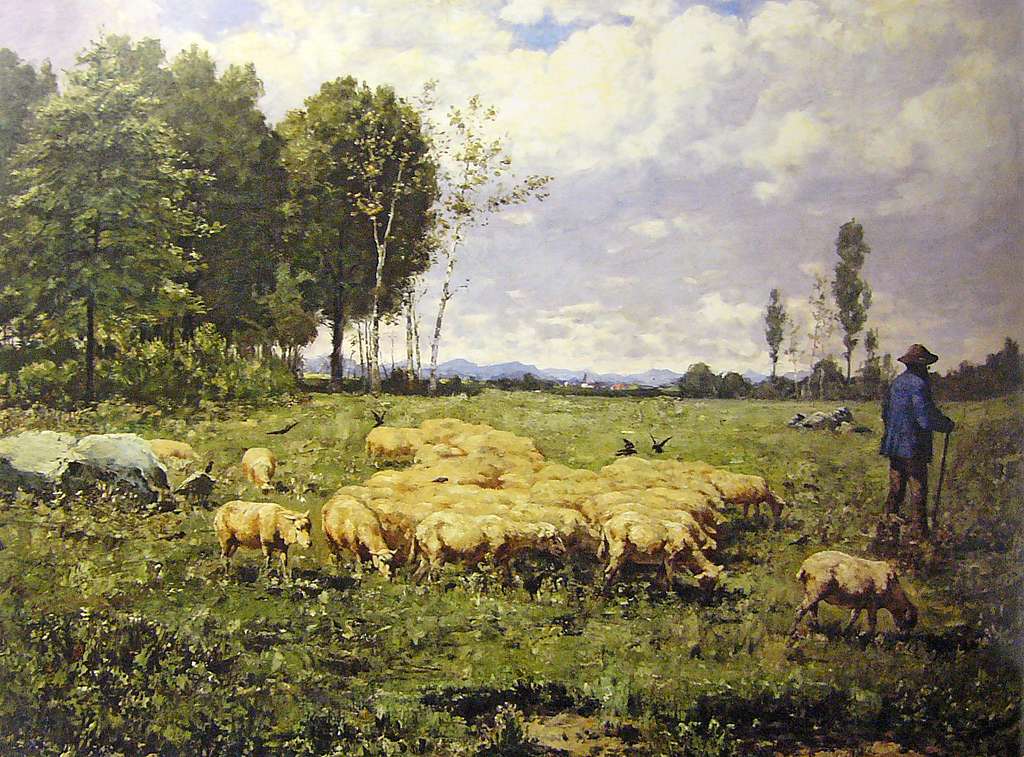
“The Shepard,” a painting by Alexander Roche (1861-1921)
Haiku by Ingrid Jendrzejewski, Joseph Howse, and Srini

rush hour
the paper bag
crossing the street

Ingrid Jendrzejewski (UK)
April 2024 at Cafe Haiku (Cityscape series)

Commentary from Hifsa Ashraf:

The opening line makes this haiku quite interesting. ‘Rush hour’ is now a new normal, where everyone is trying to meet the requirements of a fast-paced life. No ellipses after it may mean it’s open to interpretation. Everyone can fit in the scene according to their daily routine. It can be jobs, errands, studies, meet-ups, business, events, etc. In any case, the time is crucial and significant. The ‘sh’ sound in ‘rush’ highlights the urgency of work, while the silent ‘h’ in ‘hour’ shows how quickly it passes without letting us be aware of it. 

The second line shows us those priorities that are usually not significant enough but keep poking us throughout the day. These priorities or tasks may distract us or deviate us from our main focus. ‘The’ before ‘paper bag’ refers to a specific bag or an analogy to our materialistic life that may be hollow and empty yet chaotic as well. This also indicates the mess around us that makes our life more complicated as mentioned in the third line of this haiku.

Crossing the street, or crossing our path, prompts us stop or slow down the ‘rush hour’. This could also relate to ceasing our thoughts or feelings. It also means that sometimes certain irrelevant things become relevant even if we are not paying much attention. This is how delicate our lives are. This is how emptiness or loneliness behind a fast-paced life keeps following us or crosses our paths. We realize that our relevance is defined by our attitude towards life.

raspberry fenceline
a neighbour asks
how many kids in the plan


Joseph Howse (Canada)
Kokako 42, April 2025

Commentary from Jacob D. Salzer:

An effective haiku that speaks of boundaries, social dynamics, and responsibilities. The first line is unique in that the fence itself could be the raspberry vines. Alternatively, the raspberry vines could be growing against an actual fence, and perhaps over the fence. The imagery and scent in the first line include both the sweetness of raspberries and the thorns of their vines that are likely entangled. This creates a powerful juxtaposition because we can imagine the tangled raspberry vines as being a metaphor for the complexity of relationships. In addition, there is a correlation between the plants growing (and the raspberries ripening) and the children growing and maturing over time. Will the children eventually climb over the neighbor’s fence? There is some potential humor in this haiku as well. Indeed, the neighbor’s question in the third line seems to signify a mental preparation for more babies and children in the neighborhood. I imagine a young couple buying their first house and talking about having children, which is a deep conversation that requires a lot of careful thought and planning. The last two lines could also imply that the neighbor may offer to help raise their children and support the family over the years. In summary, this is an interesting and effective haiku that speaks of boundaries, planning, responsibility, and the complex dynamics of social life in neighborhoods. A well-written haiku.

a sentence without punctuation desert silence

Srini (India)
Kingfisher Journal, issue 10, 2025

Commentary from Nicholas Klacsanzky:

The concept of this haiku is clever. It discusses a sentence without punctuation and also presents itself as such. The word “sentence” can have dual meanings: a syntactical construction and what a criminal receives (or an innocent person sent to trial) as a punishment. Having “a sentence without punctuation” could refer to a person sentenced to life in prison.

Being a one-line haiku, it can be read in multiple ways: “a sentence without punctuation/desert silence”; “a sentence/without punctuation desert silence”; “a sentence without punctuation desert/silence”; and read as one flowing thought. The most natural, in my view, would be to read it as “a sentence without punctuation/desert silence.” However, each reader may approach it intuitively in different ways. Either way, this haiku shows a strong bond between human linguistics and nature. Another perspective is that this haiku is a contrast between something fabricated (language) and something standing alone in itself (the desert).

There is no kigo or seasonal reference per se, but “desert silence” does point to a certain time. It is most probably at twilight or early morning in the desert. This has an interesting potential for resonance with the idea of a sentence. A sentence is something formed and could relate to these times when life is waking up or is unclear.

Looking at the sound, I enjoy the letters “s” and “c” being reflections possibly of the hiss of sand. The letter “t” also has a finality to it that could connect to the context of a sentence or desert silence.

This haiku follows the principle of brevity with only six words present. Basho spoke of the necessity of haiku having no hindrance for the reader, yet there is deep meaning. I believe this haiku strikes this chord. It is one of the few haiku I have seen use the word “silence” successfully without me flinching, as often the word is employed in a cliche or lazy fashion. Srini has written a haiku that is at once natural and linguistic, which comes full circle in the context of the poem.

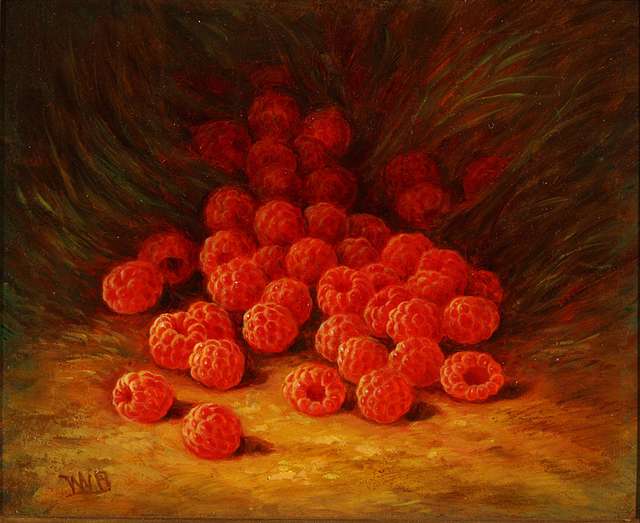
Red Raspberries on a Forest Floor by William Mason Brown, c. 1866, High Museum of Art

Haiku by Kala Ramesh, Valentina Meloni, and M. R. Defibaugh

beachcombing
countless empty homes
washed ashore

Kala Ramesh (India)
haikuKATHA: #35, September 2024

Commentary from Nicholas Klacsanzky:

What most connects me to this haiku is the multifaceted second line. I can see at least two ways to interpret “countless empty homes.” The more poetic way to see it is the homes of creatures like mollusks, and the like, washing ashore. The other interpretation is that people’s homes are coming ashore after a natural disaster like a powerful storm. Both versions bring a sense of dread and melancholy, especially in light of the contrasting leisurely activity of beachcombing. Another interpretation that may dawn on the reader is the imagery’s association with war. Our modern world is engulfed in several wars at the moment, and this haiku might be reflecting this. This way of perceiving the poem especially highlights a connection between humanity and the natural world.

Looking at the more technical aspects of this haiku, we can look at the punctuation, sound, and phrasing. There is a lack of punctuation, yet it is not quite needed. The second line acts more as a pivot without punctuation. As a reader, I intuitively paused after the first line, as if a comma or dash were there.

Kala Ramesh is a classically trained musician in Indian classical music, and it shows in her haiku. The “k” sound in “beachcombing” and “countless” brings about starkness in my mind. Conversely, the “o” sound in each line reinforces the melancholic mood of this poem.

Lastly, this haiku is paced in a way that approximates the original Japanese rhythm of haiku, which is a short first line, a longer second line, and a short third line as an English-language standard. Even though haiku is originally written in one line, it is delineated in two parts through kireji, and three lines in English represent those two parts. It is also noticeable that the poet practiced brevity and conciseness, with each word in this haiku being important and efficient.

The sum of this haiku is greater than its parts, though. The feeling one gets from the imagery, sound, and pacing is best simply felt rather than explained. A sense of compassion washes over the reader, which is sorely needed these days.

music plays—
sweet air holds a longing
for what might be

Valentina Meloni (Italy)

Commentary from Jacob D. Salzer

As a musician, I appreciate the dynamic atmosphere in this haiku. I admire how this haiku includes sound, scent, and perhaps a sixth sense, or the sense of longing. I like how the music is not defined, which allows us as the readers to hear different kinds of music. “music plays” gives me a feeling that the music is unfamiliar, and perhaps heard at some distance. I feel this adds spatial and psychological depth to this haiku. When I read the second line, I imagine breathing in the scent of a flower (or perhaps several different kinds of flowers) that has a sweet scent, though I like how the poet left the sweet scent open for the reader. I also like how the sweet air implies wind or a soft breeze that combines with the music. Through music and scent, the poet succeeds in leaving room for mystery. Perhaps most importantly, this haiku shows the power of music and its ability to inspire and bring us hope in a way that transcends words and thoughts. For me, among all art forms, music continues to be the most powerful creative expression of the human spirit. This haiku effectively expresses this sentiment, with grace, beauty, and mystery. A beautiful haiku.

prayer balloon—
our scribbled wishes
just out of reach


M. R. Defibaugh (USA)
English-Speaking Union of Japan-Haiku, March 2025

Commentary from Hifsa Ashraf:

This is a haiku that is purely based on the belief in prayers. I am a great believer in prayers. A prayer balloon is a symbolic way of writing and sending prayers, which is quite subtle. I find it a beautiful way to show one’s deep connection with prayers, wishes, and desires, and demonstrate it tangibly. It also helps the person psychologically to let go of worries with the flying balloon. 

The em dash after the prayer balloon shows its significance for the poet. The second line is about one’s wishes that are scribbled and highlighted on the balloon. It is a way to share one’s desires in the most obvious manner, where one is not only wishing them in their hearts but also aware of those wishes by scribbling them.

I find it therapeutic when one writes down their prayers or wishes on a delicate balloon that can carry the weight of those prayers and wishes easily, and acts as a bridge between the person and God. When a prayer is being scribbled on a balloon, it involves all senses, which means the person is mindful and fully aware of what’s in their heart and what should be written. This is the act of knowing. 

The third line is a sort of comparison and contrast with the second one—the act of unknowing. The person’s conviction and beliefs are intact whilst scribbling the wishes, but there is a sense of helplessness or no anticipation of those wishes; there are some sort of expectations and thoughts that gather in the mind after releasing the balloon in the air. This is a sort of realization that certain things are not in our control; we can make efforts only. ‘Just’ in the third line means the person has precise thoughts on it that once the wishes are done, they are not in our hands anymore—especially in this case, where the balloon disappears after some time. So, it’s a journey from seeing to beyond seeing, where one’s thoughts and feelings oscillate from known to unknown or vice versa. 

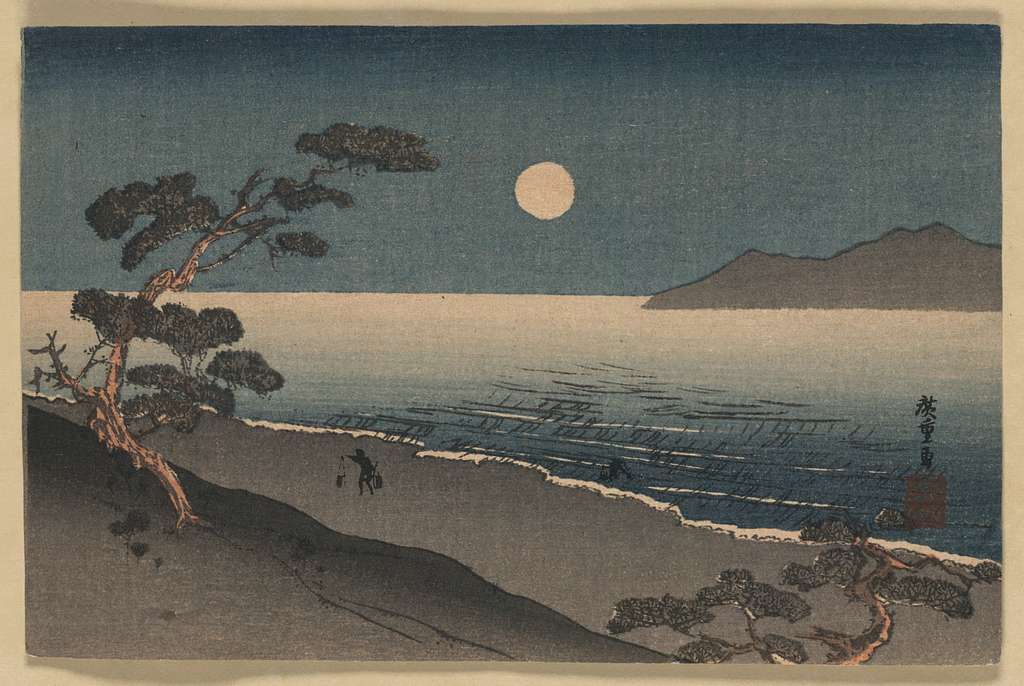
Matsumoto print, no. 39. The Matsumoto Do, Ltd. Tokyo, Japan.