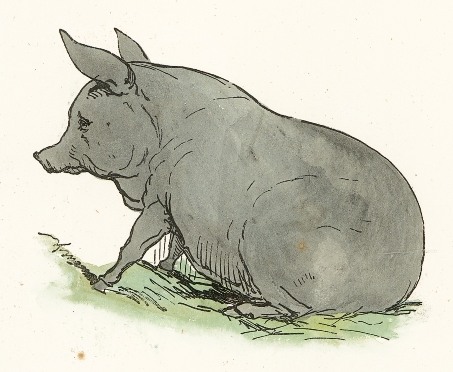
pig and i spring rain
(Published in Frogpond, 2:3-4, 1979)
© Marlene Mountain (1939 – 2018) (USA)
Pigs and rain both symbolize abundance, power, and strength. So, I can see a very close connection between the first word (pig) and the last word (rain). Another element that comes to my mind is the food chain. Rain helps to nourish plants and bring fertility to crops. Pig meat is used as food, so it shows the interdependence of different elements of nature that gain strength only if the cycle is not disrupted. Spring symbolizes the abundance of blessings, whether it is in the form of food or rain, that makes a person happy.
Besides that, I can see a friendly relationship between animals, nature, and human beings—key elements of nature. Spring here also indicates harmony and a balanced relationship among all nature’s agents.
Spiritually, I can see a balance between physical (pig) and spiritual (rain) needs.
In addition, I can see the dominance of ‘i’ in this haiku that indicates the individual identity of these three: pig, i, and rain.
– Hifsa Ashraf (Pakistan)
“The transparent, childlike directness of this haiku and the poet’s complete immersion in sensory awareness put it in the category of “much harder to do than it looks”. I look to this poem often when I feel my own poetry is becoming too weighted down with words and thought.”
(From Favourite Haiku on the New Zealand Poetry Society‘s website)
– Melissa Allen (USA)
“I think it was de Tocqueville who, after seeing how many roving bands of semi-domesticated pigs ran unattended in the city streets of America in the 18th century, remarked that they were a perfect expression of America’s come-one come-all, democratic spirit. This poem by Marlene Mountain reminded me of him because by using the non-capitalized personal pronoun “i” she puts herself on a plane with the “pig”, and is as free as a pig is to enjoy the rain which falls democratically on all alike. There is something uninhibited in the pig’s appreciation of rain that the poet may well share, even if she does not bask, Moonbeam McSwine-like, in the mud. It is the poet’s joy to participate in the fructifying seasonal rebirth brought on by the change of weather, and take pleasure in the simple companionship of this uncomplicated animal. Reading it is like breaking through barriers to a free place.”
(From re:Virals 109 on The Haiku Foundation blog)
– Garry Eaton (Canada)
“American poet, Marlene Mountain, has been experimenting with single line or ‘monostich’ haiku since the late 1960s and this is one of her most anthologised.
From a formal aspect there’s a seasonal reference, what’s known as a kigo in the Japanese classical tradition, with spring rain. There’s a natural caesura, or breath pause, after pig and i: an invitation to consider its juxtaposition with spring rain. From a semantic point of view: pig and i is a more formal choice than ‘me and the pig’. And pig rather than ‘the pig’ creates a kind of archetypal pig, something more than a specific farmyard oink.
Use of the lower case personal pronoun is quite common in contemporary EL haiku: the argument for it is often the dilution of personal ego – but there’s too much of a whiff of Zen in that for me. And it’s an argument that feels contradictory too: a lower case i seems to draw even more attention to itself than the standard upper case, which we’re so familiar with we hardly notice it (as long as it’s not overused). But here I’m actually in favour of the lower case for the parallel it appears to draw between the pig and the narrator, both as equals in the spring rain, on the balanced see-saw-like single line.
pig and i – spring rain
But … is the prettiness/tentativeness of spring rain making me see the pig, probably the least pretty of animals, (and the haiku) through rose-tinted spectacles? Someone else would have to analyse and argue for that case.”
(From haiku: a poetry of absence or an absence of poetry? on the An Open Field blog)
– Lynne Rees (UK)
Did you enjoy this haiku and commentary? Let us know in the comments.
 Haiku Commentary
Excellent commentary on a classic!
LikeLike
Thanks Frank :) I tried to assemble the best variety of commentary I could find.
LikeLiked by 1 person
You succeeded! 😀
LikeLiked by 1 person
Reblogged this on Frank J. Tassone and commented:
#Haiku Happenings #7: Nicholas Klacsanzky presents commentary on a haiku by Marlene Mountain!
LikeLike