
hollow winds
my thoughts turn
to firewood
© Rachel Sutcliffe (UK)
Usually, metaphors are not common in haiku, but I enjoy them the most, especially if they are well composed. This haiku reminds me of the phenomenon of action and reaction. Hollow winds reflect the cruelty, rudeness, and impoliteness that is against nature, but not against our nature. We have a lot of delusions, misconceptions, illusions, and assumptions that finally become demons without having any real existence. Paranoid thoughts take us to a level where we not only destroy ourselves, but also those around us. So, these hollow winds make us more like a slave to follow our destructive thinking more than constructive ones.
I can see a kind of submission of the self to those hollow winds—and when this happens, thoughts may turn to firewood: dry, fragile, broken, weak, and easily become ashes. So, two extremes are connected with thoughts here. The thought of nothingness that leads to nothing but nothingness :) Hollowness on one end, and ashes on the other end.
I can also see a lack of rational and critical thinking that acts like a sift to filter these thoughts. Additionally, I sense an expression of the lack of mindfulness that helps us to stay in the current moment and understand our thoughts in a better way. I can also see a negligence of emotional intelligence that helps us manage our emotions in the best way.
The letter ‘o’ in this haiku is quite significant, as it represents the vicious cycle of thoughts that continuously keep us engaged in the same pattern of life that is not real. The ‘o’ also represent the rhythm of ‘hoo’ (Sufism) that is much needed here to release the negative energies for the attainment of inner peace.
– Hifsa Ashraf (Pakistan)
“Hollow winds” is an exceptional image and also a troublesome one. I think of the wind as a lathe that hollows out wood. A lathe turns a chunk of wood into something—a useful object like a bowl or into a piece of art. Certainly firewood is useful. One also thinks of “turning” wood on a lathe. In this haiku, the wind turns the thoughts to firewood, and hence the coming cold. The wind hollows out the warmth to bring on the cold of fall. “Hollow” suggests “howl,” and howling winds suggest fall’s chill. The word “hollow” makes all the difference in this poem.
– Jim Krotzman (USA)
I quite agree that when we say “hollow winds,” we equate that with the “howling and bitter cold” kind of wind. The author then proceeded with thoughts of firewood, which to me is a natural association to the bitter cold of wind, because firewood creates fire that in turn creates heat to neutralize the effects of the former.
The moment also brings to mind the feeling of coldness brought about by being alone, and perhaps by being lonely, although the idea of aloneness could be construed in a different light. Here, the author tries to “feel comfortable” despite the odds of her physical world.
– Willie Bongcaron (Philippines)
I guess everybody knows about da Vinci’s Vitruvian Man. Leonardo wanted to show how a human being can be harmoniously unscripted into two perfect figures: the cycle of the sky, which represents divine perfection, as well as the square, which symbolizes the earth.
This poem evokes in my mind the cycle of the sky (winds), the human being (thoughts) and earth (firewood). Through the fire that purifies all the material and immaterial processes on Earth, the metamorphosis ends with ashes, again in the wind—so in the sky. This is a never ending enso (a Zen term for “circle”).
I imagine the author’s thoughts burning as a wood fire, in a sacred cleansing flame: ideas can be good or bad, creating issues. Anyway, these ideas can control a person.
But thoughts can heal and warm our impermanent passage on Earth… The author seems to find a healing source in thoughts as a kind of spiritual nourishment, as also Wilfred Bion wrote, thoughts console in grief and give hope… they are a balm for each wound, something only humans can enjoy, since only creatures with grey matter in their brain can….. (a paraphrase)
In this ku, I can perceive two dimensions: one horizontal at the beginning with the first line, then after the turn at the second line, a vertical one, picturing the fire, whose flames go to the sky.
It seems the ku invites us definitely to make the most important life change: to be reborn from a flat, material life, to a spiritual one.
Very well done Rachel. My deepest congratulations for a ku I’d like to have written myself…!
– Lucia Fontana (Italy)
What drew me to this haiku was the atmosphere it invoked and also the surprise in the third line. “hollow winds” and the purifying effect of fire have a subtle correlation in that they both present emptiness in different forms. Though the third line can be taken as the poet thinking of firewood, it could also imply that her thoughts have transformed into something like firewood: ready to be burned and let go. Maybe the poet felt that only through surrendering her thoughts, she could be relieved of a certain anguish. A haiku that captures a mood strongly and astonishes the reader in the last line.
– Nicholas Klacsanzky (Ukraine)
Did you enjoy this haiku and commentary? Let us know in the comment section.
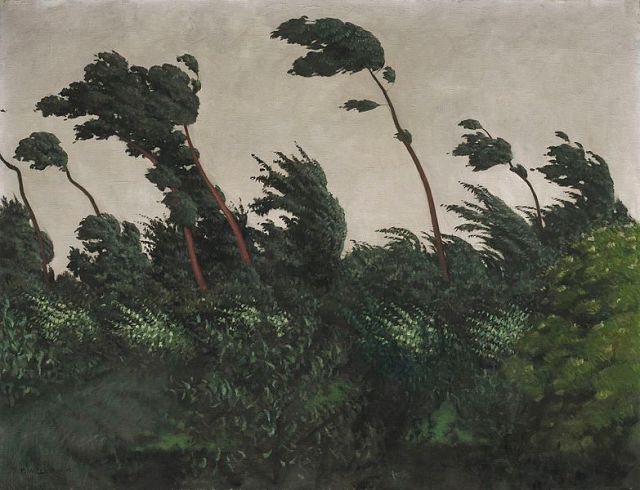
(Painting by Félix Édouard Vallotton, 1865 – 1925)
 Haiku Commentary
I found the narrator’s words about thoughts turning to firewood after that ‘hollow wind’ quite hopeful and comforting. To be curled up in front of a crackling fire after a walk in chilly weather is one of the most homely images I can think of. But perhaps that’s because I’m from cooler climes…
marion
LikeLiked by 1 person
I think that this the beauty of this ku. It can be seen as a mixture of hope and melancholy.
LikeLiked by 1 person
Indeed, Nicholas.
LikeLiked by 1 person
Loved reading the comments.
Great idea and it’s so essential to know how readers get the ku we write … for their interpretations can be so different from how we perceived our little poem!
LikeLiked by 1 person
“for their interpretations can be so different from how we perceived our little poem!”
Exactly! Thanks for your encouraging response.
LikeLike
I really enjoyed this one and all the different interpretations that could be taken from it. When I read the last line of thoughts turning to firewood, I thought first that cold weather calls for a fire. Then I thought perhaps it could also mean she has found burning inspiration in her thoughts as the wind howls outside her window!
LikeLiked by 1 person