low tide
in the gull’s footprints
echoes of flight
– Jane Williams (Australia)
First of all, I would like to discuss my immediate thought about this haiku that struck my senses and that’s the letter ‘o’ which dominates this haiku. This indicates the life cycle where we strive to fulfill our needs or dreams and to move to the next level or phase to do the same.
When there’s low tide, the waves are not as charged as they are during high tide, which means there is a calm situation on the seashore. So, low tide is equivalent to our positive or constructive thinking that helps us to make our life more meaningful by planning and managing our goals.
The gull’s footprints are a subtle expression of things that may not be very strong but can create a huge impact on our lives. The webbed feet of a gull is commonly prominent on seashores and are a sign of life, freedom, free will, mindfulness, and positivity.
To me, “echoes of flight” is about the destiny that is calling someone to take a flight, to strive and achieve the purpose of life. Echoes are the personal experiences that resonate in one’s mind about one’s forthcoming life. In other words, it’s the clarity of purpose that comes with maturity and a peaceful mind.
– Hifsa Ashraf (Pakistan)
The thing that intrigued me initially about this haiku is the pivot line: “in the gull’s footprints.” This allows the poem to be read in at least two ways: “low tide in the gull’s footprints/echoes of flight” or “low tide/in the gull’s footprints echoes of flight.”
In the first reading, you can see water fill the footprint, and this act being said to be echoes of flight. In contrast, in the second reading, we get a juxtaposition of low tide with the echoes of flight in the gull’s footprints.
“echoes of flight” can be seen as metaphorical or physical. It could be about memories of flight, or it could be about the sound of wings reverberating (or even the shadow of wings). This phrase gives this haiku a special touch of originality.
Personally, the way I read it is that within our beginnings, we can see what we can achieve. Though this haiku is mostly objective, it’s probably a metaphor for how our trajectory as a person can be perceived from the very outset.
Hifsa rightly admired the usage of the letter “o” in this poem. I want to point out the letter “l” in this haiku as well. With its prevalence, it gives the reading of the poem a lilting feeling, like the flight of a gull.
The structure of the poem is the standard for English-language haiku that mirrors the traditional Japanese rhythm of haiku. The lack of punctuation is a benefit as it allows the pivot line to work its wonders. In terms of the kigo, or seasonal reference, gulls can be either a kigo for spring or autumn, traditionally. I think in this haiku, it most likely is a seasonal reference to spring.
With its substance, pivot line, musicality, and imagery, this is a must-read haiku.
– Nicholas Klacsanzky (USA)
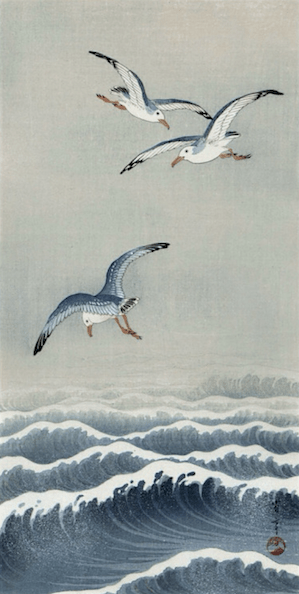
Painting by Seitei (Shotei) Watanabe


This is beautiful, its imagery and sound. I love that it can be read in more than one way. “Echoes of flight” and “low tide,” with their repeating long vowel sounds provide a kind of echo.
LikeLiked by 1 person
Thanks for your comment and observations.
LikeLike