between the bed wrinkles winter shadows
— Martin Gottlieb Cohen (USA)
Previously published in Shamrock Haiku Journal, Issue 27, 2014
Like most one-line haiku in English (Japanese haiku are almost always written in one vertical line), this can be read in several ways. Readers will probably parse it as:
between the bed wrinkles/winter shadows
But there is also:
between the bed/wrinkles/winter shadows
and:
between the bed wrinkles/winter/shadows
…which all have different flavors. But for this commentary, I will speak about “between the bed wrinkles/winter shadows.”
A bed is an intimate place where we sleep, rest, read a book, watch TV, work on our computer, reproduce, or just daydream. So, having winter shadows tucked away in one’s bed wrinkles seems to be an addition to that intimacy. It is a connection between the natural and human world. When we read this haiku, we feel as if nature is never far away, even when we least expect it.
The imagery, though, is more than just a connection. It conveys a mood. “winter shadows” is a kigo or seasonal reference. When we think of winter shadows, we think of loneliness and reflection. In this context, the poet might be expressing his solitary nature at the time of this being written. However, this loneliness is accompanied by a companion: winter shadows. So, this poem may simultaneously express both loneliness and companionship.
Let’s take a look at the sounds of the haiku. We have two cases of alliteration with “between/bed” and “wrinkles/winter.” I feel the first case allows us to read the phrase more smoothly, while the second case makes us read it more disjointedly. This allows us to see the break in parts of this haiku.
Overall, I enjoy the expression of both loneliness and companionship in succinct imagery, helped powerfully by a kigo.
— Nicholas Klacsanzky (USA)
Darkness, shadows, and bed wrinkles—these three aspects can make a night more mysterious. For a moment, this haiku took me back to the time when I used to read mystery novels, which gave me an impetus to read the whole story in one sitting.
The word ‘between’ shows a transition. It also activates our thinking where we immediately start trying to figure out what is happening in the poem. It encourages us to shift our attention to the rest of the poem.
‘bed wrinkles’ is a phrase that can be interpreted in many ways. It shows restlessness, sleeplessness, memories, ageing, nightmares, loneliness, chaos, fatigue, and other physical or mental aspects that make a person change their position while lying down on a bed. It also connects to how life becomes complicated, even when someone tries to take a rest after the long and tiring journey of life. Bed wrinkles shape up like waves, labyrinths, and circles.
Winter shadows reveal the mystery that starts with the word ‘between’. These shadows are deep and dark, which are vivid and influential in many ways. Metaphorically, these shadows relate to traumatic events that cause restlessness and sleeplessness. Mostly, shadows never leave a person, whether of their own or of surroundings. In this monoku, it can be the combination of all types of shadows that collectively disturb the body and soul of a person that overshadows the peace of the night.
This profound monoku depicts the wholeness of life where both the inner and outer world of a person is in a constant flow, which builds the momentum from one reality to another, from one element to another, and makes life more sophisticated in many ways. I feel as if the transformation of one’s thoughts and feelings is inversely proportional to cosmic matters and the environment. That is why the scene ends on a dreamless night.
— Hifsa Ashraf (Pakistan)
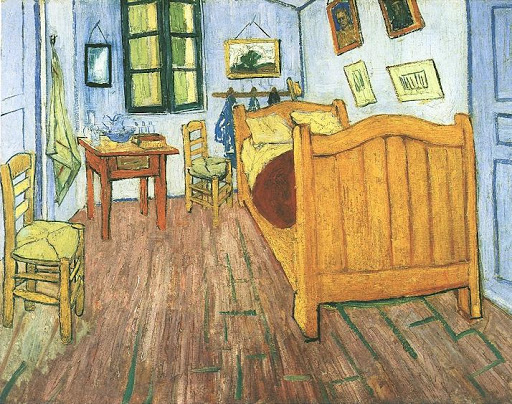
— Painting by Vincent van Gogh
 Haiku Commentary
between the bed wrinkles winter shadows
— Martin Gottlieb Cohen (USA)
I also like reading this single line haiku where ‘shadows’ could be experienced as a verb. The use of a double alliterative effect with the b-letter words and wrinkles/winter
The bed is a huge symbol from Mick Ronson’s Empty Bed (Io Me Ne Andrei) and Ryan Adams own The Empty Bed song.
In my own humble way I’ve written Strange Bed – an ekphrastic blend of haibun [prose+haiku] and Tanka Story [prose+tanka] also called “tanka prose”, published by The British Haiku Society:
https://area17.blogspot.com/2017/02/strange-bed-ekphrastic-haibun.html
Martin Gottlieb Cohen’s incredible single line poem has that magical six words that Ernest Hemingway took advantage of, to great effect:
“For sale: baby shoes, never worn.”
https://en.wikipedia.org/wiki/For_sale:_baby_shoes,_never_worn
It’s also why Country Music is so incredibly successful, because they contain sadness, a universal sadness.
Another reading, or misreading, by myself, that heightens the poetic line for me all over again is:
“between”
the bed wrinkles
“winter shadows”
or
between/winter shadows
the bed wrinkles
A remarkable piece of writing in just six words.
Alan Summers
co-founder, Call of the Page
LikeLiked by 2 people
re:
“The use of a double alliterative effect with the b-letter words and wrinkles/winter”
between the bed wrinkles winter shadows
— Martin Gottlieb Cohen (USA)
Alliteration can be seen as calming, comforting, and coaxing people together. Here we have all of that but also a slight intentional roughness of rhythm where “wrinkles” and “winter” immediately follow the b-words,, perhaps replicating an actual multi-wrinkied unmade bed with trip-hazard sheets all curled, knotted, tangled!
Alan Summers
Call of the Page
LikeLiked by 1 person
Thank you for the great commentary, Alan! I didn’t think of “shadows” being used a verb. I’m sure Martin will enjoy reading your commentary.
LikeLiked by 2 people
I think I would have seen that on my own, anyway, but Karen’s new prompt for a haiku course might have also been in the back of mind.
warm regards,
Alan
LikeLiked by 1 person
Thanks, Alan, for fleshing out the poem, sorry, a bit of slapstick. Interesting comments. wish I could analyze like that. Need to take a course in reviewing.
Nicholas, I am glad you found one attempt of mine you liked. Appreciate your comment. It is a shame you could not play your music at Seabeck Zoom Conference.
Hifsa Ashraf thank you so much for your thoughts and your presentation at Seabeck!
All the Best,
martin
LikeLiked by 2 people
Hifsa, I do not know if you are going to believe me, but that very painting provoked me into writing my attempt. This is appropriately spooky on the day after Halloween that was usually celebrated here in the States but now, at least in my town, silenced by Covid 19.
LikeLiked by 1 person
Maybe I’ll find a way to play properly through Zoom.
Did you mean that the van Gogh painting we chose for this post is what inspired you to write the haiku in the first place? That would be quite a coincidence that we chose this painting.
LikeLiked by 1 person
Spooky but yes!
LikeLike
Wow!
LikeLike
You exposed me! Come from France. Do you have a spare bridge I can borrow?
LikeLiked by 2 people