friend’s secret
the first to know it
me and the wind
— Samo Kreutz (Slovenia)
(previously published on the Asahi Haikuist Network, October 2020)
Commentary
This is an interesting haiku that sparks a conversation about trust, interconnection, and friendship.
I like the mystery of the first line. What is the secret? Why is it a secret in the first place? It seems we sometimes keep secrets out of self-protection or simply because we don’t trust someone enough. Sometimes we might keep a secret out of respect for someone else, as to not emotionally or psychologically burden them. In this haiku, I feel a heavy weight in the secret. Perhaps the friend is revealing their gender identity for the first time. Though, I like how the poet left it open for us as readers. In the first line, I feel the strong bond and trust between two friends.
The second line makes me think this is the poet’s best friend, being the first person to know the secret. Consequently, I feel an even deeper trust and connection, as well as even more significance in the secret.
The third line solidifies the bond between two friends. At the same time, it also maintains mystery in the wind. We don’t know if anyone overheard the secret and the consequences of that. We also don’t know where the secret might travel to over time and who else might hear it. Depending on who hears the secret, it may significantly change one person’s life—and therefore many people’s lives, to some degree—because everything is connected. I feel a deep truth in this even on a subconscious level. In a sense, whether we like it or not, I feel we are all sharing our secrets subconsciously with each other all the time, in every second of life. Indeed, I feel the quality of our silence and presence can sometimes speak much louder than words. Along those lines, it seems our body language can also sometimes be doorways into our secrets and the subconscious.
The wind in the last line could also signify how fast and how far words can travel. If the friend makes a mistake and shares the secret, and then it spreads like a wildfire, what are the consequences? On the extreme end, it may even break the bonds of that friendship. However, in this haiku, I see the wind as benevolent. I like how the wind is invisible, just as the poet keeps their friend’s secret hidden. I feel this shows the power of trust, respect, and mystery in friendship.
On a personal note: in college, I told a female classmate that once she knows something about me, the entire city will know about it due to the strong social bonds of women. She laughed, but also acknowledged a bit of truth in that statement. In short, words can travel far and fast in this digital age. Especially with social media at our fingertips, I feel this haiku reminds us to be careful with our words.
I think this haiku leaves us with a question: What will you share with your friends (or even your best friend) and what will you decide to keep a secret?
This is a subtle haiku with social significance, mystery, and psychological power.
— Jacob D. Salzer (USA)
A simple yet deep haiku which revolves around a secret—a friend’s secret. The first line gives us straight information about a friend who confided in another friend without knowing how significant that secret is. The second line implies that the information in this secret is given to the person whom that person trusts the most. But then, there is a twist in the story where the wind is being involved, indicating it is revealed or disclosed, or spread out as news, a rumor, whispers, or by other means. ‘The wind’ may depict the particular time when it is made public.
I see both tangible and intangible sides of a secret that may be perceived differently by the secret-keeper and the wind (others). There is another side to this and that is eavesdropping—someone who overheard it and made it public.
In other words, a secret cannot remain a secret for life, as this universe holds all information whether we share it with others or keep it with us. It’s time that decides the significance of information and when it will be revealed.
— Hifsa Ashraf (Pakistan)
What drew me to this haiku is that the wind is given an important place alongside a dear friend. Or, it could be seen that the wind is possibly an intruder in the conversation, who will carry the secret to other people around. Either way, this haiku is a recognition of the power and place of nature within human society.
In terms of the kigo, it could be any season. It could be a gentle or forceful wind at the scene. Sometimes, haiku can have universal kigo or no kigo at all. That’s fine. Since long, haiku in Japan have at times been kigoless.
For aesthetics, the haiku could be illustrative of both shiori (a delicacy verging on pathos that intends a deep sympathy for both nature and humanity) or kisetsu (awareness of the deep relationship between humanity and the seasons).
The pacing of the lines is reminiscent of the traditional Japanese rhythm in haiku, with a short first part, a longer second part, and short third part. This rhythm is not only there for the feel of it, but it also lends to the content being brief and having a somber tone.
Sonically, there is a rare occurrence of two words beginning with “f.” The letter “f” has a certain strength and starkness that heightens our awareness while reading this haiku. Also, the wispy sound of the two “w”s mirrors the wind’s music.
The language of this haiku matches the tradition in Japan with simple words and casual ways of expression. It express profundity in a laidback way.
An enjoyable and deep haiku that gets us thinking about our connection with nature.
— Nicholas Klacsanzky (USA)
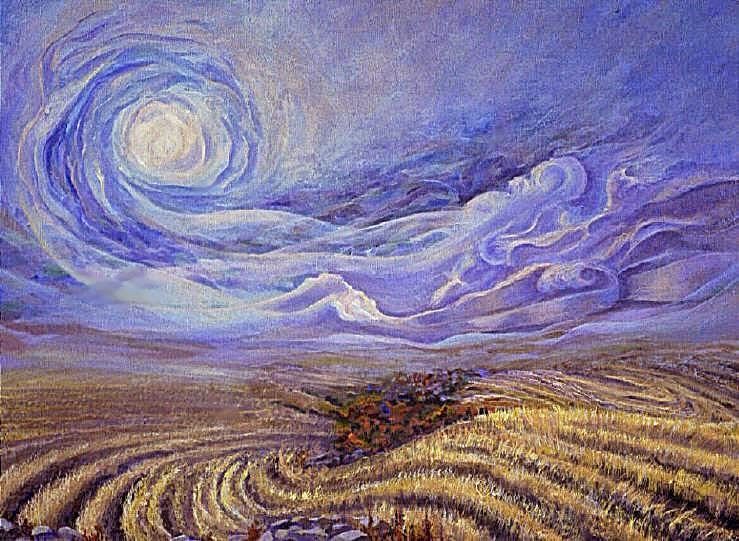
Painting by Vincent van Gogh
 Haiku Commentary
I like the role of the wind. I see the secret being shared with only this close friend outside away from prying ears. I think of that song..Written in the Wind. The secret is there but will it be shared too?
LikeLike
I enjoyed reading all the three comments on this haiku. However, I missed seeing any discussion on its technical structure. As it stands, it appears to me like three separate lines. In other words, it does not have a phrase-fragment or a fragment-phrase structure. Of course, it may not be absolutely essential that such rules be followed. Another matter that caught my attention was the use of the word “me”. In reply to the question “Who knows the secret?”, the poet is saying “me” (apart from the wind). A secret can be known by “me”, but can “me” know a secret? From this point of view, L3 might have sounded better as “the wind and I”. But proceeding that way will give more importance to the “wind”. I doubt that the poet meant it that way. The poet was the first to know it and then the “wind”, which either kept it to itself or spread it across. When I think of the fragment-phrase structure, I conclude that L1 is the fragment. But the way the poem is written, L2 and L3 do not constitute a phrase. The poem continues to appeal, it is wonderful, it stays with the reader. Perhaps the poet does not subscribe to the phrase-fragment or fragment-phrase rules. No harm in that as far as I know.
LikeLike
Sorry, I was wrong about the fragment-phrase question. The poet has obviously used L2 as the pivot. He doesn’t need the fragment-phrase form. However, I am still not clear about the use of “me” instead of “I”. Thank you.
LikeLike