remembering
a simpler time
ghost apple
— Jerome Berglund (USA)
(previously published in Frogpond 46:1)
The word “ghost” provides a haunting effect in this haiku. It seems the third line is communicating that modern civilization will not likely return to simpler times. I appreciate how this haiku allows me to get transported into an apple orchard before computers and smartphones were invented. This haiku could even speak of times before electricity. As a result, I can experience a lot more silence, quality conversations, and a slower pace of life in those days.
This is an important haiku that speaks of the past, present, and perhaps hints at a haunting or consequential future.
— Jacob D. Salzer
The first line of this haiku shows the ongoing thoughts or memories of a person who is enjoying the process of remembrance.
‘Remembering’ without punctuation gives no clue to the intensity of this cognitive process which gives readers enough room to take it as something easily coming to the mind or that maybe a person is struggling to recall something from the past.
A ‘simpler time’ may reflect a comfortable part of the past that has no expectations, hardships, or sophisticated lifestyles. It may be a childhood where a person is carefree and has more freedom to enjoy each moment of life fully; a time when a person has no responsibilities to fulfill. The word ‘simpler’ shows a person’s struggle to seek solace in remembering a time when life was not challenging.
‘Ghost apple’ hints at the season. It may be deep winter—a time when a person is more introspective or nostalgic. A ghost apple also symbolizes the illusion of memories, which manifests in denial when a person tries to escape from reality by shifting their focus from a difficult circumstance to something that can give sanctuary. This haiku might also be about the poet seeing a ghost apple as a child and might infer that it is better to focus on the here and now.
In terms of sound, the letter ‘m’ provides the mood of mystery of the past and present being simultaneous, which is happening silently within the person.
As Hifsa mentioned, the kigo for this haiku is probably winter. A ghost apple could mean several things, but most likely it is referencing the phenomenon when an apple is coated with freezing rain and then later becomes frozen itself. As the apple rots and gets mushy, it eventually slips out of the icy mold and the apple-shaped ice is left on the tree. It’s quite a spectacle.
The image in this haiku (ghost apple) has several interpretations. The ghost apple itself could be remembering a simpler time, but that is more abstract or personified. The other interpretation is that the poet is remembering a simpler time and sees the ghost apple as a representation of remembrance in a moment of realization. Remembrance is beautiful at times, but also “cold” like the dead or a ghost.
For the kireji, or punctuation as an approximation of a cut marker, the line break in the second line is enough. An ellipsis could work after the second line, though.
Looking at the pacing, the haiku matches the standard of English-language haiku, with a short first line, a longer second line, and a short third line. “ghost apple” comes as a surprise when it’s read on the page and even more when it’s read out loud.
In terms of Japanese aesthetics, we could say that this haiku contains aware or emotional or spiritual responses from seeing an object—especially its transitory nature. Just by seeing the ghost apple, the poet has been drawn into the dimension of remembrance, which triggers deep emotions of transience.
Hifsa made a great comment about the letter “m” but I also enjoy the letter “l” in this haiku. It gives a sense of sweetness and softness to the haiku.
Overall, this is a concise and effective haiku with a unique image, prompting profound imagination in the reader.
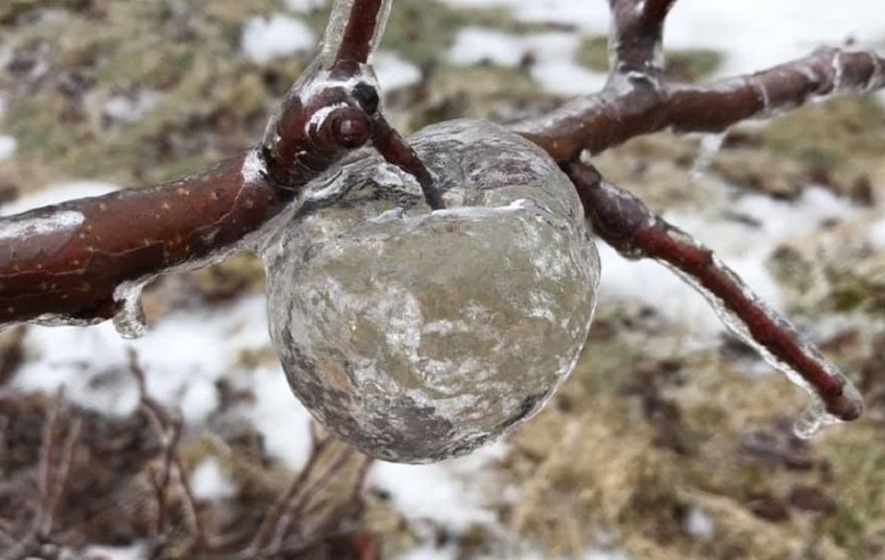
Photograph by Andrew Sietsema
 Haiku Commentary
I had a powerful reaction to this haiku. I’m old enough to remember much simpler times and these words took me back to an innocence that will never come again. Ghost apple is so right on as an image. I didn’t relate it to the weather. It took me back to when we would climb an elderly lady’s tree to pick an apple to eat on our way home from school. Those days are gone.
LikeLiked by 1 person
Thank you for sharing your memory. This haiku also took me back to a time when I would roam my neighborhood as a little boy and take apples from people’s orchards as a snack. I thought that nature belonged to everyone and didn’t understand property then. Indeed a simpler time.
LikeLiked by 1 person