
winter sky swallows the words I can’t take back
— Kelly Sargent (USA)
Cold Moon Journal, March 2024
Commentary from Hifsa Ashraf:
A winter sky stays dull and dim but remains open to wild imagination. This monoku reflects various shades of a winter sky when we read it in one go. I focused on the first three words for a while, which can be read in three ways: winter/sky swallows, winter sky/swallows, and winter sky swallows.
The repetition of ‘s’ and ‘w’ sounds makes it more interesting to read and interpret. Sky swallows usually reflect loyalty, a new beginning, hope, transformation, and more. It seems it alludes to a murmuration that is getting the poet’s attention due to its shapeshifting, shades, shadows, and sound. The use of ‘swallows’ makes this monoku more profound and dynamic. The swallows in the sky could indicate the end of the winter as well which commonly is related to positive outcomes.
The second part of this monoku takes this monoku to another aspect that is more personal and profound. It looks like a mirror reflection of the first part of the monoku. When I read it as a whole, ‘the words I can’t take back’, it gives me a feeling that the person wants to express all that follows the murmuration in the winter sky. ‘the words’ is a catch here as they may reflect personal experiences that are either positive or negative.
If I read the second part of this monoku with the central word ‘swallows’ that juxtaposed this poem, it looks like the person is still in conflict.
“winter sky” is a ground where the poet masterfully displayed profound feelings and thoughts, while allowing readers to find as many interpretations as possible. It is a good exercise for the brain and heart to solve the mystery of this haiku.
no headstones;
buried all across the south
remains of slave ships
— W. Barrett Munn (USA)
Haikuniverse, January 9, 2024
Commentary from Jacob D. Salzer:
An important haiku that shows part of the darker history of the U.S. This haiku transports us back in time, yet we can still feel the consequences of slavery today. I can feel the unbearable weight of colonialism and capitalism when I read this haiku. It is unfathomable in my eyes to imagine being a slave or a slave owner. Some people who are buried are not always remembered with a designated tomb or headstone. This haiku conjures up several questions that we can ask ourselves: What else dwells beneath the ground that we walk on every day? How much of history is skewed, buried, or not documented? How can we preserve history to the best of our abilities, so that we, collectively, can (hopefully) learn and grow and not make the same mistakes? What are examples of modern-day slavery and what are the consequences? How many consumers are conscious of where their products come from? How many people know the origins of the things they buy? How many are aware of the working conditions in various factories? How many of us are open-minded to life after death? Where does karma originate? What is the nature of the soul? Despite the horrifying history, I appreciate how this haiku shines a light into the dark and lets us attempt to see those who are not seen.
this morning
in the shell hole
lone bud
— Fatma Zohra Habis (Algeria)
Commentary from Nicholas Klacsanzky:
I enjoy how the second line interacts with the first and third lines. It can be read as “this morning in the shell hole/lone bud” or “this morning/in the shell hole lone bud.” The phrase “shell hole” makes me imagine both an ammunition shell and a shell from the sea. Both interpretations are valid and intriguing. Perhaps, though, morning and a bud connecting with ammunition is more poetic.
“lone bud” could refer to early spring or late winter, when buds are either just coming up or leaving for the time being. With “morning,” I get the feeling it could be the start of spring. This provides the haiku with a tone of hope. Ultimately, I believe it expresses that like the morning, new beginnings arise even in the most difficult of times and that life goes on even through the passed.
Another striking element of this haiku is its sound. The strongest sound comes from the letter “o,” which could represent a hole in its own right and demonstrate a soothing atmosphere to the poem. Also, with only eight words and the traditional rhythm of a short line/longer line/short line, the poem is economical and effective. The poet, I believe, rightly did not add punctuation, as it could have detracted from the flow of the pivot line and would have stood out too much. The haiku presents a simple image but has poignant overtones that can take the reader to different symbolistic places.
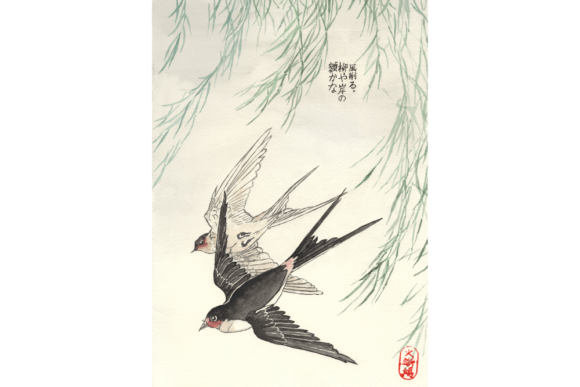
Painting by Daria Melantova
 Haiku Commentary
Thank you so much Nicholas Klacsanzky for your wonderful comment,and many thanks to all team of haikucommentry for their efforts .
LikeLiked by 2 people
You’re very welcome.
LikeLike