Samo Kreutz’s secret

friend’s secret
the first to know it
me and the wind

Samo Kreutz (Slovenia)

(previously published on the Asahi Haikuist Network, October 2020)

Commentary

This is an interesting haiku that sparks a conversation about trust, interconnection, and friendship.  

I like the mystery of the first line. What is the secret? Why is it a secret in the first place? It seems we sometimes keep secrets out of self-protection or simply because we don’t trust someone enough. Sometimes we might keep a secret out of respect for someone else, as to not emotionally or psychologically burden them. In this haiku, I feel a heavy weight in the secret. Perhaps the friend is revealing their gender identity for the first time. Though, I like how the poet left it open for us as readers. In the first line, I feel the strong bond and trust between two friends.

The second line makes me think this is the poet’s best friend, being the first person to know the secret. Consequently, I feel an even deeper trust and connection, as well as even more significance in the secret.

The third line solidifies the bond between two friends. At the same time, it also maintains mystery in the wind. We don’t know if anyone overheard the secret and the consequences of that. We also don’t know where the secret might travel to over time and who else might hear it. Depending on who hears the secret, it may significantly change one person’s life—and therefore many people’s lives, to some degree—because everything is connected. I feel a deep truth in this even on a subconscious level. In a sense, whether we like it or not, I feel we are all sharing our secrets subconsciously with each other all the time, in every second of life. Indeed, I feel the quality of our silence and presence can sometimes speak much louder than words. Along those lines, it seems our body language can also sometimes be doorways into our secrets and the subconscious. 

The wind in the last line could also signify how fast and how far words can travel. If the friend makes a mistake and shares the secret, and then it spreads like a wildfire, what are the consequences? On the extreme end, it may even break the bonds of that friendship. However, in this haiku, I see the wind as benevolent. I like how the wind is invisible, just as the poet keeps their friend’s secret hidden. I feel this shows the power of trust, respect, and mystery in friendship.

On a personal note: in college, I told a female classmate that once she knows something about me, the entire city will know about it due to the strong social bonds of women. She laughed, but also acknowledged a bit of truth in that statement. In short, words can travel far and fast in this digital age. Especially with social media at our fingertips, I feel this haiku reminds us to be careful with our words.

I think this haiku leaves us with a question: What will you share with your friends (or even your best friend) and what will you decide to keep a secret? 

This is a subtle haiku with social significance, mystery, and psychological power.

— Jacob D. Salzer (USA)

A simple yet deep haiku which revolves around a secret—a friend’s secret. The first line gives us straight information about a friend who confided in another friend without knowing how significant that secret is. The second line implies that the information in this secret is given to the person whom that person trusts the most. But then, there is a twist in the story where the wind is being involved, indicating it is revealed or disclosed, or spread out as news, a rumor, whispers, or by other means. ‘The wind’ may depict the particular time when it is made public.

I see both tangible and intangible sides of a secret that may be perceived differently by the secret-keeper and the wind (others). There is another side to this and that is eavesdropping—someone who overheard it and made it public. 

In other words, a secret cannot remain a secret for life, as this universe holds all information whether we share it with others or keep it with us. It’s time that decides the significance of information and when it will be revealed.   

Hifsa Ashraf (Pakistan)

What drew me to this haiku is that the wind is given an important place alongside a dear friend. Or, it could be seen that the wind is possibly an intruder in the conversation, who will carry the secret to other people around. Either way, this haiku is a recognition of the power and place of nature within human society.

In terms of the kigo, it could be any season. It could be a gentle or forceful wind at the scene. Sometimes, haiku can have universal kigo or no kigo at all. That’s fine. Since long, haiku in Japan have at times been kigoless.

For aesthetics, the haiku could be illustrative of both shiori (a delicacy verging on pathos that intends a deep sympathy for both nature and humanity) or kisetsu (awareness of the deep relationship between humanity and the seasons).

The pacing of the lines is reminiscent of the traditional Japanese rhythm in haiku, with a short first part, a longer second part, and short third part. This rhythm is not only there for the feel of it, but it also lends to the content being brief and having a somber tone.

Sonically, there is a rare occurrence of two words beginning with “f.” The letter “f” has a certain strength and starkness that heightens our awareness while reading this haiku. Also, the wispy sound of the two “w”s mirrors the wind’s music.

The language of this haiku matches the tradition in Japan with simple words and casual ways of expression. It express profundity in a laidback way.

An enjoyable and deep haiku that gets us thinking about our connection with nature.

Nicholas Klacsanzky (USA)

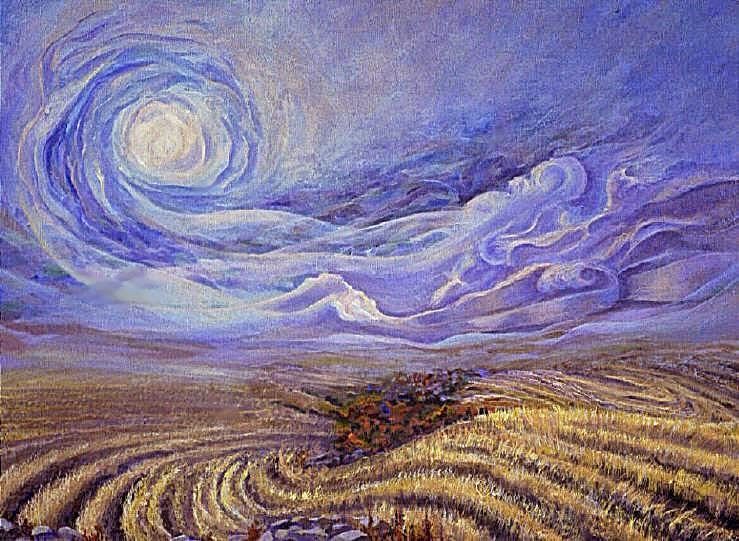
Painting by Vincent van Gogh
Daniela Misso’s Moorings

moorings 
creaking on the lake…
deep autumn

Daniela Misso (Italy)

(published in Wales Haiku Journal, Autumn 2020)

Commentary

This is an excellent haiku with depth, a strong atmosphere, and mystery (yugen). It also evokes potent emotions and has metaphorical value as well. 

Starting with the first line, moorings comes from the verb moor. As an intransitive verb, there are three definitions of moor I would like to highlight:

moor

1. To fix in place; secure: synonym: fasten.

2. To provide with an abiding emotional attachment. 

3. To secure a vessel or aircraft with lines or anchors.

Source: https://www.wordnik.com/words/moor

With these definitions in mind, the moorings in this haiku are not only strong cables, ropes, or anchors that are securing a boat or vessel to a dock (or another structure); they are also a metaphor for emotional attachments in a relationship (or within several relationships). In particular, the second definition above “to provide with an abiding emotional attachment” reminds me of a couple providing for their family. More concretely, I can see an emotional attachment to a specific boat as well. In this haiku, I imagine an empty boat overflowing with memories and stories. However, I feel these stories could be not only from one person’s lifetime, but rather span across several generations and even several lifetimes. 

Furthermore, I would like to highlight this definition of moorings: 

moorings

1. the place where a ship is anchored or fastened.

Source: https://dictionary.cambridge.org/es-LA/dictionary/english-portuguese/moorings

With this definition, in this haiku, I feel a very strong emotional attachment to the lake and the surrounding land. Therefore, this haiku is not limited to emotional attachments between people, but also includes our emotional attachments with Mother Earth. I also like that the lake in this haiku is not named, leaving it open for the reader to connect with experiences they’ve had at different lakes. 

Moving to the second line, I am drawn to the sound. Creaking brings an eerie feeling that amplifies the silence of the scene and has a haunting quality to it. I could see this haiku being the start of a mystery novel or movie. In light of the moor definitions, moorings creaking could signify the wear and tear of an emotional attachment between two or more people over time that, despite the challenges, is showing strength, dependability, and longevity. On the other hand, the creaking sound could point to a degree of uncertainty and weakness in a relationship. I like how the creaking sound evokes the emotional complexity of relationships. This interpretation equally and powerfully applies to our relationships with Mother Earth.

In the third line, deep autumn effectively shows us how cold it is, with hints of winter already in the air. I feel it adds to the atmosphere of the scene and brings the universal emotions of grief, loss and letting go, but also expresses a slower pace of life and reflection.

This is a moving haiku that has depth, a strong atmosphere, and significant emotional and metaphorical power.

— Jacob D. Salzer (USA)

What is being moored? This question came to my mind after reading this poem. Perhaps boats, thoughts, fatigue, silence, worries, nostalgia, or anything else that is still hidden from our sight. Moorings indicate that we have to run our imagination wild and think of things that may fit best to the scene, as we have choices. So, the person who is at the seaside is the one who ties up whatever they want. I see it as more personal, intangible, and discreet where it’s not the matter of fastening boats but the things that are related to it—maybe something burdensome as alluded to in the second line by using the word ‘creaking’. But on the other hand, a person may not have control over those choices that are creaking and haunting again and again.

The poet concludes the scene by taking us to the deep autumn which adds more depth and silence in the background, where one can introspect and find out how to run the boat of life without distractions, and shortcomings.

The sound of ‘ing’ in this haiku resonates with the feelings of helplessness and aimlessness that continue without any interruption.

Hifsa Ashraf (Pakistan)

Jacob and Hifsa have provided thorough commentary that leaves me with a bit to add. I will go over the kigo (seasonal reference), pacing, sound, and language.

Sometimes in haiku, using a direct name of a season works well, and this haiku is a fine example of that. What is interesting is commonly haiku poets put the kigo in the first line if they are naming it directly. But in this haiku, the kigo carves out a more resonant space for the reader to ponder as it is given in the last line. The way the kigo interacts with the creaking brings out the melancholy, introspection, and loneliness of autumn.

The pacing of the lines follows the standard for English-language haiku with a short first line, a longer second line, and a short last line that mimics the traditional Japanese haiku rhythm.

As Hifsa noted, the “ing” sounds carry that somberness that is present in haiku. Also, the “m” sounds bring a sense of eeriness, and “ee”/”ea” slows down the pace. There are many elongated syllables in this haiku, which showcase the slowness of time of the moment described.

The language is simple and concise, with enough poetic phrasing to bring out emotion. Not one word is unnecessary and the poem is not begging for words to be added.

The relation between human-made instruments and nature, combined with the mentioned season, makes this haiku especially resonant.

Nicholas Klacsanzky (USA)

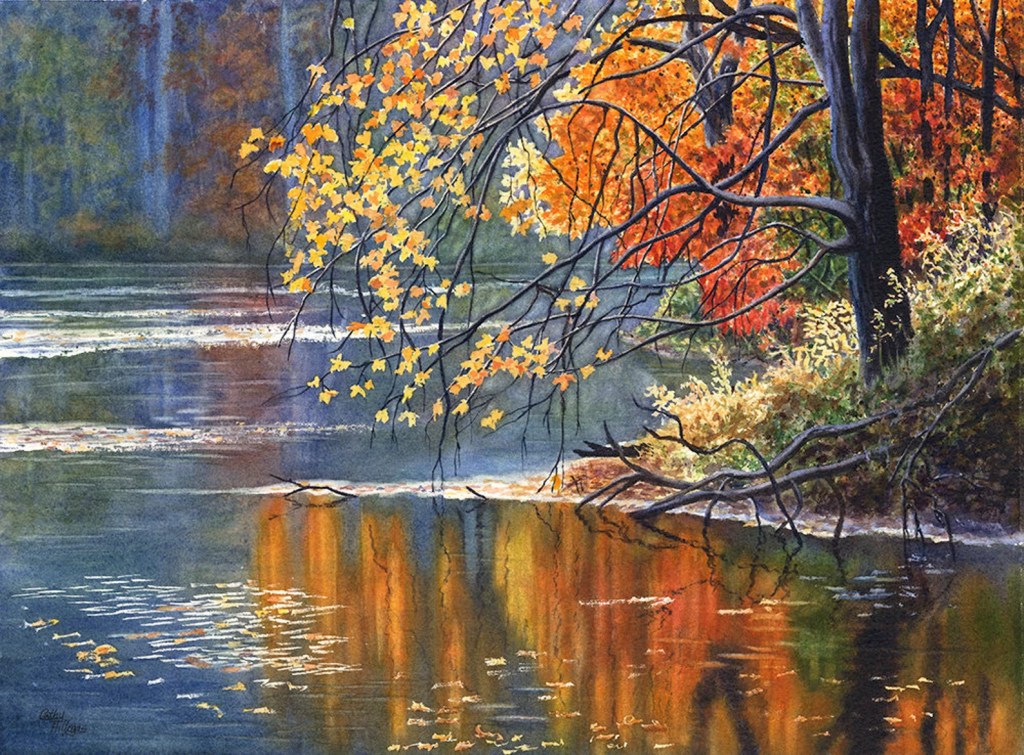
Watercolor painting by Cathy Hillegas

Srinivas S’s footprint

between waves the life of a footprint

Srinivas S (India)

(The Heron’s Nest, March 2021)

This simple monoku manifests all the key perspectives of life, but the most obvious one is the journey of life. It may consist of hardship and difficult trials. A footprint is something that is left behind in life—a past life that may be imprinted in the mind as a memory or depicts the choices a person made, the path they took. A footprint could symbolize the vivid memories of a person of life events where every step carved or reshaped one’s decisions, choices, and thinking.

The concept of waves is cleverly used in this monoku as our senses that are connected with the surrounding through waves, our brain activities, our nervous system, and our body is similar to the rhythmic movement of waves. What matters the most is whether these waves erase the footprint or fill it with water. It may also unfold the path one has chosen, the path that faces the ups and downs of life, or to and fro movement. The concept of our lives is shown in this haiku as a footprint, which is the mark that a person leaves behind as an example or memory.

Hifsa Ashraf (Pakistan)

This is a beautiful monoku that sparks a conversation about the miracle of life, impermanence, reincarnation, and the afterlife. 

When I read “between waves” I see it as a metaphor for between lifetimes. In a vast scale of time, a human lifetime appears to be like a brief footprint. 

In that sense, I feel the footprint could create a sense of melancholy (from how brief human lives are) and also joy and gratitude (from how precious life is). The footprint could be from a child, an adult, or an elderly person. It could also be the footprint of a seagull or of a dog running on the beach. I like how the poet left this open for us as readers. 

The footprint also shows a single step on a long journey, as part of a larger story. In that sense, this monoku makes me wonder what stories have been passed down and recorded throughout several generations and what stories have been lost? Some stories have been preserved, while other stories have been mistranslated or buried and forgotten. I think this is a critical subject because stories and literature have significant influence and power. Stories contain our ethics, values, and principles of how to live. They create new worlds and different ways of seeing. They record history and document what we learned. They can inspire our imagination. And, they set an example. In particular, I think some of the oldest stories and legends from Indigenous People contain strong values and important lessons for us all, especially involving spirituality, community, and taking care of Mother Earth.

Additionally, I see the footprint as a metaphor for a samskara or mental impression. We could ask ourselves: compared to the sand, how real is the footprint? It seems we all leave several marks in this lifetime and some impressions seem to last longer than others. But, in the end, it seems something universal (in this case, the ocean) washes away all our impressions or footprints. Then, it seems we’re only left with the wordless present moment, without a past or a future. As the Estonian composer Arvo Pärt has said: “Time and timelessness are connected. This moment and eternity are struggling within us.” On the other hand, I wonder if perhaps our impressions and memories are permanently stored in a universal consciousness. In any case, it is the silence itself that carries all words and sounds. Everything appears to rise and fall into silence. Even as the footprint disappears, the sound of the waves is in synch with the rhythm of my heartbeat. 

The footprint also shows engagement and actively participating in the play of life vs. becoming a passive observer. I think there is a time and place for active, compassionate observing, and as haiku poets we do this very well, but I think there’s also a time and place to be actively immersed in life and living without reflection or observation. In fact, sometimes, only when I return home from an adventure does a haiku appear.

This is a monoku that is simultaneously deep and simple at the same time. I think it’s also a moment that many people can relate to and has a universal appeal and power. 

A beautiful monoku. 

Book recommendations on these subjects: Indian Legends of the Pacific Northwest by Ella E. Clark, The Spiritual Teachings of Sri Ramana Maharshi, and The Power of Now by Eckhart Tolle.

— Jacob D. Salzer (USA)

I can’t touch on more about the interpretation and meaning of this haiku that Hifsa and Jacob already expressed. They discussed the many layers of this monoku’s substance deftly.

I’ll now explore the technical points of this poem. First, there is no specific kigo or seasonal reference to be found in this haiku. We know that perhaps it is a low tide but the action of the haiku might be talking about someone walking close to the waves at any kind of tide. There is no issue is not having a kigo. The requirement for haiku to have a kigo has been loose for a century, even in Japan. Perhaps the exclusion of kigo began to be commonplace in Japan in the late 1800s, with masters such as Kawahigashi Hekigotō and Ogiwara Seisensui.

This haiku being written as one line is not experimental or strange, as haiku is originally written as one vertical line in Japanese. The major difference between English monoku and Japanese haiku is that English monoku don’t use punctuation usually. Japanese haiku have kireji, or cutting words that signify a shift in grammar or phrasing to make the two parts of a haiku distinct. Without punctuation, though, English monoku can be read in more ways sometimes:

between / waves the life of a footprint

between waves / the life of a footprint

or as one phrase: between waves the life of a footprint

In terms of sound, we have the unusual consonance of “w” which makes a “whhh” noise when said, imitating the song of waves. The “e” and “i” sounds also bring another layer of softness to the reading.

The haiku is noticeably brief. With only seven words, the poem is quite concise. This is hard to pull off, and if one is a beginner in this art form, I would not recommend writing in such a terse way. By Srinivas has skillfully used the right combination of words, sounds, and phrasing to create a strong visual effect in the reader and potent resonance.

Nicholas Klacsanzky (USA)

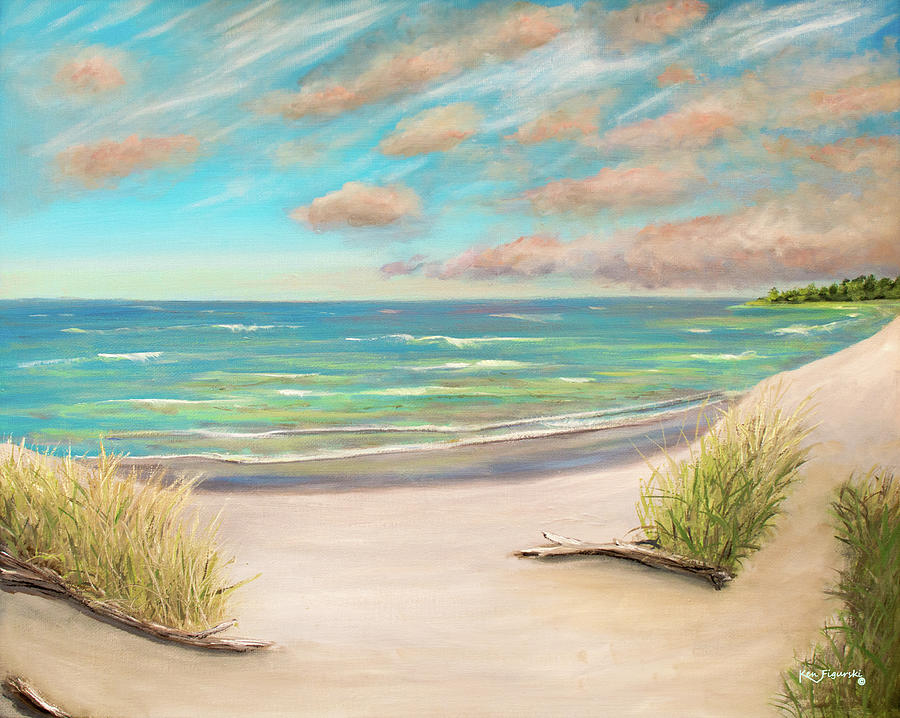
Painting by Ken Figurski