Jacob Salzer’s green tea

scent of green tea
in my travel mug
the forest’s darkness

Jacob Salzer (USA)
(published in The Heron’s Nest, December 2021)

Commentary

Commentary is first by the poet himself, and then others

Green tea is my favorite beverage. According to my college studies, green tea polyphenols have more neuroprotective benefits than any other kind of tea, among many other health benefits. It is an integral part of my life, and I take it with me at times.

Last year, I spent some quality time hiking forests in the Pacific Northwest, particularly on the Columbia Gorge in Washington state and the Wildwood Trail in Portland, Oregon. The Wildwood Trail is the largest urban forested trail in the United States, running over 30 miles long. On this trail, I started to contemplate the soil’s rich darkness that provides nutrients and a safe haven for tree roots and plants. I contemplated geological history and the layers of the Earth. I also thought about the balance of darkness and light that is necessary for trees and plants to grow and thrive, as well as the cycles of life, our ancestors, and the womb of Mother Earth. But the forest’s darkness in this haiku is not limited to the soil alone. I wanted to express the depth, resilience, and mysteries of a forest and how we are connected to the Earth in both obvious and much more subtle ways.

For me, green tea is a bridge in this haiku. It constantly reminds me that I’m a part of something much larger than myself. It reminds me to step outside of my small ego, to remain conscious of my connections with Mother Earth, and to be grateful. Perhaps more subtly, the scent of green tea could resemble transience and my mortality. Simultaneously, if we envision tea steam, it could signify the human spirit evaporating into what Indigenous people call the Great Spirit or the Great Mystery. Additionally, the forest’s darkness might conjure up all the damage we have done collectively to forests, and points to the dangers in a forest, especially at night.

In short, this haiku reminds me to walk in the forest with respect, reverence, and compassion.

 — Jacob Salzer (USA)

A meditative state of mind that travels from here and now to an unknown time. I can feel a sense of transformation that isn’t limited to the scent of green tea, as it highlights how the sense of smell takes us to a special situation, memory, thoughts, or simply daydreaming that can be related to the scent of green tea. It is a deep, therapeutic process where the poet is transformed while holding a travel mug, and travels from the present to the past, or from the present to the future, or from the outer world to the inner world.

I see a sense of realization and awareness here, where ‘the forest’s darkness’ can be interpreted as his inner world/inner self that is revealed to him during this ‘tea meditation’ where each sip is clearing his mind and thoughts—a sort of crystallization of thoughts. The journey to the inner self is being bridged by the traveling that usually brings a person close to their true self especially when they are alone.

Overall, I liked the mystery of this traveling without ‘time & space’ from a cup of tea to the forest’s darkness. There is also an element of healing where one can confront the dark side of one’s life, and to gradually overcome it through patience, self-awareness, and spending quality of time with oneself.

When Nick shared this haiku with me, I felt as if I am the one who is on this journey of transformation. So, an idea came across my mind about this haiku where I read it like this:

green tea dregs
in my travel mug
the forest’s darkness

HIfsa Ashraf (Pakistan)

Looking at the technical side of this haiku, it is hard to identify a direct kigo, or seasonal reference. “the forest’s darkness” might refer to autumn or winter, though.

In terms of Japanese aesthetics, this haiku may present yugen and/or zoka. Yugen is the subtle profundity of things that are only vaguely suggested, while zoka is the ongoing, continuous self-transforming creativity of the natural world. I think this haiku subtly suggests many deep meanings through its juxtaposition, as Jacob and Hifsa have espoused. The idea of nature’s movement to a travel mug in the form of green tea reminds me of zoka.

For the pacing, the length of the lines are a bit different than the standard English-language haiku. Usually, it is a short first line, a longer second, and a short third. There is nothing wrong in deviating from this, however. There is an elongated syllable in the second line in “travel” that makes it a longer read than shown. What is also cool about the second line is that it acts as a pivot line where the forest’s darkness could be in the travel mug, or the scent of green tea could be in the travel mug—or both.

There are significant things to mention about the sound, too. “e” is the most prominent letter in this haiku, with it being in almost every word. It is a lilting letter that adds positivity to a haiku that has a sense of mystery. The letter “t” is also a major player, where most of the instances of it introduce a softness to the reading.

This is a haiku with many interpretations possible, written in a light way with profound resonance.

Nicholas Klacsanzky (USA)

Painting by Lilith Lucratea

Marilyn Ward’s flowerpot

filling 
a broken flowerpot 
soft sunlight

— Marilyn Ward (UK) 

(previously published in Hedgerow 134, March 2021)

Commentary

The subtle side of nature often reflects through our lives, especially when it comes to filling a void or mending flaws. Nature is our best companion that inspires us to live with hope and resilience. It also teaches us how things, even flawed, are useful for us and others. 

This haiku is a great example of wabi-sabi where nature itself is healing its own elements and mending its flaws. It’s a lesson that even if we are completely broken, we should not lose hope, and find ways to move forward by self-healing. I also see mysticism in this haiku that reminds me of a saying of Jalaluddin Rumi which says: 

“The cure for pain is within pain.”

Let’s keep the soft sunlight of kindness, compassion, and love to heal our flaws. This is how nature teaches us by demonstrating daily that there is no other way of obtaining inner peace. 

Hifsa Ashraf (Pakistan)

I like the mood in this haiku. We don’t know why the flowerpot is broken. I like how this brings mystery to the poem and makes me feel the haiku is part of a larger story. I also like the notion that when something is broken it can create new growth and opportunities. In that sense, I like the metaphorical power of this haiku. The broken flowerpot could be a symbol for a divorce or a breakup that is, at the same time, the start of something new.

This haiku also brings to mind the Japanese art of kintsugi. “Poetically translated to ‘golden joinery,’ kintsugi, or Kintsukuroi, is the centuries-old Japanese art of fixing broken pottery. Rather than rejoin ceramic pieces with a camouflaged adhesive, the kintsugi technique employs a special tree sap lacquer dusted with powdered gold, silver, or platinum.” (Source: https://mymodernmet.com/kintsugi-kintsukuroi/

With kintsugi in mind, I like how the sunlight in this haiku serves as gold lacquer, filling the cracks and empty spaces in this flowerpot. From this perspective, I like how the broken flowerpot is made whole again. But even when the sun sets, I appreciate seeing the broken flowerpot alone with a wabi-sabi aesthetic, which roughly translates to finding beauty in imperfection and what is transient. I appreciate this notion of seeing beauty in the broken flowerpot versus seeing it as only something that needs to be “fixed.” 

Contrast is a technique found in some haiku and, in this case, I think it works very well. I like the 3 contrasts I see: 1) between the hard edges of the flowerpot and soft sunlight, 2) between something broken and something that is whole, and 3) between the loud sound of a flowerpot breaking and the quiet sun. In terms of contrast, the main interpretation I receive is: no matter what is broken in our lives, the power of compassion and gentleness has more depth and seems to last beyond what has happened. This haiku also shows me that the sun is more powerful—and will last longer—than anything that is made and invented by humans. In either interpretation, I feel there is a spiritual quality to this haiku that brings me hope and reassurance. 

In short, this is an emotional haiku with psychological, metaphorical, and spiritual power. 

Jacob D. Salzer (USA)

Jacob and Hifsa have explained the meaning of this haiku and the aesthetics therein well. I will now discuss the kigo (seasonal reference), pacing, sound, and word usage.

“soft sunlight” and “flowerpot” seem to point to spring. This connects well to the theme of renewal through kintsugi. The lightness of the haiku also aligns well with spring.

The poem follows the common English-language haiku format of a short first line, a second longer line, and a short third line. This is supposed to approximate the rhythm of traditional Japanese haiku.

The most prominent letter in this haiku is “f” in “filling,” “flowerpot,” and “soft.” The first two “f”s bring starkness while the third comes with a delicateness. More soft sounds present themselves with “o” in “broken,” “flowerpot,” and “soft.” The musicality of this haiku manifests a positive tone.

Simplicity and concision is seen in the vernacular used in this haiku. Haiku regularly avoid formal and academic language, and aim for brevity. This is exactly what the poet followed.

A haiku that is at once emotional, philosophical, and direct. It lends much to the reader in terms of resonance.

Nicholas Klacsanzky (USA)

Painting by Sheetal Shah


Samo Kreutz’s secret

friend’s secret
the first to know it
me and the wind

Samo Kreutz (Slovenia)

(previously published on the Asahi Haikuist Network, October 2020)

Commentary

This is an interesting haiku that sparks a conversation about trust, interconnection, and friendship.  

I like the mystery of the first line. What is the secret? Why is it a secret in the first place? It seems we sometimes keep secrets out of self-protection or simply because we don’t trust someone enough. Sometimes we might keep a secret out of respect for someone else, as to not emotionally or psychologically burden them. In this haiku, I feel a heavy weight in the secret. Perhaps the friend is revealing their gender identity for the first time. Though, I like how the poet left it open for us as readers. In the first line, I feel the strong bond and trust between two friends.

The second line makes me think this is the poet’s best friend, being the first person to know the secret. Consequently, I feel an even deeper trust and connection, as well as even more significance in the secret.

The third line solidifies the bond between two friends. At the same time, it also maintains mystery in the wind. We don’t know if anyone overheard the secret and the consequences of that. We also don’t know where the secret might travel to over time and who else might hear it. Depending on who hears the secret, it may significantly change one person’s life—and therefore many people’s lives, to some degree—because everything is connected. I feel a deep truth in this even on a subconscious level. In a sense, whether we like it or not, I feel we are all sharing our secrets subconsciously with each other all the time, in every second of life. Indeed, I feel the quality of our silence and presence can sometimes speak much louder than words. Along those lines, it seems our body language can also sometimes be doorways into our secrets and the subconscious. 

The wind in the last line could also signify how fast and how far words can travel. If the friend makes a mistake and shares the secret, and then it spreads like a wildfire, what are the consequences? On the extreme end, it may even break the bonds of that friendship. However, in this haiku, I see the wind as benevolent. I like how the wind is invisible, just as the poet keeps their friend’s secret hidden. I feel this shows the power of trust, respect, and mystery in friendship.

On a personal note: in college, I told a female classmate that once she knows something about me, the entire city will know about it due to the strong social bonds of women. She laughed, but also acknowledged a bit of truth in that statement. In short, words can travel far and fast in this digital age. Especially with social media at our fingertips, I feel this haiku reminds us to be careful with our words.

I think this haiku leaves us with a question: What will you share with your friends (or even your best friend) and what will you decide to keep a secret? 

This is a subtle haiku with social significance, mystery, and psychological power.

— Jacob D. Salzer (USA)

A simple yet deep haiku which revolves around a secret—a friend’s secret. The first line gives us straight information about a friend who confided in another friend without knowing how significant that secret is. The second line implies that the information in this secret is given to the person whom that person trusts the most. But then, there is a twist in the story where the wind is being involved, indicating it is revealed or disclosed, or spread out as news, a rumor, whispers, or by other means. ‘The wind’ may depict the particular time when it is made public.

I see both tangible and intangible sides of a secret that may be perceived differently by the secret-keeper and the wind (others). There is another side to this and that is eavesdropping—someone who overheard it and made it public. 

In other words, a secret cannot remain a secret for life, as this universe holds all information whether we share it with others or keep it with us. It’s time that decides the significance of information and when it will be revealed.   

Hifsa Ashraf (Pakistan)

What drew me to this haiku is that the wind is given an important place alongside a dear friend. Or, it could be seen that the wind is possibly an intruder in the conversation, who will carry the secret to other people around. Either way, this haiku is a recognition of the power and place of nature within human society.

In terms of the kigo, it could be any season. It could be a gentle or forceful wind at the scene. Sometimes, haiku can have universal kigo or no kigo at all. That’s fine. Since long, haiku in Japan have at times been kigoless.

For aesthetics, the haiku could be illustrative of both shiori (a delicacy verging on pathos that intends a deep sympathy for both nature and humanity) or kisetsu (awareness of the deep relationship between humanity and the seasons).

The pacing of the lines is reminiscent of the traditional Japanese rhythm in haiku, with a short first part, a longer second part, and short third part. This rhythm is not only there for the feel of it, but it also lends to the content being brief and having a somber tone.

Sonically, there is a rare occurrence of two words beginning with “f.” The letter “f” has a certain strength and starkness that heightens our awareness while reading this haiku. Also, the wispy sound of the two “w”s mirrors the wind’s music.

The language of this haiku matches the tradition in Japan with simple words and casual ways of expression. It express profundity in a laidback way.

An enjoyable and deep haiku that gets us thinking about our connection with nature.

Nicholas Klacsanzky (USA)

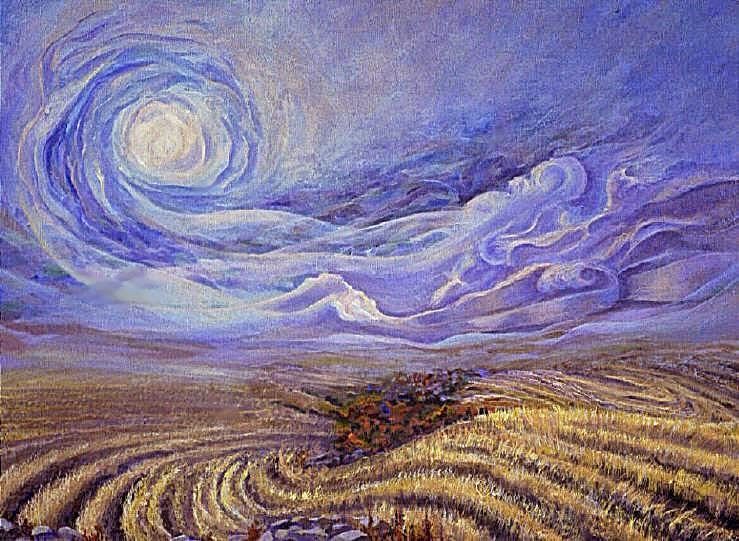
Painting by Vincent van Gogh