Andrea Cecon’s slanting rain

slanting rain
the shift worker whistling
slightly out of tune

Andrea Cecon (Italy)
Modern Haiku, issue 48:2

I enjoy the layers of sound in this haiku. “slanting rain” tells me it’s raining pretty hard. On the first read, “whistling” brings to mind a construction worker, though I like how the occupation is not defined in this haiku and left open for the reader. If we imagine the work is being done outside, I have compassion for the person in the haiku, still devoted and working despite the time of day/night and the weather. Even if the work is being done inside, I have compassion for the person working late into the night and/or early morning. “whistling slightly out of tune” brings to mind how a person can be tired or somewhat fatigued working such odd hours, yet their dedication and focus carries them through. The whistling may also be slightly out of tune against the loud sound of pouring rain. I think whistling in this haiku is also helping the person finish their work-shift. Like walking through mud, it is challenging, but with strength and persistence, it can be done. 

I used to work the graveyard shift at a theater. I always found it interesting to drive home at 1 am after the last movie ended. The quiet neighborhoods were palpable as I drove past silent houses. It was interesting to be awake while almost everyone else was fast asleep.

This is a powerful haiku that conveys compassion for dedicated, hard-working people who work odd hours while most people are sleeping. 

Jacob Salzer (USA)

It happens that when a person spends all day on a task that is tiresome and laborious, then they may not enjoy things in the surroundings or they may not find it soothing when there is bad weather. This haiku represents the life of a shift worker that may sound full of fatigue. ‘slanting rain’ expresses nature’s harsh mood where nothing comes straight and calm. It is a struggle when one cannot escape one’s duty during a slanting rain. But, the word ‘whistle’ gives a twist in the haiku as it shows that either the shift has ended and the person is enjoying their off-time. Maybe they are going back home or daydreaming. Or, it may give a hint of ‘whistleblowing’, calling out those who are not complying with their duties due to the slanting rain. In either situation, it seems that the person in question is enjoying their time.

Overall, slanting rain and whistling both allude to the opposite moods of a person during laborious work or a rough day. It also shows how a person after some hardship needs some relaxation, which may or may not be enough to unwind their fatigue, stress, or frustration.

Finally, the letter ‘s’ in this haiku sounds more like a complex situation where a person is not fully enjoying his life due to a laborious job that may not be paying well.

Hifsa Ashraf (Pakistan)

Jacob and Hifsa explored a lot of what I wanted to say. But, I wanted to add that in this haiku, I see nature and humanity crossing paths. The slanted rain, with the sound of a possible storm, is akin to whistling off tune. I believe there is not quite a cause and effect relationship. It is more the shift worker feeling nature’s mood and integrating it into their being.

In this world of artificiality and superficiality, we often forget how connected we are to nature. From the food we eat, the materials we use, to our surroundings, nature and humanity is always intertwined. This haiku displays a brief moment where that relationship shows as stark as a whistle.

Nicholas Klacsanzky (USA)

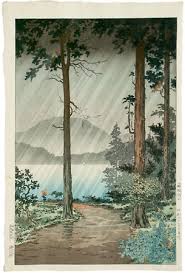
Tsuchiya Koitsu, Morning Rain at Hakone, 1938

Trivarna Hariharan’s comb

wind swept leaves––
the memory of mother
combing my hair

Trivarna Hariharan (India)
(previously published in Isacoustic)

A touching haiku. When I hear and see “wind swept leaves,” I feel the spirit of the author’s deceased mother loving and connecting with the poet from another dimension. It’s as if the wind itself is the mother’s spirit that carries her voice and invisible hands.  

Jacob Salzer (USA)

This heartfelt ku reflects many shades of memories related to the poet’s mother. Windswept leaves here may indicate autumn or dry leaves that have no destination or direction. The leaves have been further scattered due to the strong wind. Same are the thoughts and memories of the loved one that scatters or loses the colour of life when the strong wind of time blows them away. 

The last line, ‘combing my hair’, may either reflect how a person is either contemplating or getting ready for a funeral. Combing hair may also show how things get settled after tragedies or mourning. Also, it may represent the deep remorseful feelings of a person who finds it soothing to untangle hair. 

Hifsa Ashraf (Pakistan)

I feel there are two sides to this: one of melancholy and one of warmth. Wind swept leaves in relation to one’s mother combing our hair, especially as a young girl, can bring out emotions of lightness and relaxation. On the other hand, autumn can bring about feelings of loneliness and a sense of emptiness. Having these two interpretations enrich the reading experience.

Finding a comparison between leaves and hair, and the motion of combing and the wind, is a great haiku moment. The poet has seen a common natural occurrence and discovered a link between it and her deepest memories.

Onto the technical sides of things, the format is standard for English-language haiku. The kigo (seasonal reference) is clear, the kireji (cut marker between parts) is given as an em dash, and the sense of reverence to the main subject often displayed in traditional haiku is present. There is also a strong sonic element to the haiku: the letter “m” dominates with “memory,” “mother,” and “combing.” This letter usually conjures a sense of satisfaction in readers. The letter “r” is also featured. It’s almost as if we can hear the roar of the wind.

A naturally written haiku that uses a common experience in nature to find a special connection with a childhood memory.

Nicholas Klacsanzky (USA)

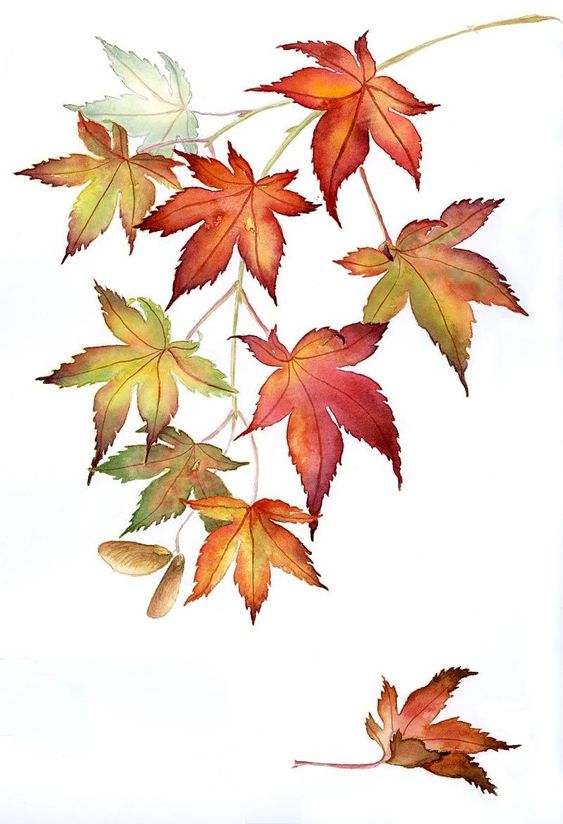
Unknown painting of maple leaves.

Brad Bennett’s skull

cradling
the baby’s skull…
summer clouds

Brad Bennett (USA)
(previously published in Modern Haiku 51:3)

There are two soft spots on a baby’s head where the skull bones have not yet joined together. These soft spots are called fontanels and allow flexibility for the newborn baby to move through the mother’s birth canal. Metaphorically, this softness and flexibility could be the neutral place between two rigid points of view: a bridge between apparent opposites or two sides. I really like how “summer clouds” could be the clothes a mother is wearing, or a blanket, or a pillow. Though I imagined a mother in this haiku, it also could be a father. There is inherent warmth and compassion in “cradling” with its gentle, slow movement. 

There is another interpretation that leads to a contemplation of life and death, and the unsettling, sad stories of very short human lives. However, “baby’s skull” could be another form of life in this haiku. It could be a baby bird’s skull left in a puddle reflecting summer clouds. Summer clouds could also conjure up a feeling of heaven with sunlight coloring or illuminating the clouds, though I feel the real heaven is not seen in the sky but is rather hidden within us. Even in the midst of death, this haiku could imply that the baby’s soul has merged with the universal spirit. 

Brad did a great job using a powerful verb and descriptive imagery, leaving space for the reader’s imagination and engagement.

Jacob Salzer (USA)

Cradling can mean an oscillation between two ends, which indicates something is not yet settled. The baby’s skull and ellipses at the end shows mystery that can be haunting and sad as well. The baby’s skull may point to either a newly born child or a child that is weak due to malnutrition, drought, poverty, or other reasons.

The skull as a hard part of the head may show the significance of what’s in it: wisdom, insight, the intellect, or thoughts that people are gifted to use to overcome issues in order to make this world safe for the next generation. The action of cradling allows readers to think gently and wisely about the issues a newborn must face: the recent pandemic and climate change.

I think summer clouds show a connection between the human intellect and the confusion or obscurity of the global issues that threaten the survival of the current and upcoming generations. It seems cradling/oscillating is more like moving in between the positive and the negative aspects of life.

This insightful haiku is well woven with the threads of mystery and prudence, which makes it unique and thought provoking.  

Hifsa Ashraf (Pakistan)

The above commentaries already mentioned the interpretations of this haiku in depth. I want to add that the word “skull” makes all the difference. If the poet had written “head,” a different resonance would have been created. “Skull” brings us to thoughts of mortality and perhaps transformation, as newborns’ skulls are malleable. This flexibility relays the message that as parents and family members, we shape a child’s future.

With summer clouds, I felt the transience of youth but also the magic of it. It’s a great intuitive comparison with a baby’s skull. The poet could be saying that the newborn has passed away, and now summer clouds are cradling the child.

Looking at this haiku more technically, we clearly have a kigo (seasonal reference) and kireji (mark for separating the two parts of the poem). The lengths of the lines are standard for English-language haiku, and this haiku rightly employs brevity and simple language. In terms of sound, the letters “c” and “k” in this haiku present a stark sonic experience.

With powerful word choice, imagery, and sound, this haiku creates a strong resonance that stays with the reader.

Nicholas Klacsanzky (USA)

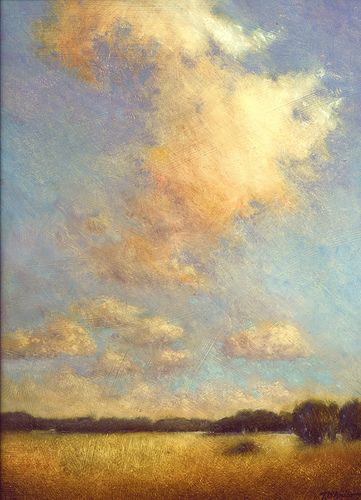
“Summer Clouds” by Tony D’amico