scent of green tea
in my travel mug
the forest’s darkness
— Jacob Salzer (USA)
(published in The Heron’s Nest, December 2021)
Commentary
Commentary is first by the poet himself, and then others
Green tea is my favorite beverage. According to my college studies, green tea polyphenols have more neuroprotective benefits than any other kind of tea, among many other health benefits. It is an integral part of my life, and I take it with me at times.
Last year, I spent some quality time hiking forests in the Pacific Northwest, particularly on the Columbia Gorge in Washington state and the Wildwood Trail in Portland, Oregon. The Wildwood Trail is the largest urban forested trail in the United States, running over 30 miles long. On this trail, I started to contemplate the soil’s rich darkness that provides nutrients and a safe haven for tree roots and plants. I contemplated geological history and the layers of the Earth. I also thought about the balance of darkness and light that is necessary for trees and plants to grow and thrive, as well as the cycles of life, our ancestors, and the womb of Mother Earth. But the forest’s darkness in this haiku is not limited to the soil alone. I wanted to express the depth, resilience, and mysteries of a forest and how we are connected to the Earth in both obvious and much more subtle ways.
For me, green tea is a bridge in this haiku. It constantly reminds me that I’m a part of something much larger than myself. It reminds me to step outside of my small ego, to remain conscious of my connections with Mother Earth, and to be grateful. Perhaps more subtly, the scent of green tea could resemble transience and my mortality. Simultaneously, if we envision tea steam, it could signify the human spirit evaporating into what Indigenous people call the Great Spirit or the Great Mystery. Additionally, the forest’s darkness might conjure up all the damage we have done collectively to forests, and points to the dangers in a forest, especially at night.
In short, this haiku reminds me to walk in the forest with respect, reverence, and compassion.
— Jacob Salzer (USA)
A meditative state of mind that travels from here and now to an unknown time. I can feel a sense of transformation that isn’t limited to the scent of green tea, as it highlights how the sense of smell takes us to a special situation, memory, thoughts, or simply daydreaming that can be related to the scent of green tea. It is a deep, therapeutic process where the poet is transformed while holding a travel mug, and travels from the present to the past, or from the present to the future, or from the outer world to the inner world.
I see a sense of realization and awareness here, where ‘the forest’s darkness’ can be interpreted as his inner world/inner self that is revealed to him during this ‘tea meditation’ where each sip is clearing his mind and thoughts—a sort of crystallization of thoughts. The journey to the inner self is being bridged by the traveling that usually brings a person close to their true self especially when they are alone.
Overall, I liked the mystery of this traveling without ‘time & space’ from a cup of tea to the forest’s darkness. There is also an element of healing where one can confront the dark side of one’s life, and to gradually overcome it through patience, self-awareness, and spending quality of time with oneself.
When Nick shared this haiku with me, I felt as if I am the one who is on this journey of transformation. So, an idea came across my mind about this haiku where I read it like this:
green tea dregs
in my travel mug
the forest’s darkness
— HIfsa Ashraf (Pakistan)
Looking at the technical side of this haiku, it is hard to identify a direct kigo, or seasonal reference. “the forest’s darkness” might refer to autumn or winter, though.
In terms of Japanese aesthetics, this haiku may present yugen and/or zoka. Yugen is the subtle profundity of things that are only vaguely suggested, while zoka is the ongoing, continuous self-transforming creativity of the natural world. I think this haiku subtly suggests many deep meanings through its juxtaposition, as Jacob and Hifsa have espoused. The idea of nature’s movement to a travel mug in the form of green tea reminds me of zoka.
For the pacing, the length of the lines are a bit different than the standard English-language haiku. Usually, it is a short first line, a longer second, and a short third. There is nothing wrong in deviating from this, however. There is an elongated syllable in the second line in “travel” that makes it a longer read than shown. What is also cool about the second line is that it acts as a pivot line where the forest’s darkness could be in the travel mug, or the scent of green tea could be in the travel mug—or both.
There are significant things to mention about the sound, too. “e” is the most prominent letter in this haiku, with it being in almost every word. It is a lilting letter that adds positivity to a haiku that has a sense of mystery. The letter “t” is also a major player, where most of the instances of it introduce a softness to the reading.
This is a haiku with many interpretations possible, written in a light way with profound resonance.
— Nicholas Klacsanzky (USA)

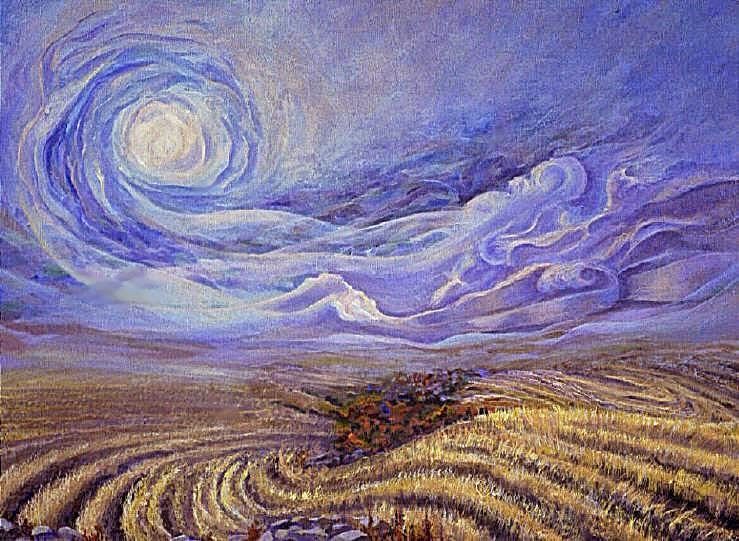
Painting by Lilith Lucratea