Robert Kingston’s Afternoon Sun

afternoon sun
a fly ends the sentence
in the crime book

Robert Kingston (UK)
Bones Journal, 13, 2017

We got an interesting comparison (or contrast?). The fly, so intense and looming on the page of the crime book… and the afternoon sun, blazing and overwhelming. It could be a contrast with the black fly and the bright afternoon sun.

I don’t know if a “crime book” refers to a novel, a non-fiction book about crime, or something that the police use. But that’s part of the fun while reading this poem.

Back to the content: a fly usually comes to dead things, so a fly landing on the page is bringing something tangible to the reading experience of this book. It’s like the fictional and the real world collided at that moment. I think that is the “aha” moment the poet felt. The word “sentence” also has a double meaning: the literal one and the one referring to sentencing in courts.

Breaking down the sound, the long “oo” sounds give a leisurely pace and the “s” letters supply a sharp resonance–a good contrast.

The structure of the haiku/senryu is standard and does fine without any punctuation.

An overall playful and enjoyable haiku/senryu that has a deeper layer if you look close enough.

Nicholas Klacsanzky (USA)

This haiku takes me back to my teenage world where I used to read suspense novels and digests. I liked the way the writer conceived the idea of this haiku about a crime scene but also intrigues me to know more about the whole story.

“afternoon sun” is the time when our thoughts and feelings slow down due to the daytime activities and we want something that can make us relaxed and can rejuvenate our energies. I can feel the sense of getting involved in an activity that engages a person’s mind into something more complex and sophisticated like a crime story.

The fly could be a metaphor for something that bothers us or takes our attention away from what we are trying to focus on. It could be the thoughts of a person or any news or any distraction in the environment that lead us to reveal the mystery on our own or let our experience predict the next part of the story. It may be a point of haste where we don’t indulge in the step-wise process of mystery that is written in the crime book. It is the success of a crime book writer who plotted the story in a way where the curiosity of a person is distracted by the environment or surroundings, and it frequently happens these days.

I miss the reading environment these days where all my senses fully enjoy the book that I am holding in my hands.

Hifsa Ashraf (Pakistan)

If you enjoyed this haiku and commentary, please leave us a comment.
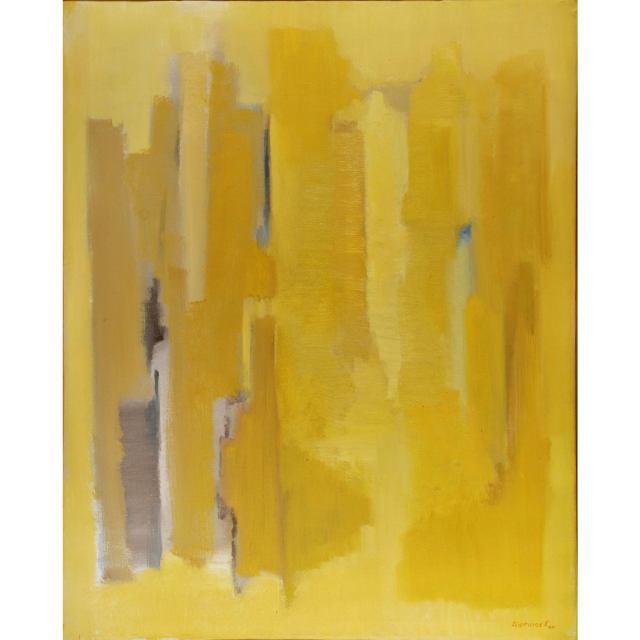
1980-abstract-painting-afternoon-sun-40x50-r-baranet-6740

– painting by Robert Baranet called “Afternoon Sun”
Elaine Wilburt’s Shadow

crescent moon —
enough shadow
to imagine

Elaine Wilburt (USA)
Published originally in Chrysanthemum 26, 2019

A crescent moon or a new moon is the start of a new month, which brings hope and energy with it. I take the crescent moon as a source of yearning for new dreams and plans.

“enough shadow” metaphorically has two meanings here: the dark side of the moon that goes into the light with lunar phases and becomes visible to the eyes, and the shadow of a person, which can be called a persona. In both cases, shadows reflect our desires that need time to get fulfilled. I could see a close connection to life’s stages and lunar phases, where a person grows physically, spiritually, emotionally, and mentally over a period of time. But before that, every aspect of life remains a mystery, like a shadow, and becomes visible once it gets enlightened by time and reflects our true self and/or potential.

Hifsa Ashraf (Pakistan)

I feel this haiku represents a “glass half full” perspective. It makes me think about how something negative, depressing, or solemn can be seen in a positive light. Also, as Hifsa noted, a crescent moon represents a fresh beginning. With that, I believe the poet is expressing optimism for the path ahead on a new journey.

You can say, in addition, that when we look at a crescent moon, we sometimes to fill in the dark space with light through our imagination. We try to view the moon as full, even though it is crescent. So, the haiku could be speaking to our desire to fill in the holes in our perception.

The word “enough” is strong in this poem. It paints the scene perfectly, as it refers to dusk and the shadows that creep in at that time. It demonstrates the level of awareness the poet had when she wrote this haiku.

There is a potent sense of sound in the poem as well. With strings of “o”s, the pace slows down, reminiscent of dusk. With the ample “n”s it has, a feeling of dignity is given to its reading.

Lovely phrasing, imagery, and sound make this haiku impressive.

Nicholas Klacsanzky (USA)

If you enjoyed this haiku and commentary, please leave us a comment.

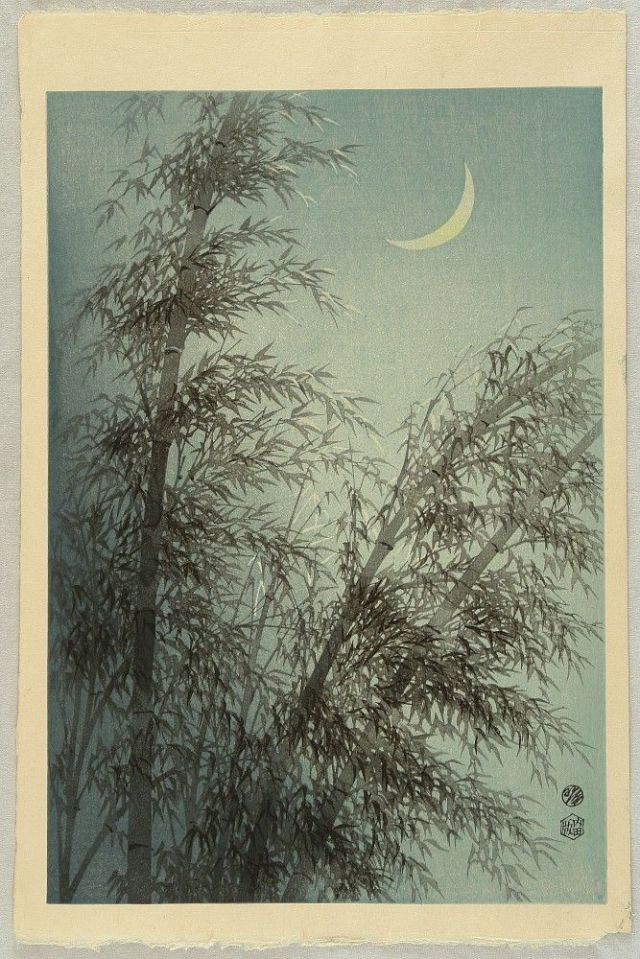
f26763ca0bec1bb194185f083953fa73
Painting by Kotozuka Eiichi(琴塚 英一 Japanese, 1906-1976)


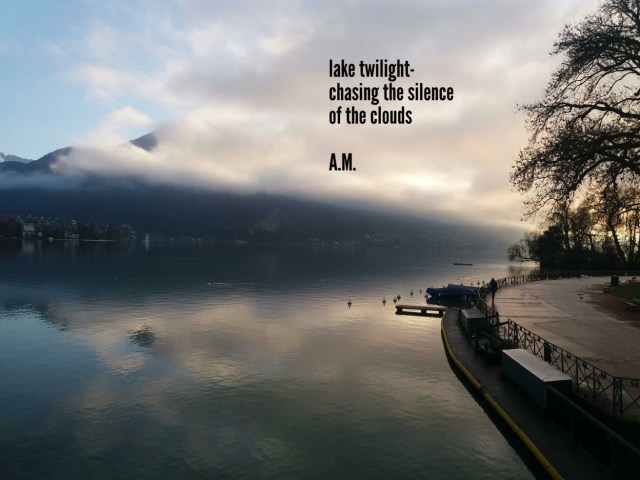
Anna Maria Domburg-Sancristoforo’s Lake Twilight

aviary-image-1517294710424Photograph by Lorena Campiotti, haiku by Anna Maria Domburg-Sancristoforo
Published in Failed Haiku, issue 28, 2018

I enjoy the mystical sense this haiku brings. With the comparison of twilight at a lake and the chasing of clouds’ silence, the reader looks through their mind’s eye to imagine a meditative experience. The poet is perhaps wanting to leave her ego behind and become one with something more primal and foundational: the silence of nature.

Twilight is a time of being between daylight and darkness—something difficult to grasp or pin down. The “chasing” of the silence that clouds contain, either by the narrator or twilight itself, is another thing of abstractness and obscurity. This is akin to the Japanese aesthetic of yugen, which suggests subtle profundity and is associated with mystery.

The structure of the poem fits the rhythm of traditional haiku well and has a clear cut marker (kireji) in the first line to bring about more complexity and a juxtaposition. The strongest sounds in the haiku are the “l”s and “i”s.  Both supply us with a lilting feeling, which in an abstract sense is like the movement of clouds.

The photograph conjures an epic scene to take in and sets the environment well. It compliments the haiku, as it does not go directly into the “chasing” part. It delivers the scene to us so we can dive more into the mind of the poet.

Nicholas Klacsanzky (USA)

The opening line of this haiku takes us to the colourful sky that can be observed at twilight. Mostly, twilight has fading colours i.e. red, purple, yellow, and blue. These fading colours reflect the colours of an aura that we have in the evening, especially at twilight. So, the lake’s twilight complements or blends with the colours of our aura. I can feel the deep silence of the lake at twilight that is due to either the migration of birds or other lake creatures, or due to abandonment. In both cases, the lake reflects the colours of twilight, as well as the mood of the person who was observing it.

Chasing silence may indicate the meditative thoughts that are closely embedded in the silence of the lake and intertwined with the colours of the sky. The narrator may have had profound experiences of seeing clouds, which may also be her ongoing thoughts (maybe chaotic), and she wants to move beyond those thoughts to finally get a peaceful mind.

This haiku beautifully presents the whole image in a subtle way, where we can observe a deep relationship among twilight colours, clouds, silence, and mood. It reveals the mystery of human curiosity to go deeper into one’s thoughts and feel the depth of subtle experiences. Overall, I enjoyed the imagery of this haiku which moved me to vividly experience a lake twilight.

Hifsa Ashraf (Pakistan)

If you enjoyed this haiku and commentary, please leave us a comment.