Kat Lehmann’s River

what remains
after the river is gone
this empty bed

– Kat Lehmann (USA)
Published in Mayfly 68, 2020

I always wonder how to express my deepest feelings about certain themes of life that are well connected with the most essential element of nature: ‘water’. I love it when someone challenges me to write about topics that really cover annihilation.

In this haiku, Kat beautifully expressed her feelings in a simple but most elegant way without letting go of the flavours of the right metaphor that is the beauty of a well-crafted haiku.

What remains is a question mark that we all need to address at the end of this temporary life for which we spend a lifetime to solve the mystery of what we get in the end. The ‘river’ is well placed in this haiku that reflects our thoughts, feelings, and constant learning and building up of a momentum in our lives. I think the flow of the river may be interpreted in two ways: 1) physical life 2) mental or spiritual life. Both goes on until we stop breathing and/or stop thinking about what is necessary for survival.

The empty bed both of the river and our life indicates nothingness and or annihilation where only a deep silence prevails. This haiku also depicts the process of evolution and revolution that both start and end in nothing. This is the ultimate meaning of life.

– Hifsa Ashraf (Pakistan)

At first glance, this poem might seem like a matter-of-fact statement, which a lot of fine haiku do. But then, we get an “aha” moment. The empty bed is both positive and negative. The empty bed could be a representation of the emptiness and harshness of the dry season, but it could also mean a place where new life can flourish without hindrance. Plus, the author could be referring not to a riverbed but to the bed in her house—thus making it a double entendre.

The empty bed is also a sight to behold. The way the river carved into the earth is now fully visible and we can witness what the river did to the soil and rock. It may be empty, but it’s full of memories etched into the earth.

I think the poet did right by not including punctuation, as it would have made the second line too long, in my opinion. The poet retains the traditional Japanese rhythm of haiku.

In terms of sound, the most striking letter is “r,” which gives the haiku added power and weight. The sound of “e” in the last line with “empty bed” has long syllables, which creates a sense of melancholy and starkness.

A fine haiku that gives many introspective associations to readers.

– Nicholas Klacsanzky (USA)
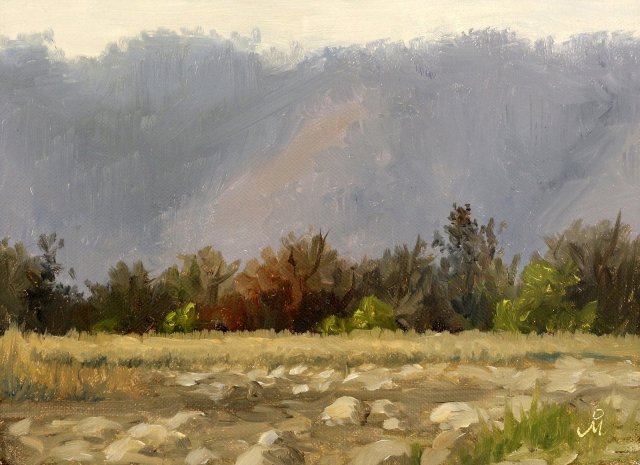
blue-mountains-at-corbett-national-park-landscape-painting-mandar-marathe

– Painting by Mandar Marathe

Robin Anna Smith’s Alchemy

dusk gathers
with the alchemy
of ravens . . .
alone, in a clearing
my heart picked clean

– Robin Anna Smith (USA)
UHTS Fleeting Words Tanka Contest 2019, First Place

There are a few short poems that inspire me deeply due to their brevity and brilliance. The beauty and the dimensions of our imagination are endless as one can grasp the attention of anyone through its majestic power and subtlety. This poem is one of them.

I loved the opening line of this wonderful tanka that pauses my thoughts and lets me feel the colours and the hues of dusk that tickle my slumberous senses to fully grasp the overall picture of that dusk.

The second and third lines, ‘with the alchemy/of ravens . . .’, is beautifully embedded in this dynamic poem and this may be the crux of the whole theme of this tanka. The word ‘alchemy’ depicts the magical power of the dark that purifies our thoughts and heart through contemplation and maybe through meditation. Ravens here depict the sign of intellect that pass through the trials of time before getting into proper shape. This is the experience of wholeness where a person walks alone in this journey as it varies from individual to individual. This highest level of personal experience also touches the spiritual boundaries where a person wants peace at heart, which is the ultimate goal of life. This only comes through the self-awareness that is reflecting very clearly in this tanka and brings one’s thoughts and feelings together to enjoy the subtle experience of wholeness.

Looking at the technicalities, the ellipsis placed after the word ‘ravens’ makes it significant to ponder in our day-to-day experiences before we finally get to the path of our ultimate destiny. By uniting the first and the last lines, one can understand the ultimate purpose of life.

– Hifsa Ashraf (Pakistan)

The power behind this tanka lies in its imagery and the connection between its two parts. Also, the poem packs in a lot of substance within five lines, while allowing the reader to imagine and fill in blanks.

I like that Robin embraces the more metaphorical and free approach to tanka that many western poets don’t delve into. Some western adherents of tanka practice it as a longer haiku and don’t utilize its more abstract and imaginative side.

Let’s break this tanka down line by line. “dusk gathers” sets the time and scene. We can feel that this poem will contemplative.

“with the alchemy” is a surprising line and makes the reader excited to see what will happen next in the tanka.

“of ravens . . .” is highly symbolic. In Native American culture, the raven is sacred and in some tribes, was the creator of the world. This could be the connection to alchemy. Also, in many cultures, ravens are seen as mystical creatures that are either seers, magical beings, or harbingers of something to come. The ellipsis makes the clear sign of this part of the tanka ending and shows that this process of alchemy and dusk gathering is gradual.

“alone, in a clearing” is concise but delivers substantial symbolism with the clearing being like the poet’s sense of being alone. The comma puts more emphasis on the word “alone” and allows the reader to feel it more.

With “my heart picked clean”, Robin does not say, but as a reader, I can imagine the ravens picking the poet’s heart clean. Maybe this could be part of the alchemy mentioned earlier. Alchemy is about transformation, and the process of cleaning one’s heart can be said to be a type of metamorphosis.

In terms of the format, this tanka follows the traditional Japanese rhythm faithfully. Looking at its sound, the letter “c” is most prominent. It reminds me of the clicking of beaks. In this case, ravens’ beaks.

A tanka packed with imagery, symbolism, and feeling, it’s clear why this poem won first place in the UHTS Fleeting Words Tanka Contest.

– Nicholas Klacsanzky (USA)

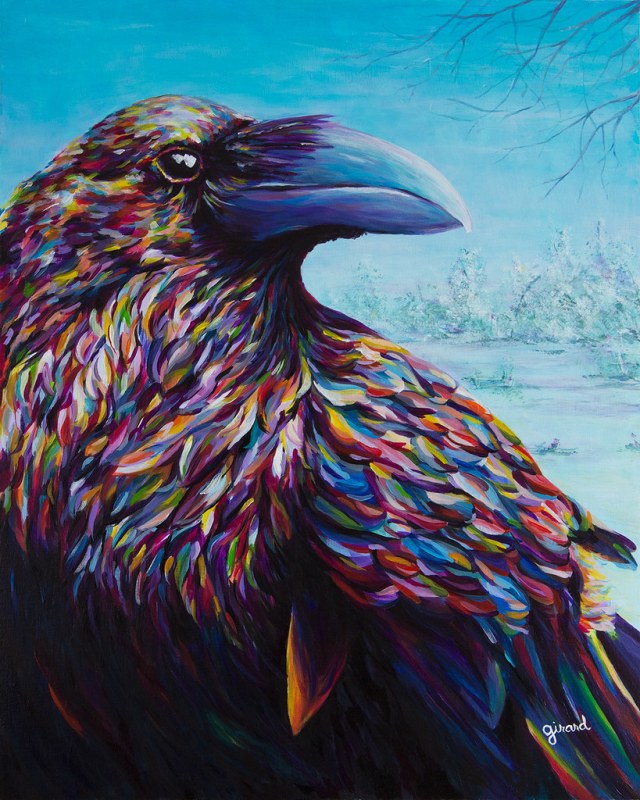
Raven painting– Painting by Claudelle Girard

Elancharan Gunasekaran’s Raft

raft anchored
to the full moon…
shadows dive in

– Elancharan Gunasekaran (Singapore)
Published in Wales Haiku Journal, summer, 2019

Not only is the imagery striking but the way the poet plays with the senses is highly creative. The full moon, reflected on the water, appears to be anchoring the raft either by a string or a chain. This, of course, isn’t factual, but it looks this is actually taking place. This type of imagery is prevalent in haiku and was used often by the old masters, such as Basho.

In the second part, we have another play on our perception. The shadows diving into the full moon could be from anything around: plants, trees, people, animals, etc. But not everything has to be spelled out in haiku. It’s often key to allow space for the reader to imagine a scene from their own experience and ideas so that they can participate in the poem.

With these two fantastical images, the poet merges the cosmos and the earthly. They interact with each other and the distance between them is bridged. I think this connects well with the Zen concept of non-dualism.

Looking at the technical aspects of this haiku, the ellipsis slows down the pace of the scene and hints at its peacefulness. The length of the lines is in standard fashion, connecting to the rhythm of traditional Japanese haiku. In terms of sound, the most interesting part is the two “f”s in the poem. It’s a heavy letter that seems to correlate well with the weight of an anchor, as noted in the haiku.

Full of intriguing imagery and plays of perception, this haiku makes for an enjoyable and mysterious read.

– Nicholas Klacsanzky (USA)

I liked the opening line of this, where there is a sense of proximity and closeness. It puts my ongoing thoughts on a halt and I start exploring my deep connection with the deep water and its mysterious shades. I feel as if my thoughts are anchored for a short while and the sea becomes a subtle ground for anchoring myself to the moon.

It sounds meditative. The full moon is another reason for this mesmerism as the moonlight takes me deep into my profound inner self and I run my imagination wild where strings of the moonlight anchor my thoughts and feelings.

The ellipsis pauses our thoughts to fully absorb the feelings and to enjoy the imagery. The last part of this haiku is a shift from light to dark which seems more like yin-yang where there are comparisons and contrasts in feelings where one can see the moonlight clearly on water due to the shadows that define its boundaries.

The overall imagery of this haiku is subtle and surreal but it’s very well crafted with a fact that there’s a very deep connection between Earth, water, and celestial bodies and one can feel this deep connection with a peaceful mind. It’s definitely beyond seeing.

In terms of sound, the letter “o” creates an uninterrupted rhythm of mystic feelings where there’s no concept of time and space but a continuous cycle of an extraordinary experience.

– Hifsa Ashraf (Pakistan)

b7e7e2e5f57fc33cdaaaeb2018a78b55

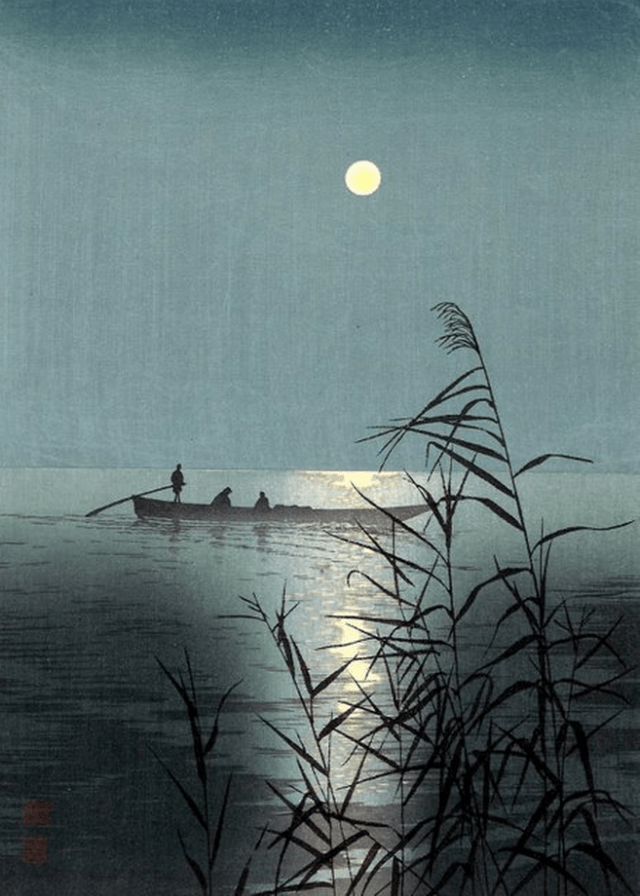
– Painting by Shoda Koho, “Moonlit Sea,” c. 1920