Jacob D. Salzer’s long journey

a long journey . . .
in mother’s clothing
the scent of snow

Jacob D. Salzer (USA)
(published in Autumn Moon Haiku Journal 7:1, Autumn/Winter 2023)

Commentary by the poet

In this haiku, I primarily wanted to honor my mother and her long Earth journey (and her soul’s journey, if readers are open-minded to past lives and reincarnation). I am also writing about my mother going for a long walk in the snow and carrying the “outside” into the house. The scent of snow in her coat lingers. I’m also recognizing the long journey of falling snow, as snow falls from miles above us to reach the Earth. I hope this haiku can act as a portal for the reader to reflect on their own mother and her unique journey.

Commentary by the other editors

This haiku sounds simple but carries many stories of life’s journey. A long journey describes a period that may last more than a year or a lifetime. But, it signifies the essence of a trip that has ups and downs, and deep personal experiences. The ellipses stop us for a while and let us ponder the various aspects or types of journeys. I see it as a life’s journey that has myriad phases and stages where the person continuously passes through experiences within the self and with other people.

The second line tells us about the traveller but it still doesn’t show whether she is the one who carries the clothing or is having a long journey. It may have two interpretations. One is that she passes through rigorous experiences i.e. departure, separation, illness, loneliness, etc. The second interpretation would be that someone close to her carries her clothes as a possession.

The last line depicts deep feelings, as the smell of snow can mean something went as cold as snow and leaves painful memories. Another aspect can be the smell of a person that comes from the clothes and the poet may take it as the smell of snow, akin to the lingering memories of a loved one. In both cases, the person remains discreet in expressing their feelings and tries to relate those emotions with the scent of snow, which does not make a sound.

Hifsa Ashraf

Thinking about the seasonal reference in this haiku, “the scent of snow” is clearly directed at winter. However, a residue of snow could mean that winter has passed and that spring has come. So, the poet could be reexperiencing winter in the time of spring. This could symbolize how the poet feels about his mother’s life or even his life reflected by the one that brought him existence.

The two parts of the haiku combine well in that duration is present in each section. “Long” and “scent” both work to illustrate time passing by. “Journey” relates well to the implied cycle of seasons. With our phases as personalities, they can be representative of seasons—though one season can carry remnants of another season in it. The poet could be referring to how memory sticks to our personalities and in direct connection to his mother, it could mean that his mother has memories “too cold” to burn away.

With the punctuation, which delineates the two-part structure of the haiku, the ellipsis illustrates the duration of the journey. It also makes certain that the reader does not inadvertently read the second line as flowing from the first line.

The pacing emulates the traditional rhythm of Japanese haiku without the restriction of the syllabic count, which is often cited as an erroneous method of matching the format of Japanese haiku. The short/long/short practice is closer to the original haiku rhythm.

Looking at the sound, the letter that jumps out at the reader is “o.” Strewn throughout the poem, it gives a sense of elongation with the long syllables. In my opinion, it also heightens the emotional resonance of the subject of the haiku.

The way human life intermixes with nature in this haiku makes it special. It creates pathos and perhaps something verging on the surreal. A relatable, yet transcendent haiku.
Nicholas Klacsanzky

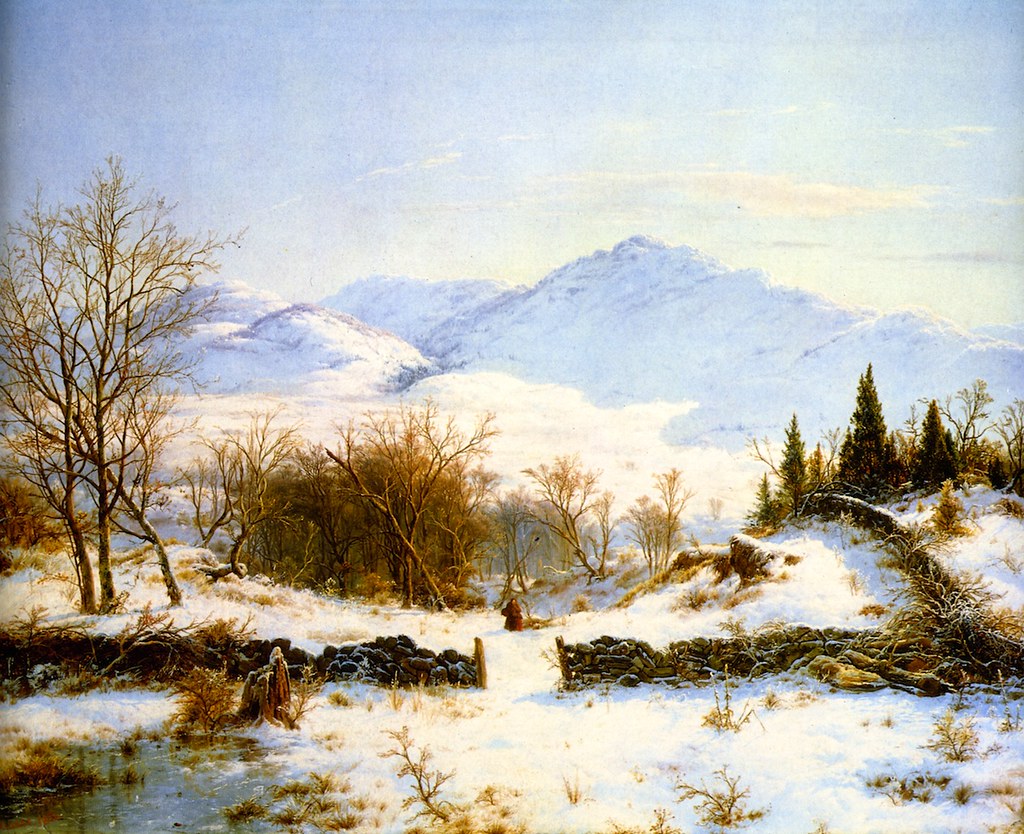
Winter Scene by Louis Remy Mignot, 1856
Jacob D. Salzer’s river mist

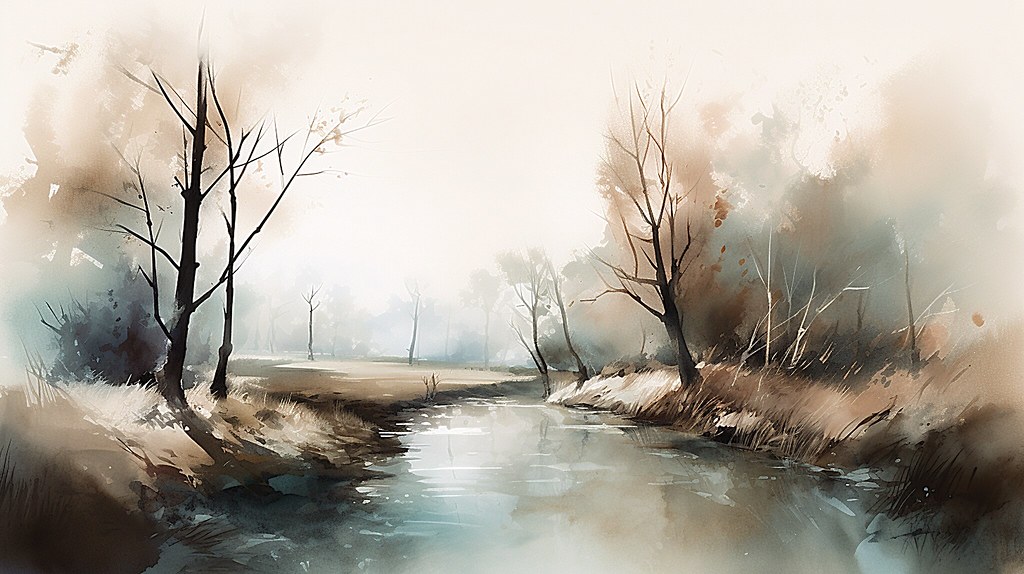
river mist…
the faint whispers
of a lost prophet

Jacob D. Salzer (USA)
Published in The Heron’s Nest, Volume XXIV, Number 3: September 2022

Commentary

The haiku begins with a mystery of belief or religious life. The poet may have diluted thoughts or beliefs. I see ‘river mist’ as a sign of a lack of clarity or less understanding of one’s beliefs where one’s thoughts may be covered in a mist—the discontinuity of a spiritual or religious lesson. I also see it as how directionless a person is if they have no spiritual or religious leader who can show them the path and live a modest and peaceful life. The ellipses after ‘mist’ let us pause and ponder more on things that are not clear to us, which may be misguided or misleading in many ways.

After ‘mist’, ‘faint whispers’ add more to the modification of religious practices that used to be followed by people to get inspiration and guidance for a righteous path. With time, certain voices have lost their strength, positive influence, and power which may be the cause of some worldly chaos.

I see ‘lost prophet’ here as a spiritual leader who helps us heal wounds of our soul and who inspires us as a role model to live an exemplary life full of compassion, kindness, and peace. In other words, this haiku might be implying that we don’t have much of a platform to explore and understand our spirituality currently. 

Hifsa Ashraf

The haiku begins with perhaps a spring kigo in “river mist.” Coupled with the second part of the haiku, I feel the season is early spring with the word “whispers.”

The word “mist” connects well to “whispers” and even to “lost.” It’s a strongly visual haiku in that respect. You can see the mist move about the river, like the whispers of a lost prophet. The juxtaposition shows a comparison between nature and spirituality. It could be that the mist is the whispers themselves, or that the whispers are simply present in the river mist.

The idea of a lost prophet is intriguing. It could be that a prophet has passed away, is physically lost, or that the people have stopped listening to them.

Looking at the punctuation, the ellipses act as a kireji or cutting word that as Hifsa noted, allows us to pause and imagine the mist floating over the river. The haiku is stronger because of this effect.

The sense of sound in this haiku is something to pay keen attention to as well. The letter “r” struck me as the most important. It gave me the feeling of a moving river. Overall, the haiku has a soft reading to it that is reminiscent of whispers.

In terms of pacing, the haiku follows the standard English-language format of a short first line, a longer second line, and a short third line to approximate the original rhythm of Japanese haiku.

Salzer has done a fine job to combine spirituality, nature, and human limitations.

Nicholas Klacsanzky

The first interpretation I was going for is the lost prophet signifies he or she has physically passed away. As the prophet takes their last breath, all that’s left of his/her life are faint whispers, Mother Earth, the endless river, and the mist. The mist could symbolize their spirit passing away/slowly evaporating into sunlight as the river of life flows on. When I saw the river mist in my mind’s eye, I felt an ethereal quality right away, and this led to writing about faint whispers. I also saw the evaporating mist as a kind of transfiguration. I appreciate how mist is water in a more subtle form that becomes nameless and formless. 

I also wrote ‘a lost prophet’ to describe how the prophet may feel lost in human civilization, i.e.  he or she doesn’t truly feel like they belong in human society. As a result, he or she retreats to Nature and finds their true home there, to such an extent that even their own words and teachings have become indiscernible and are only heard now as faint whispers. In other words, their life and teachings could now be Silence itself. It could be that the person has lost all labels, including the word ‘prophet.’ The sound of the river and his or her voice is all that remains instead of words. But the whispers are so faint, we and maybe even the prophet cannot know what they are saying. I intentionally left that open for the reader to hear maybe faint words in his or her whispers, maybe to hear their final words, but in a very gentle way; but the real message I’m going for is not found in words at all, but in the silences and in the sound of the river, and the Great Mystery and a deep wordless Love. 

In short, I wanted to describe a transition from someone being mentally pinned as ‘a prophet’ to the essence of the prophet’s Real teaching that is not found in words but in Nature and Silence. Now, the river’s mist is the whispers of the prophet, calling people back to Nature, to Real Spirit and Love. There is a mergence of identity when the prophet loses their mental labels. They are now unified with Mother Earth and the Divine Spirit as there are no longer any mental barriers. I was deeply inspired to show a wordless Love found in Nature in this haiku. 

I also wrote ‘a lost prophet’ to possibly mean the person has become physically lost in Nature. The person perhaps has left behind city life for good, but they were maybe not really prepared, and got lost in Nature, leading to their physical death. This circles back to the first interpretation. As the prophet takes their last breath and says their last faint whispers with hardly any physical strength left, what survives is Mother Earth and Spirit. I wanted to show perspective too, that the founding of religions is actually not very old compared to the history of Mother Earth Herself, and that the human race and human history is actually not very old either. But the prophet also may not necessarily be religious at all. I was actually leaning more towards a spiritual prophet outside of religion whose teachings revolve around Mother Earth.

There is another darker interpretation I thought about when writing this. I saw “a lost prophet” as someone who is mentally lost, who has gotten so caught up in the ‘prophet’ label and has a kind of ‘cult’ following. Some people may follow this prophet into Nature and suffer the consequences. When this lost prophet finally dies, the hollowness of their life is revealed in the mist, and their faint whispers and corrupt words have disappeared for good.

In this haiku, I also wanted to show how all verbal words are transient. Words appear and disappear, just like the mist.

In the end, I feel Nature will endure, and the Great Spirit. The Great Mystery will last. And Silence and Love.

Jacob D. Salzer

Painting by M. Martin Vicente

Jacob Salzer’s green tea

scent of green tea
in my travel mug
the forest’s darkness

Jacob Salzer (USA)
(published in The Heron’s Nest, December 2021)

Commentary

Commentary is first by the poet himself, and then others

Green tea is my favorite beverage. According to my college studies, green tea polyphenols have more neuroprotective benefits than any other kind of tea, among many other health benefits. It is an integral part of my life, and I take it with me at times.

Last year, I spent some quality time hiking forests in the Pacific Northwest, particularly on the Columbia Gorge in Washington state and the Wildwood Trail in Portland, Oregon. The Wildwood Trail is the largest urban forested trail in the United States, running over 30 miles long. On this trail, I started to contemplate the soil’s rich darkness that provides nutrients and a safe haven for tree roots and plants. I contemplated geological history and the layers of the Earth. I also thought about the balance of darkness and light that is necessary for trees and plants to grow and thrive, as well as the cycles of life, our ancestors, and the womb of Mother Earth. But the forest’s darkness in this haiku is not limited to the soil alone. I wanted to express the depth, resilience, and mysteries of a forest and how we are connected to the Earth in both obvious and much more subtle ways.

For me, green tea is a bridge in this haiku. It constantly reminds me that I’m a part of something much larger than myself. It reminds me to step outside of my small ego, to remain conscious of my connections with Mother Earth, and to be grateful. Perhaps more subtly, the scent of green tea could resemble transience and my mortality. Simultaneously, if we envision tea steam, it could signify the human spirit evaporating into what Indigenous people call the Great Spirit or the Great Mystery. Additionally, the forest’s darkness might conjure up all the damage we have done collectively to forests, and points to the dangers in a forest, especially at night.

In short, this haiku reminds me to walk in the forest with respect, reverence, and compassion.

 — Jacob Salzer (USA)

A meditative state of mind that travels from here and now to an unknown time. I can feel a sense of transformation that isn’t limited to the scent of green tea, as it highlights how the sense of smell takes us to a special situation, memory, thoughts, or simply daydreaming that can be related to the scent of green tea. It is a deep, therapeutic process where the poet is transformed while holding a travel mug, and travels from the present to the past, or from the present to the future, or from the outer world to the inner world.

I see a sense of realization and awareness here, where ‘the forest’s darkness’ can be interpreted as his inner world/inner self that is revealed to him during this ‘tea meditation’ where each sip is clearing his mind and thoughts—a sort of crystallization of thoughts. The journey to the inner self is being bridged by the traveling that usually brings a person close to their true self especially when they are alone.

Overall, I liked the mystery of this traveling without ‘time & space’ from a cup of tea to the forest’s darkness. There is also an element of healing where one can confront the dark side of one’s life, and to gradually overcome it through patience, self-awareness, and spending quality of time with oneself.

When Nick shared this haiku with me, I felt as if I am the one who is on this journey of transformation. So, an idea came across my mind about this haiku where I read it like this:

green tea dregs
in my travel mug
the forest’s darkness

HIfsa Ashraf (Pakistan)

Looking at the technical side of this haiku, it is hard to identify a direct kigo, or seasonal reference. “the forest’s darkness” might refer to autumn or winter, though.

In terms of Japanese aesthetics, this haiku may present yugen and/or zoka. Yugen is the subtle profundity of things that are only vaguely suggested, while zoka is the ongoing, continuous self-transforming creativity of the natural world. I think this haiku subtly suggests many deep meanings through its juxtaposition, as Jacob and Hifsa have espoused. The idea of nature’s movement to a travel mug in the form of green tea reminds me of zoka.

For the pacing, the length of the lines are a bit different than the standard English-language haiku. Usually, it is a short first line, a longer second, and a short third. There is nothing wrong in deviating from this, however. There is an elongated syllable in the second line in “travel” that makes it a longer read than shown. What is also cool about the second line is that it acts as a pivot line where the forest’s darkness could be in the travel mug, or the scent of green tea could be in the travel mug—or both.

There are significant things to mention about the sound, too. “e” is the most prominent letter in this haiku, with it being in almost every word. It is a lilting letter that adds positivity to a haiku that has a sense of mystery. The letter “t” is also a major player, where most of the instances of it introduce a softness to the reading.

This is a haiku with many interpretations possible, written in a light way with profound resonance.

Nicholas Klacsanzky (USA)

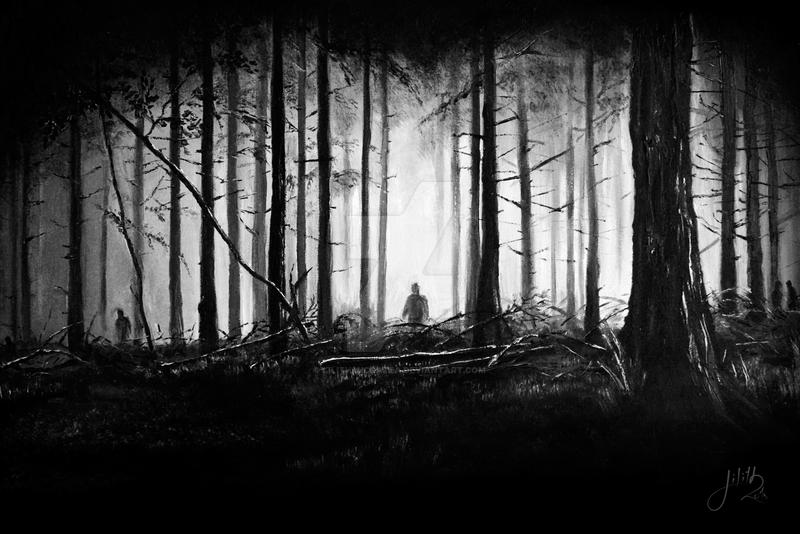
Painting by Lilith Lucratea