Jacob Salzer’s green tea

scent of green tea
in my travel mug
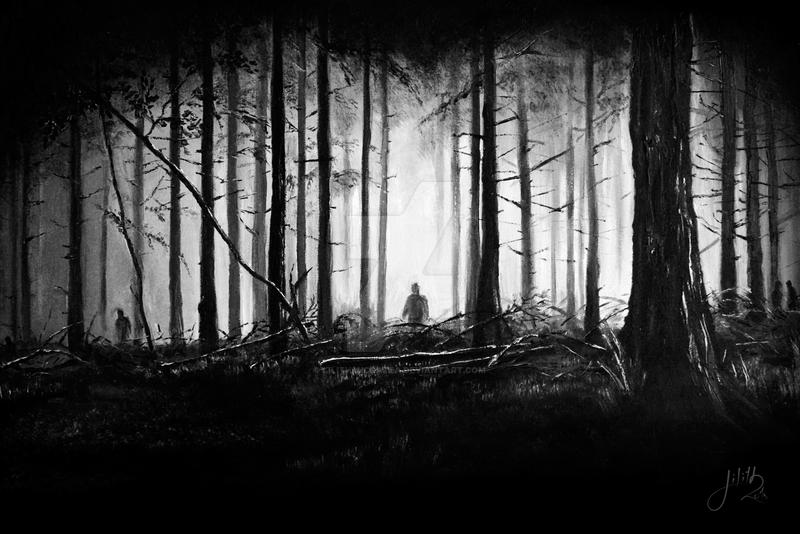
the forest’s darkness

Jacob Salzer (USA)
(published in The Heron’s Nest, December 2021)

Commentary

Commentary is first by the poet himself, and then others

Green tea is my favorite beverage. According to my college studies, green tea polyphenols have more neuroprotective benefits than any other kind of tea, among many other health benefits. It is an integral part of my life, and I take it with me at times.

Last year, I spent some quality time hiking forests in the Pacific Northwest, particularly on the Columbia Gorge in Washington state and the Wildwood Trail in Portland, Oregon. The Wildwood Trail is the largest urban forested trail in the United States, running over 30 miles long. On this trail, I started to contemplate the soil’s rich darkness that provides nutrients and a safe haven for tree roots and plants. I contemplated geological history and the layers of the Earth. I also thought about the balance of darkness and light that is necessary for trees and plants to grow and thrive, as well as the cycles of life, our ancestors, and the womb of Mother Earth. But the forest’s darkness in this haiku is not limited to the soil alone. I wanted to express the depth, resilience, and mysteries of a forest and how we are connected to the Earth in both obvious and much more subtle ways.

For me, green tea is a bridge in this haiku. It constantly reminds me that I’m a part of something much larger than myself. It reminds me to step outside of my small ego, to remain conscious of my connections with Mother Earth, and to be grateful. Perhaps more subtly, the scent of green tea could resemble transience and my mortality. Simultaneously, if we envision tea steam, it could signify the human spirit evaporating into what Indigenous people call the Great Spirit or the Great Mystery. Additionally, the forest’s darkness might conjure up all the damage we have done collectively to forests, and points to the dangers in a forest, especially at night.

In short, this haiku reminds me to walk in the forest with respect, reverence, and compassion.

 — Jacob Salzer (USA)

A meditative state of mind that travels from here and now to an unknown time. I can feel a sense of transformation that isn’t limited to the scent of green tea, as it highlights how the sense of smell takes us to a special situation, memory, thoughts, or simply daydreaming that can be related to the scent of green tea. It is a deep, therapeutic process where the poet is transformed while holding a travel mug, and travels from the present to the past, or from the present to the future, or from the outer world to the inner world.

I see a sense of realization and awareness here, where ‘the forest’s darkness’ can be interpreted as his inner world/inner self that is revealed to him during this ‘tea meditation’ where each sip is clearing his mind and thoughts—a sort of crystallization of thoughts. The journey to the inner self is being bridged by the traveling that usually brings a person close to their true self especially when they are alone.

Overall, I liked the mystery of this traveling without ‘time & space’ from a cup of tea to the forest’s darkness. There is also an element of healing where one can confront the dark side of one’s life, and to gradually overcome it through patience, self-awareness, and spending quality of time with oneself.

When Nick shared this haiku with me, I felt as if I am the one who is on this journey of transformation. So, an idea came across my mind about this haiku where I read it like this:

green tea dregs
in my travel mug
the forest’s darkness

HIfsa Ashraf (Pakistan)

Looking at the technical side of this haiku, it is hard to identify a direct kigo, or seasonal reference. “the forest’s darkness” might refer to autumn or winter, though.

In terms of Japanese aesthetics, this haiku may present yugen and/or zoka. Yugen is the subtle profundity of things that are only vaguely suggested, while zoka is the ongoing, continuous self-transforming creativity of the natural world. I think this haiku subtly suggests many deep meanings through its juxtaposition, as Jacob and Hifsa have espoused. The idea of nature’s movement to a travel mug in the form of green tea reminds me of zoka.

For the pacing, the length of the lines are a bit different than the standard English-language haiku. Usually, it is a short first line, a longer second, and a short third. There is nothing wrong in deviating from this, however. There is an elongated syllable in the second line in “travel” that makes it a longer read than shown. What is also cool about the second line is that it acts as a pivot line where the forest’s darkness could be in the travel mug, or the scent of green tea could be in the travel mug—or both.

There are significant things to mention about the sound, too. “e” is the most prominent letter in this haiku, with it being in almost every word. It is a lilting letter that adds positivity to a haiku that has a sense of mystery. The letter “t” is also a major player, where most of the instances of it introduce a softness to the reading.

This is a haiku with many interpretations possible, written in a light way with profound resonance.

Nicholas Klacsanzky (USA)

Painting by Lilith Lucratea

Jacob Salzer’s dream catcher

dream catcher
a new hole
in the spider’s web 

Jacob Salzer (USA) 
(published previously in Mare Liberum: Haiku & Tanka)

Commentary by the poet:

This haiku came from observation. I saw a spider’s web with a missing spider and a new hole in the web as if a large bug had managed to fly through it (or perhaps the hole was from an insect that the spider had devoured). However, this has been left open for interpretation. Because a spider’s web inherently has many holes in it, “a new hole” could simply mean the spider is creating a larger web and a new hole or an opening has been made through newly connected threads. The spider itself is not explicitly mentioned in this haiku. Therefore, it could be a part of this haiku or it could be missing altogether.

Metaphorically, in this haiku, the spider’s web is the world and the spider is the mind. Just as the spider spins a web out of itself and then lives in it, so it seems the mind spins a web of thoughts out of itself and lives in its own creation. This brings to mind a quote from my favorite movie Waking Life: “They say dreams are real only as long as they last. Couldn’t you say the same thing about life?

Ultimately, the “new hole” in the spider’s web, devoid of a spider, could be a symbol for piercing through the illusion of separation and leaving behind a hole of silence to allow light to shine through clearly, devoid of thoughts. Thus, the mind, even the “I” thought, has seemingly disappeared in the light.

I juxtaposed the spider’s web with a dream catcher (also sometimes spelled dreamcatcher) because they look similar to me.

Here is a note I received from the St. Joseph’s Indian School:

“Native Americans of the Great Plains believe the air is filled with both good and bad dreams. According to legend, the good dreams pass through the center hole to the sleeping person. The bad dreams are trapped in the web, where they perish in the light of dawn. Historically, dreamcatchers were hung in the tipi or lodge and on a baby’s cradleboard. Learn more about the Lakota (Sioux) culture at stjo.org/culture.”

I believe I left room for different interpretations in this haiku. It seems a spider’s web and dream catchers could mean various things to people. Perhaps this haiku could conjure up different dreams you’ve had. Of course, your commentary and interpretations are most welcome.

Commentary by others:

I loved the connection between a ‘dream catcher’ and the ‘spider’s web’ as both yearn to fulfill their dreams. Like the spider’s web, every dream needs consistency, determination, and hard work in order to be achieved. ‘A new hole’ indicates that the spider’s web is already broken or destroyed by both internal or external factors. The hole may be distorted thoughts, distractions, illusions, or delusions that block our view of the world whilst pursuing our dreams. More than one hole indicates drastic life changes that destroy the scheme of a dream or a spider’s web.

On the contrary, the dream may be either unrealistic or abstract, making it impossible to achieve. In that case, a new hole may symbolize the realities or awareness/conscious understanding of the dream that again and again destroy the complicated web of a dream and sensitize the person to live in reality. 

Hifsa Ashraf (Pakistan)

Jacob and Hifsa have explored the interpretations and meanings behind this haiku in depth. I want to add that besides the clear association between a spider web and a dream catcher, I see the spiritual significance of the word “dream.” To me, it inspires thoughts of Buddha’s teaching about the end of suffering being the giving up of desires. This haiku could represent that as we seek to fulfill our desires, we cause a disruption in nature. On the flip side, it could mean that to escape being a seeker of fulfillment, we need to pass through the web of this mundane life.

I like the run of “e” sounds in almost every word in this haiku. It gives me a sense of wonder. The pacing and format of the haiku look effortlessly composed. Punctuation and line length are not as important as the feel of the haiku.

A wonderful haiku that bubbles with interpretations and contemplations.

Nicholas Klacsanzky (USA)

Jacob Salzer’s intruder

THE INTRUDER

You stole her computer, her jewelry, and her credit cards, and bought things from companies around the world.

Yes, they cleaned up the shattered glass you left behind. And they have a new alarm system now, with a fence that nobody can climb.

You too are bound by the laws of karma. I just hope the seeds of karma will soon be destroyed before they grow into a vast, criminal tree.

morning mist . . .
the prisoner’s breath lingers
above barbed-wire

Jacob Salzer (USA)
(previously published Contemporary Haibun OnlineJanuary 2020)

This haibun (prose and haiku) starts with the worldly possessions of a person whom he loves. The computer, jewelry, and credit cards all show the signs of luxuries that a person possesses. The word ‘stole’ means that a person has either taken away all these luxuries or made her deprived of worldly comfort.

Having only shattered glass left behind indicates the mark of a broken relationship where there is nothing left. So, when someone enjoys worldly possessions by destroying others, their own life becomes more barren and destroyed as the analogy of seeds and trees in this haibun beautifully explains.

The morning mist reflects the confusion and chaos where there is no clear picture of what is right and what is wrong, and what is beyond the thick layer of mist that becomes a barrier. The prisoner’s breath could signify the efforts of an enslaved person who is so lost in worldly possessions and mundane life that they forget the consequences and put their life at stake. The barbed wire is another way of making a person conscious of their deeds whilst committing criminal activities.

Overall, the morning mist is like a ‘pleasure’, the prisoner’s breath is like their ego, and the barbed wire is their superego. The overall imagery of this haibun revolves around seeking pleasure by wrongdoings and eventually being caught up in the web of karma, where things that come around, go around. The pleasure principle takes a person to the verge of destruction where they lose their values, principles, and ethics, which destroys everything just to gain worldly wealth and temporary comfort. But when they get caught, they find themselves merely a sign of destruction.

The title of this haibun is quite intriguing as ‘intruder’ is any foreign or outer attraction that takes our focus away from the self, and we get lost into the luxuries of life until we achieve nothing.

Hifsa Ashraf (Pakistan)

I like how this haibun is laid out into short paragraphs that are no longer than two sentences each. It makes the content easily digestible and stark. 

It is interesting how Salzer creates a narrative with the wrongdoing being demonstrated in the prose and the result of that action in the haiku. A lot of times, haibun make a leap of subjects and do not necessarily create a plot. Both methods are viable and in the case of this haibun, it creates pathos. 

The morning mist is free and travels where it wills. But with the prisoner, even their breath “lingers above the barbed-wire.” So, this could signify that the criminal in this story is locked away within and without. 

With an eye of sound, it is intriguing to note that each paragraph of the prose begins with the letter “y.” Also, in the haiku, we have the alliteration of “m” and a strong string of “r” sounds. The letter “r” is hard and brings about the roughness of life in prison to the reader’s mind. 

The meter of the haiku is also punchy and seems to reflect the violence of the criminal’s situation. Take the second line for example: the Prisoner’s Breath Lingers.

I feel that overall, Salzer conveyed a sense of remorse for both of the parties: the victim and the thief. An essential principle of haiku is to covey compassion, and this haibun is a fine example of this idea. 

Nicholas Klacsanzky (USA)

Morning-Mist

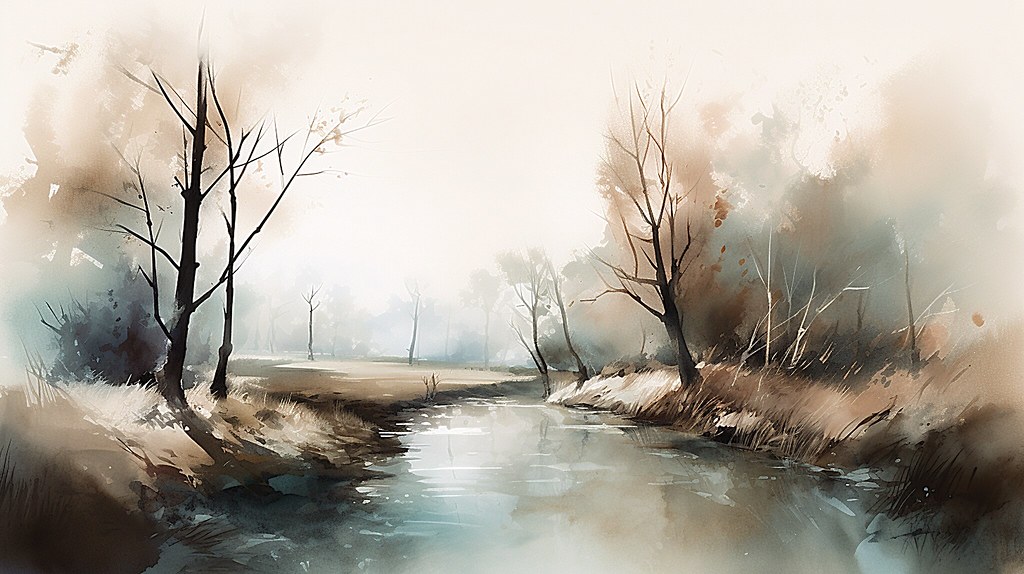
– Painting by Ria Hills