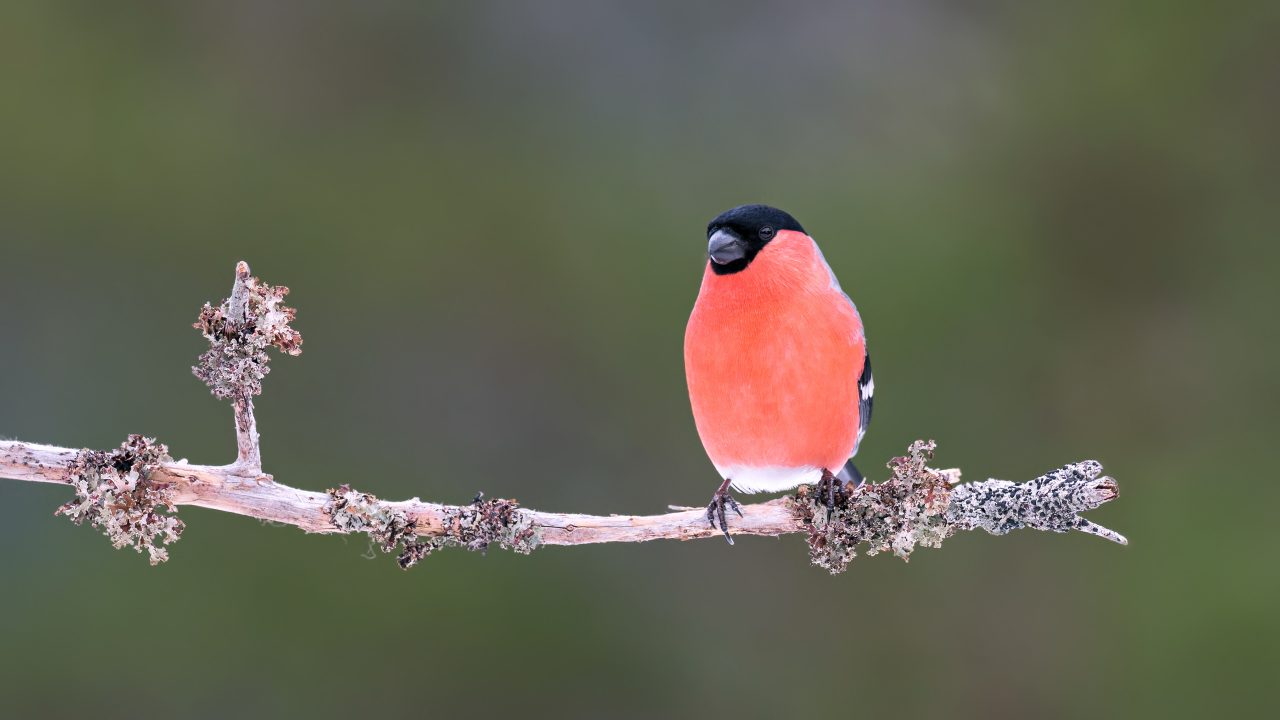
Francesco Palladino’s lockdown

lockdown
in the flight of a seagull
a little sea

Francesco Palladino (Italy)

The current lockdown has changed our lives so much. We see new dimensions or unique perspectives often. This may be due to shifting from one normal to another which is original and profound in many ways.

In this haiku, the writer finds a subtle yet vivid moment where he feels the delicacy of existence in a beautiful way. The flight of a seagull seems to indicate a set direction in life or set objectives that one has planned before or during the current pandemic. It can also mean that the person has gained maximum mindfulness, where he accomplished his objectives or has had profound learning experiences. The ‘little sea’ to me shows a level of knowledge that is vast and/or an abundance of knowledge due to clear thoughts.

The other aspect of this haiku may be contrary to the above. Maybe, the lockdown and the self-isolation has disturbed the thought process of the narrator, where he lives in an imaginary world and finds his objectives merely an illusion or daydream about them instead of fulfilling them. The ‘little sea’ may be a mirage that comes our way during our daily routine and we seek solace in it until the lockdown is over.

Looking at the sound, the letter ‘l’ shows the stiffness or persistence of a thought process occurring during a lockdown.

Hifsa Ashraf (Pakistan)

What I enjoyed immediately about this haiku is the pivot in the second line. It can refer to both the first and last lines. In a poem as small as a haiku, this is a powerful technique that creates more layers.
Thus, you can read it as:

1) lockdown in the flight of a seagull/a little sea

or:

2) lockdown/in the flight of a seagull a little sea

The first version is saying that the poet sees the lockdown in the flight of a seagull and he is comparing it to a little sea. The second version is giving the idea that a lockdown is like a little sea, which the flight of a seagull can show.

Both point to a similar theme, in my opinion: within the seagull, and perhaps within all of us, is a sense of isolation but also a grandness. This mix of feelings reflects in the autumn kigo of a seagull (though seagulls can ultimately refer to almost all seasons).

It is interesting to note the use of articles. Employing “the” with “flight” puts a focus on the act of the bird rather than the creature itself. It gives readers something to nibble on in terms of freedom/containment. In this time of quarantine, we struggle to have even basic freedoms.

“a little sea” could be metaphorical but also physical. The seagull could still be wet from a dive or some seaweed could be clinging to its wings while in flight.

As Hifsa noted, the “l” sounds in this haiku work well. I have a bit of a different take, though. I feel this letter in the poem provides a sense of the seagull lilting on the wind, free and at ease.

It seems Palladino is espousing the concept that freedom is present even when we are in a lockdown or have our movement restricted. That we should find inner joy even when our environment becomes demarcated.

Nicholas Klacsanzky (USA)

s-l1600

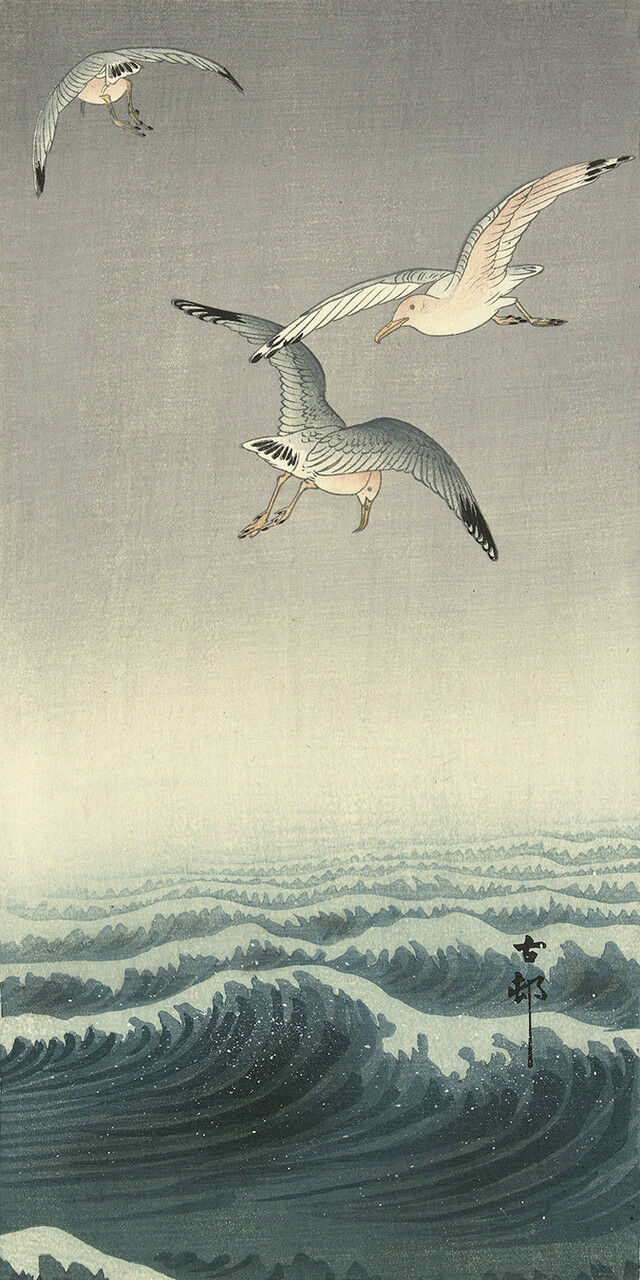
— “Three Seagulls” by Ohara Koson 1900–1936
Haiku about “dust”

Haiku Commentary had a prompt challenge on Twitter that revolved around the theme of “dust.” Here are our favorite submissions and commentary on them. 

rising dust . . .
the old argument
resettled

— Marion Clarke (Ireland)

The opening line of this haiku alludes to the visibility, progress, and movement of something very intangible and subtle. ‘Dust’ may reflect resilience, hope, positivity, strength, or life. When a person moves on in life with all these characteristics, they find it easier to understand certain realities of life and their underlying meanings.

When we look back into the past, old arguments look vague and meaningless. We hold fast to our points of view over the years and ruin relationships because our state of mind doesn’t accept them or see through them for a better reflection of the causes of those arguments.

The resettling of arguments means a new perspective on past disagreements or the reasons behind those arguments that bring more understanding of life.

— Hifsa Ashraf (Pakistan)

Haiku often showcase two slices of life that contrast in a unique and meaningful way. Here we have the action of rising and resettling juxtaposed, written in a way that can be taken both mundanely and metaphorically.  We can easily imagine by reading this haiku that an argument has settled on an imaginary ground and dust rising from its impact of touching the earth.

Nicholas Klacsanzky (USA)


my childhood memories
a cloud
of chalk dust

— Paul David Mena (USA)

Childhood memories always remain with us no matter how old we are or how hard it is to get through our lives. We always cherish those memories no matter how bittersweet they are. Those flashbacks of the past look like a cloud of chalk dust that we enjoy for a moment and then get back to our routine lives. This also means that vivid memories are fading away either due to life experiences of both childhood or present or due to ageing. In any case, if words have been erased, only chalk dust remains for a short while. A cloud also shows fading memories or forgetting, where a person loses the details of childhood memories and has only short glimpses of their childhood.

The word ‘my’ depicts the personal experiences of the poet where he finds it hard to remember those memories. The letter ‘c’ in this haiku displays the half circle of those memories that result in mere images or glimpses from childhood without having any significant details.

— Hifsa Ashraf (Pakistan)

I have written plenty of haiku on childhood memories and can say that it is quite difficult to do so. Mena has composed one with power and brevity in a seemingly effortless fashion (the trick is to make it look effortless when it is not). “Chalk dust” has many implications, as it pertains to education, writing, purity, innocence, and possibly more.

Nicholas Klacsanzky (USA)


dust on your photos
the last fragments of you
that remain

— Shane Pruett (USA)

While the poet is looking at photos of a beloved of his, there remain parts of this person that are still technically alive on the pictures: the individual’s dust. This brings about an extra layer of sadness because even though a part of this person is still with the poet, it is a part that is non sentient and cannot interact with him. This haiku might reflect the Japanese aesthetic of mono no aware (物の哀れ), which is about the pathos and transience of things, and that sometimes brings about beauty in melancholy.

Nicholas Klacsanzky (USA)

There are certain memories in life that we want to forget but cannot as they leave deep imprints on our minds and hearts. But still, time is considered as the best healer. So, the memories of loved ones remain as mere dust.

Specks of dust on photos, metaphorical flashbacks, or vivid memories are fading away or not getting the importance they deserve. This may be due to a change in priorities or other perspectives of life or ageing when someone cannot remember certain things of the past or ignore them.

In this haiku, ‘last fragments’ show the loosening of memories that the narrator once held dear. These fragments are dust, which also shows the annihilation of memories.
Ultimately, this haiku speaks about the transformation of a relationship from a tangible personal touch to the intangible thoughts and memories that later fizzle out in the dust of time.

Hifsa Ashraf (Pakistan)


an attic window sill
a wasp curls
into its own dust

— Alan Summers (England)
Haiku of Merit: Ginko & Kukai event with Professor Hoshino Tsunehiko (1997)
Pub. Yomiuri Shimbun Go-Shichi-Go On-Line Language Lab (Japan, 2005)

An attic window sill is a place where many creatures yearn for their dreams and rest for a moment or two and then fly away. An attic window may be a reflection of memories where a person finds themselves close to their inner self and feel protected.

The analogy of a wasp who curls into its dust may indicate the protection that we acquire after time. When we relate this to human life, our experiences reshape our potential and abilities where we can transcend and transform with time. The connection between ‘attic’ and ‘dust’ shows the stages of maturity that we gain phase by phase and eventually gain the maturity level where the outcomes of those experiences become our strength and protect us from an unseen future. ‘Dust’ may also reflect the annihilation where a person bends down due to either ageing or the brunt of the past that they bury under the dust of time or death.

The articles ‘an’ and ‘a’ project the individual experiences of a person that are more subtle but profound. The letter ‘w’, I feel, gives a sense of the ups and downs in life that reshape our intellect and bring ultimate maturity until death.

Hifsa Ashraf (Pakistan)

To me, the act of the wasp curling into its own dust is representative of an attic itself: self-contained, enclosed, and a place of possible loneliness. The wasp being at the windowsill adds more to the pathos of this haiku, as it indicates that the wasp wished to leave the stuffy attic for its free life outside. It brings into question humanity’s relationship with nature and makes us think about how we can live in more synchronicity with the natural world.

Nicholas Klacsanzky (USA)

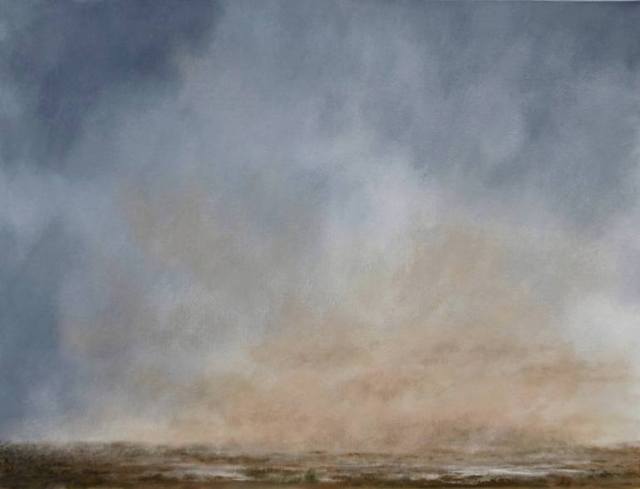
5982985-KTKJFJFX-7

— “Dust Haze” by Steffie Wallace

Jacob Salzer’s intruder

THE INTRUDER

You stole her computer, her jewelry, and her credit cards, and bought things from companies around the world.

Yes, they cleaned up the shattered glass you left behind. And they have a new alarm system now, with a fence that nobody can climb.

You too are bound by the laws of karma. I just hope the seeds of karma will soon be destroyed before they grow into a vast, criminal tree.

morning mist . . .
the prisoner’s breath lingers
above barbed-wire

Jacob Salzer (USA)
(previously published Contemporary Haibun OnlineJanuary 2020)

This haibun (prose and haiku) starts with the worldly possessions of a person whom he loves. The computer, jewelry, and credit cards all show the signs of luxuries that a person possesses. The word ‘stole’ means that a person has either taken away all these luxuries or made her deprived of worldly comfort.

Having only shattered glass left behind indicates the mark of a broken relationship where there is nothing left. So, when someone enjoys worldly possessions by destroying others, their own life becomes more barren and destroyed as the analogy of seeds and trees in this haibun beautifully explains.

The morning mist reflects the confusion and chaos where there is no clear picture of what is right and what is wrong, and what is beyond the thick layer of mist that becomes a barrier. The prisoner’s breath could signify the efforts of an enslaved person who is so lost in worldly possessions and mundane life that they forget the consequences and put their life at stake. The barbed wire is another way of making a person conscious of their deeds whilst committing criminal activities.

Overall, the morning mist is like a ‘pleasure’, the prisoner’s breath is like their ego, and the barbed wire is their superego. The overall imagery of this haibun revolves around seeking pleasure by wrongdoings and eventually being caught up in the web of karma, where things that come around, go around. The pleasure principle takes a person to the verge of destruction where they lose their values, principles, and ethics, which destroys everything just to gain worldly wealth and temporary comfort. But when they get caught, they find themselves merely a sign of destruction.

The title of this haibun is quite intriguing as ‘intruder’ is any foreign or outer attraction that takes our focus away from the self, and we get lost into the luxuries of life until we achieve nothing.

Hifsa Ashraf (Pakistan)

I like how this haibun is laid out into short paragraphs that are no longer than two sentences each. It makes the content easily digestible and stark. 

It is interesting how Salzer creates a narrative with the wrongdoing being demonstrated in the prose and the result of that action in the haiku. A lot of times, haibun make a leap of subjects and do not necessarily create a plot. Both methods are viable and in the case of this haibun, it creates pathos. 

The morning mist is free and travels where it wills. But with the prisoner, even their breath “lingers above the barbed-wire.” So, this could signify that the criminal in this story is locked away within and without. 

With an eye of sound, it is intriguing to note that each paragraph of the prose begins with the letter “y.” Also, in the haiku, we have the alliteration of “m” and a strong string of “r” sounds. The letter “r” is hard and brings about the roughness of life in prison to the reader’s mind. 

The meter of the haiku is also punchy and seems to reflect the violence of the criminal’s situation. Take the second line for example: the Prisoner’s Breath Lingers.

I feel that overall, Salzer conveyed a sense of remorse for both of the parties: the victim and the thief. An essential principle of haiku is to covey compassion, and this haibun is a fine example of this idea. 

Nicholas Klacsanzky (USA)

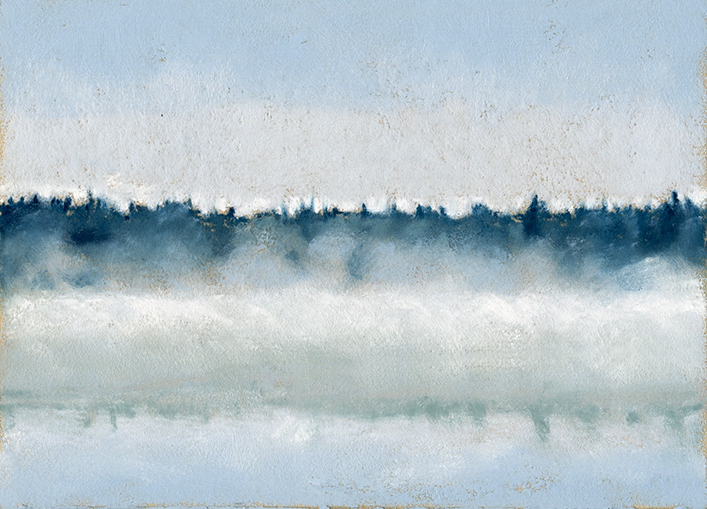
Morning-Mist

– Painting by Ria Hills

Praniti Gulyani’s first hijab

my first hijab . . .
a shadow
on the flower

Praniti Gulyani (India)

(Previously published in Old Song: Red Moon Anthology, 2017)

The opening line of this haiku indicates the first experience of a person wearing a hijab (veil) which is significant in terms of its religious, cultural, and social value. A first hijab also means that a girl has entered into puberty where she has to cover herself up as a means of her protection when she is interacting with a world full of strangers and experiencing a different perspective of life that is more mature.

A shadow, in my opinion, means the self-reflection of one’s thoughts about drawing a line to protect herself from the outer world. A new self-image that is more careful and thoughtful. This shadow can also be the fears that a woman holds in her youth regarding her body, beauty, and self. Through a hijab, she is trying to keep herself away from the darkness of the outer world.

It is like a flower that unfurls and reaches the stage of blossom where many insects and seasons ruin its beauty and loses the charm of life.

The use of an ellipsis after ‘hijab’ indicates the deepest feelings of a person, which is more than merely a piece of cloth.

Hifsa Ashraf (Pakistan)

What drew me to this haiku was the topic of “hijab” which is not a common theme in this art form, and that the second part of the poem is open to many powerful associations. 

As Hifsa mentioned, donning a hijab is part of the process of coming of age for a Muslim girl. Going through puberty as a girl is not something I’m familiar with as a man, but I can see the possible mixed emotions that it would bring. You are at once excited and scared for what becoming a young woman can entail. Perhaps the second part of the haiku is speaking about a more universal experience of one’s innocence being tainted. The poet, it seems, is expressing this through the lens of her religious and cultural experience. 

I feel each word and line break in this haiku is deliberate and potent. It has a serious tone and is not celebratory. In my opinion, the pacing of the poem is telling the reader “take this seriously” as the weight of the words can be felt palpably. 

In haiku, we speak of kigo, or seasonal references. “First hijab” can be said to be a kigo as it refers to a certain period of time. We can also say that wearing one’s first hijab could signify the spring of one’s life.

What is also interesting to note is the relation between the shadow and a hijab’s color, which is traditionally black. The correlation between the two parts of the haiku becomes even more apparent when considering this. 

I like that Gulyani did not explain what kind of flower she was referring to. That would detract from the power of mentioning her first hijab. It would also make the haiku too heavy with three distinct subjects to consider. “Flower” has many references, spiritually, physically, and metaphorically. I will leave it to the reader to puzzle over them in the context of this haiku.

Finally, I want to take note of its technicalities. Though the first line is the longest, which is traditionally short, I believe having “my” in the poem is important. Without it, the haiku would not be perceived as so personal. The brevity of the poem is commendable and no word is wasted. The poem seems to have been written effortlessly, but I doubt it. The best poems seem natural on the page, but behind them, there are sometimes hours and days of work. In terms of the sound, the “i”s in the first line make it stark and the “o” sounds in the last two lines slow down the pace, which is effective with such a short poem. 

Gulyani has written a unique and personal haiku that needs to be heard. It has resonance, brevity, and flow. Not only that, but she has also written about a substantial subject with the weight it deserves.

Nicholas Klacsanzky (USA) 

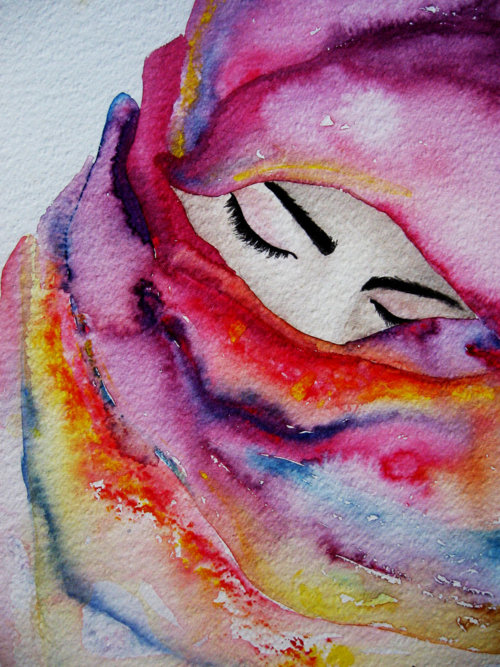
d5jlxvu-1a018e82-d370-45ca-9d0f-e16333eebc95

– Painting by nysahanny  


Alan Summers’ duskfall

duskfall…
the moon bumps
into a paperboat

Alan Summers (UK)
(Published previously in The Heron’s Nest vol. XXI no. 4, 2019)

It’s difficult sometimes to summarize a whole story into the shortest possible amount of words, but when someone does it, it becomes a masterpiece. This haiku is one of those masterpieces that shows why haiku is considered as one of the finest forms of creative writing.

‘Duskfall’ with an ellipsis gives the imagery of a silent yet sad evening where there are no activities. The word itself shows the ending of life when dusk has fallen and is followed by darkness. But, the ending of life can also mean a new beginning that is deeper in nature. It looks like the locus of control is shifting from the outer world to the inner one where subtle aspects of nature get active and replace worldly life.

In this haiku, I can see both outer and inner aspects of life where outer life activities gradually enter into the night and let night complete the rest of the story. The moon bumping into a paper boat shows how things delicately work out of realities, especially when they enter into the night where a moon gradually comes close to Earth and touches the temporary or fragile part of life, which is a paper boat in this case.

Hifsa Ashraf (Pakistan)

Mr. Summers is often experimental and inventive in his choice of words and phrasing. In this haiku, “duskfall” is one such example. It is not a recognized word by the majority of dictionaries but it is intuitively understood. It has a potent imagistic sense to it, with the motion of dusk falling either into place or dropping away. I prefer to think it is the former. As Hifsa pointed out, the ellipsis helps to create movement as well.

The next two lines provide a startling but calming image of the moon bumping into a paper boat. However, we can discern that the moon is not actually hitting the paper boat, but its reflection is.

A fun part of reading this haiku is figuring out the connection between the first line and the next two lines. The haiku seems to say: “the coming of dusk is like the moon’s reflection bumping into a paper boat.” A lot could be interpreted from this, but I feel that the image gives rise to mystery and magic.

What is also curious is that Mr. Summers plays with color with the two parts: dusk being black and the moon and paper boat being white. In a way, the coming of the blackness accentuates the white. I get a sense that the poem could be speaking of yin and yang: the sky and the earth, the night and day, are intertwined and balance each out.

Besides all this thought, witnessing the moment described would be joyous and spectacular, especially in the quiet of dusk. Like in any poetry, haiku have a layer of mental interpretation and a layer of mood/atmosphere. Understanding both can give us a comprehensive picture of a poem.

Another feeling I get from this haiku is the beauty of the “o” sounds in “moon,” “into,” and “paperboat.” These long syllables slow down the poem and create the scene of dusk potently.

It’s difficult to write an original haiku about the moon after 100s of years of tradition of doing so. Mr. Summers has done it through his unique juxtaposition, word choice, and imagery.

Nicholas Klacsanzky (USA)

rhoucfpca7r01

– Painting by Gareth Naylor.

Réka Nyitrai’s pinned butterfly

pinned butterfly –
even in death
beautiful

Réka Nyitrai (Romania)

(published previously in Scryptic issue 2.4 December 2018)

I liked the simplicity of this haiku that straight away touched me deeply. We mostly mention living creatures in our poems as a source of inspiration but this unique haiku took another unique dimension of life which itself is full of life.

‘pinned butterfly’, if I imagine, means the transformation of life into death but still finds its way to get the attention of the masses. When we pin something, we try to highlight it on a wall or board or any other place where it can be seen by many people. It also shows how things become important after death, and especially how death carves their beauty and makes them immortal.

Yes, this happens only through imaginative and creative thoughts that never die. Our thoughts and creativity make things immortal no matter what stage of life they are at and whether they are alive or dead—whether they are dynamic or static. The only thing that matters in the imaginative world is how we make things alive and immortal through our creative thinking. This haiku is the epitome of the imagination that takes us to a static stage of life where butterflies don’t flutter, don’t leave trails, don’t fly high, and don’t spread fragrance. It is a meditative stage of life where one finds existence in stillness and in deep silence. The en dash after ‘butterfly’ means a short pause which also reflects the stillness of life both during the creative and/or meditative process.

Hifsa Ashraf (Pakistan)

This haiku brings to mind how beautiful endings are at times. Sunsets. Outros in songs. A person’s last words. A pinned butterfly.

The beauty that the poet sees in the pinned butterfly brings it back to life in a symbolic sense. It is alive with color and elegance, albeit in stillness. But by pinning the butterfly, we can relish it’s beauty forever in a certain moment. That moment happens to be its death.

Getting technical, we can say this haiku displays muga (a Japanese aesthetic), or spiritual selflessness. The poet does not discuss herself and focuses solely on the beauty of the butterfly, in its new transformation.

The dash is useful to make a clear split between the parts. Also, it could visually represent a pin. The economy with which the poem is written is admirable. With only six words, it carries a powerful message. The sharp “i” sounds in the haiku also direct one’s attention to the image of a pin.

Simple yet poignant, this haiku allows readers to contemplate the beauty of the afterlife in its physical sense. It also brings about an introspection on what it means to be alive.

Nicholas Klacsanzky (USA)

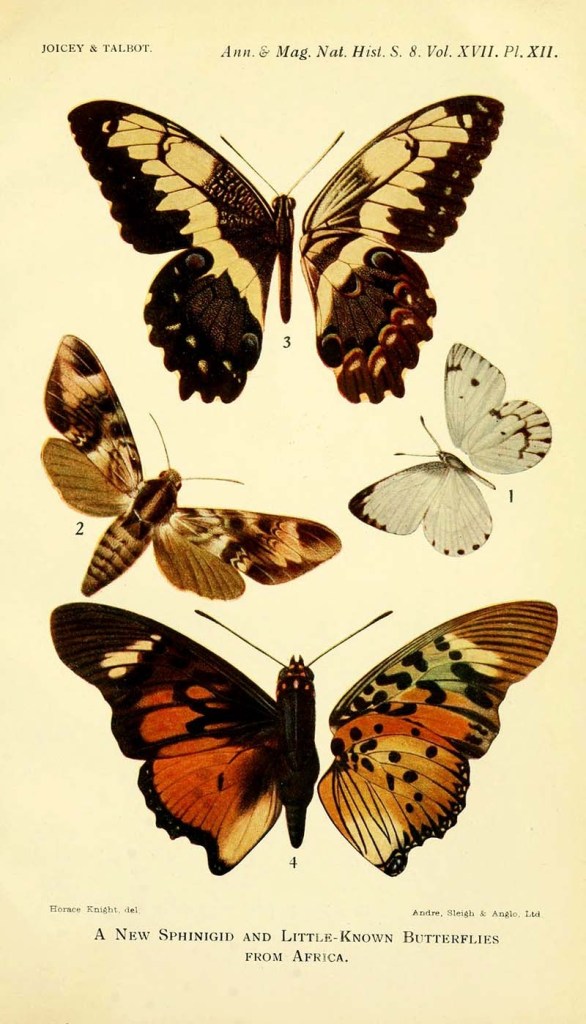
Sphingid-and-little-known-butterflies-from-Africa-1916-s

Isabel Caves’ setting sun

setting sun
a child learns to say
“imaginary”

Isabel Caves (New Zealand)
(Previously published in Poetry Pea – Haiku Pea Podcast Series 2 Episode 2

The way I see the setting sun in this haiku is more about the transformation from day to night which also means the transformation of one’s focus from the outer world to the inner one. I loved the way the writer cleverly used the word ‘sunset’ positively where all energies converge into darkness but also enlighten the mind.

The second part of this haiku is about the transformation of learning where a child learns in the daylight most probably from nature and dreams or creates through imagination based on that learning. The word ‘imaginary’ here means the abstract thinking of a child which is chiseled by the daily life experiences before that reaches the stage where they start uniquely perceiving the world. It’s about the transformation from one stage of life to another, from light to darkness, or vice-a-versa. I liked the quotation marks around ‘imaginary’ which make it more significant and unique.

Hifsa Ashraf (Pakistan)

The setting sun in the context of this haiku seems to have two moods:

1) Sad, in that the child learns what imagination is and what it is not. Before, the child had no mental concept of it.

2) The beauty and epicness of a sunset can be compared to one’s imagination.

As a reader, I seem to follow the first interpretation. As soon as we have words for things, we ruin them, in a sense. The mystery, the grandeur, the innocence is lost. Nature is no longer filled with spirits and magic, but are given scientific names and explanations. They become mental concepts rather than something to witness as is. Through mental obstruction, we can lose the child within.

In terms of the sound in the haiku, it seems that the letter “s” is the most prominent. The string of “s” sounds in the first two lines and the absence of it in the last line makes the ending more striking. I’m glad the poet did not add a dash or an ellipsis in the first line as a kireji, or cut word or phrase, which is traditionally seen in haiku. With the quotation marks, it was already enough punctuation, and more punctuation would make it too busy. The format is standard for English-language haiku, although one tries to avoid having one word in the last line in order to not be either too sentimental or pointed. However, it works well here with the quotation marks and as a surprise.

A haiku that touches upon innocence and the loss of it, it’s a powerful tribute to our imagination.

Nicholas Klacsanzky (USA)

1888-vincent-van-gogh-the-sower

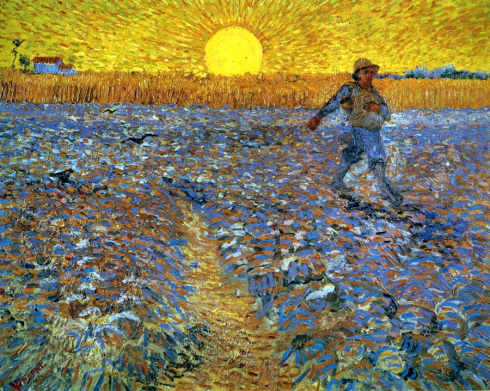
Painting by Vincent van Gogh, The Sower, 1888

Carmela Marino’s dream

moon flower…
the rest of a dream
on the windowsill

Carmela Marino (Italy)

This haiku beautifully covers the deep feelings of both day and night. A dream that starts at the night gradually enters into the daylight as a daydream. I loved the analogy of a night dream with a moon flower that reflects the fresh start of a day. The star-shaped structure of this flower brings hope in one’s life that there’s nothing to worry about as this flower blooms at night, so it looks surreal like a dream that also blooms and makes one’s life worth living.

I loved the twist in this haiku where the writer takes us from a moon flower to a morning scene in continuation of the night dream. A windowsill is a place that is used for pondering and daydreaming. So, the night dream is not over yet and the dreamer is still in a state of dreaming that now shifts from darkness to light. This means the follow up of the dream even in the daylight.

I loved the mystery behind this haiku which takes us on an ethereal journey of dreaming which is an essential part of our life in terms of hope and purpose. I loved the way the writer used both ‘moon flower’ and ‘windowsill’ as metaphors where there is no disconnection of dreams and/or a journey that starts from within and then connects us with the outer world. The ellipsis after moon flower gives a beautiful break to stop and enjoy the glory of the night and the gradually blooming process of a dream.

Hifsa Ashraf (Pakistan)

We got a kigo, or a seasonal reference, for spring with “moon flower.” But more importantly, we are given a flower that only blossoms at night. This connects strongly to dreams, where our imagination and subconscious “blossoms” at night. With the ellipsis, the silence of that time can be felt.

In the next two lines, much can be implied. My initial thought is that the poet wakes up and sees the moon flower on her windowsill. It’s possible that the poet was dreaming of something that related to the flower in question.

The other interpretation is that the content of the dream is a mystery to the reader, and that mystery corresponds to the intriguing flower that blooms at night.

Finally, the dream (either physical or abstract) could be represented by an ornament or an object that rests on the windowsill. This continuation lends to the idea that nature still is active and even blooms at night, as with the moon flower.

I get an ethereal feeling from this haiku. In a way, it brings me into a dream world. We can discuss interpretations of haiku, but I think the feeling we get from haiku is most important.

In terms of its structure, we have a classic format that mirrors traditional Japanese haiku and which is most common in English-language haiku. If we look at the sound, we immediately catch wind of the usage of “o” to slow down the pace and to make the poem more dreamlike.

With the aesthetic of yugen, or deep mystery, this haiku puts readers in a powerful state and makes them see nature with more abstraction and imagination.

Nicholas Klacsanzky (USA)

Moonflower

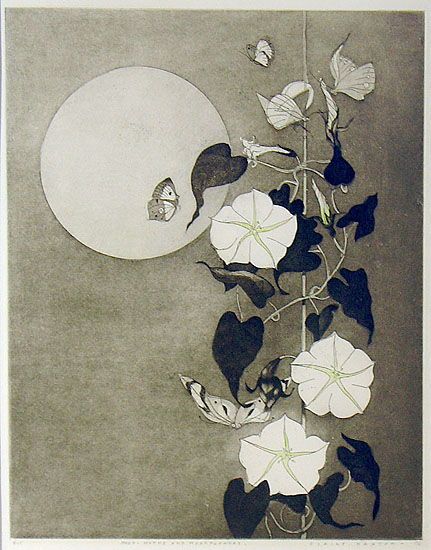
– Painting by Elaine Haxton(Australian, 1909-1999)Moon, Moths and Moonflowers, 1976


Florin Golban’s Storm

after the storm—
playing hopscotch
among the blossoms

Florin Golban (România)
International Honourable mention, Vancouver Cherry Blossom Festival 2019

In general, storms cause chaos. There’s no specification of storm in this haiku, which makes it more open for discussion. But, every storm interrupts our daily routine, especially the recreational. The same goes for a difficult time, which puts all activities on halt.

Hopscotch is the resumption of a happy or carefree time that one has after a difficult time, where they enjoy playing it among nature. The blossoms indicate that life is in full bloom where there’s no tension or chaos. It’s more like back to normal where a person enjoys all their favourite activities, especially outdoor ones.

It also depicts resilience that one develops over a period of time.

Hifsa Ashraf (Pakistan)

The em dash in the first line allows us as readers to take in what happened from the devastation by the storm. In this case, the poet focuses on the blossoms strewn on the street or sidewalk. Fallen blossoms, especially of the cherry variety, are highly beautiful and evocative.

The act of playing hopscotch among the blossoms can represent several things:

1. Playing in the midst of destruction or the loss of something beautiful.
2. That we should not pay attention to the chaos around us and remain positive.
3. We should be connected to nature. Nature is a part of our everyday life.
4. And more…

The feeling this haiku gives me is mixed: happiness and sorrow. Happiness for the play and sorrow for the destruction. But great haiku often have layered and/or complex feelings behind them.

In terms of the sound, the prominent letter is “o.” It slows down the reading and makes the moment being portrayed seem longer. The use of “o” is balanced enough to not be intrusive and gives music to the poem.

The length of each line is relatively the same, which is fine. Usually, the second line is the longest in a haiku, but no harm done. Besides, there are no hard and fast rules for haiku.

I think this spring haiku brings out a sense of joy and melancholy simultaneously with great effectiveness.

Nicholas Klacsanzky (USA)

large

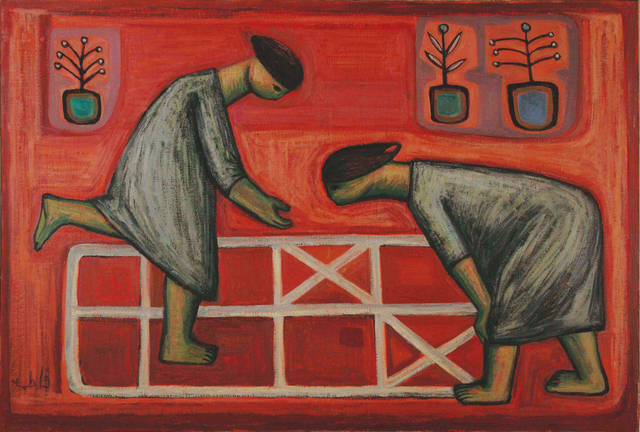
Painting by Fatma Arargi (1954)

Pravat Kumar Padhy’s zero

the zero-shadow moment I am with myself

Pravat Kumar Padhy (India)
Published previously in The Heron’s Nest Vol. XXI, Number 3, 2019

There are many monoku about shadows that pull at my heartstrings but this one is more intriguing in terms of the theme, where one doesn’t have to feel the sense of the moment but rather dig deeper to know how to relate it to one’s own life experiences.

A zero-shadow, in my opinion, indicates the complete absence of the shadow in one’s life. The word ‘zero’ itself reflects the degree of nothingness in this haiku where the writer feels it’s more like the temperature which is cold at zero. A zero-shadow also depicts a lack of connectivity or loneliness due to various reasons.

When you feel that you have a zero-shadow that represents your existence means you’re all alone without having a single ray of hope in your life. It also means the detachment of worldly relationships that act more like shadows and get lost when a person is having trouble or is in the dark.

In terms of sound, the letter ‘m’ in this haiku can relate to the echoes from the heart that are remorseful due to this miserable time.

Hifsa Ashraf (Pakistan)

As with most fine one-line haiku, this poem can be read in several ways:

the zero-shadow
moment I am with myself

or:

the zero-shadow moment
I am with myself

or:

the zero-shadow moment I am with myself

…which all have different available interpretations. However, as a reader, I’m naturally inclined to read it as the second version. In this version, we have a clear break in subjects.

This poem is like a realization that one is truly alone and with oneself. I don’t get a sense that this haiku is about loneliness, though. It’s more about observing who you are fully without any impediment.

I can’t say that this monoku has a kigo, though it’s indicative of noon. In my imagination, I see this haiku taking place in either summer or spring.

Looking at this haiku technically, I enjoy the originality of “zero-shadow,” the length and rhythm of the line, and the sound, which was aptly mentioned by Hifsa.

Overall, I enjoy this one-line haiku for its ability to put the reader in the state expressed, which is the state of the total observation of the self.

Nicholas Klacsanzky (USA)

farmer at noon

Painting by Imai Kageki (1891 – 1960)