
Haiku and haibun by Gareth Nurden, Sathya Venkatesh, and Anthony Lusardi

civil twilight
around the old parish
the halogen glow of snow

Gareth Nurden (Wales)

Commentary by Nicholas Klacsanzky:

What initially got me interested in this haiku was the first line, “civil twilight.” I had to look it up, and found out that it means “the brightest of the three twilight phases, occurring when the sun is between the horizon and 6° below the horizon. It provides enough natural light for most outdoor activities, often making artificial lighting unnecessary. It begins in the morning before sunrise and ends in the evening after sunset” (National Weather Service). I never saw this kigo being used, and I was impressed by its sense of sound. The running of “i” and “l” through the line makes it sing.

The second line further sets the scene and serves as a pivot between the first and third lines. The lack of punctuation helps this pivot succeed. The word “parish” is wonderful in its specificity, while “old” adds to the “l” sound in the first line and creates a contrast of times.

Though the first line introduced the time of day, the last line features the season: winter. This supplies a direct comparison between the state of the parish and the stark season it now inhabits. The word “halogen” is a brilliant touch, not just from an imagistic standpoint but also from a mood perspective. The radioactive glow of halogen is reminiscent of war, industry, science, and more. However, the take that stuck with me is the relation to the aftermath of war. The old parish is most likely in ruin (physically or metaphorically), and the halogen of snow magnifies this fact. The snow and twilight did not intend to illustrate the old parish’s wrecked state, but it did in the poet’s eyes, and maybe in the eyes of others around. On another note, the third line keeps with “l” and “o” sounds that blend musically with the second line, and some of the first line.

The relationship between civil twilight and the halogen glow of snow creates toriawase, or a skillful combination of different elements. Though both of these parts are of nature, the old parish brings in a human and spiritual element. This adds another layer to the toriawase.

This haiku is understated and unfolds with meaning with each line and word. It brings in time, seasons, and the connection between human architecture and spirituality with the natural world. It is a contemplative work that delivers through excellent diction, imagery, and phrasing.

red alert
the umbrella seller sits back
to enjoy his tea


Sathya Venkatesh (India)
published in haikuKATHA, issue #44, 2025

Commentary by Hifsa Ashraf:

The haiku presents a striking shift in mood, moving from danger or urgency to quiet ease. The opening line, “red alert,” signals danger or impending disruption, immediately creating tension and uncertainty. Without punctuation, it allows readers to imagine various interpretations, the most common ones maybe a storm, heavy rain, or another natural calamity.

The second line introduces an umbrella seller that subtly hinting at the nature of the alert. Umbrellas suggest rain or rain related disasters. Yet instead of reacting with alarm, the seller seems to be relaxed, creating a contrast between the urgency and the utter relaxation.

In the final line, “to enjoy his tea,” there is a quiet sense of ease, even a hint of enjoyment. The umbrella seller appears untroubled, suggesting that what brings concern to some may offer opportunity or simply remain an ordinary moment to others.

The overall imagery can be read as revealing a colder, more self-interested side of human nature, where one benefits from circumstances that may trouble many. At the same time, the haiku remains open to multiple interpretations and invites the reader to consider both its subtle implications and its silences.

A haibun:

while reading ryokan’s poetry

i thought about the annual christmas parade in boonton, new jersey. held right after black friday on main street with fire trucks and floats for every local business. the high school marching band, the politicians, the VFWs, the church choirs, the boy and girl scouts and all the neighbors lining up and down the road, taking selfies and tossing confetti with the first falling snow. and if i was his pupil, i would try to convince ryokan to join me in the festivities . . . yet i would imagine, he would convince me to join him near the rockaway river, right near its small falls, far away from all activities and ask me to just listen.

                        late autumn moon;
                        eventually the town sleeps
                        but never the river

Anthony Lusardi (USA)
first published in failed haiku, issue #111, September 2025

Commentary by Jacob D. Salzer

This is an intriguing haibun where modern culture collides with Nature. The parade and modern culture also contrast with the monastic life of a Japanese poet, calligrapher, and Zen Buddhist priest, Ryōkan, who lived in the 18th and 19th centuries. The annual Christmas parade is loud and full of bright colors, sounds, and music, flashing phone cameras, confetti, etc. The parade is happening after Black Friday, when people buy things that day at discounted prices, but it can also involve physical violence and be dangerous. This kind of stimulation at the parade and during Black Friday can easily activate the human sympathetic nervous system (fight, flight, or freeze).

By contrast, the life of Ryōkan is strongly aligned with the beauty of Nature, without loud sounds or other excessive multisensory stimulation. The atmosphere of his life in Nature easily activates our parasympathetic nervous system (rest and digest), where we can relax, while being fully alert and present.

In this haibun, a powerful example of the collision between two worlds is “tossing confetti with the first falling snow.” With Ryōkan’s life and perspective in mind, perhaps the poet is ultimately starting to see modern culture as a kind of distraction that has established traditions, but are ultimately short-lived, while our true home is found in Nature and a quiet mind.

According to Britannica: “Ryōkan (born 1758, Izumozaki, Japan—died Feb. 18, 1831, Echigo province) was a Zen Buddhist priest of the late Tokugawa period (1603–1867) who was renowned as a poet and calligrapher. The eldest son of a village headman, he became a Buddhist priest at about the age of 17 under the religious name of Taigu Ryōkan. When he was 21 he met an itinerant monk, Kokusen, and followed him to his temple, Entsū-ji, at Tamashima, Bitchū province. He followed a life of monastic discipline there for 12 years. After Kokusen’s death he traveled to various parts of Japan as a mendicant priest. In old age he returned to his native Echigo province, where he studied the Man’yōshū and ancient calligraphy. He developed a strong master-pupil relationship with a young nun, Teishin, who after his death compiled Hachisu no tsuyu (1835; “Dew on the Lotus”), a collection of his haiku and waka poems. He also executed many pieces of calligraphy that are esteemed for their elegant beauty.”

Interestingly, there is no capitalization found in this haibun, aside from VFW’s (which I learned means Veterans of Foreign Wars, which is an organization representing U.S. veterans who have served in overseas conflicts). The lowercase words in this haibun seem to create a tone of humility.

In short, this is an intriguing haibun that offers social commentary on modern culture and the importance of being in Nature. It also provides a small window into the life of Ryōkan and Zen Buddhism. Despite our technological advances, cities will rise and fall with time, but Nature will remain. A powerful haibun.
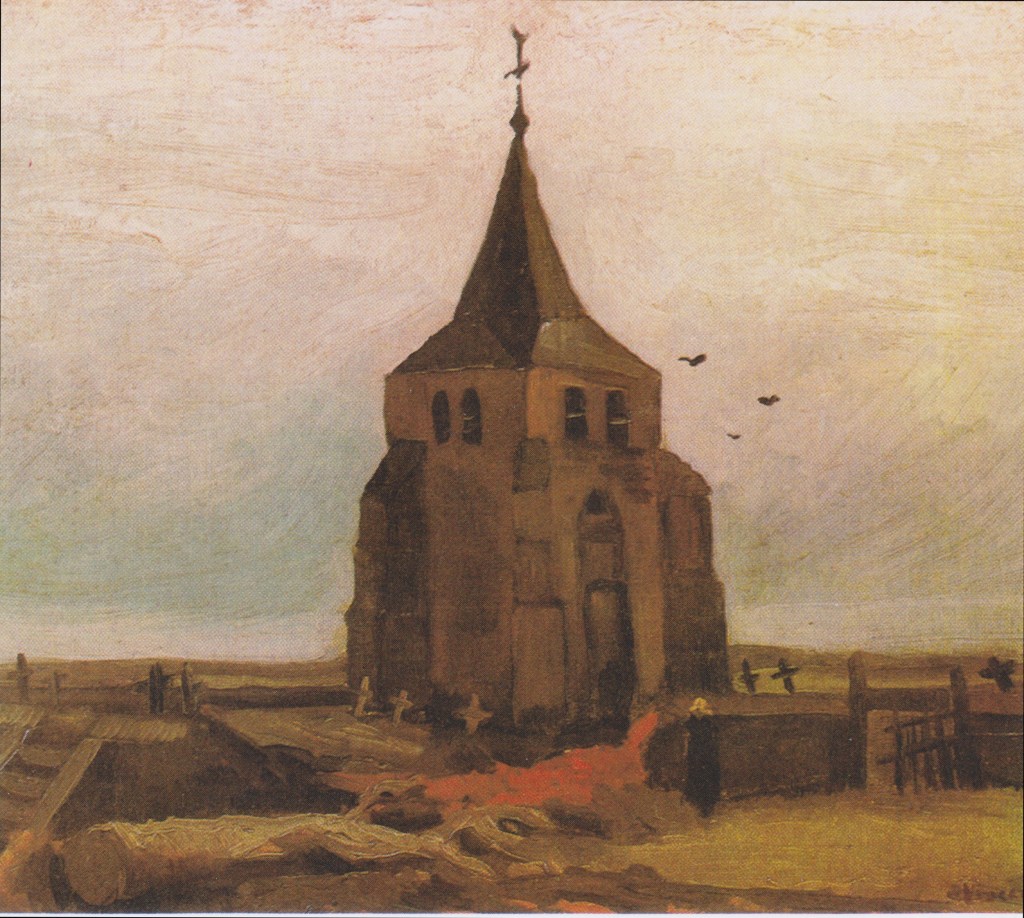
Old Church Tower at Nuenen, 1884, Vincent van Gogh

Jacob Salzer’s intruder

THE INTRUDER

You stole her computer, her jewelry, and her credit cards, and bought things from companies around the world.

Yes, they cleaned up the shattered glass you left behind. And they have a new alarm system now, with a fence that nobody can climb.

You too are bound by the laws of karma. I just hope the seeds of karma will soon be destroyed before they grow into a vast, criminal tree.

morning mist . . .
the prisoner’s breath lingers
above barbed-wire

Jacob Salzer (USA)
(previously published Contemporary Haibun OnlineJanuary 2020)

This haibun (prose and haiku) starts with the worldly possessions of a person whom he loves. The computer, jewelry, and credit cards all show the signs of luxuries that a person possesses. The word ‘stole’ means that a person has either taken away all these luxuries or made her deprived of worldly comfort.

Having only shattered glass left behind indicates the mark of a broken relationship where there is nothing left. So, when someone enjoys worldly possessions by destroying others, their own life becomes more barren and destroyed as the analogy of seeds and trees in this haibun beautifully explains.

The morning mist reflects the confusion and chaos where there is no clear picture of what is right and what is wrong, and what is beyond the thick layer of mist that becomes a barrier. The prisoner’s breath could signify the efforts of an enslaved person who is so lost in worldly possessions and mundane life that they forget the consequences and put their life at stake. The barbed wire is another way of making a person conscious of their deeds whilst committing criminal activities.

Overall, the morning mist is like a ‘pleasure’, the prisoner’s breath is like their ego, and the barbed wire is their superego. The overall imagery of this haibun revolves around seeking pleasure by wrongdoings and eventually being caught up in the web of karma, where things that come around, go around. The pleasure principle takes a person to the verge of destruction where they lose their values, principles, and ethics, which destroys everything just to gain worldly wealth and temporary comfort. But when they get caught, they find themselves merely a sign of destruction.

The title of this haibun is quite intriguing as ‘intruder’ is any foreign or outer attraction that takes our focus away from the self, and we get lost into the luxuries of life until we achieve nothing.

Hifsa Ashraf (Pakistan)

I like how this haibun is laid out into short paragraphs that are no longer than two sentences each. It makes the content easily digestible and stark. 

It is interesting how Salzer creates a narrative with the wrongdoing being demonstrated in the prose and the result of that action in the haiku. A lot of times, haibun make a leap of subjects and do not necessarily create a plot. Both methods are viable and in the case of this haibun, it creates pathos. 

The morning mist is free and travels where it wills. But with the prisoner, even their breath “lingers above the barbed-wire.” So, this could signify that the criminal in this story is locked away within and without. 

With an eye of sound, it is intriguing to note that each paragraph of the prose begins with the letter “y.” Also, in the haiku, we have the alliteration of “m” and a strong string of “r” sounds. The letter “r” is hard and brings about the roughness of life in prison to the reader’s mind. 

The meter of the haiku is also punchy and seems to reflect the violence of the criminal’s situation. Take the second line for example: the Prisoner’s Breath Lingers.

I feel that overall, Salzer conveyed a sense of remorse for both of the parties: the victim and the thief. An essential principle of haiku is to covey compassion, and this haibun is a fine example of this idea. 

Nicholas Klacsanzky (USA)

Morning-Mist

– Painting by Ria Hills

Anna Cates’ Dreamsicles

THE HAPPY GUY

Shopping for orange dreamsicles at Dollar Tree, I found myself in the checkout aisle behind two young men, dressed like handymen. The one closest to me suddenly declared, “I love you!” to the cashier, a large, middle-aged woman with mousy hair.

“He always embarrasses me,” the other guy laughed.

“Why shouldn’t I say something positive?” the man defended himself before turning to me. “I love you!” he said, a sincere smile on his face.

“I love you too,” I replied with a grin.

I left the store with my dreamsicles, thinking how it isn’t every day that two complete strangers look each other in the eye and say, “I love you!”

a daisy’s
yellow joy . . .
warbler trills

© Anna Cates (USA)

It seems the idea of this haibun is to make readers think about themselves and about today’s people. What does it take today to be human? It is very complicated. You smile and a guy thinks, “she is hitting on me.” A man gives you compliments and you begin having wrong ideas.

The prose part in the haibun is very clever and good. In my opinion, this haibun could have two more haiku: one after the description of the cashier, and one more after the guy said I love you to the other guy.

Laughing Waters (USA)

This haibun is versatile in many ways, as I can see various elements of our daily thoughts, the shopping spree, chitchat with people where we exchange smiles, and helping out strangers—the strangers we are connected to strongly for our needs, for our daily requirements.

I liked the way the poet composed the prose in a delightful way, which basically tells us about the dilemma of human beings. We usually bring our conscious filters when someone chats with us unexpectedly in a friendly way. In this era, if people try to connect with each other publicly, it is almost always taken in a suspicious way.

The haiku part of this haibun is well embedded with the emotions of a person who really wants to feel a deep connection with strangers, who are none other than human beings. The soft trilling of a warbler depicts the sincere and lovely feelings of a person that she/he shares through words like ‘I love you!’. But, we perceive it according to our mindsets and in a specific way. Unfortunately, we want to connect with each other as human beings but, we cannot, as we start defining every single gesture, feelings, and words and categorize them according to our set perceptions and experiences. But, deep down, we want the opposite—we want to be heard by others, we want to be accepted unconditionally by others, we want to be connected without any barriers, and we want to be appreciated by others. All this is just a simple wish we want, like a daisy’s yellow joy—the center of it—and in our case, the heart that is the center of joy, that usually fades away due to our thoughts and perceptions.

Hifsa Ashraf (Pakistan)

I like the realness of this story, and also its uncommon situation. When I read the prose, I could tell right away it was from reality. I have also been in similar circumstances when people in public are goofing off or acting in a unique way that is positive. It gives a certain vibrancy to life.

Besides being able to easily identify with the story, I like the slightly surrealistic haiku accompanying it. It connects nicely with the unusual, but very ordinary occurrence in the story.

Touching upon the technical stuff, the ellipsis works well to illustrate the warbler’s trill. I also enjoy the economy of the language, with the haiku being only six words. The rolling of “l” sounds and “y” sounds make the poem musical as well.

In terms of the prose, I enjoy the descriptions of the people and the naturalness of the dialogue.

A haibun that explores the extraordinary in the ordinary in a delightful way.

Nicholas Klacsanzky (Ukraine)

Did you enjoy this haibun and commentary? Please leave us a comment.

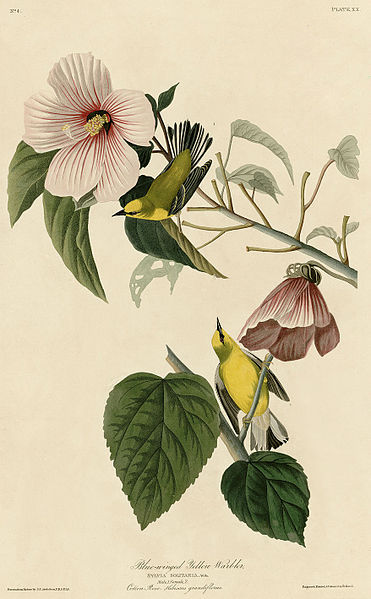
371px-Blue-winged_Yellow_Warbler_(Audubon)

John James Audubon (1785–1851)