Panagiotis Kentikelenis’ Kin

closed casket kin gather after a long time

© Panagiotis Kentikelenis (Greece)

A heartfelt senryu that reflects human miseries and departures. “closed casket” may symbolize death, annihilation, and endless miseries where a person exists but does not live life fully. In this case, I can see the departure of a lone person who was abandoned by his family and/or having prolonged illness. The only misery here is that people wait for the death of such relatives, who become a hassle for the family—especially when one has to visit them every day. These days, people rarely visit their relatives because of busy lives. So, only the departure of someone makes an extended family come together in order to attend the funeral, and that visit is just a formality in most cases. So, the closed casket also symbolizes the death of values, sympathy, and the human factor that is missing these days.

Hifsa Ashraf (Pakistan)

I was impressed by this strong juxtaposition around the topic of accepting death. By reading this poem, i tumbled into one of the myths i most love: Orpheus and Eurydice. Famous is the unforgivable mistake the lover commits by coming back from the realm of the dead, the Persephone’s, the underworld. According to Phaedrus in Plato’s Symposium, the infernal deities only “presented an apparition” of Eurydice to him. Plato’s representation of Orpheus is in fact that of a coward; instead of choosing to die in order to be with his love, he mocked the deities in an attempt to visit Hades, to get her back alive. As his love was not “true”—meaning that he was not willing to die for it—he was punished by the deities, first by giving him only the apparition of his former wife in the underworld and then by having him killed.

Coming back to the words of the poem, “kin gather after a long time” gives the idea of escapement and a sad reason to meet each other. It is the consequence of the increasing loss of family bounds in contemporary society, no more interested in developing emotional ties among blood relatives as in the past….

This poem is a chilling warning to live life generously by sharing our emotions and experiences rather than to be lonely and self centered.

Lucia Fontana (Italy)

Senryu often exhibit a dark irony, and this poem is a fine example of this case. A family comes together to see a loved one at a funeral that has not seen each other for an extended period of time, but they do not even have a chance to see this relative due to the closed casket. It reminds me of when certain relatives at a particular funeral I attended gave many flowers, but they rarely gave flowers to this person during the time she was alive. As Hifsa said, family gatherings, even funerals, are now becoming increasingly detached from emotion and connection. The irony in this senryu points to this societal conundrum well without stating it.

I also enjoyed the economy of this senryu, as in only eight words, it carries a lot of meaning and implications. This is even more evident in the fact that it is a one-liner. By being a monoku, it can be read in several ways: “closed casket/kin gather after a long time,” “closed casket kin/ gather after a long time,” and “closed casket kin gather after a long time.” This allows the reader to find more nuances in this seemingly simple verse.

Sonically, the first three words begin with a “k” sound. This lends to the starkness of the moment. In addition, the long “o”s of “closed” and “long” adds to the melancholy.

A succinct one-line senryu that creates pointed commentary on the nature of our modern familial relationships—especially its disconnection.

Nicholas Klacsanzky (Ukraine)

32338489975_d1133dde68_z
– Art by Ron Frazier

Did you enjoy this poem and commentary? Let us know in the comments.

Tony Quagliano’s Night

the night nurse
stays to talk
her blue mascara

© Tony Quagliano (USA) (1941–2007)

This haiku has two main aspects: professional and personal. Night duty may be either over a certain time or night shifts themselves. In both cases, it is a tough duty, where a nurse has to be vigilant for any type of emergency.

“The” indicates a specific person who is doing her job. I think she is exhausted and alone. That’s why she is looking for someone who can give her company. It’s a sharing of personal feelings that may be not good in this case. As a nurse, she is supposed to console patients—especially ones who have lost hope or are passing through a critical condition. So in that case, she is more like an active listener who not only consoles patients, but also helps them speak their hearts.

“blue mascara” symbolizes the deep feelings she might be feeling: sadness, loneliness, or frustration. The color blue can also indicate depression or sickness. So, I can see this sequence in it: night – talk – blue, all in one—sharing or listening to painful feelings and relating one’s own feelings to others’ emotions.

Hifsa Ashraf (Pakistan)

This poem is subtly captivating: the author in three lines sketches the profile of a caregiver, a night nurse. The detail he gives, “her blue mascara,” makes me imagine that he exactly is the one she is staying to talk with, since a person should be very close to notice the colored shadow on one’s eyes…

It seems the night calls off the rules of nurse and patient: for a while they are only two human beings talking together. Again, the detail of the blue mascara causes me to imagine also a quite intimate conversation… A nurse, and maybe more, a “night nurse,” can be set free in the male collective image of sensual feelings. She is probably young, since blue mascara isn’t so commonly used as the black one each woman, at any age, would use. Also, “stays to talk” suggests to me that she became available when she shouldn’t have been … As if her emotions would bring her out of the professional code to keep a certain distance from the patient …

I can also imagine the “blue” among the lashes as tears, symbolized by the color of water, and think the night nurse is sad for some reason, maybe she is so emphatically enthralled that she can’t control her emotions or she is mirroring someone else’s pain: again, for not being trained enough in managing the right distance because of her young age… In any case, I’m intrigued by the reasons, the untold feelings, and the unrevealed wishes that are moving within the conversation between them …

Lucia Fontana (Italy)

Blue mascara is usually dark, it seems. Maybe the mascara could be matching the color of a coming dusk or the night sky. However, I would go with Lucia’s and Hifsa’s interpretation that the color could be a representation of her mood and the atmosphere of the hospital. It is as if she is embodying the hospital itself, and loses her identity in it.

The sense of sound in this senryu makes it melodic. With “night nurse,” “talk and “blue,” “her” and “nurse,” and “stays” and “talks,” there are many sonic connections. Also, with three words per line, the poem is compact and to the point. However, the poem could avoid referring to the protagonist twice by:

blue mascara
the night nurse
stays to talk

But the original is strong as it is without this adjustment, and this change would be more or less arbitrary. It’s a moody senryu that evokes much in its small space.

Nicholas Klacsanzky (Ukraine)

If you enjoy this senryu and commentary, please leave us a comment. 

abstract-art-painting-paint-background-wallpaper-1459379-pxhere.com.jpg

– art by Suzy Hazelwood

Anna Cates’ Dreamsicles

THE HAPPY GUY

Shopping for orange dreamsicles at Dollar Tree, I found myself in the checkout aisle behind two young men, dressed like handymen. The one closest to me suddenly declared, “I love you!” to the cashier, a large, middle-aged woman with mousy hair.

“He always embarrasses me,” the other guy laughed.

“Why shouldn’t I say something positive?” the man defended himself before turning to me. “I love you!” he said, a sincere smile on his face.

“I love you too,” I replied with a grin.

I left the store with my dreamsicles, thinking how it isn’t every day that two complete strangers look each other in the eye and say, “I love you!”

a daisy’s
yellow joy . . .
warbler trills

© Anna Cates (USA)

It seems the idea of this haibun is to make readers think about themselves and about today’s people. What does it take today to be human? It is very complicated. You smile and a guy thinks, “she is hitting on me.” A man gives you compliments and you begin having wrong ideas.

The prose part in the haibun is very clever and good. In my opinion, this haibun could have two more haiku: one after the description of the cashier, and one more after the guy said I love you to the other guy.

Laughing Waters (USA)

This haibun is versatile in many ways, as I can see various elements of our daily thoughts, the shopping spree, chitchat with people where we exchange smiles, and helping out strangers—the strangers we are connected to strongly for our needs, for our daily requirements.

I liked the way the poet composed the prose in a delightful way, which basically tells us about the dilemma of human beings. We usually bring our conscious filters when someone chats with us unexpectedly in a friendly way. In this era, if people try to connect with each other publicly, it is almost always taken in a suspicious way.

The haiku part of this haibun is well embedded with the emotions of a person who really wants to feel a deep connection with strangers, who are none other than human beings. The soft trilling of a warbler depicts the sincere and lovely feelings of a person that she/he shares through words like ‘I love you!’. But, we perceive it according to our mindsets and in a specific way. Unfortunately, we want to connect with each other as human beings but, we cannot, as we start defining every single gesture, feelings, and words and categorize them according to our set perceptions and experiences. But, deep down, we want the opposite—we want to be heard by others, we want to be accepted unconditionally by others, we want to be connected without any barriers, and we want to be appreciated by others. All this is just a simple wish we want, like a daisy’s yellow joy—the center of it—and in our case, the heart that is the center of joy, that usually fades away due to our thoughts and perceptions.

Hifsa Ashraf (Pakistan)

I like the realness of this story, and also its uncommon situation. When I read the prose, I could tell right away it was from reality. I have also been in similar circumstances when people in public are goofing off or acting in a unique way that is positive. It gives a certain vibrancy to life.

Besides being able to easily identify with the story, I like the slightly surrealistic haiku accompanying it. It connects nicely with the unusual, but very ordinary occurrence in the story.

Touching upon the technical stuff, the ellipsis works well to illustrate the warbler’s trill. I also enjoy the economy of the language, with the haiku being only six words. The rolling of “l” sounds and “y” sounds make the poem musical as well.

In terms of the prose, I enjoy the descriptions of the people and the naturalness of the dialogue.

A haibun that explores the extraordinary in the ordinary in a delightful way.

Nicholas Klacsanzky (Ukraine)

Did you enjoy this haibun and commentary? Please leave us a comment.

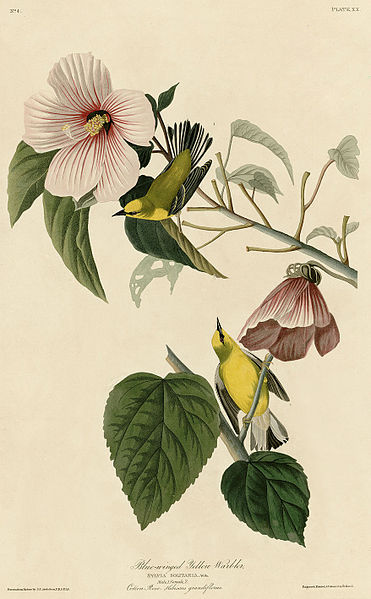
371px-Blue-winged_Yellow_Warbler_(Audubon)

John James Audubon (1785–1851)