corporate avenue –
even the trees
follow in line
— Lucas Weissenborn (Norway)
first published in Failed Haiku, Volume 10, Issue 111, August 2025
Commentary by Jacob D. Salzer:
This haiku/senryu essentially shows the consequences and limitations of corporations and a corporate mindset, which is hierarchical, with the CEO at the top of the pyramid. The CEO’s vision and values trickle down, affecting the entire corporation and all employees. The CEO and senior management usually make far more money than the rest of the employees, sometimes to an extreme extent. The straight line mentality of “business as usual” seems to have inherent limitations and psychological consequences.
The last line reminds me of a conveyor belt: the same thing is done every day, much like a machine, and the employees within certain corporations may start to feel like gears in the machine. As a result, this poem indirectly shows the beauty and importance of creativity, as it avoids the straight-lined mentality. Even the trees in this poem that were planted along the avenue may appear to be artificial, given that they were planted in a perfect straight line. Also, the word “follow” in the last line reminds me of the corporate and military culture to follow orders. In the U.S., the best-paying jobs are often found in corporations. Some corporations have made more significant contributions to humanity, while others feed materialism and a consumer-based society. Non-profit organizations, such as The Nature Conservancy, have tried working with corporations to inform them that environmental stewardship is critical, not only for the planet, but for their own business as well. I don’t know how successful they have been with this endeavor, but I think The Nature Conservancy is worthy of praise and recognition for its sincere efforts.
While some people may regard this poem as a senryu, with the focus on the corporation (and because it was published in Failed Haiku), others may see this as a haiku, capturing part of modern culture. Regardless, this is an important poem that provides a window into the world of corporations and their limitations. May more corporations see the bigger picture to take better care of the Earth, people, employees, and other species.
mist over the pond –
last year’s reeds
still whisper
— Vaishnavi Pusapati (India)
Commentary by Nicholas Klacsanzky:
Living in the Pacific Northwest, I’m very familiar with mist. It gives a spiritual, mysterious mood. Sometimes it is a welcome sight, and other times, you wish you could drive more clearly. Anyway, the first line presents a classical haiku scene with a dash to allow readers to pause before considering the second half. Thinking about mist in India, the primary season for it would be winter, specifically from late November to February. Having this haiku placed in winter resonates with the stark imagery in the last two lines.
I enjoy the surprise from the second line to the third. I expected the last line to be something like “still standing.” But “still whisper” resonates much more and leaves white space for the reader to fill in. The reeds could be staying around in a dry form, with the wind making music while moving through them. Also, the reeds could now be in a different form, as all decomposed matter transfers to other beings. The whispering of last year’s reeds could be part of the flora and fauna in the area or beyond.
The pacing of the lines is a little different than usual, with a longer first line and decreasing line lengths from there on. The first line could simply be “misty pond,” but the image of the mist suspended over the pond creates a more substantial effect in comparison to the whispering of last year’s reeds.
It appears to me that the most prominent letter in this haiku is “r.” It gives a weight to the reading and mood of the poem. Also, each word is chosen well and is compact, with only nine words in the haiku. It’s a haiku that effectively captures the mood of the scene and allows our imagination to see how a passed-on being still breathes through new life.
childhood home
I reach for a hand
no longer there
— Neena Singh (India)
published in THF Volunteer Haiku Anthology—Kick the Clouds, 2025
Commentary by Hifsa Ashraf:
Childhood homes, family havelis, and ancestral spaces are among my most cherished themes in haiku. I spent my school summer vacations in our family haveli in the rural side of Punjab, where I experienced nature in its purest form. Those moments remain deeply embedded in my memory and continue to be a part of my poetry.
This haiku captures the innocence of a time when relationships were simple, honest, and pure. The opening line, ‘childhood home’, invites the reader to pause and absorb its emotional weight and strength. In the subcontinent, such homes are often vibrant, shared spaces where extended families live together under one roof. They are rich with relationships, daily rituals, and collective memory. Here, the poet evokes not just a physical place, but a nurturing environment that shapes one’s social and emotional values.
The second line, ‘I reach for a hand,’ introduces an intimate and personal gesture. It suggests the presence of a loved one, perhaps a grandparent, an aunt/uncle, or a cousin, etc. The act of reaching conveys both connection and longing. It feels like a vivid recollection of childhood, where true family bonds once existed. At the same time, it hints at absence and an emotional void.
The final line, ‘no longer there’, brings a subtle shift. A gentle sense of yūgen reflects a deep, unspoken awareness of life’s transience. Maybe time has changed the landscape of the home; the people who once lived there are gone, whether through distance or death. What remains is an emptiness that contrasts beautifully with the warmth of memory. Yet, in recalling these moments, the poet brings them to life.
Having no punctuation invites the reader to linger in the space, to experience the gaps where memory fades, and absence quietly endures.
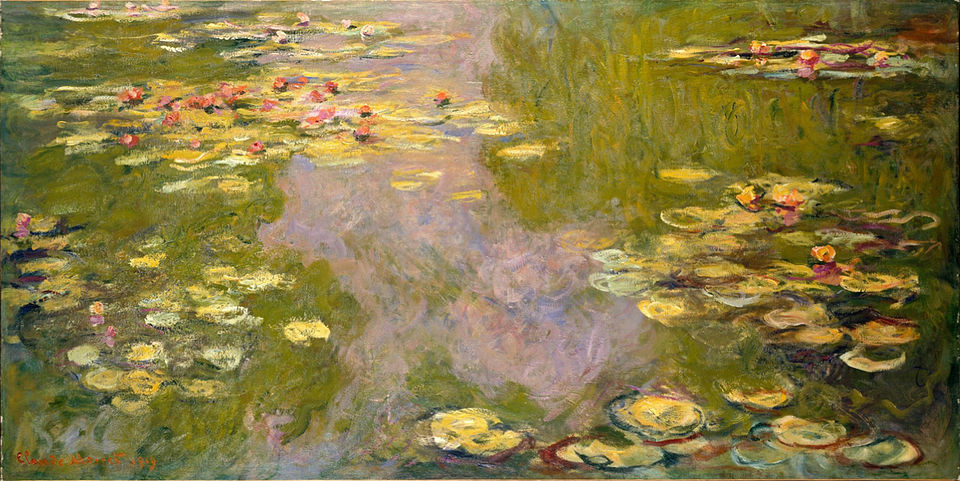
Water Lilies, a 1919 painting by impressionist Claude Monet

